
Engineering Plastics 3D Printing – PETG-CF, Nylon, ASA, PA12
Technical summary: Engineering plastics are the materials you choose when PLA or standard resin cannot handle the load, temperature, humidity or UV exposure a part will see in service. CT3D offers engineering plastics 3D printing in Vietnam on three platforms: FDM filament extrusion (PETG-CF, PA/Nylon, ABS, ASA), SLA photopolymerization with ABS-like resins in several hardness grades, and SLS/MJF powder-bed fusion with PA12. Our engineers match the material to the part’s actual service conditions rather than defaulting to habit, which cuts down the number of trial-and-error iterations during prototyping.
Typical jobs include assembly-line jigs and fixtures, snap-fit housings, outdoor sensor covers, prototype gears and bushings, and small batches of functional PA12 components. Send a STEP, STL, 3MF, IGES or OBJ file together with a short description of how the part will be used; every quote comes with a free manufacturability (DFM) review, and we sign an NDA on request.
Engineering plastics 3D printing at a glance
| Technologies | FDM (filament), SLA (resin), SLS / MJF (PA12 powder) |
|---|---|
| Materials | PETG-CF, Nylon (PA), ABS, ASA, ABS-like resin (white, yellow, black, brown grades), PA12 powder |
| MJF tolerance | Approx. ±0.05 mm (per CT3D documentation) |
| FDM pricing | By actual weight: ABS from 1,000 VND/g, ASA from 2,000 VND/g, carbon-fiber filament from 2,750 VND/g (indicative) |
| Resin and PA12 pricing | Quoted per file |
| File formats | STEP, STL, 3MF, IGES, OBJ – 2D drawings with tolerances are welcome |
| Delivery | Pick-up at our workshop or shipping within Vietnam, typically 1–3 days after completion; international shipping on request |
When should you switch from commodity plastics to engineering plastics?
PLA is easy to print and inexpensive, but it softens as ambient temperature rises, is brittle under impact and degrades in sunlight. Standard resin delivers a beautiful surface finish but breaks easily at thin sections. Consider engineering plastics if your part has any of the following requirements:
- It is assembled with screws or snap-fits, or carries cyclic loads.
- It operates near motors, lamps or heat-generating PCBs, or inside a vehicle parked outdoors.
- It is exposed to oil, mild solvents, high humidity or prolonged UV.
- It is large and must stay flat with minimal warping.
- It needs sliding motion or wear resistance – gears, bushings, guide rails.
If the part is for display only, commodity plastics remain the more economical choice – see our FDM 3D printing page for PLA and PETG options. Material-based pricing is covered in our 2026 3D printing price guide.

How the three technologies work
Engineering plastics are not tied to one machine. The same functional requirement – say, a clip that must flex thousands of times – can be met by different processes, and each one builds the part in its own way:
- FDM (fused deposition modeling): a filament of PETG-CF, nylon, ABS or ASA is melted and extruded through a nozzle, tracing each layer as a series of lines. It is the most economical route for medium and large parts, and its strength depends heavily on wall count, infill and build orientation.
- SLA (stereolithography): a UV laser cures liquid ABS-like resin layer by layer. Parts come out with crisp edges and a smooth surface, then need washing and full UV post-curing to reach their final properties.
- SLS / MJF (powder-bed fusion): thin layers of PA12 powder are fused – by a laser in SLS, or by a jetted fusing agent and infrared heat in MJF. The loose powder supports the part, so no support structures are needed and many parts can be nested in one build.
SLS and MJF: same PA12, different mechanisms
SLS uses a laser to sinter the powder area by area; MJF jets a heat-absorbing fusing agent onto the powder layer and then heats the entire layer. Neither needs support structures, because the unfused powder supports the part. MJF typically delivers higher throughput when many parts are nested in the same build chamber, with a tolerance of approximately ±0.05 mm per CT3D documentation.
Capabilities and material range (scope of work)
| Material | Technology | Strengths | Limitations to know | Typical applications |
|---|---|---|---|---|
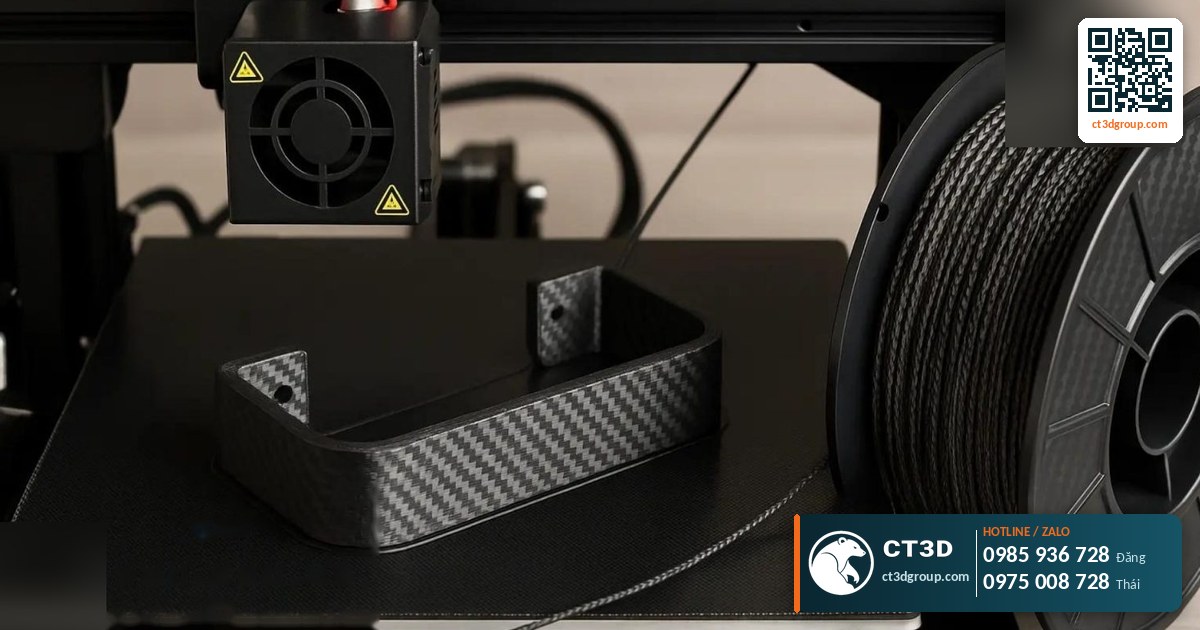
| Carbon-fiber reinforced PETG (PETG-CF) | FDM | High stiffness, low warping, matte surface | Reduced ductility, abrasive to nozzles | Jigs and fixtures, support frames, large housings |
| Nylon (PA) | FDM | Tough, impact-resistant, wear-resistant | Hygroscopic – filament must be dried before printing | Gears, hinges, couplings |
| ABS | FDM | Good heat resistance, easy to sand, paint and bond | Shrinkage – requires an enclosed build chamber | Enclosures, assembly parts |
| ASA | FDM | UV and weather resistant | Shrinkage similar to ABS | Outdoor parts, vehicle trim |
| ABS-like resin | SLA | Crisp detail, tougher than standard resin | Requires full UV post-curing | Prototype device housings, small parts |
| PA12 powder | SLS / MJF | Uniform mechanical properties, no support structures needed | Slightly grainy surface; default color gray/white | Functional components, low-volume production |
Source: CT3D operating experience and technical documentation. Specific mechanical properties depend on the material manufacturer, build orientation and infill density.
Material properties and selection criteria (materials & standards)
ABS-like resin: color indicates hardness grade
In the ABS-like resin line CT3D uses, each color corresponds to a different hardness level. From most flexible to stiffest, the order is: white, yellow, black, brown. When a part needs elasticity for snap-fits or impact absorption, our engineers typically recommend white or yellow; when it must hold its profile, resist bending and stay dimensionally stable, black or brown is the better fit. Color is therefore a technical specification, not just an aesthetic choice.
Anisotropy in FDM parts
FDM parts are built from stacked extrusion lines, so the bond between layers (Z direction) is weaker than the bond within a layer (XY direction). A bracket printed upright may delaminate under load where the same bracket printed flat would not. That is why CT3D always identifies the load direction before setting build orientation, and adds perimeters (wall loops) in load-bearing areas rather than simply increasing infill. See also: how infill affects strength.
Moisture and nylon
Nylon absorbs moisture from the air. Wet filament causes bubbles, a rough surface and reduced strength. In our workshop, nylon filament is dried before printing and stored sealed. Printed nylon parts will also equilibrate with ambient humidity, so tight-fit dimensions should include a reasonable tolerance allowance.
Quick selection guide
Start from the worst condition the part will see, not the average one. A housing that sits indoors most of the year but spends summer afternoons on a car dashboard should be specified for the dashboard. The chart below gives sensible starting points; the final choice is confirmed in the DFM review.

Design guidelines for functional plastic parts
Good design matters more than material choice for many functional parts. The values below are typical industry starting points, not CT3D guarantees – exact limits depend on the material, part size and orientation, and our engineers will flag anything critical in the DFM review.
| Feature | FDM (PETG-CF, PA, ABS, ASA) | SLA (ABS-like resin) | SLS / MJF (PA12) |
|---|---|---|---|
| Load-bearing wall | Typically 2 mm or more (several perimeters) | Typically 1.5 mm or more | Typically 1.5–2 mm or more |
| Threads | Use heat-set inserts rather than printed threads | Coarse printed threads or inserts | Printed threads possible for coarse pitches; inserts for repeated assembly |
| Internal corners | Add fillets to spread stress | Add fillets; avoid sharp notches at thin sections | Add fillets |
| Clearance between mating parts | Typically 0.3–0.5 mm | Typically 0.2–0.3 mm | Typically 0.3–0.5 mm |
| Snap-fits | Orient the flexing arm along the layers (XY), not across them | Prefer the more flexible white or yellow grade | Well suited; keep arms generous in thickness |
| Large flat areas | Ribs instead of solid thickness to limit warping | Hollow and add drain holes | Even wall thickness; add escape holes for powder in hollow parts |
The most common reason a functional print fails is not the material but the orientation: a thin feature printed so that the load pulls the layers apart. Telling us how the part is loaded is the single most useful piece of information you can include with your files.
Finishing options
- Standard cleanup: support removal for FDM and SLA, washing and full UV post-curing for resin, powder removal and cleaning for SLS/MJF.
- Sanding and priming: ABS and ABS-like resin sand easily, which makes them good candidates for appearance prototypes.
- Painting: parts can be primed and painted to the color you need – see our 3D printing painting and plating service.
- Bonding and assembly: ABS bonds well; multi-part assemblies can be glued, screwed with heat-set inserts or clipped together.
- Threaded inserts: heat-set brass inserts are recommended for FDM parts that will be assembled and disassembled repeatedly.
Surface finishing steps after printing are covered in our guide to 3D print post-processing.
Industry applications
- Assembly plants: PETG-CF locating fixtures that resist deformation over long-term use.
- Outdoor equipment: electrical box covers, sensor housings and camera mounts in ASA.
- Mechanical engineering and automation: prototype gears, rollers and slide bushings in nylon or PA12.
- Electronics product development: ABS-like resin prototype housings for appearance checks and PCB fit testing.
- Low-volume production: clips, couplings and complex air ducts in MJF/SLS PA12.
If your part needs temperature or load resistance beyond what polymers can provide, see our metal 3D printing (SLM) service. For an overview of how the technologies compare, see our FDM vs SLA vs MJF vs SLM comparison.
FDM vs SLA vs SLS/MJF for functional plastic parts
The table below compares the three platforms in general terms. It describes typical behavior of each process, not a guarantee for a specific part.
| Criterion | FDM | SLA (ABS-like resin) | SLS / MJF (PA12) |
|---|---|---|---|
| Best at | Stiff fixtures, large housings, outdoor parts | Detailed housings, appearance and fit prototypes | Tough functional parts, batches of small components |
| Surface | Visible layer lines | Smooth, crisp edges | Slightly grainy, uniform matte |
| Strength profile | Strong in XY, weaker between layers | Depends on resin grade; less impact-tough than nylon | Most uniform in all directions |
| Supports | Needed for overhangs | Needed; contact marks are sanded | Not needed |
| Accuracy | Good for most fits | High for small features | Approx. ±0.05 mm for MJF (CT3D documentation) |
| Pricing basis at CT3D | By weight (from 1,000 VND/g for ABS) | Per file | Per file |
| Color | Filament color | White, yellow, black, brown (hardness grades) | Gray/white by default |
When quantities rise into the hundreds and the design is frozen, it is worth comparing printing with vacuum casting – our engineers can quote both.
Quality control
- Material control: moisture-sensitive filaments are dried and stored sealed; resin is kept at 25–28°C during printing.
- Process control: build orientation, layer height and infill are recorded for each part so repeat orders can be reproduced.
- Dimensional inspection: fit dimensions are measured with calipers, micrometers or gauges; high-requirement parts can be 3D scanned and compared against CAD – see 3D scanning inspection.
- First article inspection (FAI): for production orders, a first article is sent for approval before the full batch runs.
How to order: our workflow

- RFQ: send your STEP/STL/3MF files and describe the service conditions: temperature, load, environment and quantity.
- DFM review: our engineers assess wall thickness, fillet radii, threaded holes (heat-set inserts are recommended for FDM) and build orientation relative to the load direction.
- Material recommendation and quote: usually with an alternative option so you can compare cost versus performance.
- Production: material drying, printing, support removal, post-curing (resin) or powder cleaning (SLS/MJF).
- QC: inspection of fit dimensions, appearance and flatness.
- Delivery: pick-up at our workshop or shipping within Vietnam, typically 1–3 days after completion; international shipping can be arranged on request.
Why work with CT3D on engineering plastics
- Three platforms in one workshop: FDM, SLA and SLS/MJF, so the recommendation follows the part rather than the machine we happen to own.
- Material chosen for the service condition: load, heat, humidity and UV are discussed before printing, with an alternative option in the quote.
- Free DFM review with every quote: orientation, wall thickness, inserts and clearances are checked before production.
- Repeatable results: orientation, layer height and infill are recorded so repeat orders match the first batch.
- Confidentiality: your files are used only for your project, and we sign an NDA on request.
- Engineering support in English and international shipping on request.
Frequently asked questions (FAQ)
Which plastic should I choose for outdoor parts?
ASA is the preferred choice because it offers better UV and weather resistance than ABS, while remaining just as easy to post-process.
What material is best for 3D printed gears?
Nylon or PA12 provide good toughness and wear resistance. For light loads where dimensional stability matters, PETG-CF is worth considering.
Does the color of ABS-like resin affect its hardness?
Yes. White is the most flexible; yellow and black are stiffer; brown is the stiffest in the line. Our engineers select the color based on whether the part needs toughness or rigidity.
How are engineering plastics priced?
FDM is priced by actual weight in grams: ABS from 1,000 VND/g (≈ US$0.04/g), ASA from 2,000 VND/g (≈ US$0.08/g), carbon-fiber filament from 2,750 VND/g (≈ US$0.11/g). Prices are indicative. Resin and SLS/MJF PA12 are quoted per file.
Should I choose FDM, SLA or SLS/MJF for a functional part?
FDM suits stiff fixtures, large housings and outdoor parts at the lowest cost. SLA with ABS-like resin suits detailed housings and fit prototypes. SLS/MJF PA12 gives the most uniform strength in all directions and suits batches of small functional parts. Our engineers recommend one route and usually an alternative in the quote.
How accurate are engineering plastic prints?
Accuracy depends on the process, size and geometry. For MJF PA12, CT3D documentation gives a tolerance of approximately ±0.05 mm. For tight fits, send a 2D drawing marking the critical dimensions so we can orient the part and check those features after printing.
Can 3D printed plastic parts take screws?
Yes. For FDM parts that will be assembled more than once, heat-set threaded inserts are recommended instead of printed threads. PA12 and ABS-like resin can hold coarse threads, but inserts are more durable for repeated assembly.
Why do nylon parts change size slightly after printing?
Nylon absorbs moisture from the air. CT3D dries nylon filament before printing, but the finished part will still settle to the ambient humidity, so tight-fit dimensions should include a reasonable tolerance allowance.
Can you produce small batches, not just prototypes?
Yes. SLS/MJF PA12 is well suited to low-volume production because many parts can be nested in one build. For production orders, a first article is sent for approval before the full batch runs.
Real footage from the CT3D workshop
Watch the video Metal, SLA, MJP lost-wax and PA12 3D printing produced by CT3D to get a clearer picture of our process and product quality. More videos are available on our Chế Tạo Vlog – CT3D channel.
Contact CT3D – send your files for a fast quote
Whether you have 3D CAD files (STL, STEP, IGES, OBJ), 2D drawings, photos or just an idea, send them to CT3D. Our engineers will review your files, advise on technology and materials, and send a quote with lead time.
- Email: [email protected] – [email protected]
- Phone / Zalo: +84 975 008 728 (Mr. Thai) – +84 985 936 728 (Mr. Dang) – or use our Contact form
- Headquarters: Binh Duong, Vietnam.
- Workshops: Ho Chi Minh City, Vietnam.
- Other workshops and drop-off points: Can Tho, Da Nang, Bien Hoa, Ba Ria – Vung Tau, Hanoi, Hai Duong, Hai Phong. We ship nationwide across Vietnam and can arrange international delivery.
- Website: ct3dgroup.com – in3d.edu.vn
CT3D – 3D design & prototyping: 3D printing, 3D scanning, reverse engineering, silicone mold making, paint finishing, CNC machining, composite fabrication, and supply of 3D printers and 3D printing materials.
Ready to start your engineering plastics project?
Send your CAD files (STEP, STL, IGES, OBJ), drawings or photos. You get a fast quote with a free manufacturability review, and we sign an NDA on request.