
Large-Format 3D Printing in Vietnam – FDM & SLA up to 800 mm
Technical summary: Large-format 3D printing (large-format additive manufacturing) at CT3D runs on two platforms: FDM thermoplastic extrusion for big, cost-optimized volumes, and large-format SLA resin printing with a build volume of up to 800×800×500 mm for parts that need a smooth surface. Objects larger than the machine envelope are segmented in software, printed in sections with registration keys, joined with structural adhesive and then seam-finished. Our large-format 3D printing service in Vietnam supports 1:1 scale prototypes, statues, props, display models and large technical parts.
Because sections are printed in parallel on several machines and then assembled, finished size is set by the assembly plan and transport rather than by a single printer. Send STL, STEP, OBJ, 3MF or IGES files with the final dimensions and intended use; you receive a fast quote with a free manufacturability review, a proposed segmentation plan and a delivery schedule. We sign an NDA on request.
Large-format printing at a glance
| Technologies | Large-format FDM and large-format SLA resin |
|---|---|
| Single-piece SLA size | Up to 800×800×500 mm |
| Larger objects | Segmented, printed in sections, keyed, bonded and seam-finished |
| Layer height | FDM 100–300 microns; SLA 25–100 microns |
| Tolerance | FDM ±0.1–0.3 mm; SLA ±0.05–0.1 mm |
| FDM pricing | By actual weight, from 650 VND/g for PLA and PETG (indicative); large-format resin quoted per file |
| Delivery | Nationwide in Vietnam in 1–3 days after completion; international shipping on request |

The engineering challenges of printing large objects
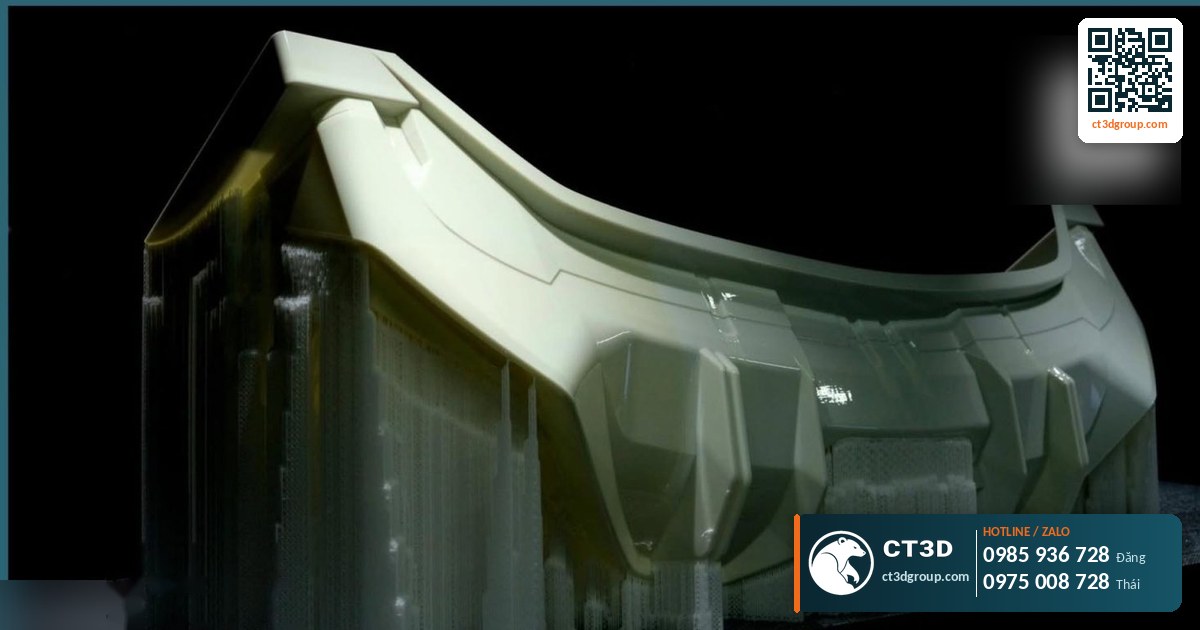
Scaling up a print file is not simply a matter of dragging the scale slider. As volume grows, print time increases with the cube of size, the risk of a mid-print failure rises, accumulated thermal stress causes warping, and every layer line becomes visible on large surfaces. With resin, wide horizontal cross-sections generate high peel forces on every layer, which can cause layer tearing or a failed print. That is why CT3D treats large-format printing as an engineering problem: technology, orientation, segmentation and support structure strategy are all decided before the machine starts.
How large-format printing works: segmentation and assembly
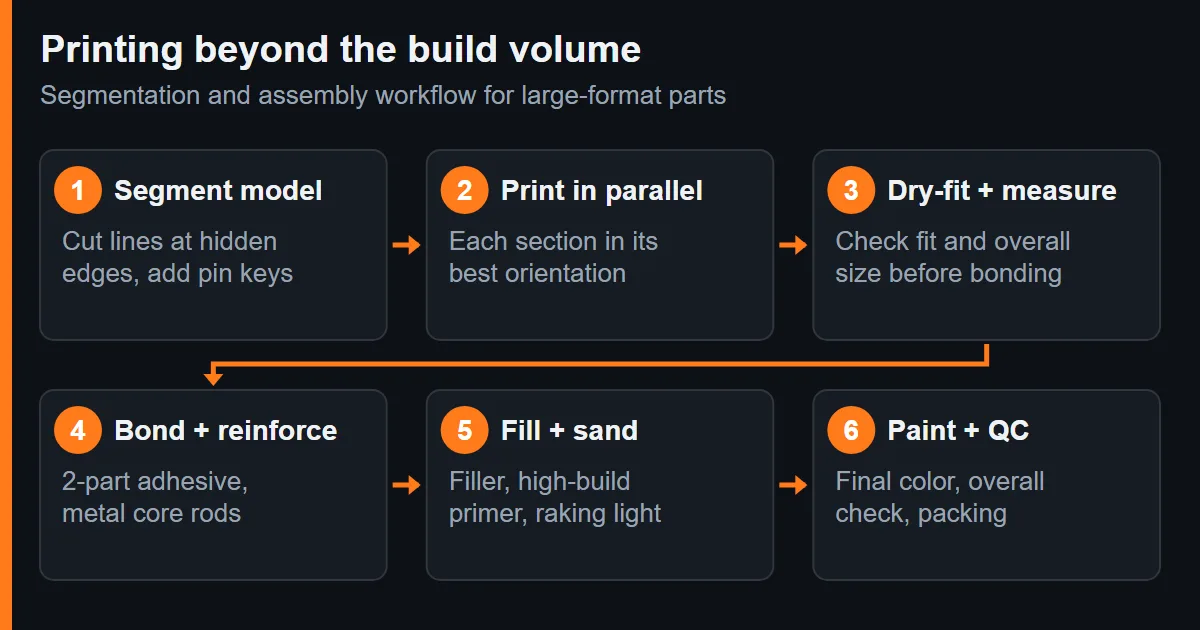
Segmentation is the core skill of large-format printing. Instead of forcing one huge print, the model is divided into sections that each print reliably, then rebuilt into a single object. The six stages are shown below.
Where to place the cut lines
Cut lines are placed at volume transitions, folded edges, garment creases or faces that will be hidden once installed. Each section should be optimized for its own best print orientation, which does not have to match the orientation of the overall object. Our engineers also consider the cross-sectional area so that sections are not too thin at the joint and will not break during transport.
Registration keys and joining materials
Mating faces are designed with pin-and-socket features, tongue-and-groove joints or telescoping sleeves so that the sections self-align. For load-bearing parts, CT3D inserts metal core rods or aluminum tubes running through several sections. Two-part structural adhesive is used for permanent joints; for props that need to be disassembled, we can leave pockets for nuts or magnets.
Seam finishing before painting
After joining, seams are filled, sanded flat through progressively finer grits, coated with a high-build primer/filler and re-inspected under raking light. These steps are detailed in our guide to 3D print post-processing.
Capabilities and technical specifications
| Parameter | Large-format FDM | Large-format SLA resin |
|---|---|---|
| Principle | Molten plastic filament extruded through a nozzle | UV laser cures liquid resin layer by layer |
| Layer height | 100–300 microns | 25–100 microns |
| Tolerance | ±0.1–0.3 mm | ±0.05–0.1 mm |
| Single-piece build size | Machine-dependent; oversized parts are segmented | Up to 800×800×500 mm |
| Materials | PLA, PETG, ABS, ASA, carbon-fiber filament | Standard, ABS-like, tough, clear and high-temperature resins |
| Surface | Visible layer lines; filling and sanding needed for a premium paint finish | Smooth, minimal layer lines, less finishing work |
| When to choose | Large volumes, thick walls, budget-optimized | Statues, large figures, close-up display models |
Source: technology specifications from CT3D documentation. Actual results depend on geometry and build orientation.
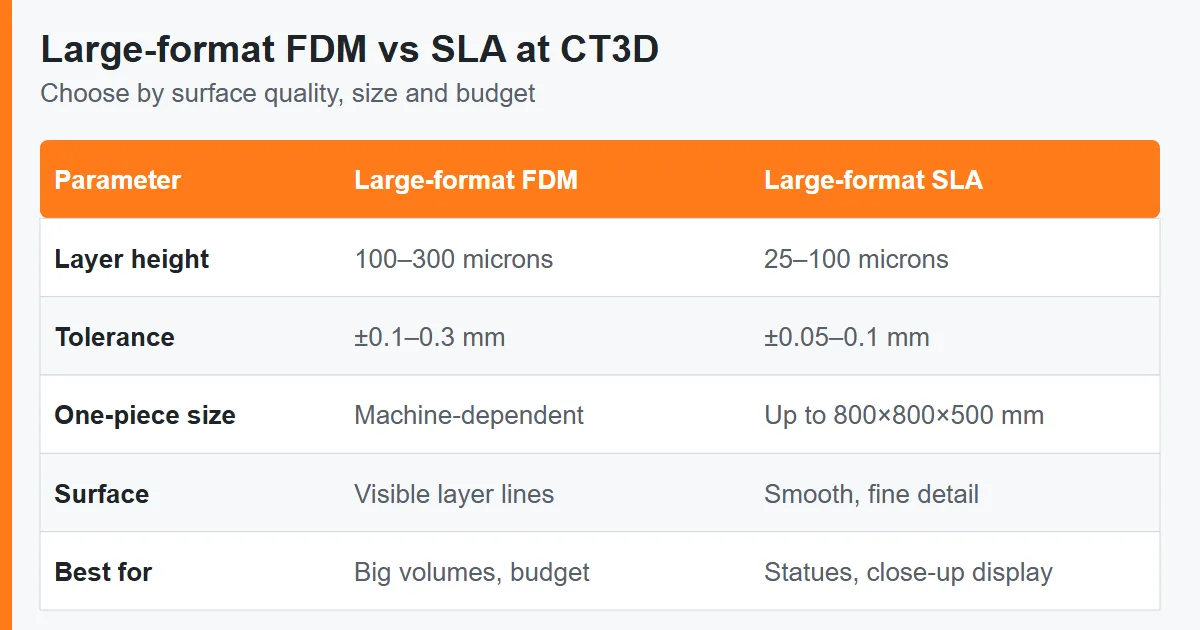
As the table shows, each technology has its own sweet spot. If you are undecided, our FDM vs resin 3D printing comparison explains the differences in more detail, and our article on large-format 800×800×500 mm resin printing goes deeper into statues and single-piece models.
Materials & standards
For large-format FDM, PLA prints easily with low shrinkage, making it ideal for indoor display models. PETG is tougher and more impact-resistant, suiting props that are moved frequently. ABS and ASA offer better heat resistance; ASA is also UV-resistant, making it a good fit for semi-outdoor parts, but both shrink more and require a thermally stable build chamber. Carbon-fiber filled filament adds stiffness for large frames and fixtures. For SLA, ABS-like resin is chosen when a tough, less brittle model is needed; tough resin for assembly parts; clear resin for light-transmitting models.
| Material | CT3D indicative pricing 2026 (FDM, by actual weight) |
|---|---|
| PLA | from 650 VND/g (≈ US$0.025/g) |
| PETG | from 650 VND/g (≈ US$0.025/g) |
| ABS | from 1,000 VND/g (≈ US$0.04/g) |
| ASA | from 2,000 VND/g (≈ US$0.08/g) |
| Carbon-fiber filament | from 2,750 VND/g (≈ US$0.11/g) |
Source: CT3D 2026 FDM price list; prices are indicative. Parts over 500 g or larger quantities are quoted as projects; large-format resin is quoted per file. Post-processing, rush orders and file preparation are charged separately. See also our 3D printing price guide.

Design guidelines for large prints
A file prepared for a small print often needs changes before it scales well. The points below are general good practice; values marked “typically” are common industry starting points, and our engineers confirm the details for your model in the DFM review.
| Topic | Recommendation |
|---|---|
| Watertight mesh | Export a closed, manifold mesh; open edges and self-intersections cause slicing errors at large scale. |
| Hollowing (SLA) | Hollow large resin parts and add drain holes so uncured resin can escape; this also reduces peel forces and cost. |
| Shell thickness | Typically 2–4 mm for hollow resin shells and several perimeters for FDM shells, thicker where sections are joined or mounted. |
| Orientation (SLA) | Tilt wide surfaces 20–45° to reduce peel force and layer tearing. |
| Cut lines | Place them on edges, creases or hidden faces; keep the joint cross-section generous so sections do not snap in transport. |
| Registration keys | Pins, sockets or tongue-and-groove joints with a small clearance, typically 0.2–0.4 mm, so sections self-align without force. |
| Reinforcement and mounting | Plan channels for metal core rods or aluminum tubes, and mark where the object will be fixed, hung or lifted. |
| Transport | Agree the maximum sub-assembly size early – doors, vehicles and crates often set the real limit. |

Finishing options
- Raw print: supports removed and cleaned; FDM layer lines and seams remain visible – suitable for fit checks and internal reviews.
- Sanded: seams and layer lines sanded through progressively finer grits.
- Primed: filler and high-build primer applied and checked under raking light, ready for your own painting.
- Painted: full color finish for display, events and statues – see our painting and plating service.
- Demountable: nut or magnet pockets for props that must be taken apart and reassembled on site.
Industry applications
- Product development: 1:1 scale prototypes of machine housings, home appliances and vehicle interior parts for ergonomics and appearance reviews.
- Art and religious statuary: large SLA-printed statues; CT3D has published a 1 m tall Catholic statue printed in SLA and a large reclining Buddha statue.
- Advertising and events: enlarged product models, 3D letters, mascots and stage props.
- Architecture: massing models, facade models and site models split into panels for transport.
- Industrial: large jigs and fixtures, inspection gauges and master patterns for composite mold making – see FRP composite molds.

Large-format printing vs other ways to make big parts
3D printing is not the only route to a large object. The comparison below is general guidance to help you choose; CT3D offers all three routes and can combine them in one project.
| Criterion | Large-format FDM | Large-format SLA | CNC foam + coating |
|---|---|---|---|
| Typical use | Big volumes, fixtures, props | Statues, figures, close-up display models | Very large mascots, lettering, sculptures |
| Detail level | Medium | High | Medium; fine details often added by printing |
| Surface before finishing | Layer lines | Smooth | Foam texture; needs coating |
| Weight | Medium (depends on infill) | Higher per volume unless hollowed | Very light core |
| Size limit | Set by segmentation and transport | 800×800×500 mm per piece, then segmented | Very large blocks |
For very large, lightweight shapes, see CNC foam cutting; for durable outdoor pieces, a printed or CNC master can be turned into a composite FRP statue.
Quality control
With multi-section products, small errors on each section can accumulate into a large deviation in overall dimensions. CT3D controls this by measuring the main sections before joining, dry-fitting to check the fit, and re-measuring the overall dimensions after bonding. Resin sections are inspected for layer tearing, support marks and full cure after additional UV exposure. FDM sections are checked for delamination and warping at the base and edges. If you need a comparison against CAD, we can 3D scan the finished product and export a deviation color map – see 3D scanning inspection.
| Risk | Cause | Countermeasure |
|---|---|---|
| Warping of large sections | Thermal shrinkage on cooling | Low-shrink material, stable build chamber, added brim |
| Resin layer tearing | High peel force on wide cross-sections | Tilt the model 20–45°, hollow it, add drain holes |
| Misaligned joints | Accumulated tolerance | Registration keys, dry-fit, measure before bonding |
| Visible seams after painting | Insufficient filling, adhesive shrinkage | Multiple filler coats, high-build primer, raking-light inspection |
How to order: our workflow
- RFQ: send STL/STEP/OBJ/3MF files via our Contact form, Zalo or email, together with the final dimensions, purpose (display, fit testing, props) and surface requirements.
- DFM review: our engineers check that the mesh is watertight, verify wall thickness and recommend the technology, build orientation, segmentation plan and infill density.
- Quote: based on material volume, machine hours, assembly and finishing labor, with a delivery schedule.
- Production: multiple sections are printed in parallel on several machines to shorten lead time, with every print job monitored.
- Assembly, finishing, QC: dry-fit, bonding, filling, painting and overall dimensional check.
- Delivery: packed in sub-assemblies and shipped by domestic courier, post, air freight or collected from our workshop; nationwide delivery within Vietnam in 1–3 days after completion. International shipping can be arranged on request.

No 3D file yet? CT3D can model the object from sketches or photos with our 3D CAD design service, or capture an existing object with 3D scanning and scale it up.
Why choose CT3D for large-format printing
- Two technologies, one plan: FDM for budget-friendly volume, SLA up to 800×800×500 mm for smooth detail – or both in one object.
- Segmentation engineering included: cut lines, registration keys and internal reinforcement are designed before printing, not improvised afterwards.
- Parallel production: sections run on several machines at once to shorten lead time.
- Finishing in-house: bonding, filling, priming and painting are done in the same workshop.
- Verified size: sections are measured before bonding, and a 3D scan with a deviation map is available on request.
- Free DFM review with the quote, NDA on request, engineering support in English and international shipping on request.
Frequently asked questions (FAQ)
What is the maximum print size?
Single-piece resin parts up to 800×800×500 mm. Anything larger is segmented and assembled, so in principle the final size is limited only by the assembly plan and transport.
Will the seams show on a multi-section model?
If the model is painted, seams are filled and sanded so they are virtually invisible. If the raw plastic color is kept, the seams will remain slightly visible.
Should I choose FDM or SLA for a large model?
FDM when you need large volumes, moderate strength and optimized cost. SLA when you need a smooth surface, fine detail and close-up display quality.
How long does large-format printing take?
It depends on volume, layer height and level of finishing. CT3D prints multiple sections in parallel and confirms the lead time for each file.
How accurate is a large print?
Per CT3D documentation, large-format FDM holds about ±0.1–0.3 mm and large-format SLA about ±0.05–0.1 mm. On multi-section objects, CT3D measures sections before bonding and re-checks overall dimensions after assembly to keep accumulated error under control.
How are large prints made strong enough to handle?
Sections are joined with two-part structural adhesive and self-aligning keys, and load-bearing objects get metal core rods or aluminum tubes running through several sections. Mounting and lifting points should be agreed in the DFM review.
How is large-format printing priced?
Large-format FDM is priced by actual weight, from 650 VND/g for PLA and PETG (indicative); parts over 500 g or larger quantities are quoted as projects. Large-format resin is quoted per file. Post-processing, rush orders and file preparation are charged separately.
Can you ship large models outside Vietnam?
Yes. Large objects are packed in sub-assemblies, and international shipping can be arranged on request. Tell us the destination early so the segmentation plan fits the crates or cartons.
Can I order a large print without a 3D file?
Yes. CT3D can build the 3D model from sketches, photos or dimensions, or 3D scan an existing object and scale it up before printing.
Real footage from the CT3D workshop
Watch the video Affordable SLA 3D printing produced by CT3D to get a clearer picture of our process and product quality. More videos are available on our Chế Tạo Vlog – CT3D channel.
Contact CT3D – send your files for a fast quote
Whether you have 3D CAD files (STL, STEP, IGES, OBJ), 2D drawings, photos or just an idea, send them to CT3D. Our engineers will review your files, advise on technology and materials, and send a quote with lead time.
- Email: [email protected] – [email protected]
- Phone / Zalo: +84 975 008 728 (Mr. Thai) – +84 985 936 728 (Mr. Dang) – or use our Contact form
- Headquarters: Binh Duong, Vietnam.
- Workshops: Ho Chi Minh City, Vietnam.
- Other workshops and drop-off points: Can Tho, Da Nang, Bien Hoa, Ba Ria – Vung Tau, Hanoi, Hai Duong, Hai Phong. We ship nationwide across Vietnam and can arrange international delivery.
- Website: ct3dgroup.com – in3d.edu.vn
CT3D – 3D design & prototyping: 3D printing, 3D scanning, reverse engineering, silicone mold making, paint finishing, CNC machining, composite fabrication, and supply of 3D printers and 3D printing materials.
Ready to start your large-format 3D printing project?
Send your CAD files (STEP, STL, IGES, OBJ), drawings or photos. You get a fast quote with a free manufacturability review, and we sign an NDA on request.