
Custom Bronze Casting Vietnam – Lost-Wax & Patina
Technical summary: CT3D’s custom bronze casting service in Vietnam combines a digital workflow (3D scanning, 3D modeling and 3D printed patterns) with lost-wax investment casting, and sand casting for larger pieces. Casting patterns are printed in castable resin or printable wax, or reproduced in wax from an RTV silicone mold when multiple copies are needed. After casting, parts are de-gated, cold-worked, polished and finished with a patina such as antique bronze, red copper or golden brass. The service is well suited to statues, relief panels, logos and emblems, commemorative medals and corporate gifts.
Partner foundry model: CT3D handles all engineering work before and after casting – 3D scanning, 3D modeling, castable resin/wax pattern printing, silicone master molds, dimensional inspection, surface finishing and patina. Melting and pouring are carried out at a partner foundry with dedicated furnaces and an established investment casting process, under CT3D’s technical supervision and quality acceptance (QC). You work with a single point of contact: CT3D.
This page explains how custom bronze casting works with a digital pattern, which pattern route suits which job, how to design a piece so it casts well, what finishes are available, and how to get a quote. You can start from a 3D file, a drawing, a few photos or a physical original – one piece or a series.
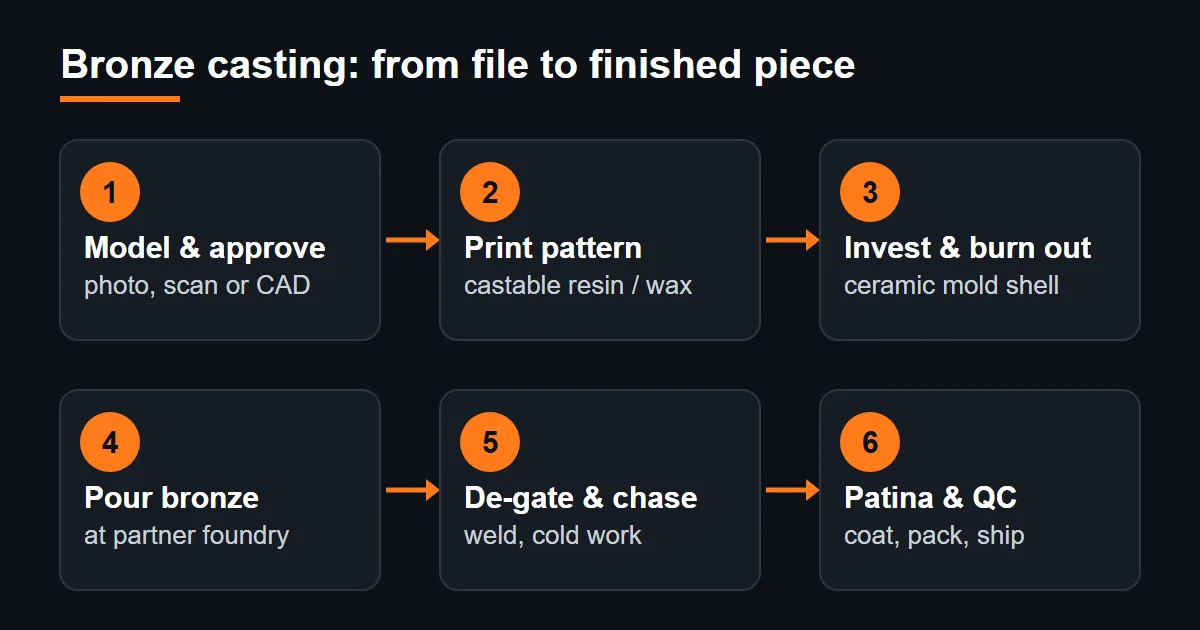
Bronze casting at a glance
| Item | What CT3D offers |
|---|---|
| Casting methods | Lost-wax (investment) casting for small to medium parts; sand casting or sectioned casting for large pieces |
| Pattern options | SLA / DLP castable resin, printable wax, large-format resin masters, RTV silicone molds for wax copies |
| Pattern accuracy | SLA: layer 25–100 µm, ±0.05–0.1 mm; DLP: ±0.03–0.08 mm |
| Largest one-piece printed pattern | Up to 800 × 800 × 500 mm; larger pieces are split into sections |
| Alloys | Brass (Cu-Zn), bronze (Cu-Sn), red copper – grade recommended per project |
| Finishes | Mirror polish, brushed satin, antique patina, blackening, anti-oxidation lacquer |
| Quantity | From a single piece; silicone molds for repeat castings |
| Input files | STL, STEP, IGES, OBJ, 2D drawings, photos or a physical sample |
How a digital workflow changes bronze casting
In the traditional approach, an artisan sculpts the model by hand in clay or wax, and every change in proportion means re-sculpting. Once a 3D model is part of the process, the form is controlled on screen: resizing, refining facial features, adding lettering or merging a logo are simple file edits. A 3D printed castable resin pattern burns out cleanly in the mold-firing kiln, leaving an accurate cavity for the molten metal.
The practical engineering benefits: consistent dimensions across multiple castings; fine ornamentation reproduced more evenly than hand sculpting allows; and archived files that let you recast a piece years later. For restoration projects, CT3D can 3D scan the original and rebuild damaged areas, as in our work on statue restoration with 3D scanning.

How lost-wax bronze casting works – step by step
Lost-wax (investment) casting is the standard route for detailed bronze pieces. With a 3D printed pattern, the sequence looks like this:
- 3D model and approval. We build or clean up the 3D model, add shrinkage allowance and, for larger pieces, hollow it out and plan the sections. You approve the model on screen.
- Pattern printing. The pattern is printed in castable resin or wax. For several identical pieces, a master is printed and an RTV silicone mold is made to produce wax copies.
- Gating and investing. Sprues and vents are attached so metal can flow in and air can escape. The pattern assembly is coated with a refractory investment that forms a heat-resistant mold.
- Burnout. The mold is fired in a kiln. The resin or wax burns or melts out, leaving a precise cavity in the shape of the part.
- Pouring. Molten copper alloy is poured into the hot mold at the partner foundry and left to solidify.
- Break-out and chasing. The mold is broken away, sprues are cut off, and the surface is chased: seams are removed, small defects are weld-repaired and details are sharpened by cold work.
- Finishing and patina. Polishing, satin brushing or chemical patina, followed by a protective lacquer or wax, then final inspection and packing.

Scope of work and casting pattern specifications
- 3D design: modeling from photos, drawings or concepts; mesh preparation and repair (STL/OBJ) for printing. See our 3D CAD design service.
- 3D scanning and reverse engineering: digitizing physical originals, with scaling up or down as required.
- Casting patterns: castable resin, printable wax, or standard resin masters used to make silicone molds for wax reproduction.
- Casting and finishing: investment casting for small to medium parts; large pieces are cast in sections and welded together; followed by cold work, polishing, patina and protective coating.
| Pattern-making process | Reference specifications | Best suited for |
|---|---|---|
| SLA resin printing | Layer height 25–100 µm, tolerance ±0.05–0.1 mm, fine details down to 0.05 mm | Medals, logos, small statues |
| DLP resin printing | Layer height 25–100 µm, ±0.03–0.08 mm | Jewelry, micro details |
| Large-format resin printing | Up to 800×800×500 mm | One-piece patterns for large statues (for mold making) |
| RTV silicone mold | Wax reproduction from a single master | Multiple castings of the same design |
Source: resin printing specifications from CT3D technical documentation.
Note that the pattern tolerance is not the tolerance of the finished bronze. Shrinkage during cooling, investment behavior and the amount of chasing all add variation, so dimensions that matter (mounting holes, fitting faces, plinth interfaces) should be marked on your drawing so they can be checked or finish-machined after casting.

Which pattern route should you choose?
The right pattern depends mainly on quantity and size. A one-off commemorative piece goes straight from a castable resin print into the investment mold. Jewelry-scale parts with very fine detail suit printed wax or DLP resin. When the same design will be cast again and again – emblems, awards, a series of statues – it is more economical to print one master, make an RTV silicone mold and inject wax copies. Learn more about silicone mold making.

Copper alloys and surface finishes
| Material group | Characteristics | Typical use |
|---|---|---|
| Brass (Cu-Zn) | Bright yellow color, easy to polish | Logos, emblems, gifts |
| Bronze (Cu-Sn) | Excellent mold filling, good environmental durability | Art statues, outdoor relief panels |
| Red copper | Warm reddish tone, high copper content | Devotional statues, ceremonial objects |
Source: common copper alloy classifications used in decorative casting; the specific alloy grade is recommended by our engineers for each project.
Available finishes include mirror polish, brushed satin, chemically applied antique patina, blackening to highlight details, and anti-oxidation lacquer. If budget is limited, consider polyresin or cold-cast bronze (bronze powder mixed with resin) for a faux-bronze look – see our painting and plating for 3D printed models and polyresin statues.
Finishing options in detail
| Finish | What it looks like | Best for |
|---|---|---|
| Mirror polish | Bright, reflective metal; shows the true alloy color | Logos, emblems, award plaques, small gifts |
| Brushed satin | Soft, even sheen with fine directional lines; hides fingerprints better than mirror polish | Signage, architectural details, modern pieces |
| Antique patina | Brown to dark bronze tones applied chemically, with highlights rubbed back on raised areas | Statues, busts, relief panels, devotional pieces |
| Blackening | Dark recesses that make lettering and ornament stand out | Inscriptions, medals, detailed reliefs |
| Protective lacquer or wax | Clear coat over the chosen finish to slow oxidation | All pieces, especially those handled often or placed outdoors |
Copper alloys keep changing color as they age, especially outdoors. A lacquer or wax coat slows this down, and occasional re-waxing keeps a patina even. If you want a specific tone, send a reference photo with your request so our team can advise on how closely it can be matched.
Design for casting
- Wall thickness: large statues should be hollow with uniform walls so the metal solidifies evenly, avoiding shrinkage porosity.
- Shrinkage compensation: copper alloys shrink as they cool, so the pattern must be scaled up accordingly; our engineers apply the compensation directly in the file.
- Fillets: sharp internal corners are prone to hot tearing; round them off.
- Raised lettering and ornaments: features that are too thin may not fill completely; keep stroke width and height sufficiently large.
- Sectioning: large pieces are split into modules with locating joints, cast separately, then welded and cold-worked.
Practical design guidelines
The values below are general guidance used in decorative bronze casting. The exact limits depend on size, alloy and pattern route, and our engineers confirm them for your part during the technical review.
| Feature | General guidance |
|---|---|
| Wall thickness of hollow pieces | Keep walls as even as possible; sudden changes from thin to thick areas are a typical cause of shrinkage porosity |
| Thick solid areas | Core them out or hollow them where you can; thick masses cool slowly and tend to sink or form voids |
| Raised text and fine relief | Strokes that are thin and tall are hard to fill; slightly wider, lower strokes cast more reliably |
| Internal corners | Use generous fillets instead of sharp corners to reduce hot tearing |
| Thin projecting parts (fingers, swords, ribbons) | Thicken slightly or cast separately and weld on; this also reduces the risk of damage in transport |
| Mounting points | Plan threaded bosses, pins or base plates in the model so the piece can be fixed securely to its plinth or wall |
Industry applications
| Sector | Products |
|---|---|
| Religious and devotional | Buddha statues, Catholic statues, liturgical objects |
| Corporate | Bronze logos, emblems, commemorative medals, partner gifts |
| Architecture | Relief panels, bronze signage, decorative elements |
| Sports and events | Trophies, medals, honorary statues |
| Jewelry | Castable resin patterns for rings and pendants |
Learn more about wax and castable resin pattern printing and custom 3D trophy production, and see related services for decor and corporate gifts and Catholic altars and liturgical furnishings.
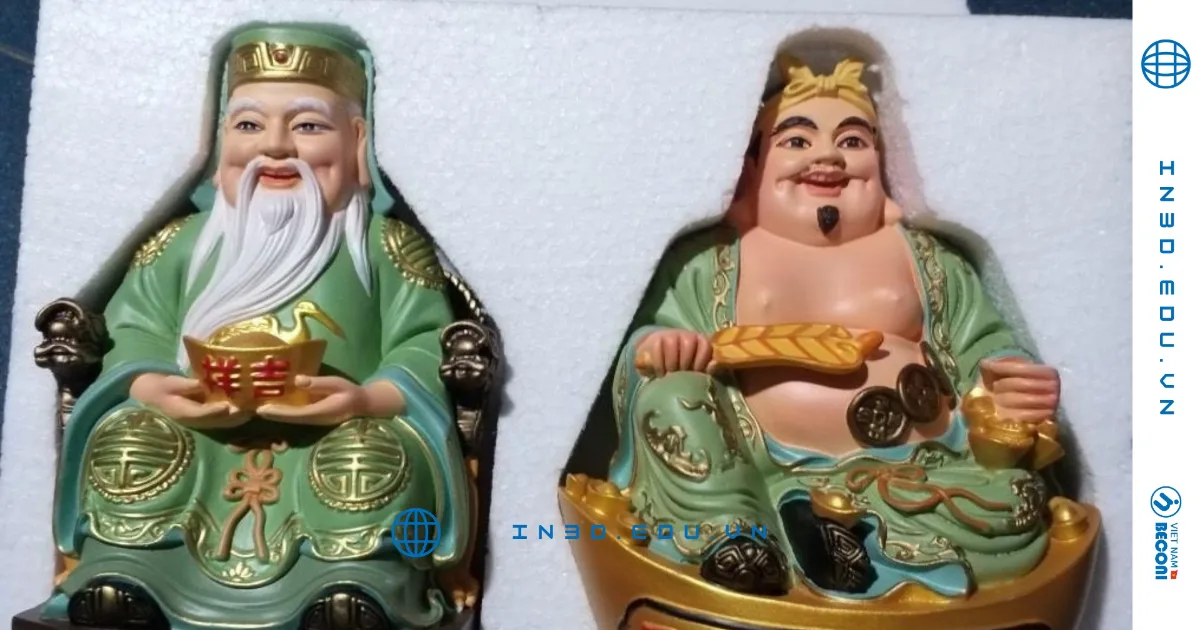
Quality control
- Before casting: file checks (wall thickness, watertight mesh) and printed pattern approval with the customer.
- After casting: inspection for gas porosity, shrinkage porosity, cracks and missing details; weld repair and cold work where needed.
- Dimensions: key dimensions measured against the file; large statues can be 3D scanned for comparison.
- Surface: uniform patina color without blotching; complete, sealed protective coating.
Because the pattern is digital, the approved 3D file is the reference for every check. For larger or high-value pieces, a 3D scan of the finished casting can be compared with the original model to show where shape deviations are – see 3D scanning inspection.
Investment casting vs. sand casting for bronze products
| Criterion | Investment casting (lost-wax) | Sand casting |
|---|---|---|
| Surface detail | Very high; preserves fine ornamentation and small lettering | Moderate; rougher surface that requires more cold work |
| Suitable size | Small to medium; large pieces must be sectioned | Medium to large, simple solid shapes |
| Input pattern | Printed castable resin, printed wax, or wax reproduced from a silicone mold | Wood pattern, 3D printed pattern or foam pattern |
| Typical applications | Logos, medals, small statues, jewelry | Large relief panels, thick signage, architectural elements |
Source: general characteristics of the two most common methods in decorative and art casting.
On many projects, CT3D combines both: the large body is sand cast or cast in sections, while fine details such as faces, hands and inscriptions are investment cast and then welded on. This approach balances surface quality and cost, and helps control shrinkage porosity in thick areas. If you are unsure which route to take, simply send photos and target dimensions; our engineers will recommend the most suitable sectioning plan and pattern material.

Bronze or a faux-bronze alternative?
Solid cast bronze is not the only way to get a bronze look. The comparison below helps decide which material fits your budget and use.
| Criterion | Cast bronze / brass | Cold-cast bronze (bronze powder + resin) | Polyresin or composite with bronze paint |
|---|---|---|---|
| Look and feel | Real metal: weight, cold touch, natural patina | Metallic surface that can be polished and patinated; lighter than metal | Bronze effect is a paint layer; lightest option |
| Typical cost | Highest – driven by metal weight and foundry work | Medium | Lowest |
| Durability | Very long life, suitable outdoors with maintenance | Good indoors; outdoor use depends on resin and coating | Indoor or sheltered use; paint may need touch-ups |
| Best for | Monuments, heritage pieces, premium awards | Gifts, interior statues, limited editions | Large decorative pieces, events, tight budgets |
Workflow and how to order
- RFQ: send photos, drawings, 3D files (STL, STEP, IGES, OBJ) or a physical sample, together with dimensions, quantity and the desired surface finish.
- Technical review: we assess wall thickness and fine details, and propose a casting method (investment or sand casting) and sectioning plan.
- Quotation: covering design, pattern making, casting and finishing, with a timeline for each stage.
- Pattern approval: you approve the 3D file and the printed pattern before casting – the most important sign-off point.
- Casting, finishing and QC: casting at the partner foundry, de-gating, cold work, patina and inspection.
- Delivery: impact-protected packaging, with delivery across Vietnam, international shipping, or pickup at our workshop.
What to include in your request: overall size (height or width), quantity, preferred alloy or color, finish (polished, satin, patina), where the piece will be placed (indoor or outdoor), how it will be mounted, and your target date. If you need an NDA before sharing designs, tell us and we will sign one.
Why work with CT3D on bronze casting
- One point of contact for the whole chain: scanning, 3D modeling, pattern printing, silicone molds, foundry supervision, finishing and patina are coordinated by one team.
- Digital patterns you can approve: you see and sign off the 3D model and the printed pattern before any metal is poured.
- In-house pattern printing: SLA, DLP and large-format resin printing let us match the pattern process to the size and detail of the piece.
- From one piece to a series: single castings straight from a printed pattern, or silicone molds for repeat production.
- Honest engineering advice: if polyresin, cold-cast or composite would serve your purpose better than solid bronze, we will tell you.
- Engineering support in English and shipping within Vietnam or internationally on request.
Frequently asked questions
Does CT3D cast bronze in-house?
CT3D does not operate its own furnace. Melting and pouring are performed at a partner foundry; CT3D is responsible for design, 3D printed patterns, molds, technical supervision, finishing, patina and quality acceptance before delivery to the customer.
I only have photos, no physical sample. Can you still cast it in bronze?
Yes. CT3D builds a 3D model from your photos, sends it for your approval, prints the pattern and only then proceeds to casting.
Can you cast a single piece?
Yes. For a one-off, the printed castable resin pattern goes straight into investment casting; when multiple copies are needed, we make a silicone mold to reproduce the wax patterns.
Can you cast large bronze statues?
Yes. Large pieces are divided into sections, cast separately and welded together, then cold-worked and given a uniform patina. The largest one-piece printed pattern is up to 800 × 800 × 500 mm; anything bigger is planned in sections.
How is bronze casting priced?
Pricing depends on metal weight, complexity, quantity and surface finish. CT3D quotes based on your file or physical sample, and the quote breaks down design, pattern making, casting and finishing.
Which alloy should I choose: brass, bronze or red copper?
Brass gives a bright yellow color and polishes easily, so it suits logos and gifts. Bronze fills molds well and is durable outdoors, so it suits statues and relief panels. Red copper has a warm reddish tone for devotional pieces. Our engineers recommend the exact grade for each project.
Can I approve the design before the metal is poured?
Yes. You approve the 3D model and then the printed pattern before casting. Pattern approval is the most important sign-off, because changes after pouring are costly.
Is cast bronze suitable for outdoor installation?
Bronze is widely used outdoors. Its color changes over time; a protective lacquer or wax slows this, and periodic re-waxing keeps the patina even. Plan mounting points in the design so the piece can be fixed securely.
Can you scale an existing statue up or down?
Yes. We 3D scan the original, scale the digital model, adjust wall thickness and shrinkage allowance, and print a new pattern at the target size.
Videos from the CT3D workshop
Watch SLA 3D printing and custom painting, produced by CT3D, to get a clearer picture of our process and product quality. More videos are available on our YouTube channel Chế Tạo Vlog – CT3D.
Ready to start your bronze casting project?
Send us your 3D file, drawing or photos with the target size, quantity and finish. Our engineers will review manufacturability, suggest the best pattern and casting route, and reply quickly with a quotation and schedule.
Contact CT3D – send your files for a fast quote
Whether you have a 3D file (STL, STEP, IGES, OBJ), a 2D drawing, photos or just an idea, you can send it to CT3D online. Our engineers will review your files, advise on process and materials, and send a quotation with a delivery schedule. We ship within Vietnam and internationally.
- Email: [email protected] – [email protected]
- Phone / Zalo: +84 975 008 728 (Mr. Thai) – +84 985 936 728 (Mr. Dang), or use our Contact form
- Head office: Binh Duong, Vietnam.
- Workshops: Ho Chi Minh City, Vietnam.
- Other workshops and drop-off points: Can Tho, Da Nang, Bien Hoa, Ba Ria – Vung Tau, Hanoi, Hai Duong, Hai Phong. Nationwide delivery and international shipping.
- Website: ct3dgroup.com – in3d.edu.vn
CT3D – 3D design & prototyping: 3D printing, 3D scanning, reverse engineering, silicone mold making, painting and finishing, CNC machining, composite installations, and supply of 3D printers and 3D printing resins and filaments.