
Industrial 3D Printing Vietnam – SLA, MJF PA12 & SLM Metal
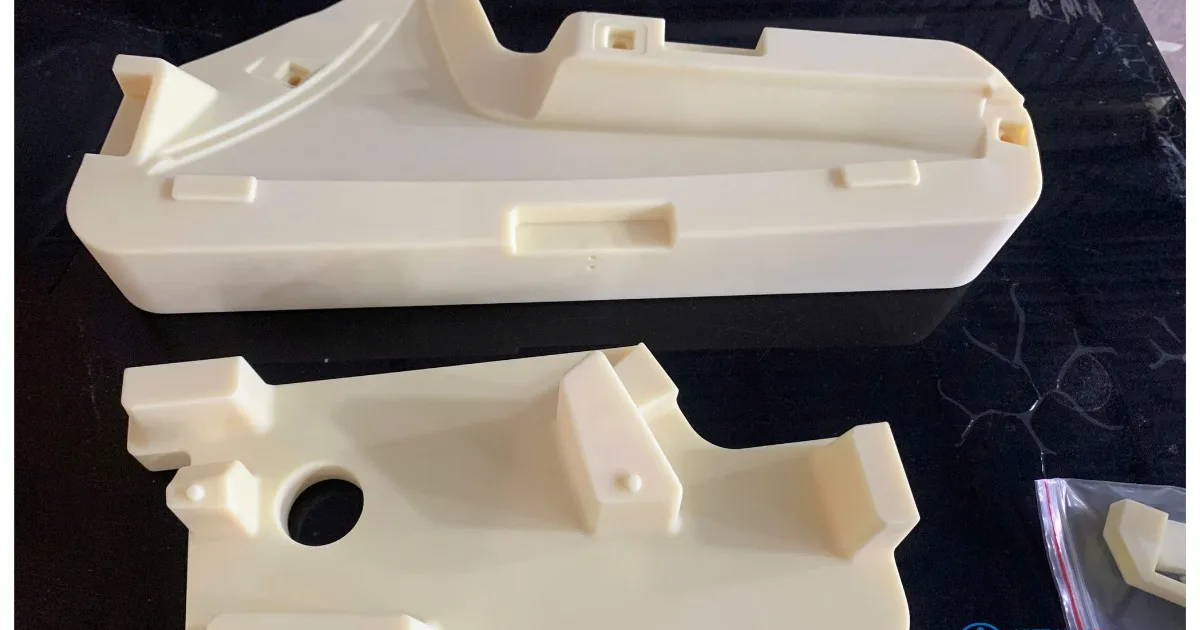
Technical summary: CT3D’s industrial 3D printing service in Vietnam runs four additive manufacturing (AM) technology groups side by side for industrial customers: resin photopolymerization (SLA/DLP), fused deposition modeling (FDM) with engineering plastics, polymer powder sintering (SLS/MJF PA12) and laser powder bed fusion of metals (SLM). Tolerances range from ±0.3 mm for FDM down to ±0.02 mm for SLM, with layer heights from 25 to 300 microns. Orders start from a single part – ideal for rapid prototyping, production jigs and fixtures, and low-volume production.
Instead of forcing every part into one process, CT3D’s engineers match each part to the technology that fits its function, quantity and budget – resin for fine detail, engineering FDM for rugged jigs, MJF/SLS PA12 for complex nylon batches and SLM for metal parts that must carry load or heat. Send your STEP, STL, OBJ or 3MF files and you will receive a free DFM review, a material recommendation and a clear lead time with your quote. We sign NDAs on request and support international customers in English.
Industrial 3D Printing at a Glance
Industrial 3D Printing – Scope of Work for Manufacturing
This page is for R&D teams, maintenance departments and design engineers who need real parts for fit testing, measurement or end use. Unlike display models, the focus here is on mechanical properties, dimensional stability and batch-to-batch repeatability. CT3D handles the following types of work:
- Functional prototypes: parts for fit checks, load testing and thermal testing before committing to tooling.
- Jigs, fixtures and gauges: for assembly lines, visual inspection, and positioning during welding or bonding.
- Spare parts: discontinued components recreated through 3D scanning and reverse engineering.
- Low-volume production: tens to hundreds of parts when injection molding is not yet economical.
- Bridge tooling: 3D printed mold inserts or master patterns for silicone molds, shortening time to market.
How the Four Technologies Work
Each technology builds parts layer by layer, but the way each layer is formed decides surface quality, strength and cost:
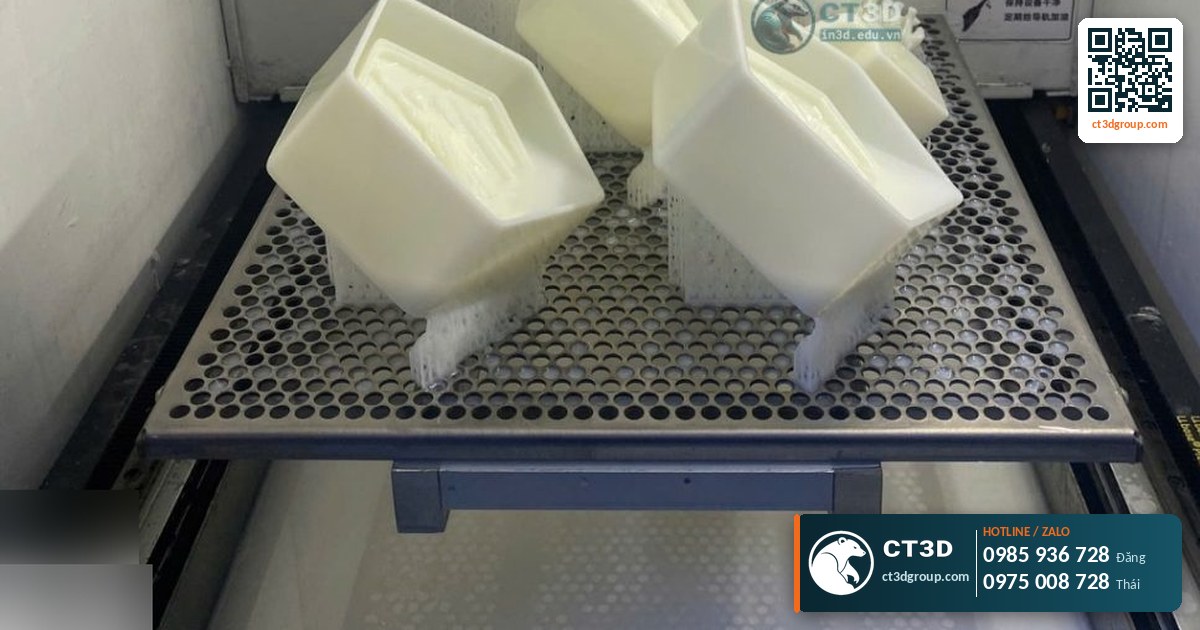
- SLA/DLP (resin photopolymerization): a light source – a laser for SLA, a projected image for DLP – cures liquid resin layer by layer. Parts need supports, then washing and UV post-curing. The result is a smooth surface with fine detail.
- FDM (fused deposition modeling): a heated nozzle extrudes thermoplastic filament along toolpaths. It is the most economical option for jigs, fixtures and large, simple parts, but strength is lower between layers.
- SLS/MJF (polymer powder sintering): PA12 powder is fused layer by layer – by laser in SLS, by a fusing agent and infrared energy in MJF. The surrounding powder supports the part, so no support structures are needed and many parts can be nested in one build.
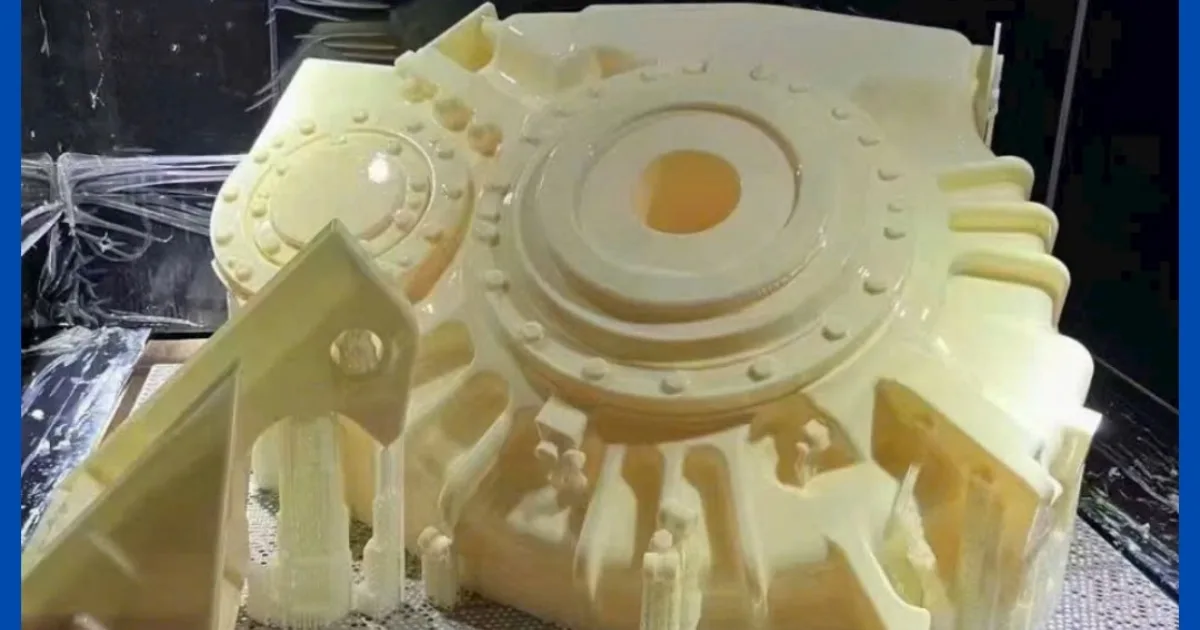
- SLM (laser powder bed fusion of metals): a laser fully melts thin layers of metal powder to create dense metal parts. Parts are anchored to a build plate with supports, then stress relieved, cut off by wire EDM or CNC, and finished.
Technical Specifications
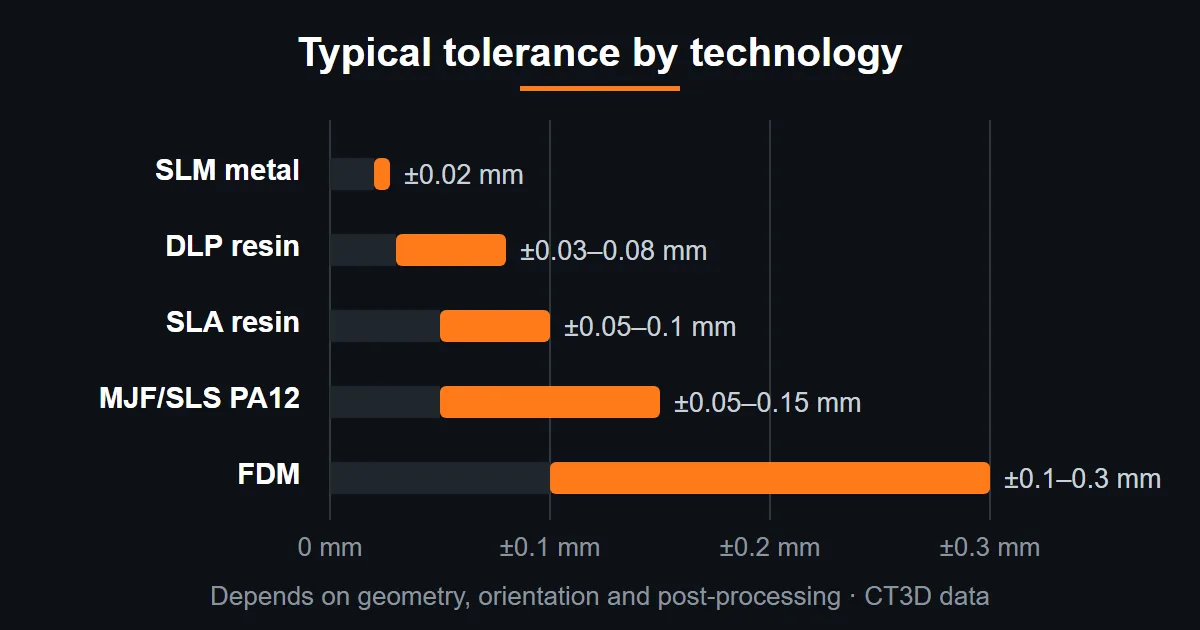
| Technology | Layer height | Typical tolerance | Build volume | Supports |
|---|---|---|---|---|
| SLA resin | 25–100 microns | ±0.05–0.1 mm | Up to 800×800×500 mm | Required, removed after printing |
| DLP resin | 25–100 microns | ±0.03–0.08 mm | Small format, fine detail | Required |
| FDM engineering plastics | 100–300 microns | ±0.1–0.3 mm | Machine-dependent; parts can be split and joined | Depends on overhang angle |
| SLS / MJF PA12 | 80–120 microns | ±0.05–0.15 mm (MJF ±0.05 mm) | Depends on powder chamber | Not required – self-supporting powder |
| SLM metal | Per machine parameters | ±0.02 mm, Ra 6–10 µm | 250×250×300 mm (modular assembly possible) | Required, removed by wire EDM/CNC |
Source: CT3D internal technical documentation. Actual tolerances depend on geometry, build orientation and post-processing.
Materials and Standards
Material selection should start from the part’s operating conditions: load, temperature, chemical exposure, UV and surface requirements. Here is how CT3D groups the options.
Photopolymer Resins
ABS-like resin is the default choice for housings and assembly parts that need a fine surface finish. It comes in several colors, and in our workshop experience hardness increases from white to yellow, black and brown – so color is also a mechanical variable. We also offer tough, clear, high-temperature, flexible, castable and PA12-like resins. After printing, resin parts are washed and UV post-cured to reach their design hardness.
FDM Thermoplastics
PETG, ABS, ASA, Nylon (PA), and carbon-fiber-reinforced (CF) PETG/Nylon. ASA is UV-resistant and suited to outdoor parts; CF materials increase stiffness and reduce warping. Keep anisotropy in mind: strength along the Z axis (between layers) is lower than in XY, so build orientation must follow the load direction.
SLS/MJF Polymer Powders
PA12 delivers more uniform mechanical properties than FDM and needs no support structures, making it possible to print internal channels, print-in-place hinges and nested parts.
SLM Metals
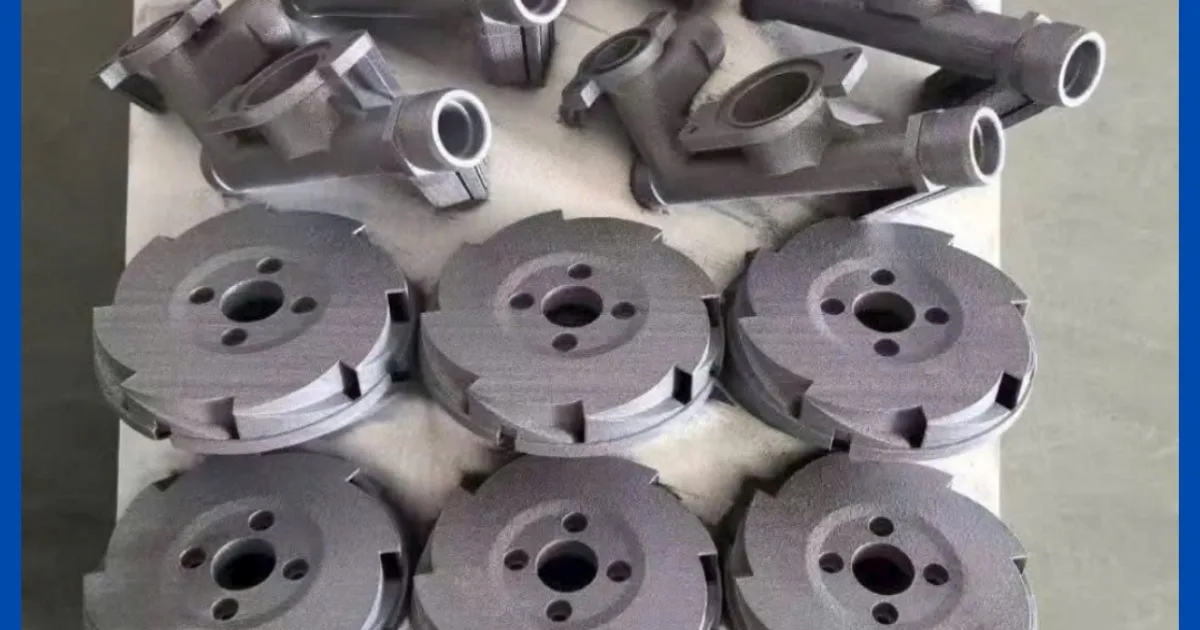
Stainless steels 316L, 304L, 17-4PH; aluminum AlSi10Mg, AlSi12, Scalmalloy; titanium Ti6Al4V, Ti Grade 2; copper Cu, CuCrZr; tool steels H13, Maraging 18Ni300; superalloys Inconel 625/718, Hastelloy; and CoCr. According to CT3D data, the tensile strength of SLM parts is equal to or 10–15% higher than that of cast parts. Learn more in our article on custom SLM metal 3D printing.
Design Guidelines for Industrial 3D Printing
Designing for the chosen process avoids failed builds and unnecessary post-processing. The values below are typical industry guidelines rather than CT3D guarantees; our DFM review checks wall thickness, overhangs, drain holes and assembly tolerances for your specific file.
| Feature | SLA/DLP resin | FDM | SLS/MJF PA12 | SLM metal |
|---|---|---|---|---|
| Minimum wall (typical) | Around 1 mm for robust walls | 2–3 extrusion widths or more | Around 1 mm or more | Typically 0.5–1 mm depending on height |
| Overhangs and supports | Supports needed; place them on hidden faces | Supports below roughly 45° from horizontal | No supports needed | Supports needed below roughly 45°; plan access for removal |
| Hollow parts | Add drain holes so resin can escape | Use infill instead of closed cavities | Add escape holes to remove powder | Add escape holes; avoid trapped powder |
| Assembly clearance (typical) | 0.1–0.2 mm per side | 0.2–0.5 mm per side | 0.3–0.5 mm for print-in-place parts | Machine critical fits after printing |
| Threads and precise holes | Inserts or post-tapping | Heat-set inserts | Inserts or post-tapping | Drill, ream or tap after printing |
For critical dimensions, include a 2D drawing with tolerances (GD&T if available) – our engineers will flag them before printing and plan inspection around them.
Post-Processing and Finishing Options
- Support removal and cleaning: standard for SLA/DLP, FDM and SLM parts.
- UV post-curing: resin parts are post-cured to reach their design hardness.
- Bead blasting: a uniform matte surface for PA12 and metal parts.
- Stress relieving and machining (metal): SLM parts are stress relieved, removed from the build plate by wire EDM/CNC and can be finish-machined on mating surfaces.
- Painting and plating: for appearance models and customer-facing samples, see 3D printing with painting and plating.
Technology Selection Matrix by Engineering Requirement
| Primary requirement | Recommended technology | Why |
|---|---|---|
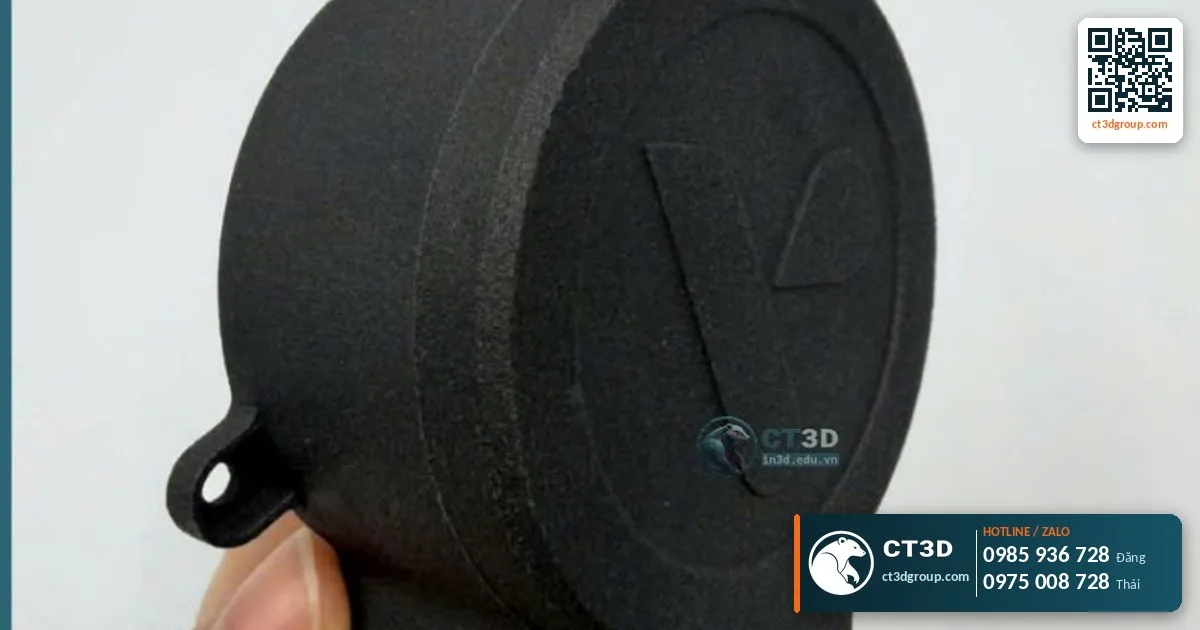
| Fine appearance, small details, raised lettering | SLA/DLP ABS-like resin | Layers as thin as 25 microns, smooth surface |
| Low-cost, fast jigs with moderate impact resistance | FDM PETG/ABS/ASA | Low cost, tough materials |
| Rigid jigs with minimal warping | FDM carbon-fiber filament | High elastic modulus |
| Complex geometry, batches of 20–200 parts | MJF/SLS PA12 | No supports; many parts nested in one build chamber |
| High loads, high temperatures, cooling channels | SLM metal | Fully dense, can be finish-machined |
Note: this matrix is for guidance only; CT3D engineers will confirm the recommendation after reviewing your files. For a more detailed comparison, see our overview of FDM, SLA, MJF and SLM 3D printing technologies.
3D Printing vs. CNC Machining vs. Injection Molding
Industrial 3D printing is one option among several. The comparison shows typical characteristics so you can see where it fits best:
| Criteria | Industrial 3D printing | CNC machining | Injection molding |
|---|---|---|---|
| Tooling | None | Fixtures only | Mold required – high upfront cost |
| Geometry freedom | Very high: internal channels, lattices, print-in-place parts | Limited by tool access | Limited by draft angles and mold design |
| Typical quantities | 1 to a few hundred | 1 to thousands | Thousands and more |
| Tolerance | ±0.02 mm (SLM) to ±0.3 mm (FDM) | Typically very tight on machined features | Typically tight and repeatable once the mold is tuned |
| Design changes | Simply update the file | Update the CAM program | Costly mold modification |
| Best for | Prototypes, jigs, spare parts, bridge production | Precise metal and plastic parts | Mass production |
Many projects combine methods: an SLM part can be printed near-net-shape and then CNC machined on critical faces, and 3D printed master patterns can be used for silicone molds before investing in injection tooling.
Industry Applications
- Electrical & electronics: prototype device housings, PCB locating trays, connector covers.
- Automotive & motorcycle: fit-check models for lamp assemblies, plastic trim and ventilation parts; inspection gauges for production lines.
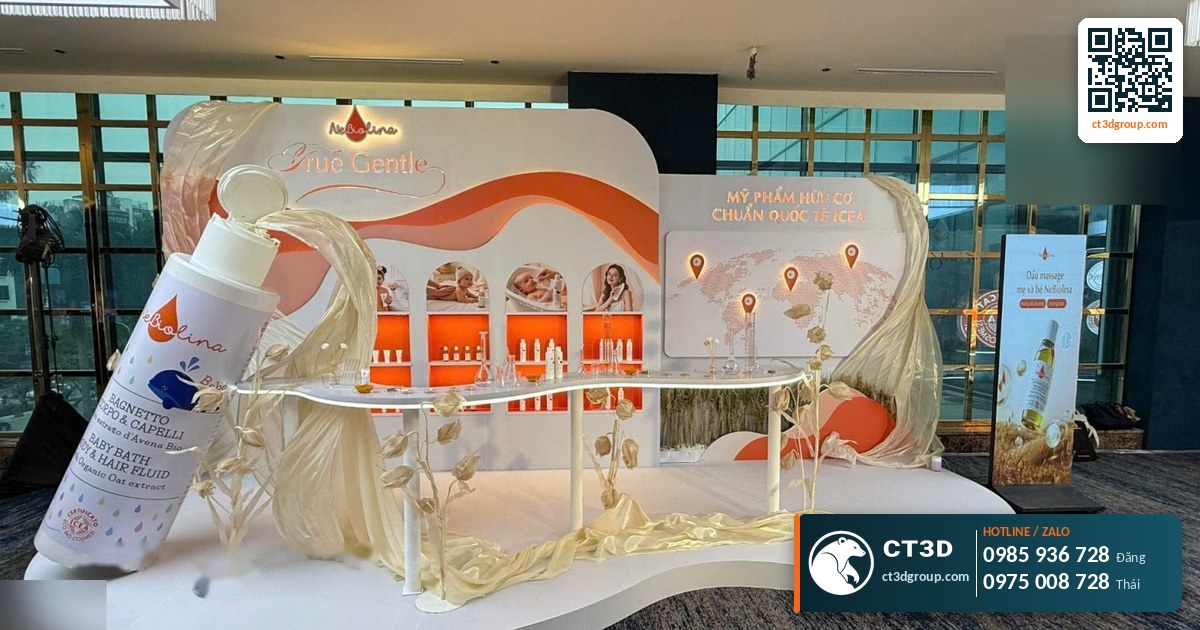
- Consumer goods: bottle, cap and packaging prototypes for design approval and packaging-line trials.
- Machinery & automation: robot grippers, sensor brackets, prototype gears.
- Tooling: mold inserts with conformal cooling channels in H13 or Maraging steel.
- Education & research: student project parts and custom-designed lab equipment.
Our website features the logos of the corporate partners, customers and technical universities that have worked with CT3D over more than 12 years in operation.
Quality Control
For industrial parts, quality means more than a good-looking surface. CT3D applies the following control points:
- Before printing: verify a watertight mesh with no normal errors; analyze wall thickness; flag critical dimensions per GD&T drawings when provided by the customer.
- During printing: monitor chamber temperature, keeping resin at 25–28°C; for SLA, tilt parts 20–45° to reduce peel forces. Our in-house resin print failure rate is kept below 5%.
- After printing: measurement with calipers, micrometers and gauges; for demanding parts, 3D scanning and comparison against CAD with a deviation color map.
- First Article Inspection (FAI): for batch orders, CT3D prints a first article for customer approval before running the full lot.
Surface finishing steps are described in our article on post-processing 3D printed parts.
How to Order – From RFQ to Delivery
- Request for quotation (RFQ): send your STEP, STL, OBJ or 3MF files via our website, Zalo or email (or use our Contact form), with quantity, preferred material and operating conditions.
- DFM review: our engineers check wall thickness, overhangs, powder/resin drain holes and assembly tolerances, and suggest file changes where needed based on DfAM principles.
- Quotation: based on volume, machine time and post-processing, with a clearly stated lead time.
- Production: build orientation, support generation, printing and post-processing (support removal, post-curing, bead blasting, and stress relieving for metals).
- Quality control (QC): measurement of critical dimensions and visual inspection.
- Delivery: pick-up at our workshop or courier/air freight delivery across Vietnam, typically 1–3 days after completion; international shipping can be arranged.
If you don’t have a 3D file yet, CT3D can create one from 2D drawings or through 3D scanning and reverse engineering. To learn more about file formats, see our article on what an STL file is.
Why Choose CT3D for Industrial 3D Printing
- Four technology groups in one place: SLA/DLP, engineering FDM, SLS/MJF PA12 and SLM metal, so the recommendation is based on your part, not on a single machine type.
- Free DFM review with every quote: wall thickness, overhangs, drain holes and tolerances checked before production.
- From one part: every technology, including SLM metal, is available from a single piece.
- Measured, not assumed: calipers, micrometers and gauges, plus 3D scanning with a deviation color map for demanding parts, and First Article Inspection for batches.
- From scan to part: no CAD file? We create one from 2D drawings or through 3D scanning and reverse engineering.
- Experience: more than 12 years in operation, working with industrial companies and technical universities.
- Confidential and international: NDA on request, English-speaking engineers and international shipping on request.
Frequently Asked Questions (FAQ)
How is acceptance of production 3D printed parts different from display models?
The acceptance criteria differ. Display models are judged mainly on appearance; industrial parts are judged on tolerances, mechanical properties, thermal stability and batch-to-batch repeatability.
Does CT3D accept orders for a single part?
Yes. Every technology, including SLM metal, is available from a single part. Volume orders are quoted per project.
How do I choose between FDM, resin, MJF and metal?
Describe the operating conditions (load, temperature, environment) and the quantity. Our engineers will check them against the technology matrix and recommend the best balance of cost and performance.
How is industrial 3D printing priced?
FDM is priced by actual weight – for example, PLA and PETG from 650 VND/g (≈ US$0.025/g), ABS from 1,000 VND/g (≈ US$0.04/g) and carbon-fiber filaments from 2,750 VND/g (≈ US$0.11/g). Resin, MJF/SLS and metal parts are quoted per file. All prices are indicative.
What is the lead time?
It depends on part size, quantity and post-processing. Our engineers state the lead time clearly in the quotation; after completion, domestic delivery within Vietnam usually takes 1–3 days, and international shipping can be arranged.
How strong are SLM metal parts compared with cast or machined metal?
SLM fully melts the metal powder, producing dense parts. According to CT3D data, the tensile strength of SLM parts is equal to or 10–15% higher than that of cast parts. Mating surfaces can be CNC machined after printing when tight fits are required.
Is PA12 from MJF/SLS suitable for functional parts and small batches?
Yes. PA12 has more uniform mechanical properties than FDM and needs no supports, so internal channels, print-in-place hinges and nested batches are possible. Our selection matrix recommends MJF/SLS PA12 for complex parts in batches of about 20–200 pieces.
How do you verify dimensions on critical parts?
Critical dimensions are measured with calipers, micrometers and gauges. For demanding parts, we 3D scan the printed part and compare it with your CAD model using a deviation color map. Batch orders start with a First Article Inspection for your approval.
Which file formats do you accept, and can you work from a drawing or sample?
We accept STEP, STL, OBJ and 3MF files. If you only have a 2D drawing or a physical part, CT3D can create the 3D model from drawings or through 3D scanning and reverse engineering. We sign an NDA on request.
Factory Video from the CT3D Workshop
Watch Large-format SLA 3D printing service, produced in-house by CT3D, to see our process and part quality. More videos are available on our Chế Tạo Vlog – CT3D YouTube channel.
Contact CT3D – Send Your Files for a Fast Quote
Whether you have a 3D file, a 2D drawing, photos or just an idea, send it to CT3D. Our engineers will review your files, advise on technology and materials, and send a quotation with a delivery schedule.
- Email: [email protected] – [email protected]
- Phone / Zalo: +84 975 008 728 (Mr. Thai) – +84 985 936 728 (Mr. Dang) – or use our Contact form
- Head office: Binh Duong, Vietnam.
- Workshops: Ho Chi Minh City, Vietnam.
- Other workshops and drop-off points: Can Tho, Da Nang, Bien Hoa, Ba Ria – Vung Tau, Hanoi, Hai Duong and Hai Phong. Nationwide delivery across Vietnam, with international shipping available.
- Website: ct3dgroup.com – in3d.edu.vn
CT3D – 3D design & prototyping: 3D printing, 3D scanning, reverse engineering, silicone mold making, finishing and painting, CNC machining, composite fabrication, and supply of 3D printers and 3D printing materials.
Start Your Industrial 3D Printing Project
Send your STEP or STL files with quantity, material preference and operating conditions. Our engineers will recommend the right technology and reply quickly with a quote and lead time.