
3D Printed Molds Vietnam – Rapid Tooling & SLM Inserts
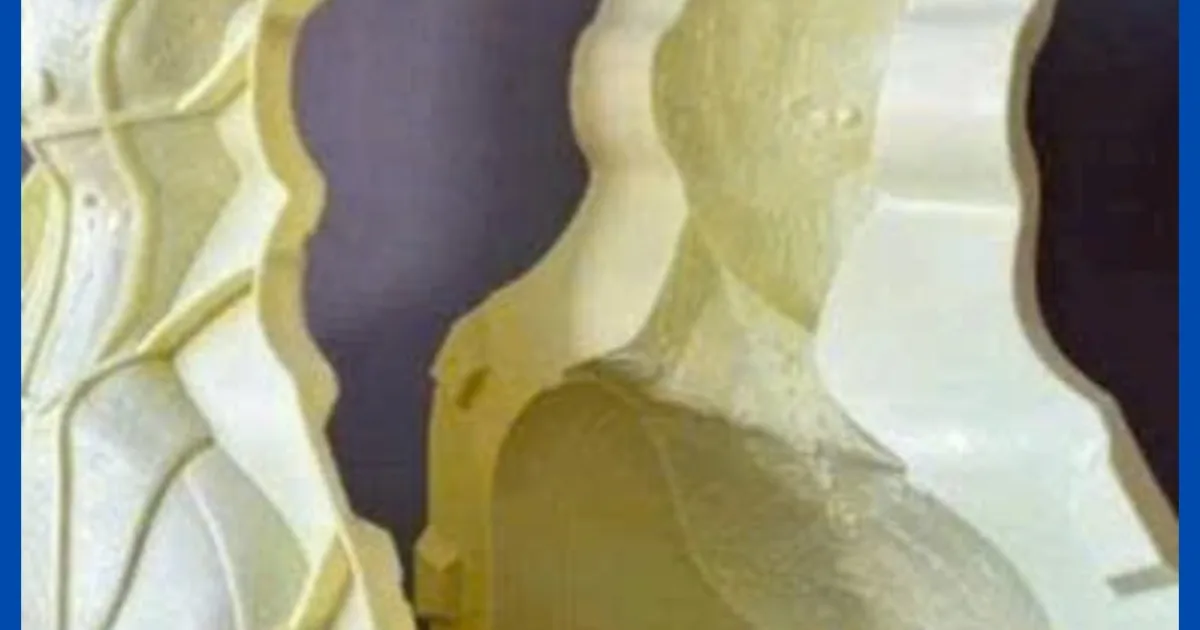
Technical summary: CT3D provides 3D-printed molds and rapid tooling built with additive manufacturing (AM): direct casting molds, master patterns for RTV silicone molds, and bridge tooling for the stage before you invest in steel tooling. Technologies include FDM, SLA/DLP/LCD resin, MJF/SLS PA12 and SLM metal printing. Tolerances reach ±0.05–0.1 mm with SLA resin and ±0.02 mm with SLM. Ideal for R&D teams, craft and art workshops, and factories that need trial molds or low-volume production.
3D Printed Molds at a Glance
| Item | Specification |
|---|---|
| Technologies | FDM, SLA/DLP/LCD resin, MJF/SLS PA12, SLM metal |
| Tolerance | ±0.05–0.1 mm with SLA resin; ±0.02 mm with SLM metal |
| Max resin build volume | 800×800×500 mm in one piece |
| SLM build volume | 250×250×300 mm; larger parts split into modules |
| Metal insert materials | H13 tool steel, Maraging 18Ni300, optional conformal cooling channels |
| Accepted files | STL, STEP, OBJ, 3MF, IGES, 2D drawings – or a physical sample for 3D scanning |
| Delivery | Across Vietnam within 1–3 days of completion; international shipping on request |
Actual values depend on geometry, build orientation and post-processing.
Rapid Tooling with 3D Printing: When Should It Replace Machined Molds?
CNC-machined steel or aluminum molds deliver consistent quality, but carry high fixed costs and long lead times. While the design is still changing, every cavity modification means re-machining. 3D-printed rapid tooling solves this: the cavity is built directly from CAD data, so you can edit the file and reprint within a few days.
CT3D engineers typically recommend 3D-printed molds in three situations: (1) you need to verify form and fit before freezing the production mold; (2) volumes are too low to amortize metal tooling; (3) the geometry is complex – ornamental patterns, undercuts, freeform surfaces – and hard for a milling cutter to reach. For high volumes and fast injection cycle times, steel molds remain the more economical choice. A break-even analysis is available in our article comparing 3D printing and injection molding.
How 3D Printing Is Used to Make Molds
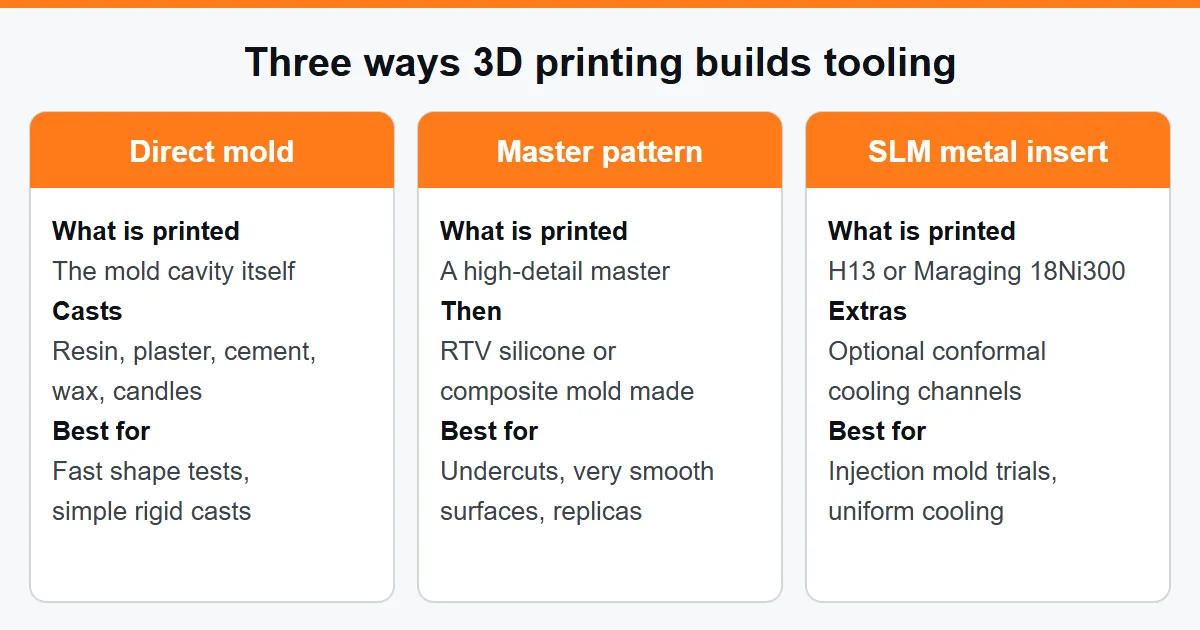
There are three main routes, and the right one depends on the casting material, the number of parts and the surface you need:
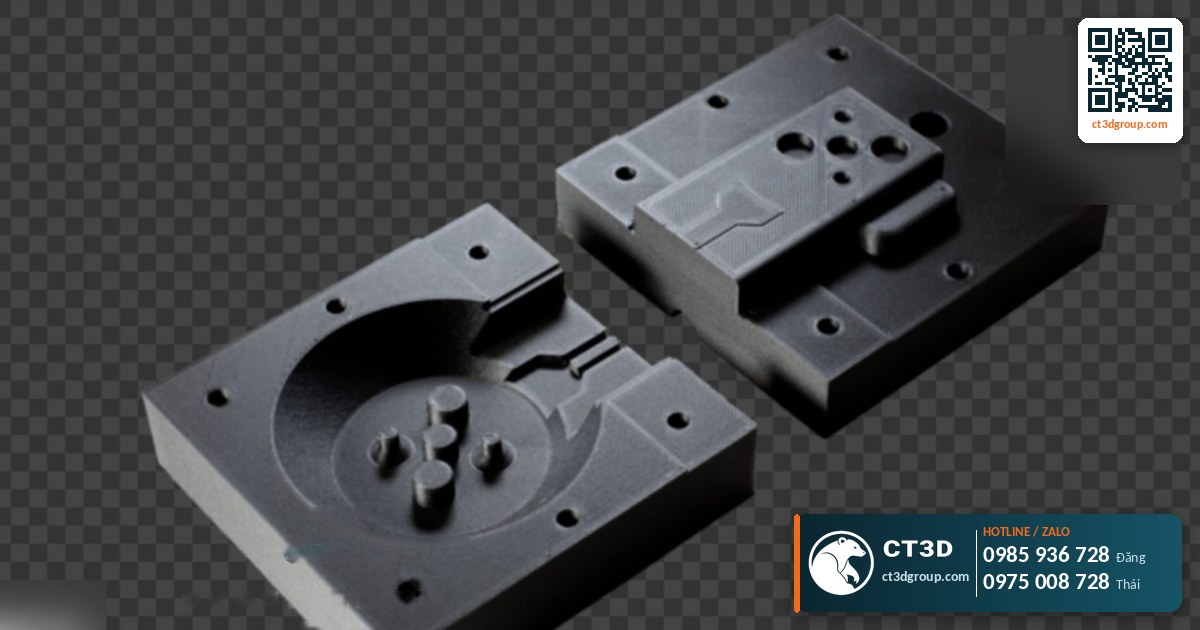
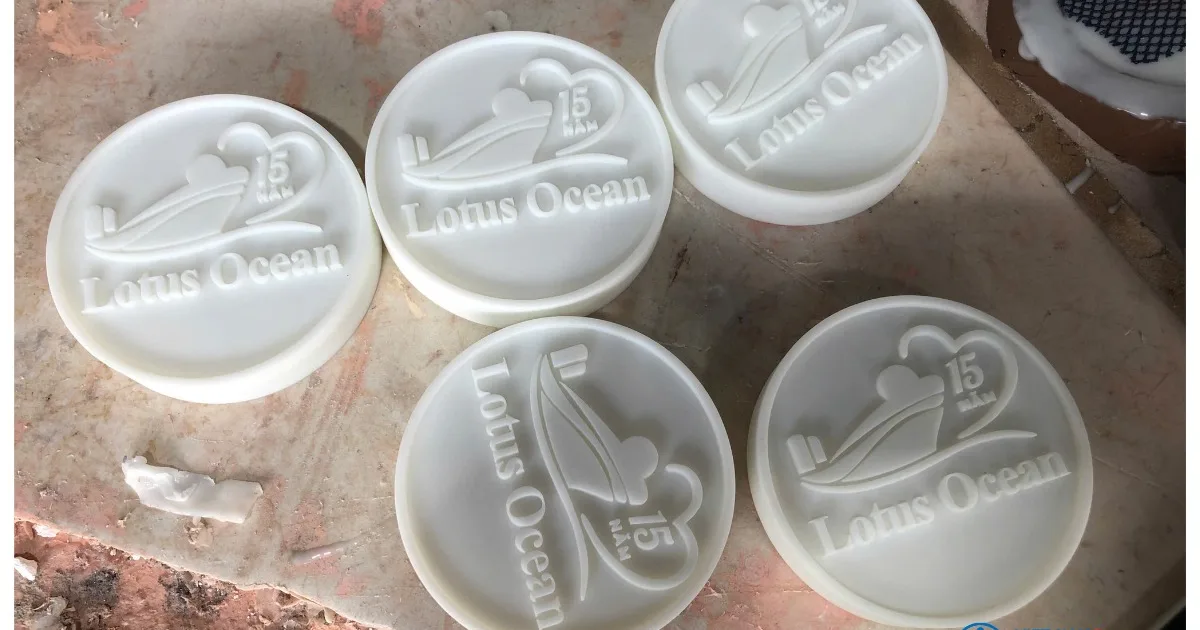
- Direct tooling: the mold cavity itself is printed and used to cast resin, plaster, cement, wax, candles or chocolate. Fastest route for shape tests and simple rigid casts.
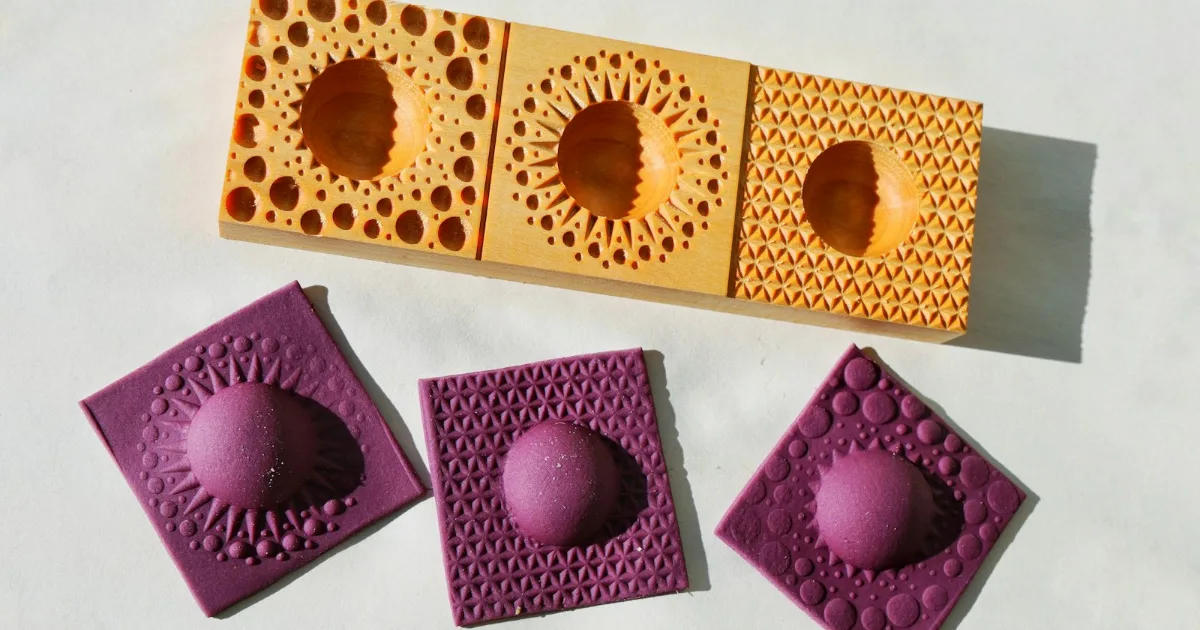
- Indirect tooling: a high-resolution master pattern is printed, finished, and used to make an RTV silicone or composite mold. Best for undercuts and very smooth surfaces.
- Metal inserts: SLM-printed steel inserts go into a mold base for injection trials, with the option of conformal cooling channels that follow the part shape.
Scope of Work and Technical Specifications
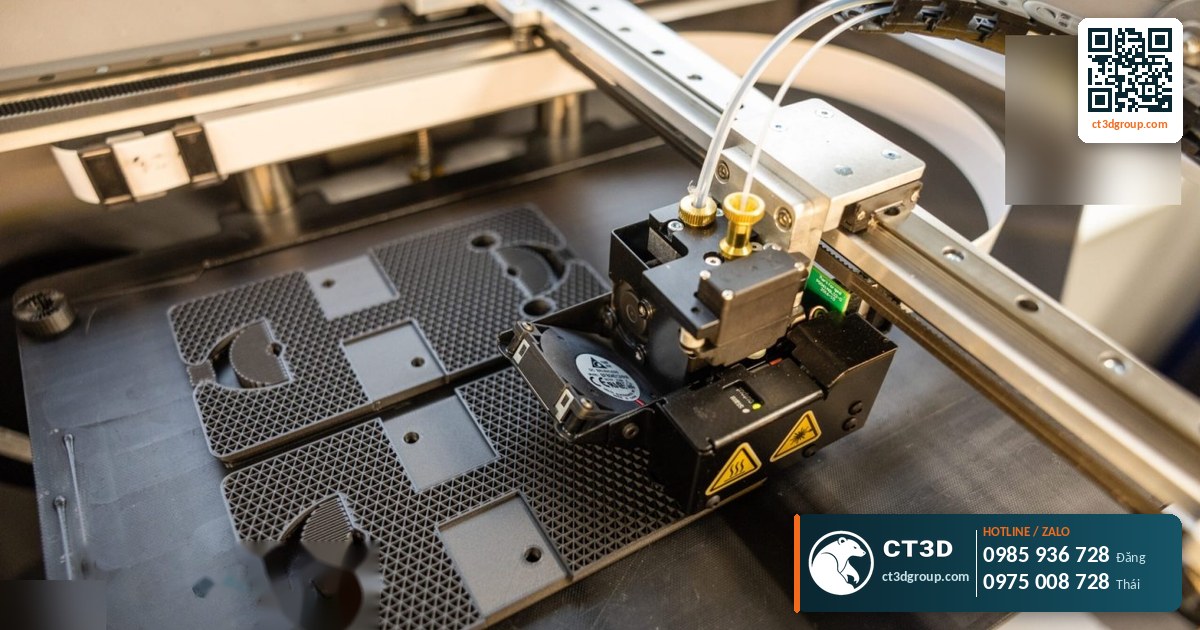
CT3D handles the full job, from input data to finished mold. If you only have a physical sample, our workshop 3D scans it and rebuilds the CAD model (scan-to-CAD) before splitting the mold. Main work items:
- Mold design: defining the parting line and adding draft angles, gates, vents and registration keys.
- Direct tooling: printing the mold cavity for casting resin, plaster, cement, wax, candles and chocolate (using food-contact-suitable materials on special request).
- Indirect tooling (master patterns): printing high-resolution master patterns as the basis for RTV silicone or composite molds.
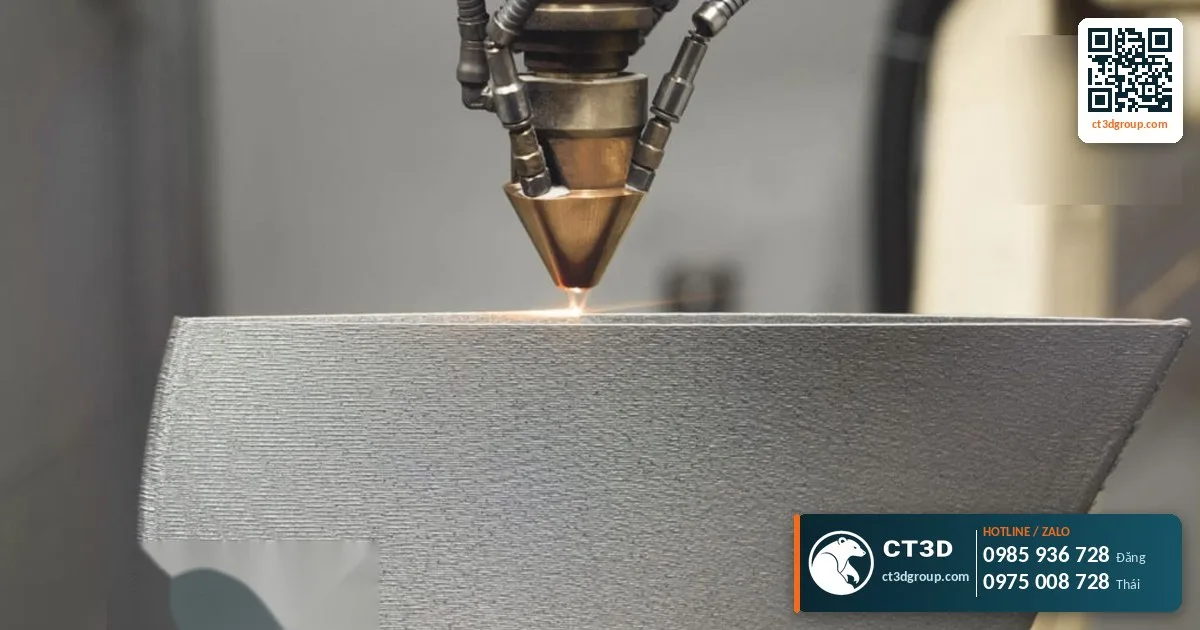
- Metal mold inserts: SLM-printed H13 tool steel or Maraging 18Ni300, with optional conformal cooling channels.
| Technology | Layer height | Tolerance | Typical role in tooling |
|---|---|---|---|
| FDM | 100–300 µm | ±0.1–0.3 mm | Rough molds, jigs, mold support shells |
| SLA resin | 25–100 µm | ±0.05–0.1 mm | Master patterns, casting molds for small parts |
| DLP resin | 25–100 µm | ±0.03–0.08 mm | Jewelry molds, micro-detail parts |
| MJF/SLS PA12 | 80–120 µm | ±0.05–0.15 mm | Impact-resistant molds, pouring fixtures |
| SLM metal | — | ±0.02 mm, Ra 6–10 µm | Steel mold inserts, conformal cooling cores |
Source: CT3D technical documentation. Actual values depend on geometry, build orientation and post-processing.
Maximum resin build volume is 800×800×500 mm, allowing large statue molds or product housings to be printed in one piece. SLM build volume is 250×250×300 mm; larger parts are split into modules.
Mold Materials and Selection Criteria (Materials & Standards)
Mold material is selected on three parameters: the temperature of the casting material, chemical compatibility with the casting compound, and the expected number of demolding cycles.
| Mold material | Advantages | Limitations to consider |
|---|---|---|
| PLA, PETG (FDM) | Low cost, fast printing, suitable for plaster and cement molds | Visible layer lines, needs priming and sanding for a smooth surface; PLA softens at low temperatures |
| ABS, ASA (FDM) | Better heat resistance than PLA, can be vapor-smoothed | Shrinks during printing, dimensional compensation required |
| Standard / Tough resin | Smooth surface, sharp detail, ideal for master patterns | More brittle than thermoplastics; requires full UV post-curing |
| High-temperature resin | For trial molds with warm casting materials and very short-run injection trials | Higher cost than standard resin |
| PA12 (MJF/SLS) | Tough, impact-resistant, good isotropy | Slightly rough surface, needs surface sealing |
| H13, Maraging (SLM) | Inserts that withstand injection heat and pressure | Quoted per file; mating surfaces require CNC finishing |
Source: material properties compiled from CT3D workshop experience and material manufacturers’ documentation.
For silicone replication molds, the mold release must be compatible with both the printed resin and the silicone; some resins that are not fully UV-cured can inhibit the cure of platinum silicone. The detailed process is covered in our article on making silicone molds from 3D-printed masters.
Mold Design Rules for 3D Printing (DfAM for Tooling)
3D-printed molds only perform well when designed according to Design for Additive Manufacturing (DfAM) principles. Points CT3D engineers check during DFM review:
- Draft angle: at least 1–3° on vertical faces; textured surfaces need more.
- Build orientation: place critical cavity faces facing up or angled to avoid support marks. For resin, tilting the part 20–45° reduces peel forces.
- Wall thickness: stiff enough to resist deformation during pouring; large molds should use stiffening ribs rather than solid walls.
- Anisotropy: FDM parts are weakest along the Z axis; align the mold’s load direction parallel to the layer plane.
- Venting and pouring: place vents at the highest point of the cavity to minimize air bubbles.
- Shrinkage compensation: add the casting material’s shrinkage factor to the cavity dimensions.
For more on fit tolerances, see our article on 3D printing accuracy and tolerances.
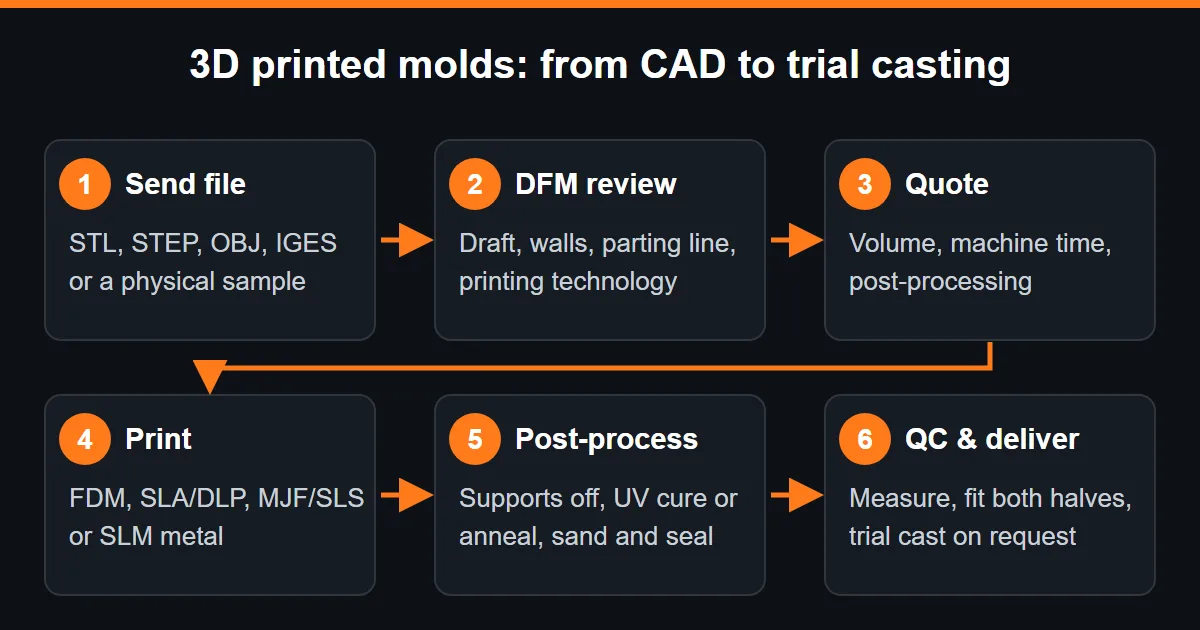
Workflow from RFQ to Delivery
- Request for quotation (RFQ): send your STL/STEP/OBJ/3MF/IGES file, 2D drawing or physical sample via our website, Zalo, email or the contact form; specify the casting material and the number of casts you need.
- DFM review: our engineers analyze the file, check draft angles and wall thickness, and propose the parting line and printing technology.
- Quotation: based on material volume, machine time and post-processing; the quote includes the schedule.
- Production: printing the mold, removing supports, UV curing or stress-relief annealing depending on the technology, sanding and surface sealing.
- Quality control (QC): measuring mating dimensions, test-fitting both mold halves and trial casting on request.
- Delivery: door-to-door delivery or pickup at our workshop; shipping across Vietnam within 1–3 days of completion, with international shipping available on request.
Post-Processing and Surface Finishing for Printed Molds
| Step | Purpose | Applies to |
|---|---|---|
| Support removal | Clean cavity faces without support marks | All technologies |
| Full UV post-curing | Reach final resin properties; avoids inhibiting platinum silicone cure | SLA, DLP, LCD resin |
| Stress-relief annealing | Reduce internal stress before machining | SLM metal inserts |
| Primer/filler and fine sanding | Remove layer lines and pinholes on cavity faces | FDM and resin molds, master patterns |
| Surface sealing | Close porous surfaces so casting material does not stick | PA12 (MJF/SLS), FDM |
| CNC finishing of mating faces | Accurate fit of inserts in the mold base | SLM metal inserts |
| Mold release | Easy demolding, chosen for the mold and casting material pair | All molds |
Industry Applications
| Industry | Mold type | Key benefit |
|---|---|---|
| Consumer product development | Master patterns for PU vacuum casting | 10–30 appearance samples before committing to injection tooling |
| Arts, crafts and statues | Silicone molds from printed masters, plaster molds | Replicating polyresin and cold-cast statues |
| Jewelry and bronze casting | Castable resin patterns for investment casting | Fine ornamental detail without hand carving |
| Mechanical engineering plants | SLM inserts, pouring fixtures, trial molds | Shorter mold trial time, more uniform cooling |
| Food and gifts | Chocolate, candle and soap molds | Low-cost seasonal design changes |
For jewelry casting, see our article on printing wax and castable resin patterns; for metal mold inserts, see our article on molds with conformal cooling channels.
3D Printed Molds vs. Silicone Molds vs. Machined Metal Molds
| Criterion | Direct 3D printed mold | Silicone mold from a printed master | CNC-machined aluminum or steel mold |
|---|---|---|---|
| Tool lead time | Typically shortest – print and post-process | Short – master plus mold curing | Typically longest |
| Tool cost | Low | Low to moderate | High fixed cost |
| Typical quantity | Trials and very small batches | Small batches; mold life depends on material | High volumes |
| Design changes | Edit the file and reprint | Reprint the master, recast the mold | Re-machining required |
| Undercuts | Limited – rigid mold needs draft | Good – flexible silicone | Need slides or inserts |
| Best for | Form and fit checks, plaster, cement, wax | Resin replicas, art pieces, appearance samples | Mass production, fast injection cycles |
General comparison; the best choice depends on geometry, casting material and quantity. See also our silicone mold and vacuum casting services.
Quality Control for 3D-Printed Molds
A mold that is off by 0.2 mm can produce cast parts that do not fit. CT3D therefore applies the following checks:
- First Article Inspection (FAI): measuring key dimensions with calipers, micrometers or 3D scanning.
- Deviation color map: comparing the scanned point cloud with CAD to assess warpage across the whole surface.
- Surface inspection: evaluating roughness (Ra), pinholes and layer lines on cavity faces; corrected with primer/filler and fine sanding.
- Fit test: assembling both mold halves and checking the gap at the parting line and registration keys.
The resin print failure rate in our workshop is kept below 5% by controlling resin temperature at 25–28°C and using proper build orientation.
Why Choose CT3D for 3D Printed Molds
- A choice of technologies: FDM, SLA/DLP/LCD resin, MJF/SLS PA12 and SLM metal, so the process is chosen to suit the mold rather than the other way round.
- Large one-piece prints: resin build volume up to 800×800×500 mm for big statue molds and housings.
- From sample to mold: 3D scanning and scan-to-CAD when you only have a physical part.
- Free DFM review with every quote: draft angles, wall thickness, parting line and build orientation checked by engineers.
- Measured results: first article inspection, deviation color maps and fit tests.
- Confidential: NDA on request; engineering support in English; international shipping on request.
Frequently Asked Questions
How many times can a 3D-printed mold be used?
It depends on the mold material, the casting material and the geometric complexity. Resin or PA12 molds used for plaster and cement can usually be cast many times with a mold release; with hot or aggressive materials, mold life is shorter. Our engineers will estimate it after reviewing your file.
I only have a sample part, no 3D file. What then?
CT3D 3D scans the sample, rebuilds the CAD model and splits the mold. Just send us the sample, or photos with dimensions.
Should I choose a direct 3D-printed mold or a silicone mold from a 3D-printed master?
Direct printed molds suit rigid casting materials and simple shapes. When the part has undercuts or needs a very smooth surface, a 3D-printed master combined with an RTV silicone mold is the more flexible option.
How long does it take to make a 3D-printed mold?
With a ready file, small molds are usually finished within a few days; if 3D modeling, mold splitting and surface finishing are needed, it takes longer. The exact schedule is stated in the quotation.
How accurate are 3D printed molds?
SLA resin reaches ±0.05–0.1 mm, DLP resin ±0.03–0.08 mm, MJF/SLS PA12 ±0.05–0.15 mm and SLM metal ±0.02 mm. Actual values depend on geometry, build orientation and post-processing.
What is the largest mold you can print?
Resin molds can be printed in one piece up to 800×800×500 mm. The SLM metal build volume is 250×250×300 mm; larger parts are split into modules.
Can 3D printed molds be used for injection molding?
High-temperature resin suits very short-run injection trials. For tougher trial conditions, CT3D prints H13 or Maraging 18Ni300 steel inserts by SLM, with mating surfaces CNC finished. For high volumes, a conventional steel mold remains more economical.
Which file formats do you accept?
STL, STEP, OBJ, 3MF and IGES, as well as 2D drawings. If you only have a physical sample, we 3D scan it and rebuild the CAD model before splitting the mold.
Shop-Floor Video from CT3D
Watch the video High-Tech 3D-Printed Molds from CT3D to get a clearer picture of our process and output quality. More videos are available on our YouTube channel Chế Tạo Vlog – CT3D (in Vietnamese).
Contact CT3D – Send Your File for a Fast Quote
Whether you have a 3D model, a 2D drawing, photos or just an idea, you can send it to CT3D online (STL, STEP, IGES, OBJ and more). Our engineers will review the file, advise on process and materials, and send a quotation with lead time.
- Email: [email protected] – [email protected]
- Hotline / Zalo: +84 975 008 728 (Mr. Thai) – +84 985 936 728 (Mr. Dang) – or use our contact form
- Head office: Binh Duong, Vietnam.
- Workshops: Ho Chi Minh City, Vietnam.
- Other workshops and drop-off points: Can Tho, Da Nang, Bien Hoa, Ba Ria – Vung Tau, Hanoi, Hai Duong and Hai Phong. Nationwide delivery across Vietnam; international shipping on request.
- Website: ct3dgroup.com – in3d.edu.vn
CT3D – 3D design & prototyping: 3D printing, 3D scanning, reverse engineering, silicone mold making, painting and finishing, CNC machining, composite fabrication, and supply of 3D printers and 3D printing resins.
Ready to Start Your Rapid Tooling Project?
Send your STEP or STL file with the casting material and quantity, and get a fast quote with a free DFM review.