
Quick answer: CT3D’s custom CNC machining service in Vietnam covers milling, cutting and engraving to drawing in wood (MDF, HDF, solid wood), EPS/XPS foam, plastics/acrylic and aluminum sheet. Send us 2D files (DXF, DWG, AI) or 3D files (STEP, STL, OBJ); our engineers will check them and quote to your drawing with a lead time. With more than 12 years in prototyping, CT3D combines CNC with 3D printing, silicone mold making, paint finishing and composite fabrication, so a single partner takes you from file to finished product. Delivery nationwide across Vietnam in 1–3 days after completion, with international shipping available on request.
Many customers come to CT3D with a very practical question: “I have a drawing – can someone cut this for me?” One needs 50 MDF panels engraved with a logo. Another needs a 3 m tall foam mascot for an event. Another needs a plastic product mock-up for a photo shoot. All of these are custom CNC machining jobs. This page explains what CT3D can do, which materials to choose, how the process works and when to use CNC instead of 3D printing. If you are new to the topic, see also our article on what CNC machining is and how it differs from 3D printing.
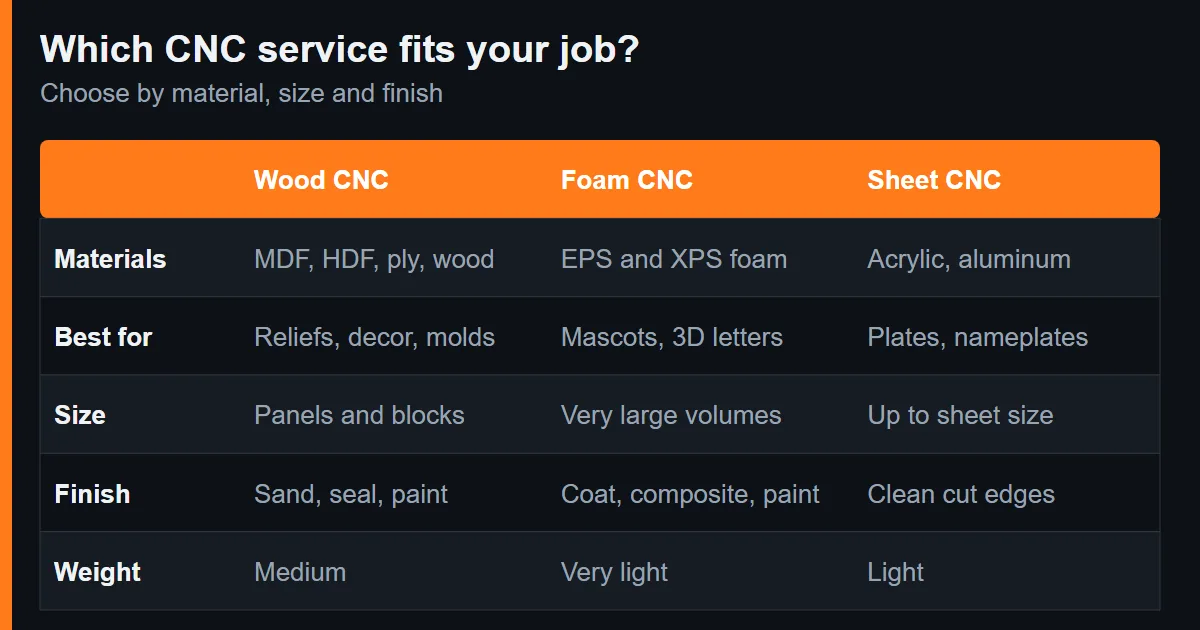
Choose your CNC machining service
CT3D’s CNC work is organized by material, because wood, foam and sheet materials need different machines, tools and finishing. Start with the service that matches your material; if a project mixes materials or needs fine details, our engineers combine CNC with 3D printing in the same order.
CNC Wood Machining
MDF, HDF, plywood and solid wood: profile cutting, lettering and logo engraving, 2.5D and 3D reliefs, furniture parts, wood molds and decor.
CNC Foam Cutting
EPS and XPS foam on a 5-axis foam CNC machine: mascots, 3D event lettering, site and display models, and cores for composite fabrication.
How to choose: CNC services compared
| Service | Materials | Best for | Typical finish |
|---|---|---|---|
| CNC wood machining | MDF, HDF, plywood, solid wood | Signage, reliefs, furniture parts, wood molds, decor | Sanded, sealed, painted or edge-banded |
| CNC foam cutting | EPS, XPS foam | Mascots, 3D lettering, site models, composite cores, very large lightweight shapes | Filler and paint, or a composite skin for durability |
| CNC plastics, acrylic and aluminum sheet (this page) | Acrylic, plastic sheet, aluminum sheet | Nameplates, display boxes, mounting plates, simple jigs, mock-up parts | Clean cut edges; drilled and pocketed as drawn |
| 3D printing (alternative) | FDM plastics, resin, PA12, metal | Complex shapes, hollow interiors, small details, undercuts | Raw, sanded or painted |
What does CT3D’s CNC machining service include?
CNC stands for Computer Numerical Control. Put simply, the machine reads toolpaths from a file and moves the cutting tool along the X, Y and Z axes to remove excess material. It is a “subtractive” process – the opposite of 3D printing, which “adds” material layer by layer.
At CT3D, CNC machining is organized into the following main service groups:
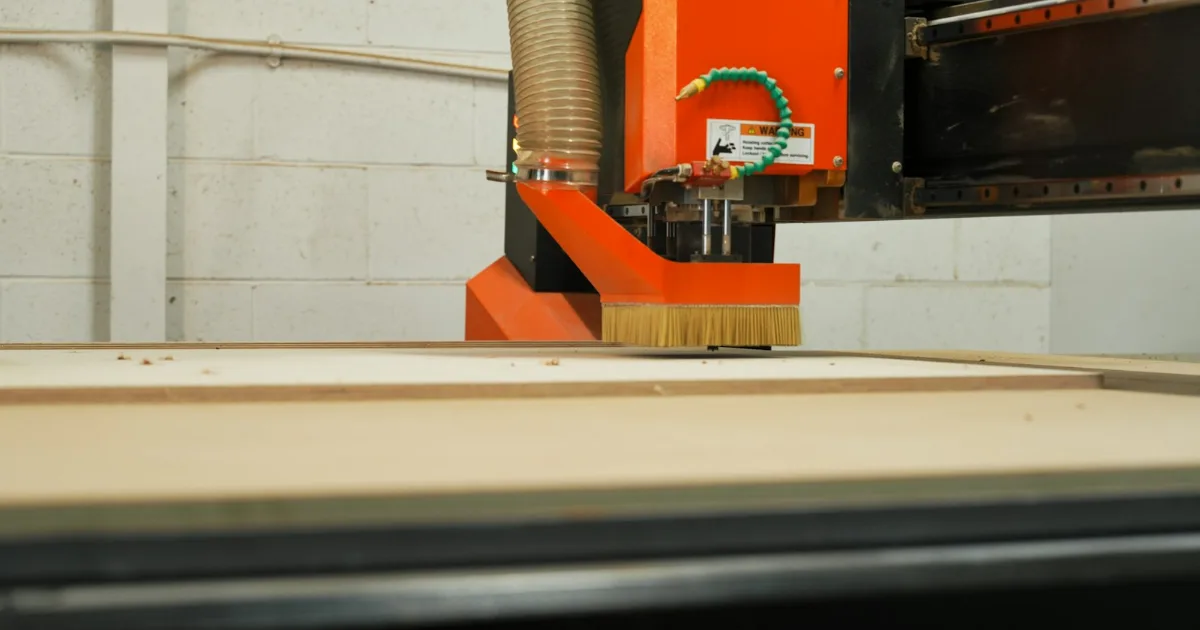
- CNC wood cutting and engraving: profile cutting of MDF, HDF and plywood; lettering and logo engraving; 2.5D and 3D relief milling; table legs, furniture components, wood molds and decor items.
- CNC EPS/XPS foam cutting: mascots, 3D event lettering, site models, display models and cores for composite fabrication. CT3D uses a 5-axis foam CNC machine for large volumes and complex curved shapes.
- CNC plastics, acrylic and aluminum sheet: sheet cutting, pocket milling and drilling for enclosures, nameplates, simple jigs and mock-up parts.
- Mock-ups and presentation models: CNC combined with 3D printing, sanding and painting to produce appearance models that look like the real product.
- Mold machining: wood molds, foam molds and master patterns for silicone molds or composite molds.
What sets CT3D apart is that you do not have to coordinate several workshops. A part can have its frame CNC milled, small details 3D printed, and then be assembled, sanded, painted and delivered – all in one place.


CNC machining materials: which one is right for the job?
Choosing the right material is the best way to keep costs down. The table below summarizes the materials CT3D machines most often and their best-fit applications.
| Material | Key characteristics | Best-fit applications | Notes |
|---|---|---|---|
| MDF / HDF | Smooth, uniform, easy to mill and paint | Reliefs, signage, wood molds, decor, mock-ups | Sensitive to water; needs a full sealing primer in humid locations |
| Solid wood | Attractive grain, durable, directional fibers | Table legs, carvings, furniture | Grain affects edge quality; should be kiln-dried first |
| Plywood | Light, stiff, multi-layer | Frames, partitions, jigs, shelving | Exposed layers on edges; can be edge-banded or painted |
| EPS foam | Very light, inexpensive, fast to cut | Mascots, site models, 3D lettering, composite cores | Beaded surface; needs filler/paint or a composite skin |
| XPS foam | Smoother and harder than EPS | Architectural models, parts needing sharp edges | Higher material cost than EPS |
| Acrylic / plastic sheet | Clear or colored, glossy surface | Nameplates, display boxes, mock-up housings | Requires suitable feeds and speeds to avoid melting or edge cracking |
| Aluminum sheet | Light, strong, thermally conductive | Mounting plates, simple flanges, technical parts | For complex metal parts, consider metal 3D printing |
Source: CT3D hands-on machining experience; material properties based on general engineering knowledge.
If you are unsure what to choose, just tell us where the product will be used (indoors or outdoors), whether it carries load, whether it needs to be lightweight or durable, and your deadline. CT3D’s engineers will recommend a material and machining approach.
When should you choose CNC, and when 3D printing?
This is the question CT3D hears most often. No single technology is best for everything – each excels at a particular type of geometry and production volume.
| Criterion | CNC machining | 3D printing |
|---|---|---|
| Principle | Removes material from a block or sheet | Adds material layer by layer |
| Strongest geometry | Flat panels, 2D profiles, reliefs, large blocks | Complex shapes, hollow interiors, small details, undercuts |
| Large sizes | Very well suited (foam, large wood blocks) | Must be segmented and assembled when exceeding the machine envelope |
| Materials | Wood, foam, acrylic, plastic sheet, aluminum | FDM plastics, resin, PA12, metal |
| Surface | Depends on stepover; flat faces are excellent | Visible layer lines (FDM) or very smooth (resin) |
| Quantity | Good for repeated sheet-cutting runs | Good for one-offs, low volumes and varied shapes |
Source: CT3D technical summary.
A simple example: a 2 m long raised-letter sign in MDF is much faster and cheaper to CNC than to 3D print. Conversely, a small character figure with hair, fingers and intricate relief will come out better with resin 3D printing. For metal parts, see our comparison of metal 3D printing and CNC to learn when it makes sense to combine the two technologies.
Combining CNC and 3D printing in one project
Many of the best projects use both. A large mascot can have a CNC-cut foam body with 3D printed eyes, logo and small details, then be coated in composite and painted. A product model can have an MDF-milled base frame and a curved shell printed in resin. This approach reduces cost while preserving detail.
Applications of custom CNC machining
CNC machining is used across many industries. Here are the types of work CT3D handles most often:
- Events and advertising: 3D lettering, large-format logos, backdrops, mascots and enlarged product models.
- Architecture and real estate: site models, massing models, terrain and facades.
- Interiors and decor: table legs, CNC-patterned screens, wall reliefs and decorative pieces.
- Religious art and fine art: reliefs, statue blanks and master patterns for casting. CT3D’s projects include the restoration of an Our Lady of La Vang statue and a Ca Mau shrimp landmark model.
- Product development and R&D: appearance mock-ups, jigs, trial molds and master patterns for silicone molds.
- Education: student project models and teaching models.
For mascots, the detailed process is covered in our article on making mascots with CNC foam and composite. If you need to reproduce many parts from a CNC master, see our article on making silicone molds from a master pattern.

What are the steps in CT3D’s CNC machining process?
CT3D follows six clear steps so you always know where your order stands:
- Send your files: 2D drawings (DXF, DWG, AI, vector PDF) or 3D files (STEP, STL, OBJ, 3MF) via our Contact form, Zalo or email. No files yet? Send photos, sketches and dimensions.
- Technical requirements: material, dimensions, quantity, finish level (raw, sanded, painted) and deadline.
- Engineering file review: we check dimensions, minimum tool radius, engraving depth and segmentation, and calculate material volume.
- Quote with lead time: CNC machining is quoted to your drawing, because price depends on material, machine time and finish level.
- Confirmation and production: toolpath programming, machining, inspection and finishing.
- Delivery: door-to-door delivery or collection from our workshop. Shipped by domestic courier, post or air freight; nationwide delivery within Vietnam in 1–3 days after completion. International shipping can be arranged on request.
What if you don’t have a drawing?
CT3D offers 3D CAD modeling, redrawing from photos, and 3D scanning with reverse engineering from a physical sample. The file is then optimized for CNC: closed profiles, layering, block segmentation and finishing allowances.
What determines the cost of CNC machining?
CT3D does not publish a fixed CNC price list, because two parts of the same size can differ several-fold in labor. Prices are quoted to your drawing based on the following factors:
- Material and stock size: MDF, solid wood, foam, acrylic and aluminum each have different material costs and cutting speeds.
- Machining type: 2D profile cutting is fastest; 2.5D engraving is moderate; 3D surface milling of curved shapes takes the most machine hours.
- Surface finish: the smaller the stepover, the smoother the surface – but the longer the run time.
- Size and number of setups: parts that need flipping, block segmentation or multi-part assembly require extra labor.
- Quantity: producing many identical panels lowers the setup cost per piece.
- Finishing: sanding, priming, color painting and composite coating are charged separately.
- File preparation and rush orders: charged extra if 3D modeling or expedited delivery is required.
Cost-saving tips: nest multiple parts on the same sheet; avoid very sharp internal corners (a round tool cannot cut a perfectly square corner); and only specify a high-quality finish on visible faces.
Common mistakes when ordering CNC machining – and how to avoid them
- Open contours in 2D files: profiles that are not closed leave the machine unable to identify the cutting area. CT3D will check and join them, but you should export a clean vector file.
- Perfectly square internal corners: milling cutters have a radius, so internal corners are always slightly rounded. If you need square corners for assembly, let us know so we can design dog-bone relief cuts.
- Features that are too thin: very thin letter strokes or ribs break easily when cutting wood or foam. Increase the thickness or move that feature to 3D printing.
- Wrong material for the environment: unsealed MDF placed outdoors will swell. Outdoor foam needs a composite coating.
- No assembly clearance: two parts cut to “exactly the same size” usually won’t fit together. Allow a clearance suited to the material.
Why choose CT3D for CNC machining in Vietnam?
- More than 12 years in 3D design and prototyping, with expertise in both CNC and 3D printing to choose the most cost-effective, appropriate approach.
- Full turnkey service: 3D modeling, CNC, 3D printing, silicone mold making, paint finishing and composite fabrication.
- Network of workshops and drop-off points: headquarters in Binh Duong; three workshops in Ho Chi Minh City, Vietnam; plus Can Tho, Da Nang, Bien Hoa, Ba Ria – Vung Tau, Hanoi, Hai Duong and Hai Phong.
- Transparent quotes based on your drawing, with a specific lead time.
- Logos of our corporate and university partners are featured on our website.
Frequently asked questions
How much does CNC machining cost?
CT3D quotes to your drawing. Price depends on material, machining type (2D cutting, 2.5D engraving, 3D milling), size, quantity and finish level. Send your files to receive a quote with lead time.
Which materials does CT3D machine?
MDF, HDF, plywood and solid wood; EPS and XPS foam; acrylic, plastic sheet and aluminum sheet. Complex metal parts can be moved to SLM metal 3D printing.
What file formats should I send?
2D files: DXF, DWG, AI or vector PDF. 3D files: STEP, STL, OBJ, 3MF. If you don’t have a file, send photos, sketches and dimensions and CT3D will build the model.
Do you accept small quantities, even a single piece?
Yes. CT3D handles everything from a single prototype to production runs. The higher the quantity, the lower the setup cost per piece.
Should I choose CNC or 3D printing?
CNC suits flat panels, 2D profiles, reliefs and large blocks. 3D printing suits complex shapes, hollow interiors and small details. Many projects combine both to optimize cost.
How long until I receive my order?
Lead time depends on volume and finish level and is stated clearly in the quote. Once complete, CT3D delivers nationwide across Vietnam within 1–3 days, or you can collect from our workshop; international shipping can be arranged.
Real footage from the CT3D workshop
Watch the video 5-axis foam CNC machine produced by CT3D to get a clearer picture of our process and product quality. More videos are available on our Chế Tạo Vlog – CT3D channel.
Contact CT3D – send your files for a fast quote
Whether you have 3D CAD files (STL, STEP, IGES, OBJ), 2D drawings, photos or just an idea, send them to CT3D. Our engineers will review your files, advise on technology and materials, and send a quote with lead time.
- Email: [email protected] – [email protected]
- Phone / Zalo: +84 975 008 728 (Mr. Thai) – +84 985 936 728 (Mr. Dang) – or use our Contact form
- Headquarters: Binh Duong, Vietnam.
- Workshops: Ho Chi Minh City, Vietnam.
- Other workshops and drop-off points: Can Tho, Da Nang, Bien Hoa, Ba Ria – Vung Tau, Hanoi, Hai Duong, Hai Phong. We ship nationwide across Vietnam and can arrange international delivery.
- Website: ct3dgroup.com – in3d.edu.vn
CT3D – 3D design & prototyping: 3D printing, 3D scanning, reverse engineering, silicone mold making, paint finishing, CNC machining, composite fabrication, and supply of 3D printers and 3D printing materials.
Ready to start your CNC machining project?
Send your CAD files (STEP, STL, IGES, OBJ), drawings or photos. You get a fast quote with a free manufacturability review, and we sign an NDA on request.