
Technical summary: CT3D runs an FDM 3D printing service in Vietnam (Fused Deposition Modeling – extrusion of molten thermoplastic filament) for rapid prototyping, jigs and fixtures, and low-volume production. Layer height is 100–300 microns with typical tolerances of ±0.1–0.3 mm. Materials include PLA, PETG, ABS, ASA, PETG-CF, PA12 (Nylon) and carbon-fiber-reinforced filaments. Indicative 2026 pricing is based on actual part weight, with PLA and PETG from 650 VND/g (≈ US$0.025/g). Our engineers run a DFM review on every file before quoting.
FDM is the most economical way to turn a CAD model into a physical part you can hold, test and assemble. If you are an engineer, product designer or maintenance team looking for affordable FDM 3D printing in Vietnam, you can send your STL, STEP, OBJ or 3MF files to CT3D and receive a quote with a manufacturability check, material advice and a delivery schedule. We sign an NDA on request and our engineers communicate in English.

FDM 3D Printing at a Glance
How FDM 3D Printing Works
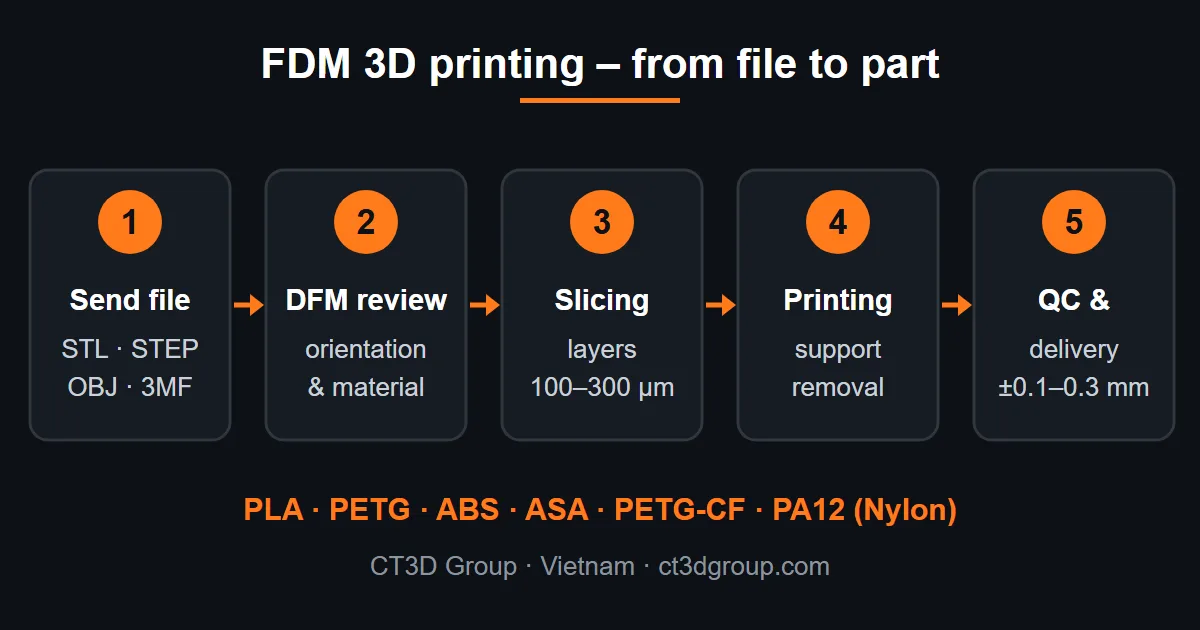
An FDM printer feeds a thermoplastic filament into a heated nozzle. The molten plastic is laid down along toolpaths generated by slicing software, one thin layer at a time, and each new layer fuses to the one below. When a layer is finished, the build plate moves down (or the print head moves up) by one layer height and the process repeats until the part is complete. At CT3D the journey from your file to a finished part follows five steps:
- File preparation: your STL, STEP, OBJ or 3MF file is checked for mesh errors and scale.
- DFM review and orientation: our engineers choose the build orientation and material based on the load case, surface requirements and support volume.
- Slicing: layer height (100–300 microns), wall count and infill are set to balance strength, surface and machine time.
- Printing and support removal: the part is printed, supports are removed and surfaces are cleaned up as specified.
- Inspection and delivery: key dimensions are measured and the part is packed for pick-up or shipping.
FDM 3D Printing Service – Scope of Work
FDM is the additive manufacturing (AM) process with the lowest cost per cm³ of all the technologies CT3D operates. A heated nozzle melts the filament, extrudes it along defined toolpaths and builds the part layer by layer along the Z axis. Thanks to this simple mechanism, FDM is well suited to medium and large parts that need practical mechanical performance on a tight budget.
What we produce:
- Form studies: evaluate ergonomics, overall dimensions and component layout before committing to injection mold tooling.
- Functional prototypes: fit checks, snap-fits, hinges and latches.
- Production jigs & fixtures: locating jigs, inspection gauges and guide rails for assembly lines.
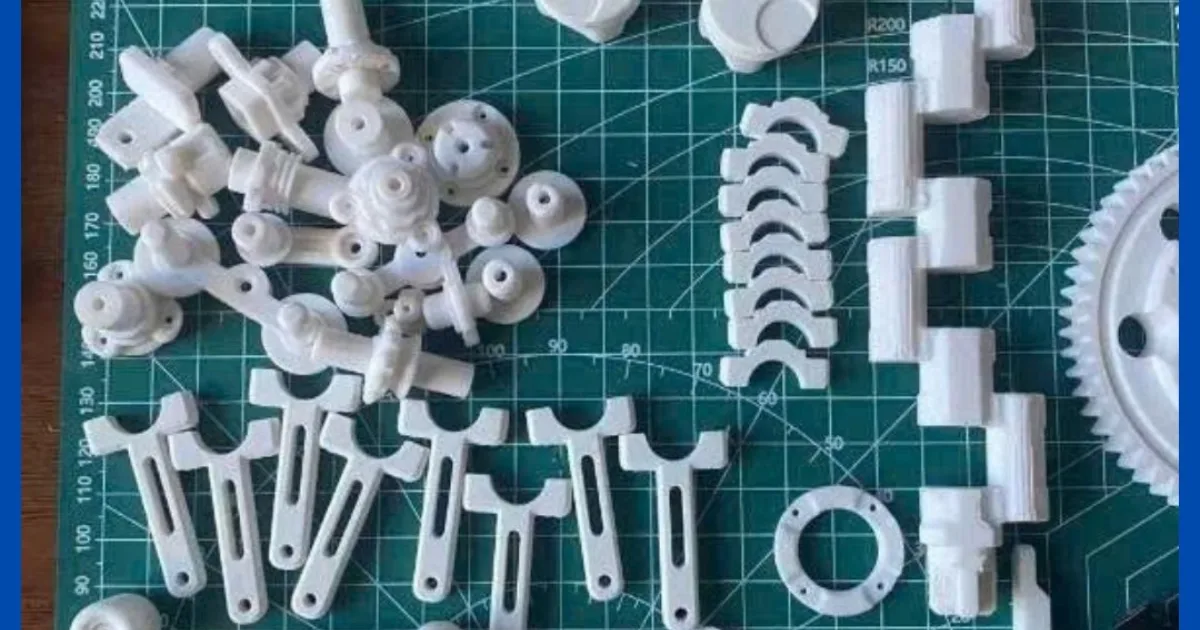
- Low-volume replacement parts: covers, enclosures, brackets and light-duty gears when volumes don’t yet justify an injection mold.
- Display and educational models: student project models, architectural scale models and corporate gifts printed in PLA.
For parts larger than a single build volume, see our large-format 3D printing service, where models are split, printed and assembled.
Capabilities and Specifications
| Specification | CT3D FDM capability | Engineering notes |
|---|---|---|
| Layer height | 100–300 microns | Thinner layers give a smoother surface but increase machine time |
| Dimensional tolerance | ±0.1–0.3 mm | Depends on material, build orientation and part size |
| Infill density | Adjusted to the load case | Low for display models; 30–50% or more for load-bearing parts |
| Accepted file formats | STL, STEP, OBJ, 3MF | STEP preferred when geometry needs editing |
| Indicative pricing | PLA/PETG from 650 VND/g (≈ US$0.025/g); ABS from 1,000 VND/g (≈ US$0.04/g); ASA from 2,000 VND/g (≈ US$0.08/g); carbon-fiber filaments from 2,750 VND/g (≈ US$0.11/g) | Minimum order charge applies below 50 g; project quote above 500 g. Prices are indicative only. |
Source: CT3D technical documentation and 2026 indicative price list.

Materials and Selection Criteria
Rather than picking a plastic out of habit, CT3D selects materials against three criteria: mechanical load, operating environment (heat, UV, humidity, chemicals) and surface requirements. The table below summarizes how our engineers match materials to service conditions.
| Material | Technical strengths | Limitations to consider | Typical applications |
|---|---|---|---|
| PLA | Dimensionally stable, low shrinkage, fast to print | Softens around 55–60°C, brittle under impact | Concept models, display models, scale models |
| PETG | Tough, moisture-resistant, resists many common chemicals | Prone to stringing; glossy surface is harder to paint | Enclosures, parts in contact with water |
| ABS | Better heat resistance than PLA; easy to sand, paint and bond | High shrinkage; warps without an enclosed chamber | Device housings, indoor assembly parts |
| ASA | UV- and weather-resistant | Prints like ABS; chamber temperature must be controlled | Outdoor parts, signage, sensor housings |
| PETG-CF | High stiffness, dimensional stability, matte finish | Abrasive to nozzles; lower toughness than plain PETG | Jigs, fixtures and brackets that must hold their shape |
| PA12 (Nylon) | Wear-resistant, impact-resistant, tough | Hygroscopic; filament must be dried before printing | Light-duty gears, couplings, hinges |
Source: general material properties, compiled from CT3D’s production experience.
One important consideration is anisotropy: the bond between layers is weaker than the bond along each extrusion path. Parts under tensile load should therefore be oriented so that the force acts parallel to the layer plane. If your part needs higher stiffness or temperature resistance, compare the options on our engineering plastics 3D printing page.
Design for FDM (DfAM) – Fewer Defects, Lower Cost
Most of the cost and risk of an FDM order is decided in the CAD file. CT3D reviews every file against the following DfAM (Design for Additive Manufacturing) principles:
- Overhangs: surfaces angled below roughly 45° from horizontal need support structures. Supports add material, machine time and leave marks on the surface.
- Wall thickness: walls that are too thin relative to the nozzle diameter print incompletely or weakly. Our engineers flag thin areas before printing.
- Assembly clearance: for mating parts with a clearance fit, allow a gap based on FDM tolerances instead of modeling a zero-gap fit.
- Small holes and threads: holes along the Z axis tend to print slightly undersize; precision holes can be drilled or reamed after printing. For small threads, use heat-set inserts.
- Infill and perimeters: for parts in bending, adding perimeter walls is usually more effective than increasing infill.
The quick-reference table below lists values that typically work well for FDM. They are general industry guidelines, not CT3D guarantees – the right value depends on the material, nozzle size and part geometry, and our DFM review will confirm it for your file.
| Design feature | Typical recommendation | Why it matters |
|---|---|---|
| Load-bearing walls | Typically at least 2–3 extrusion widths (around 1–1.5 mm or more) | Thin walls print with gaps and break easily |
| Self-supporting overhangs | Typically up to about 45° from vertical | Steeper angles need supports and leave marks |
| Clearance between mating parts | Typically 0.2–0.5 mm per side | Prevents parts fusing or jamming |
| Holes | Model slightly oversize or drill/ream after printing | Vertical holes tend to shrink slightly |
| Embossed or engraved text | Typically 0.6 mm or deeper, with bold fonts | Fine detail is limited by the nozzle diameter |
| Threads | Heat-set inserts or post-tapped holes for small threads | Printed small threads wear quickly |
| Large flat areas | Add ribs or fillets; avoid sharp internal corners | Reduces warping and stress concentration |
Infill and Layer Height – Choosing the Right Settings
Two settings drive most of the trade-off between cost, strength and appearance. Layer height controls how visible the steps on curved surfaces are and how long the print takes: 100 microns gives a finer finish, while 300 microns prints much faster for large, simple shapes. Infill controls the internal structure: display models can use low infill to save material, while load-bearing parts at CT3D typically use 30–50% or more, combined with extra perimeter walls. Because FDM pricing is based on actual part weight, lowering infill where strength is not needed is one of the easiest ways to reduce cost.
Finishing Options for FDM Parts
FDM parts come off the machine with visible layer lines. Depending on how the part will be used, CT3D can deliver it in one of several finish levels. Post-processing such as sanding, primer/filler, painting or plating is quoted separately.
- As printed: supports removed, edges cleaned – the most economical choice for jigs, fixtures and fit checks.
- Sanded: support contact areas and visible faces sanded to reduce layer lines.
- Primer/filler and paint: layer lines filled and sanded, then spray-painted in the color you specify – ABS is the easiest FDM material to sand and paint.
- Metallic effects and plating: for display parts, logos and presentation models; see 3D printing with painting and plating.
Industry Applications of FDM 3D Printing
| Industry | Typical challenge | Recommended FDM setup |
|---|---|---|
| Factories and assembly lines | Locating jigs, inspection gauges, guards | PETG-CF or ABS, high infill, multiple perimeters |
| Electronics product development | Prototype enclosures, PCB layout checks | PLA for early iterations, ABS for parts that will be painted |
| Outdoor equipment | Sensor housings, covers, externally mounted parts | ASA |
| Maintenance engineering | Light-duty gears, bushings, replacement couplings | PA12 (Nylon) |
| Education and architecture | Student project models, scale models, demonstration models | PLA, with fine layers when surface quality matters |
As volumes grow into the hundreds, FDM remains a sensible bridge production solution while injection mold tooling is being made.

FDM vs. SLA vs. MJF vs. Injection Molding
FDM is not always the right answer. The comparison below gives typical characteristics of each process to help you decide; our engineers will suggest an alternative if another process suits your part better.
| Criteria | FDM | SLA resin | MJF/SLS PA12 | Injection molding |
|---|---|---|---|---|
| Tooling cost | None | None | None | High (mold required) |
| Typical tolerance | ±0.1–0.3 mm | ±0.05–0.1 mm | Typically ±0.05–0.15 mm | Typically tightest, depends on the mold |
| Surface finish | Visible layer lines | Smooth, fine detail | Slightly grainy, matte | Defined by the mold |
| Material cost per part | Lowest of the printing processes | Medium | Medium | Very low at high volume |
| Best quantity range | 1 to hundreds | 1 to tens | Tens to hundreds | Thousands and more |
| Best for | Large parts, jigs, budget prototypes | Cosmetic models, small details | Complex functional parts, batches | Mass production |
For SLA, MJF and metal options, see our industrial 3D printing service.
Quality Control
Common FDM defects include corner warping, delamination, stringing and undersized holes. CT3D controls them by:
- Drying hygroscopic filaments (PA12, PETG) before printing to prevent bubbles and porous surfaces.
- Printing ABS and ASA in enclosed chambers to reduce temperature differences between layers.
- Choosing build orientation according to load, balancing strength, surface finish and support volume.
- Measuring functional dimensions with calipers and gauges; for assembly parts, test-fitting directly against mating parts supplied by the customer.
- Performing First Article Inspection (FAI) before running batch orders.
How to Order – From RFQ to Delivery
- Request for quotation (RFQ): send your STL, STEP, OBJ or 3MF files via our website, Zalo or email (or use our Contact form), with a description of the part’s function, quantity and color.
- DFM review: our engineers check for mesh errors, thin walls and overhangs, and recommend build orientation and material.
- Quotation: calculated from actual filament weight in grams, machine time and any post-processing, with a delivery schedule included.
- Production: slicing, printing, support removal and surface finishing as specified.
- Quality control (QC): measurement of key dimensions, visual inspection and fit testing against mating parts where available.
- Delivery: pick-up at our workshop, courier delivery across Vietnam (1–3 days after completion) or air freight; international shipping can be arranged.

Why Choose CT3D for FDM 3D Printing
- Engineering review on every file: a free DFM check of orientation, wall thickness and material comes with every quote.
- Transparent pricing: FDM is priced by actual part weight and material, so you can see how design choices affect cost.
- Material advice, not habit: PLA, PETG, ABS, ASA, PETG-CF and PA12 selected against load, environment and surface needs.
- From idea to part: no 3D file? We can model from 2D drawings, photos or 3D scan data before printing.
- Batch consistency: First Article Inspection before batch orders.
- Confidential and international: NDA on request, English-speaking engineers, delivery across Vietnam and international shipping on request.
Frequently Asked Questions
Why is FDM cheaper than resin or powder 3D printing?
FDM filament is inexpensive, the machines are simple to run, and there is no washing or UV curing as with resin. The trade-off is more visible layer lines and wider tolerances (±0.1–0.3 mm vs. ±0.05–0.1 mm for SLA).
Can FDM parts be used as load-bearing components?
Yes, provided the right material is chosen (ABS, PETG-CF, PA12), the number of perimeters is increased, infill is set appropriately and the part is oriented so that loads do not pull the layers apart.
How does CT3D price FDM 3D printing?
Pricing is based on actual weight and material: PLA and PETG from 650 VND/g (≈ US$0.025/g); ABS from 1,000 VND/g (≈ US$0.04/g); ASA from 2,000 VND/g (≈ US$0.08/g); carbon-fiber filaments from 2,750 VND/g (≈ US$0.11/g). Orders under 50 g are subject to a minimum charge; post-processing, rush orders and 3D modeling are charged separately. All prices are indicative.
Will layer lines show, and can they be smoothed?
Yes, FDM parts show layer lines, more so at 300 microns than at 100 microns. They can be reduced by sanding, or removed with primer/filler, wet sanding and paint. These finishing steps are quoted separately. If a very smooth cosmetic surface matters most, SLA resin is usually the better starting point.
Which filament is best for outdoor parts?
ASA is the usual choice for outdoor parts because it is UV- and weather-resistant. It prints like ABS, so CT3D prints it in an enclosed chamber with controlled temperature to limit warping.
How does infill affect strength and cost?
Higher infill makes a part heavier, stiffer and more expensive, because FDM is priced by weight. Display models can use low infill, while load-bearing parts typically use 30–50% or more. For parts in bending, adding perimeter walls is usually more effective than raising infill.
What if I only have a 2D drawing or photos?
CT3D can build a 3D model from drawings, photos or 3D scan data before printing. Modeling is quoted separately based on complexity.
Which files do you accept, and is my design kept confidential?
We accept STL, STEP, OBJ and 3MF; STEP is preferred when geometry needs editing. We treat your files as confidential and sign an NDA on request.
How long does delivery take?
The production lead time depends on part size, quantity and finishing, and is stated in your quotation. After completion, courier delivery within Vietnam typically takes 1–3 days; air freight and international shipping can be arranged.
Factory Video from the CT3D Workshop
Watch Liquid resin 3D printing for large-format rapid prototyping, produced in-house by CT3D, to see our process and part quality. More videos are available on our Chế Tạo Vlog – CT3D YouTube channel.
Contact CT3D – Send Your Files for a Fast Quote
Whether you have a 3D file, a 2D drawing, photos or just an idea, send it to CT3D. Our engineers will review your files, advise on technology and materials, and send a quotation with a delivery schedule.
- Email: [email protected] – [email protected]
- Phone / Zalo: +84 975 008 728 (Mr. Thai) – +84 985 936 728 (Mr. Dang) – or use our Contact form
- Head office: Binh Duong, Vietnam.
- Workshops: Ho Chi Minh City, Vietnam.
- Other workshops and drop-off points: Can Tho, Da Nang, Bien Hoa, Ba Ria – Vung Tau, Hanoi, Hai Duong and Hai Phong. Nationwide delivery across Vietnam, with international shipping available.
- Website: ct3dgroup.com – in3d.edu.vn
CT3D – 3D design & prototyping: 3D printing, 3D scanning, reverse engineering, silicone mold making, finishing and painting, CNC machining, composite fabrication, and supply of 3D printers and 3D printing materials.
Ready to Print Your Part?
Send your STL, STEP, OBJ or 3MF file with the quantity and material you have in mind. CT3D engineers will review it, suggest improvements and reply quickly with a quote and delivery schedule.