
Giới thiệu
Technical summary: CT3D’s mold making division (brand name CT-Mold) supplies tooling for the stage between design and mass production: rapid tooling, bridge tooling and molds for low-volume production. Our five solution groups are 3D-printed molds, RTV silicone molds, PU vacuum casting, FRP composite molds and CNC-machined wooden molds. Master patterns are produced by 3D printing, CNC milling or 3D scanning, cutting lead time and cost compared with conventional steel tooling when volumes do not yet justify it.
Mold Making and Rapid Tooling in Vietnam
Between a finished design and mass production there is usually a gap: you need parts that look and behave like the final product, but the quantity is too small – or the design still too uncertain – to justify a steel injection mold. CT3D’s mold making services cover that gap with tooling that is faster and cheaper to build and easy to change.
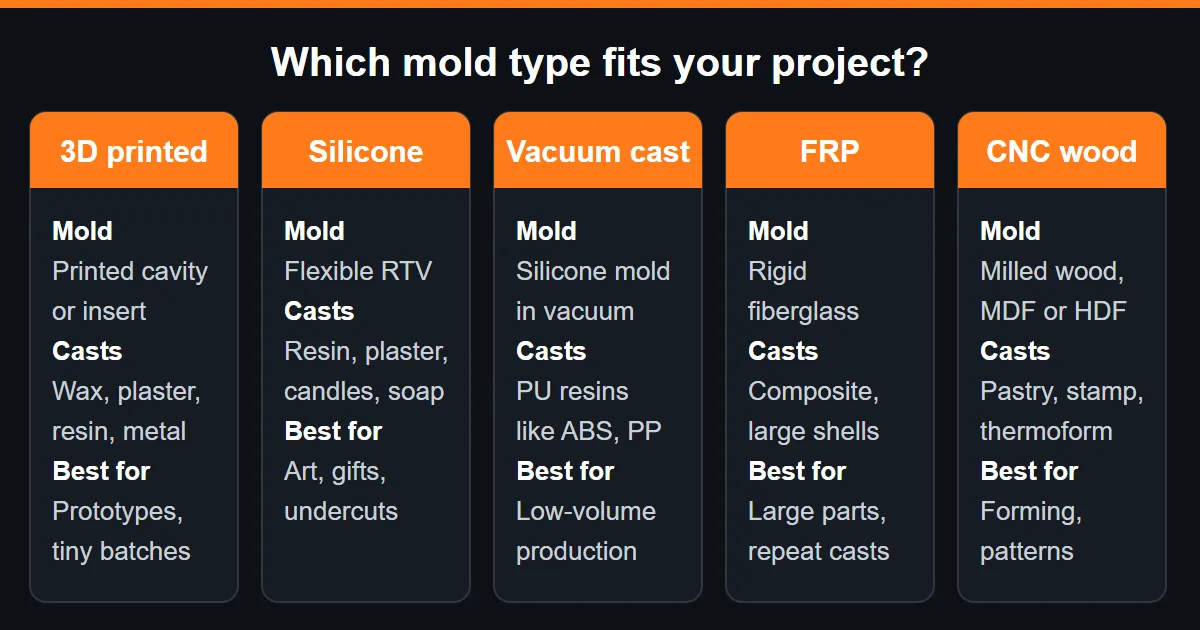
All five of our mold types start from the same place: an accurate master pattern or a printed tool, produced in-house by 3D printing, CNC milling or 3D scanning. From there, the right route depends on three questions – how many parts you need, how large they are, and which material you will cast. Small, detailed art pieces usually go into flexible silicone; plastic housings that must look injection-molded are vacuum cast in PU; large shells and statues call for rigid FRP composite molds; forming and pastry molds are milled in wood; and fast trials or steel inserts are 3D printed directly.
If you are not sure which route fits, send us your file or a photo of the part with the expected quantity. Our engineers review it free of charge with the quote, recommend a mold type and explain the trade-offs in plain English.

How to Choose the Right Mold Type
| Service | Quantity range | Part size | Undercuts | Typical cast materials |
|---|---|---|---|---|
| 3D printed molds | Trials, very small batches | Small to large (resin prints up to 800×800×500 mm) | Limited (rigid mold) | Wax, plaster, cement, resin; SLM inserts for injection trials |
| RTV silicone molds | Small batches | Small to medium | Very good (flexible) | Resin, polyresin, plaster, candles, soap, food |
| Vacuum casting | Low-volume production, e.g. 20–100 housings | Small to medium | Good (silicone mold) | PU resins simulating ABS, PP, rubber, clear plastics |
| FRP composite molds | Repeated casting | Large parts, statues, shells | Needs draft angles | Composite, large shells |
| CNC wooden molds | Forming and pattern work | Small to large | Needs draft angles | Pastry, stamping, vacuum forming, casting patterns |
Guidance only – our engineers confirm the best route after reviewing your file.
Why Use Rapid Tooling Before Investing in Steel Molds?
Steel injection molds deliver high volumes but take a long time to build and are hard to modify while the design is still changing. During product development, companies typically need a few dozen to a few hundred parts to test the market, trial an assembly line or supply samples to customers. Rapid tooling fills this gap: lower cost, shorter lead time, and the freedom to modify the master pattern and remake the mold without re-machining a full set of metal tooling.
In fine art, decor and gifts, soft molds and composite molds are often the main production method, because volumes per design are modest and the shapes have many undercuts. The differences between CNC machining and 3D printing in production are covered in our article comparing CNC and 3D printing.
Five Mold Making Solutions (Scope of Work)
| Solution | Master pattern / production method | Part material | Best suited for |
|---|---|---|---|
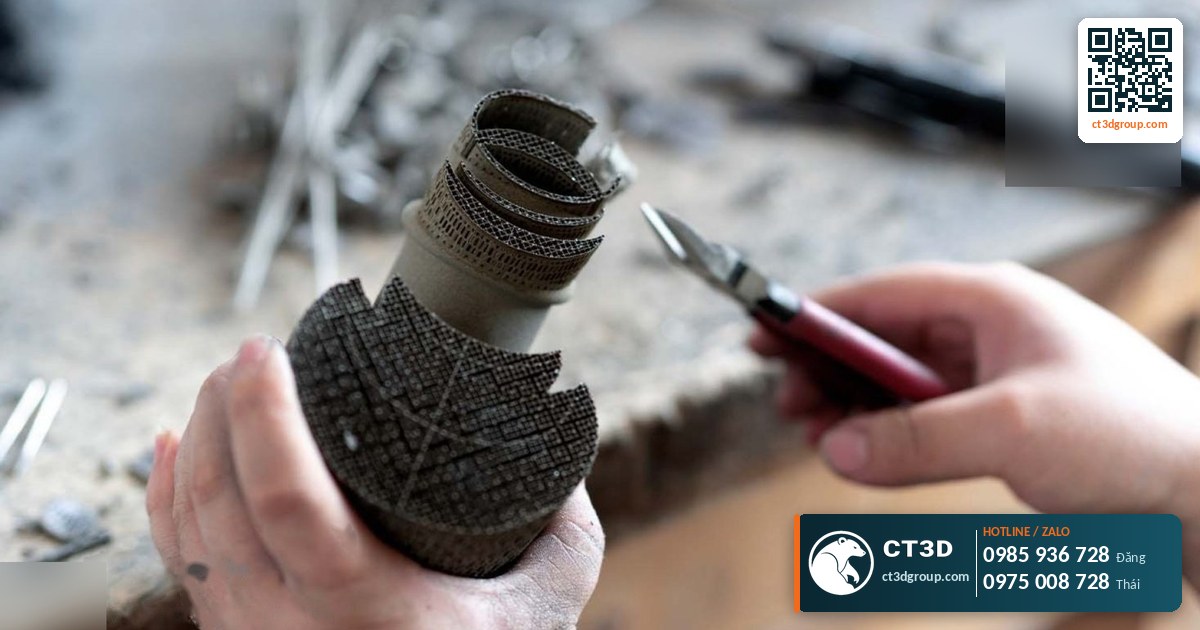
| 3D-printed molds | Directly printed mold cavity, master pattern or SLM metal insert | Depending on type: wax, plaster, plastic, cast metal | Prototypes, very small batches |
| RTV silicone molds | 3D-printed resin master or hand-sculpted master | Resin, polyresin, plaster, candles, soap, food | Fine art, gifts, handmade products |
| Vacuum casting | 3D-printed master, silicone mold, pouring in a vacuum chamber | PU resins simulating ABS, PP, rubber, clear plastics | Low-volume production |
| FRP composite molds | CNC-milled foam/wood plug, gel coat, fiberglass lay-up | Composite, statues, large shells | Large parts, repeated casting |
| CNC wooden molds | CNC-milled wood, MDF/HDF | Cake/pastry molds, stamping dies, plugs, vacuum forming molds | Forming molds, casting patterns |
Source: CT3D service catalog. The final choice depends on the specific geometry, material and quantity.
Materials & Technical Standards
The Master Pattern Determines Mold Quality
Every mold reproduces the surface of its master pattern. CT3D produces masters by SLA/DLP resin 3D printing at 25–100 micron layer heights when fine detail is needed, by FDM for large parts with lower surface requirements, or by CNC milling of EPS/XPS foam or wood for large plugs. The master is then sanded, primed (primer/filler) and polished to remove layer lines.
Key Design Parameters
- Draft angle: mandatory for rigid molds such as composite and wood; silicone molds tolerate undercuts thanks to their elasticity.
- Parting line: placed in areas with minimal cosmetic impact where flash is easy to remove.
- Shrinkage: of both the mold material and the casting material must be compensated in the master dimensions when the part has to fit an assembly.
- Mold release: chosen to be compatible with the mold material / casting material pair.
- Silicone hardness (Shore A): a balance between ease of demolding and holding the profile.
Workflow
- RFQ: send your 3D file (STEP, STL, OBJ, IGES), drawing, photos or physical sample, together with the casting material and expected quantity – online, via Zalo, email or our contact form.
- DFM review: our engineers recommend the mold type, parting line, gate and vent locations; if there is no file yet, we model it in 3D or 3D scan the physical sample.
- Quotation: itemized into 3D modeling, master production, mold making, trial casting and part finishing (if required).
- Manufacturing: master production, surface finishing, mold making.
- QC and trial casting: checking dimensions, surface quality and demolding; adjustments where needed.
- Handover: molds or cast parts are delivered from our workshop or shipped across Vietnam, typically 1–3 days after completion; international shipping can be arranged.
For the silicone workflow, see our article on silicone mold making and resin/composite casting.


Mold Selection Matrix by Requirement
| Scenario | Recommended solution |
|---|---|
| 20–100 plastic housings that look like injection-molded parts for market testing | PU vacuum casting |
| Replicating small statues and gifts with intricate patterns | RTV silicone mold |
| Large statues, mascots and machine housings | FRP composite mold from a CNC-milled plug |
| Pastry molds, pattern stamping dies, vacuum forming molds | CNC wooden mold |
| Fast shape testing, wax casting, inserts with conformal cooling channels | 3D-printed mold, SLM metal insert |
Industry Applications
- Product development: device housings and low-volume plastic parts before committing to steel tooling.
- Fine art and religious art: replicating statues in polyresin and composite; see our article on custom 3D printed models.
- Advertising and events: mascots, symbols and commemorative trophies.
- Crafts and food: candles, soap and chocolate using food-grade silicone.
- Injection molding industry: mold inserts with conformal cooling channels – see our article on metal 3D printing (SLM).
Quality Control
- Inspecting the master under raking light before mold making.
- Weighing silicone, resin and gel coat mix ratios on electronic scales.
- Vacuum degassing materials to remove air bubbles.
- Casting a First Article for customer approval before batch production.
- Recording mold parameters so repeat orders can be reproduced.
Frequently Asked Questions (FAQ)
When should I use vacuum casting instead of direct 3D printing?
When you need multiple identical parts with surface quality and mechanical properties close to injection-molded plastic. Direct 3D printing suits a handful of parts or geometries that cannot be cast.
How do you make a mold without a 3D file?
CT3D builds the file from drawings, photos or a 3D scan of a physical sample, then produces the master and makes the mold.
How does a composite mold differ from a silicone mold?
Composite molds are rigid and durable, suitable for large parts, but require draft angles. Silicone molds are flexible, capture deep details and undercuts, and suit small to medium-sized parts.
How is mold making priced?
Quotes are based on your file and quantity, covering the master, the mold and trial casting. Our engineers send a quotation with lead time after reviewing the file.
Which mold type should I choose for my project?
It depends on quantity, part size and casting material. Silicone suits detailed small to medium parts, vacuum casting suits plastic housings in low volumes, FRP suits large parts, CNC wood suits forming molds and 3D printed molds suit fast trials. Send your file and our engineers will recommend one.
Can you make the master pattern for me?
Yes. CT3D produces masters by SLA/DLP resin printing at 25–100 micron layers for fine detail, by FDM for large parts, or by CNC milling foam or wood for large plugs. The master is then sanded, primed and polished before the mold is made.
Shop-Floor Video from CT3D
Watch the video High-Tech 3D-Printed Molds from CT3D to get a clearer picture of our process and output quality. More videos are available on our YouTube channel Chế Tạo Vlog – CT3D (in Vietnamese).
Contact CT3D – Send Your File for a Fast Quote
Whether you have a 3D model, a 2D drawing, photos or just an idea, you can send it to CT3D online (STL, STEP, IGES, OBJ and more). Our engineers will review the file, advise on process and materials, and send a quotation with lead time.
- Email: [email protected] – [email protected]
- Hotline / Zalo: +84 975 008 728 (Mr. Thai) – +84 985 936 728 (Mr. Dang) – or use our contact form
- Head office: Binh Duong, Vietnam.
- Workshops: Ho Chi Minh City, Vietnam.
- Other workshops and drop-off points: Can Tho, Da Nang, Bien Hoa, Ba Ria – Vung Tau, Hanoi, Hai Duong and Hai Phong. Nationwide delivery across Vietnam; international shipping on request.
- Website: ct3dgroup.com – in3d.edu.vn
CT3D – 3D design & prototyping: 3D printing, 3D scanning, reverse engineering, silicone mold making, painting and finishing, CNC machining, composite fabrication, and supply of 3D printers and 3D printing resins.
Not Sure Which Mold You Need?
Send your 3D file, drawing or photos with the casting material and quantity. We reply quickly with a recommended mold type and a quote.