
Vacuum Casting Vietnam – Silicone Molds, Low-Volume PU
Technical summary: Vacuum casting (casting in silicone molds under vacuum) is a low-volume production method in which an RTV silicone mold replicates a master pattern, then two-part PU resin is poured inside a vacuum chamber to eliminate air bubbles. CT3D offers a complete vacuum casting service in Vietnam: 3D printing or CNC machining of the master pattern, mold making, casting, post-processing and dimensional inspection. It is the right choice when you need from a few dozen to a few hundred parts with near injection-molded appearance, without investing in steel tooling yet.
Our vacuum casting service is built for engineers and product teams who need real-looking, functional plastic parts in small batches: pilot runs, certification samples, trade-show sets or spare parts. Below you will find how the process works, what the parts can and cannot do, design rules that keep the mold alive longer, a comparison with 3D printing and injection molding, and what to send us for a fast quote.

Key Facts at a Glance
| Parameter | CT3D vacuum casting |
|---|---|
| Typical batch size | Around 10–300 parts per design |
| Master pattern | SLA 3D printing at 25–100 micron layers, tolerance ±0.05–0.1 mm; or 3/4/5-axis CNC milling |
| Mold life | Approximately 15–20 casts per silicone mold; more molds are made from the same master for larger runs |
| Casting resins | Two-part PU simulating ABS, PP, PC and rubber; hardness from soft Shore A to rigid Shore D; clear grades |
| Color and finish | Color-through, clear, gloss, matte or textured; painting and screen printing after casting |
| Special features | Insert molding of nuts and metal parts; overmolding of soft layers (after DFM approval) |
| Files accepted | STEP, STL, OBJ, 3MF – or a 2D drawing or physical sample for reverse engineering |
| Delivery | Nationwide transit within Vietnam takes 1–3 days after completion; international shipping available |
When Should You Choose Vacuum Casting Instead of Injection Molding?
Every product development cycle has a gap between one-off prototypes (rapid prototyping) and mass production with injection molds. Steel tooling is expensive, takes a long time to build and is very difficult to modify while the design is still changing. On the other hand, printing parts one by one makes it hard to achieve consistent surface finish and color as quantities grow. Vacuum casting fills exactly that gap, acting as bridge tooling.
Three signs that your project is a good fit for this method:
- You need around 10–300 parts per design, for example a sample batch for customers, a pilot run for market testing, or a set of parts for certification.
- The design is not yet frozen: each revision only requires a new master pattern and silicone mold, at far lower cost than modifying a steel mold.
- Appearance requirements are high: smooth surfaces, color-through casting, clear parts or soft, rubber-like parts.
For a deeper look at the mold-making technique, see our silicone molds page.
How Vacuum Casting Works
- Master pattern: the part is SLA printed or CNC machined, then sanded and primed to the gloss or texture the final parts should have.
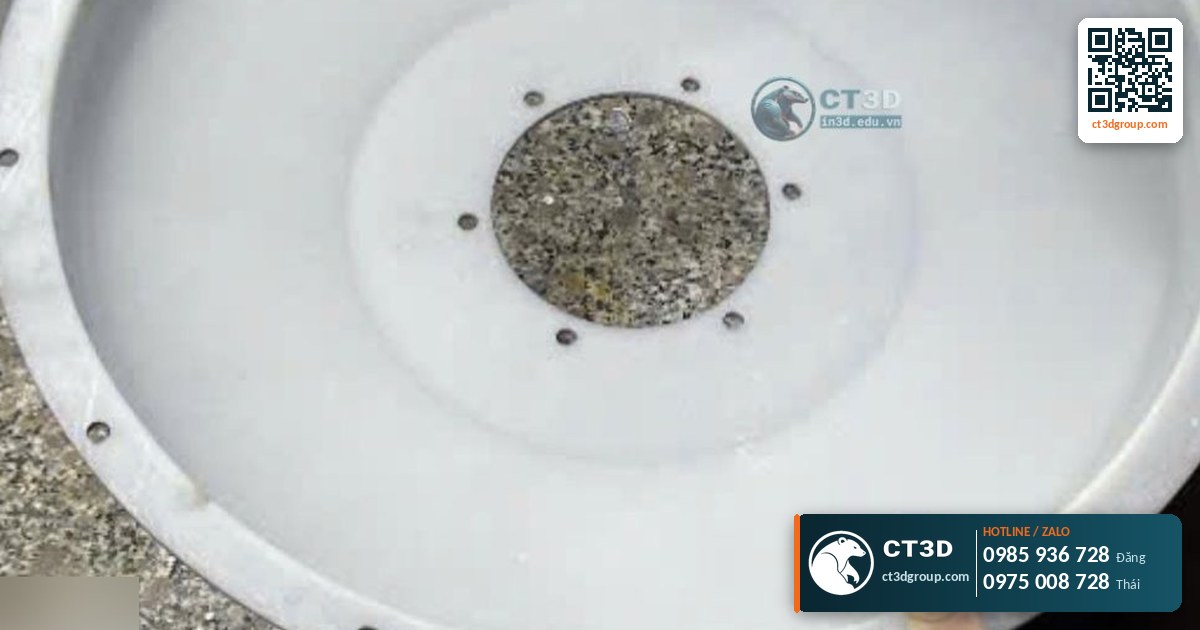
- Silicone mold: the master is suspended in a mold box with its sprue and vents, and RTV silicone is poured around it and left to cure.
- Cutting the mold: the cured silicone is cut along the planned parting line and the master is removed, leaving an exact cavity.
- Vacuum pouring: the two-part PU resin is mixed, degassed and poured into the closed mold inside the vacuum chamber, so air cannot be trapped in the part.
- Curing and demolding: the part cures under a controlled schedule, then the flexible mold is opened and the part released. The mold is reused for the next cast.
- Finishing and inspection: gates and flash are trimmed, parts are painted or printed if required, and the first article is measured.
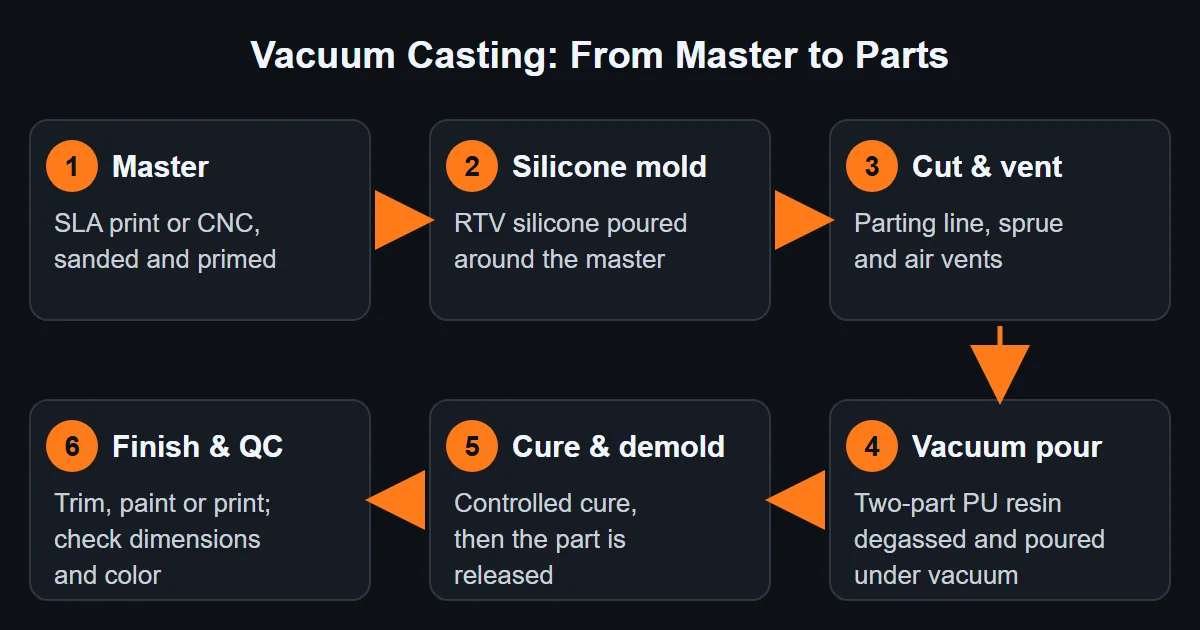

Vacuum Casting Scope of Work and Technical Specifications
CT3D takes on complete turnkey projects or individual process steps, depending on what you supply. The table below summarizes the work items and reference specifications we typically use when planning a project.
| Item | Technical details | Notes |
|---|---|---|
| Master pattern | SLA 3D printing at 25–100 micron layers, tolerance ±0.05–0.1 mm; or 3/4/5-axis CNC milling | The master is sanded and primed to the required gloss before mold making |
| RTV silicone mold | Two-piece or multi-piece mold with parting line, sprue and air vents | Mold life depends on geometry and resin type; at CT3D, vacuum casting silicone molds achieve approximately 15–20 casts |
| Casting resin | Two-part PU simulating ABS, PP, PC and rubber; hardness from soft Shore A to rigid Shore D | Selected according to mechanical and cosmetic requirements |
| Color and finish | Color-through pigmentation, clear casting, gloss, matte or textured surfaces replicated from the master | Painting and screen printing available after casting |
| Special features | Insert molding of nuts and metal parts; overmolding of soft layers | DFM approval required first |
| Lead time | Based on number of mold sections, quantity and post-processing | Quoted per file |
Source: CT3D SLA specification sheet; mold life is a general reference value for the silicone casting industry.
Casting Materials and Selection Criteria
The greatest advantage of vacuum casting is the very wide range of polyurethane resins. Rather than asking “which plastic should we use?”, CT3D engineers first ask what conditions the part must withstand, then select the matching resin system.
Rigid Resins Simulating Engineering Plastics
ABS-like PU suits enclosures, box lids and assembly parts that need rigidity. PP-like PU offers better toughness and flexibility, and is used for living hinges and snap-fit features. PC-like PU is typically chosen when clarity and moderate impact strength are needed. Important: these are simulation materials, so their mechanical properties approach – but do not fully replace – the original thermoplastics.
Elastomers
Elastomeric PU resins are classified on the Shore A hardness scale. Low values feel soft, like gaskets or push buttons; high values are closer to caster wheels or anti-slip feet. When designing soft parts, specify the target hardness on your drawing to avoid multiple rounds of trial casting.
Clear and Functional Resins
Clear resins are used for light covers, light pipes and viewing windows. The master pattern surface determines almost all of the part’s transparency, so the master must be polished very carefully. Flame-retardant resins, higher-heat resins and metal-powder-filled resins (for a heavier feel) are also available; their feasibility is checked project by project. For other clear-part options, see clear and transparent parts.
| Application requirement | Suggested resin system | Key considerations |
|---|---|---|
| Machine housings, box lids, assembly frames | ABS-like PU | Uniform wall thickness, avoid localized thick sections |
| Hinges, snap-fit parts | PP-like PU | Test the number of flex cycles on a prototype |
| Gaskets, buttons, soft grips | Shore A elastomeric PU | Specify the target hardness |
| Light covers, viewing windows | Clear PU | Master pattern needs a mirror polish |
This table is for guidance only; the specific resin system is confirmed during DFM review.

Design Guidelines for Vacuum Cast Parts
Vacuum casting is forgiving compared with injection molding, but a few design choices strongly affect part quality and how many good casts each mold delivers. The values below are general industry guidance, not fixed CT3D limits; we confirm them for your part during the DFM review.
| Feature | Typical recommendation | Reason |
|---|---|---|
| Wall thickness | Keep walls as uniform as possible; typically a few millimetres for rigid PU | Thin areas fill poorly; thick lumps shrink and warp |
| Draft | A small draft helps, although flexible silicone tolerates near-vertical walls | Easier demolding and longer mold life |
| Undercuts | Shallow undercuts release from the flexible mold; deep ones need extra mold pieces | Tearing the silicone shortens mold life |
| Ribs and bosses | Thinner than the main wall, with fillets at the base | Avoids sink marks and air traps |
| Inserts | Design pockets that hold nuts or metal parts in position during the pour | Inserts must not move when resin flows in |
| Text and logos | Raised or engraved detail with enough depth to read after painting | Very shallow detail disappears under primer |
| Dimensional tolerance | Typically a few tenths of a millimetre per 100 mm, depending on geometry and resin shrinkage | Specify critical dimensions on the drawing so they can be checked |
Finishing Options
| Finish | How it is achieved | Best for |
|---|---|---|
| Color-through | Pigment mixed into the resin before casting | Housings and parts that may be scratched in use |
| Gloss, matte or texture | Replicated from the master surface into the silicone mold | Cosmetic samples that must look like production parts |
| Clear | Clear PU cast in a mold taken from a mirror-polished master | Lenses, light covers, viewing windows |
| Painting | Primer and paint after casting, color matched on request | Exact brand colors, metallic effects |
| Screen printing and plating | Applied after casting and painting | Logos, markings, decorative metallic parts |
The general post-processing options are described on our painting and plating page.
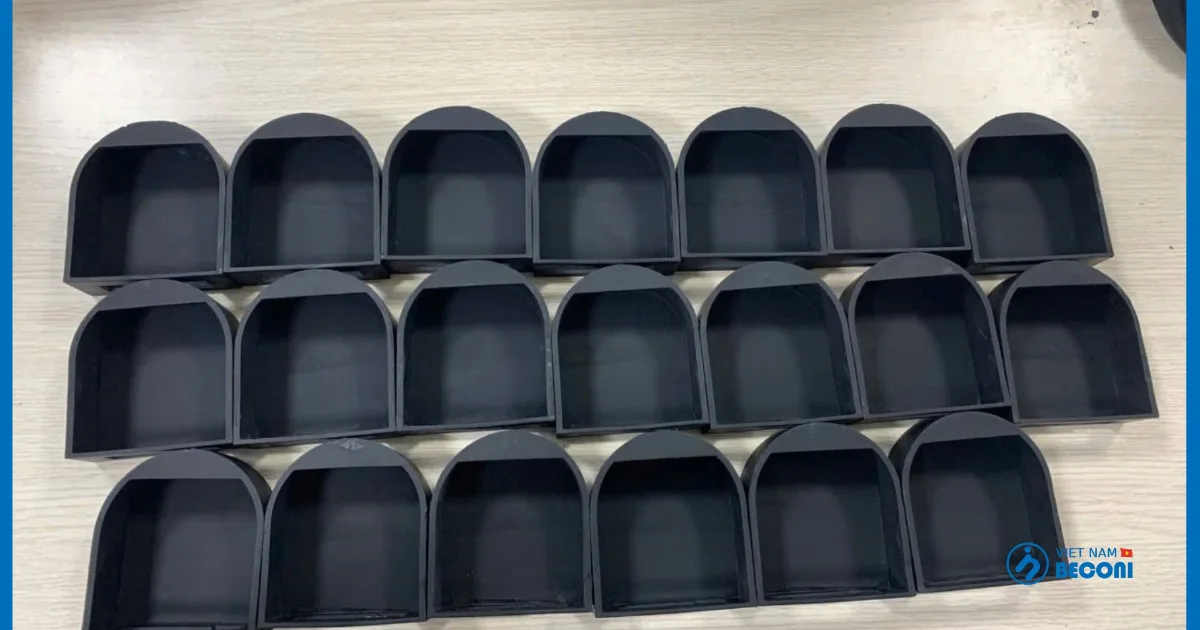
Industry Applications
- Consumer electronics and IoT devices: enclosures for field-test batches, certification samples and trade show display sets.
- Home appliances: knobs, lids and soft-touch handles for ergonomic evaluation with real users.
- Automotive and motorcycles: interior parts, trim and prototype gaskets for assembly checks before production tooling.
- Lighting: lamp shades, lenses and clear-cast light pipes.
- Gifts, crafts and models: replication of small statues, mascots and decorative parts in moderate quantities.
Vacuum Casting vs. 3D Printing vs. Injection Molding
| Criteria | 3D printing | Vacuum casting | Injection molding |
|---|---|---|---|
| Typical quantity | 1 to a few dozen | Around 10–300 per design | Typically thousands and more |
| Tooling | None | Master pattern + silicone molds | Steel or aluminum mold |
| Upfront cost | Lowest | Low | High |
| Design changes | Just edit the file | New master and mold | Costly tool modification |
| Surface and color | Varies by technology; finishing per part | Near-molded; color-through, clear or textured | Production finish |
| Materials | Printing resins and powders | PU simulating ABS, PP, PC, rubber | Real thermoplastics |
| Unit price | Flat regardless of quantity | Falls as the mold cost is shared | Lowest at high volume |
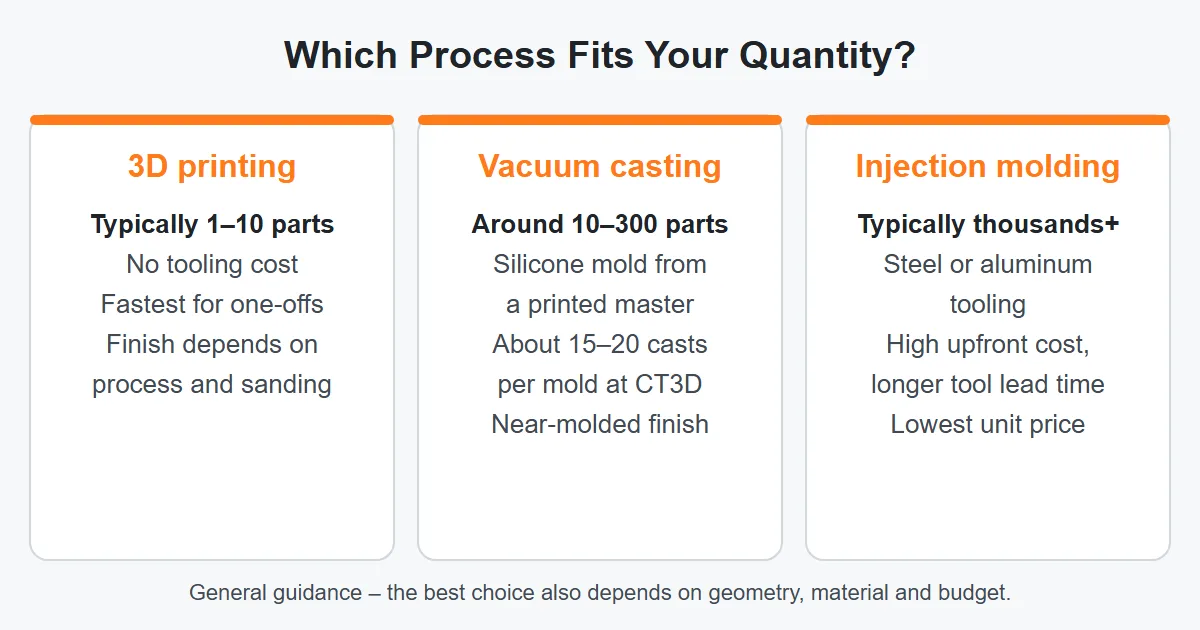
If you only need a handful of parts, see industrial 3D printing; if a printed or machined mold is closer to your need, see 3D printed molds and rapid tooling.
Quality Control of Cast Parts
The three typical defect groups in vacuum casting are air bubbles, shrinkage and deviations caused by mold distortion. CT3D controls them at the root cause:
| Defect | Common cause | Countermeasure |
|---|---|---|
| Surface or internal bubbles | Insufficient degassing, poorly placed vents | Control the vacuum cycle, add air vents |
| Short shot | Walls too thin, gate far from the area to be filled | Reposition the gate, increase local wall thickness |
| Warpage, shrinkage | Uneven wall thickness, unstable curing temperature | Propose thickness changes during DFM, stabilize the curing schedule |
| Flash at the parting line | Mold wear after many casts | Track casting count, replace molds on time |
For tight dimensional requirements, CT3D can 3D scan cast parts and generate a deviation color map against the original CAD file. This provides objective confirmation that the batch is within the agreed tolerance, rather than measuring only a few points with calipers. See 3D scanning inspection.

How to Order: From RFQ to Delivery
- Request for quotation (RFQ): send your STEP, STL, OBJ or 3MF files via our website, Zalo, email or Contact form, along with quantity, color and preferred material.
- DFM review: our engineers check draft angles, undercuts, wall thickness, parting line and gate locations. Where needed, CT3D suggests minor geometry changes to extend mold life and reduce part defects.
- Quotation with schedule: costs are split into three parts – master pattern, mold and per-part casting price – so you can calculate your break-even point.
- Production: printing or CNC machining of the master, surface finishing, silicone pouring, mold cutting, resin pouring in the vacuum chamber and curing.
- Quality control (QC): first article inspection (FAI), measurement of critical dimensions, color and surface comparison.
- Delivery: pickup at our workshop or shipment by domestic courier, post or air freight; nationwide transit within Vietnam takes 1–3 days after completion, and international shipping is available.
Why Work with CT3D
- Master and mold in-house: SLA printing at 25–100 micron layers or CNC machining, followed by silicone molding and casting in the same company.
- Transparent pricing: master, mold and per-part prices quoted separately so you can compare options.
- Free DFM review with every quote, including suggestions that extend mold life.
- Reverse engineering available: no CAD file? We can work from a drawing or 3D scan a physical sample.
- Scan-based inspection with deviation color maps when tolerances matter.
- NDA on request, engineering support in English and international shipping.
Frequently Asked Questions (FAQ)
How many parts can one silicone mold produce?
It depends on geometry, material and undercut depth. At CT3D, each vacuum casting silicone mold achieves approximately 15–20 casts; for larger quantities, CT3D makes additional molds from the same master pattern.
Can PU cast parts replace injection-molded parts?
In appearance, they come very close. Mechanically, PU only simulates thermoplastics, so testing on the actual product is needed if the part is subject to load, heat or chemical exposure.
What if I only have a 2D drawing or a physical sample?
CT3D can build the 3D file from your drawing or 3D scan the physical sample for reverse engineering, then produce the master pattern and mold.
How is vacuum casting priced?
The price consists of the master pattern cost, the mold cost and a per-part casting price. Because it depends on size, quantity and material, CT3D quotes based on your file.
What quantities is vacuum casting best for?
Around 10–300 parts per design is the typical range – for example sample batches, pilot runs or certification sets. For a few parts, 3D printing is usually cheaper; for thousands, injection molding becomes more economical.
Can you cast clear or soft rubber-like parts?
Yes. Clear PU is used for light covers and windows, with the master polished to a mirror finish, and elastomeric PU covers soft Shore A hardness ranges for gaskets, buttons and grips.
Can metal inserts or a second soft layer be added?
Yes. Nuts and metal parts can be cast in place, and soft layers can be overmolded, after the design has been approved in the DFM review.
Which file formats should I send?
STEP, STL, OBJ or 3MF files, together with the quantity, color and preferred material. Mark critical dimensions and the target hardness on a drawing if they matter.
Videos from the CT3D Workshop
Watch the video High-Tech 3D Printed Molds produced by CT3D to get a clearer picture of our process and product quality. More videos are available on our YouTube channel Chế Tạo Vlog – CT3D.
Contact CT3D – Send Your Files for a Fast Quote
Whether you have a 3D file, a 2D drawing, photos or just an idea, you can send it to CT3D online (STL, STEP, IGES, OBJ). Our engineers will review your files, advise on process and materials, and send you a quotation with a delivery schedule.
- Email: [email protected] – [email protected]
- Phone / Zalo: +84 975 008 728 (Mr. Thai) – +84 985 936 728 (Mr. Dang) – or use our Contact form
- Head office: Binh Duong, Vietnam.
- Workshops: Ho Chi Minh City, Vietnam.
- Other workshops and drop-off points: Can Tho, Da Nang, Bien Hoa, Ba Ria – Vung Tau, Hanoi, Hai Duong, Hai Phong. Delivery throughout Vietnam and international shipping.
- Website: ct3dgroup.com – in3d.edu.vn
CT3D – 3D design & prototyping: 3D printing, 3D scanning, reverse engineering, silicone mold making, painting and finishing, CNC machining, composite fabrication, and supply of 3D printers and 3D printing resins.
Ready to Start Your Vacuum Casting Project?
Send your STEP, STL, OBJ or 3MF file with the quantity, color and material you need. We review manufacturability free of charge and reply quickly with a quotation split into master, mold and per-part costs.