
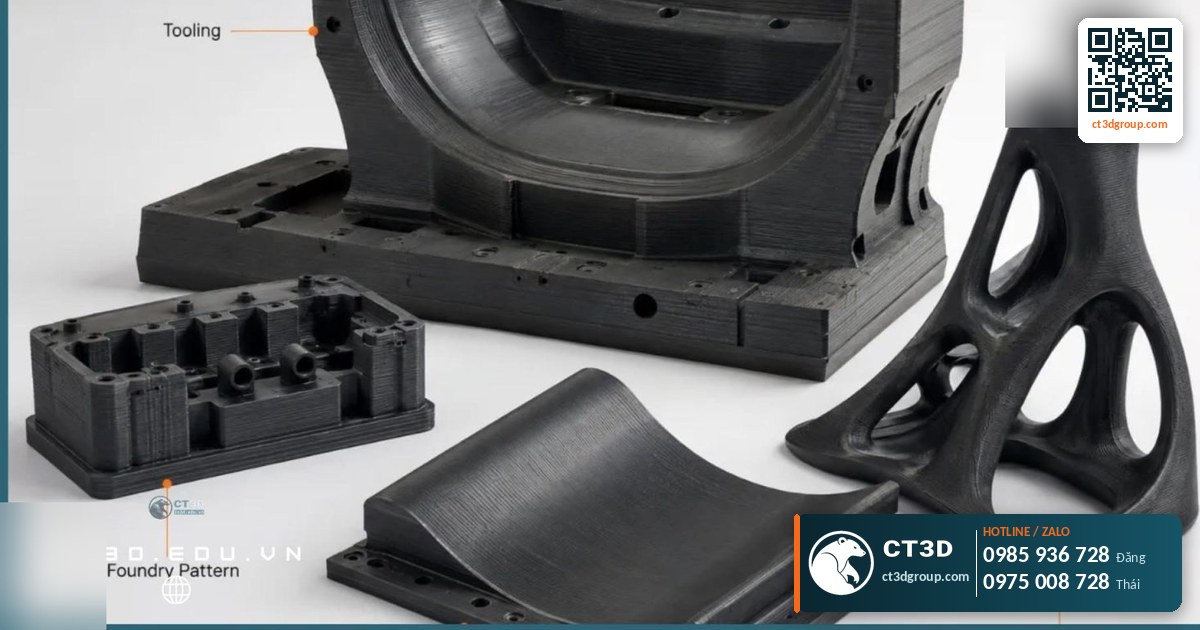
Quick answer: 3D printing time for a 10 cm FDM part typically ranges from a few hours to more than a day, depending on layer height (100–300 microns), infill, speed and the amount of support. For LCD/DLP resin, time depends mainly on part height, not on how many parts are on the build plate. Based on Ho Chi Minh City market rates in 2026, machine depreciation runs about 30,000–150,000 VND/hour (≈ US$1.2–5.8). Orders with a ready file usually ship in 1–3 days, those needing 3D modeling in 3–7 days, and painted parts in 7–14 days.
When they receive a quote, many customers ask: “It’s just one small part – why wait two days?” or “Why does a finer print cost twice as much?” The answer is machine time. Price per gram is an easy way to present a quote, but underneath it is a time calculation. This article explains that mechanism with formulas and examples so you can estimate and optimize on your own. For the full price list, see our 3D printing price guide.
What Determines 3D Printing Time?
Every 3D printing technology has its own “bottleneck” – the factor that limits speed. Once you understand the bottleneck, you know what to change to print faster.
FDM: limited by how much plastic is extruded per second
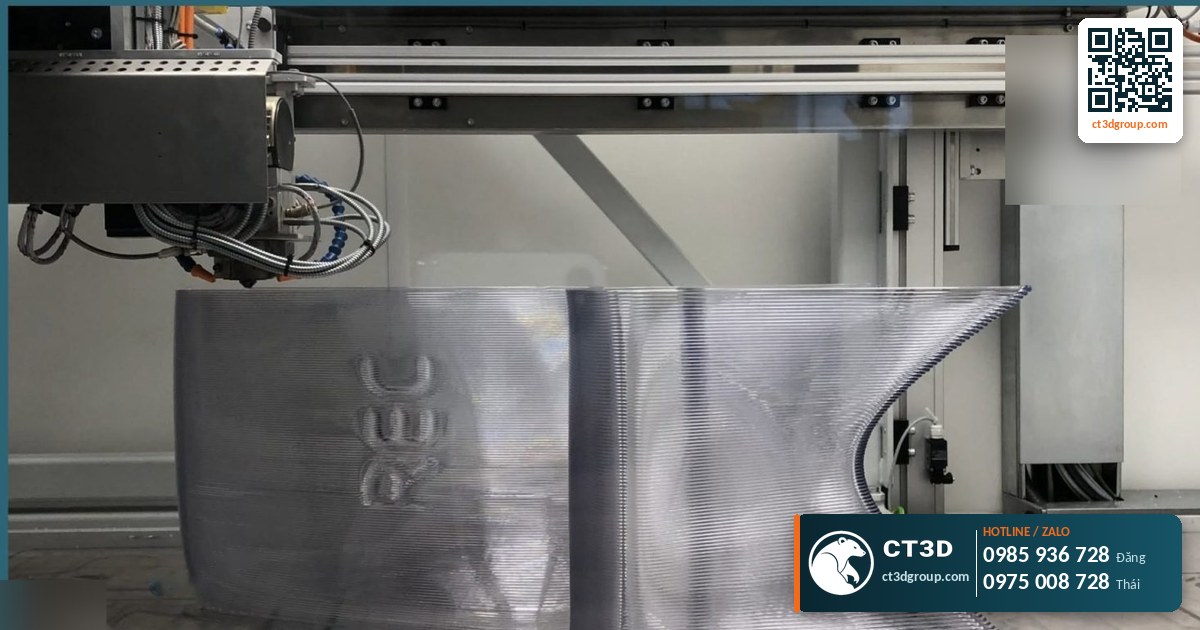
An FDM machine extrudes molten filament through a nozzle, drawing one line at a time. The hot end can only melt a certain amount of plastic per second, called volumetric flow rate (mm³/s). As a result, FDM print time is roughly proportional to the volume of plastic actually printed, plus non-extruding travel moves, layer changes and sections that must be printed slowly such as the first layer, outer perimeters and small features.
Rough estimating formula: Time ≈ Plastic volume ÷ Effective flow rate + Overhead time. The effective flow rate is always lower than the hot end’s maximum, because the machine must slow down at corners and on outer perimeters to get a good surface.
LCD/DLP resin: limited by the number of layers
LCD and DLP machines project an entire UV layer image in one exposure. Whether a layer contains 1 part or 20, the exposure time is almost the same. Print time therefore depends mainly on part height (number of layers) multiplied by the time per layer (exposure + plate lift). That is why nesting many small parts on one resin build plate is very cost-effective.
Laser SLA: depends on both height and area
SLA uses a laser to trace each line on the resin surface. The more area a layer has to scan, the longer it takes. So SLA is affected by both height and cross-sectional area. In return, SLA delivers a smooth surface and details down to 0.05 mm.
MJF/SLS and metal SLM: calculated per build chamber
Powder-bed technologies print the whole chamber at once, with many parts stacked in the powder volume. Time includes heating, printing and cooling – and cooling can be long. Pricing is therefore usually based on the share of chamber volume a part occupies, and CT3D quotes per file.
Parameters That Affect Print Time
| Technology | Layer height (CT3D data) | What drives time | Nesting multiple parts |
|---|---|---|---|
| FDM | 100–300 microns | Plastic volume, speed, number of layers | Total time rises almost in proportion to part count |
| SLA | 25–100 microns | Number of layers and laser scan area | Rises with scan area |
| DLP / LCD | 25–100 microns | Number of layers (height) | Almost no increase at the same height |
| SLS / MJF PA12 | SLS 80–120 microns | Chamber height, heating, cooling | Very efficient with a densely packed chamber |
| Metal SLM | Per machine settings | Laser scan area per layer, height | Rises with scan area |
Source: layer heights from CT3D technical documentation; time mechanisms are general principles of each technology.
Calculating Layers and Time: A Concrete Example
Take a part that is 100 mm tall.
- FDM at 0.3 mm layers: 100 ÷ 0.3 ≈ 333 layers.
- FDM at 0.2 mm layers: 100 ÷ 0.2 = 500 layers.
- FDM at 0.1 mm layers: 100 ÷ 0.1 = 1,000 layers.
- Resin at 0.05 mm (50 microns): 100 ÷ 0.05 = 2,000 layers.
With FDM, going from 0.2 to 0.1 mm layers doubles the layer count. Each thinner layer extrudes less plastic, but the machine still has to trace every perimeter and infill area on each layer at a limited speed. In practice, time usually nearly doubles. That is why, at Ho Chi Minh City market rates in 2026, standard FDM at 0.2 mm costs about 1,200–1,800 VND/g (≈ US$0.05–0.07/g), while high-resolution 0.08–0.12 mm layers go up to 3,000–5,000 VND/g (≈ US$0.12–0.19/g) (not CT3D prices).
Hypothetical flow-rate example
Suppose a PLA part weighs 100 g. PLA has a density of about 1.24 g/cm³, so the plastic volume is about 100 ÷ 1.24 ≈ 81 cm³ = 81,000 mm³. If the average effective flow rate is 8 mm³/s (an assumed value for illustration), extrusion time ≈ 81,000 ÷ 8 ≈ 10,100 seconds, or about 2.8 hours. Add travel, layer changes and a slow first layer, and the real time can be 3.5–4 hours. With thinner layers or many small features, the effective flow rate drops and time increases.
How Much of the 3D Printing Price Is Machine-Hour Cost?
A print price actually consists of: material + machine time + engineering labor (file preparation, monitoring, part removal) + post-processing + the risk of failed prints. At Ho Chi Minh City market rates in 2026 (not CT3D prices): raw PLA costs about 250,000 VND/kg (≈ US$9.6/kg), i.e. 250 VND/g; machine depreciation is 30,000–150,000 VND/hour (≈ US$1.2–5.8).
| Item (100 g PLA part, ~4 hours) | Calculation | Estimate |
|---|---|---|
| Raw material | 100 g × 250 VND/g | ~25,000 VND (≈ US$1) |
| Machine depreciation (low end) | 4 hours × 30,000 VND | ~120,000 VND (≈ US$4.6) |
| Machine depreciation (high end) | 4 hours × 150,000 VND | ~600,000 VND (≈ US$23) |
Source: raw plastic prices and machine depreciation are Ho Chi Minh City market rates in 2026, not CT3D prices; hours are an illustrative example. USD figures are indicative at 1 USD ≈ 26,000 VND.
The table shows something important: raw plastic is only a small part of the cost – machine time is the big part. So anything that reduces print time lowers the price far more than switching to a cheaper plastic. Depreciation rates vary widely because industrial machines, enclosed-chamber machines and large-format resin printers cost much more than consumer FDM printers.
At CT3D, FDM prices are converted to a per-gram rate (PLA and PETG from 650 VND/g ≈ US$0.025/g; ABS from 1,000 VND/g ≈ US$0.04/g; ASA from 2,000 VND/g ≈ US$0.08/g; carbon fiber from 2,750 VND/g ≈ US$0.11/g) so customers can compare easily. For parts with an unusual time-to-weight ratio (very thin, very tall or very fine layers), our engineers quote per file.
Five Factors That Increase or Reduce Print Time
1. Layer height
Thin layers look better but take longer. For technical parts without visible surfaces, 0.2–0.3 mm layers are sufficient. For curved surfaces that need to be smooth, you can use adaptive layers: thin on curved areas, thick on straight areas.
2. Infill
15% and 50% infill can differ significantly in weight and time, especially for large solid parts. Read more in what is infill.
3. Supports
Supports (structures that hold up overhangs) consume extra plastic, print time and removal/sanding time. Rotating the part so overhangs stay below about 45° often eliminates many supports. See 3D printing supports explained.
4. Speed and material
Each plastic has its own safe printing speed. TPU (flexible filament) must be printed slowly. Carbon fiber filament is abrasive and needs a hardened nozzle. ABS and ASA need a thermally stable enclosed chamber. Printing too fast weakens layer adhesion and increases the risk of defects.
5. Part height and orientation
For LCD/DLP resin, laying the part low reduces the layer count and shortens print time. However, in CT3D’s experience, resin parts should be tilted 20–45° to reduce peel forces and avoid failures. It is a balance between time and success rate.
Common Mistakes When Estimating Time and How to Avoid Them
| Mistake | Consequence | Solution |
|---|---|---|
| Counting only printer time | Missed deadline due to forgotten post-processing, painting, shipping | Add it all up: file + printing + post-processing + 1–3 days delivery |
| Requesting thin layers for every part | Unnecessary increase in time and price | Use thin layers only for visible surfaces |
| Printing one large solid piece | A failure midway wastes all the machine time | Split into sections and print in parallel on several machines |
| Mesh errors, non-watertight file | File must be repaired, delaying the start | Check the file before sending, prefer STEP |
| Ordering at the last minute | Rush surcharge of +30% to +50% | Plan early and build in buffer time |
Source: rush surcharges are Ho Chi Minh City market rates in 2026; causes and solutions compiled from CT3D experience.
Typical Lead Times by Order Type
| Order type | Typical lead time (market average) | Rush surcharge |
|---|---|---|
| Ready file, no post-processing | 1–3 days | 1–2 day rush about +50% |
| 3D modeling required | 3–7 days | 3–4 day rush about +30% |
| With paint finishing | 7–14 days | Depends on finish level |
Source: Ho Chi Minh City market averages in 2026, not a CT3D commitment. Nationwide delivery in 1–3 days after completion under CT3D policy.
Checklist to Shorten Lead Time and Reduce Machine Hours
- Send a STEP or STL file that has been checked for a watertight mesh and correct units (mm).
- Specify which faces must look good and which are unimportant, so our engineers can choose a sensible build orientation.
- Accept 0.2 mm layers for technical parts.
- Hollow out non-load-bearing areas and reduce unnecessarily thick walls.
- Design overhang angles below about 45° to reduce supports.
- For quantities, group them into one batch for optimal build-plate nesting. See high-volume 3D printing.
- If you do not have a file yet, order 3D modeling early. For modeling cost and time, see 3D modeling cost for printing.
How CT3D Calculates Time and Quotes
- Receive your STL/STEP/OBJ/3MF file via our website, Zalo or email.
- Record technical requirements: purpose, surface finish, material, deadline.
- Engineers slice the file in software to get weight and estimated print time, and select a suitable machine.
- Send a quote with lead time, including standard and rush options.
- Confirmation and production.
- Door-to-door delivery or pickup at the workshop.
Application example: an R&D team needs 3 housing concepts to choose from within a week. Instead of printing all three at 0.1 mm, the engineers print the first two at 0.2 mm to check assembly, and only print the selected concept at fine resolution or in resin for presentation. Total machine hours drop while the goal is still met. Customers who need a presentation model with a premium surface can refer to high-resolution SLA resin 3D printing on in3d.edu.vn (in Vietnamese).
Frequently Asked Questions
How long does it take to 3D print a 10 cm model?
With FDM at 0.2 mm layers, it usually takes a few hours to about a day depending on weight, infill and supports. With LCD/DLP resin, time depends mainly on height; 10 cm at 50-micron layers is 2,000 layers.
Why does a finer print cost more?
Thinner layers increase the layer count and machine time. At market rates, FDM at 0.2 mm costs about 1,200–1,800 VND/g (≈ US$0.05–0.07/g), and 0.08–0.12 mm layers about 3,000–5,000 VND/g (≈ US$0.12–0.19/g).
What is the machine-hour cost of 3D printing?
At Ho Chi Minh City market rates in 2026, machine depreciation is about 30,000–150,000 VND/hour (≈ US$1.2–5.8) depending on the machine type. These are not CT3D prices; CT3D converts to a per-gram rate or quotes per file.
Is printing many parts at once faster?
With LCD/DLP resin and MJF/SLS, nesting many parts in one batch is very efficient. With FDM, time rises almost in proportion to the number of parts, but you still save setup time.
How much extra does a rush order cost?
At market rates, a 3–4 day rush adds about 30%, and a 1–2 day rush about 50%.
For a full overview of cost by technology and material, see CT3D’s 3D printing price guide.
Real Footage from the CT3D Workshop
Watch the Large-format SLA 3D printing service video produced by CT3D to get a clearer picture of our process and product quality. More videos are available on our Chế Tạo Vlog – CT3D channel.
Contact CT3D – Send Your File for a Fast Quote
Whether you have a 3D file, a 2D drawing, photos or just an idea, you can send it to CT3D. Our engineers will check the file, recommend the right technology and material, and send you a quote with a lead time.
- Email: [email protected] – [email protected]
- Hotline / Zalo: +84 975 008 728 (Mr. Thai) – +84 985 936 728 (Mr. Dang), or use our contact form
- Head office: Binh Duong.
- Workshops in Ho Chi Minh City: Linh Trung (Thu Duc), Tam Binh (Thu Duc), former District 6.
- Other workshops and drop-off points: Can Tho, Da Nang, Bien Hoa, Ba Ria – Vung Tau, Hanoi, Hai Duong, Hai Phong. Nationwide delivery.
- Website: ct3dgroup.com – in3d.edu.vn
CT3D – 3D design & prototyping: 3D printing, 3D scanning, reverse engineering, silicone mold making, painting and finishing, CNC machining, composite fabrication, plus 3D printers and 3D printing resins.
Danh sách cửa hàng:
CT3D là đơn vị cung cấp trọn gói các dịch vụ thiết kế và sản xuất theo yêu cầu tại TP.HCM và khu vực lân cận (Bình Dương, Đồng Nai, Long An…). Với năng lực khép kín từ thiết kế 3D, in 3D (FDM, resin/SLA, SLS, in 3D kim loại), scan 3D – thiết kế ngược, làm khuôn, đúc composite – poly resin – poly stone đến gia công CNC và sơn màu hoàn thiện, CT3D đồng hành cùng khách hàng qua toàn bộ quy trình – từ ý tưởng, bản vẽ hay sản phẩm mẫu đến thành phẩm hoàn chỉnh. Dù bạn cần tạo mẫu nhanh, sản xuất số lượng, chế tác tượng – mô hình – quà tặng hay linh kiện kỹ thuật, đội ngũ CT3D sẽ tư vấn công nghệ và vật liệu phù hợp, đảm bảo sản phẩm sắc nét, đúng yêu cầu và tối ưu chi phí. Khách hàng tại TP.HCM và vùng lân cận có thể trao đổi trực tiếp, gửi file online và nhận sản phẩm thuận tiện, hỗ trợ cả đơn gấp lẫn dự án số lượng.
CT3D cung cấp trọn gói các dịch vụ thiết kế và sản xuất theo yêu cầu, phục vụ khách hàng tại Hà Nội và các tỉnh lân cận (Bắc Ninh, Hưng Yên, Hải Phòng, Vĩnh Phúc…). Với năng lực khép kín từ thiết kế 3D, in 3D (FDM, resin/SLA, SLS, in 3D kim loại), scan 3D – thiết kế ngược, làm khuôn, đúc composite – poly resin – poly stone đến gia công CNC và sơn màu hoàn thiện, CT3D đồng hành cùng khách hàng qua toàn bộ quy trình – từ ý tưởng, bản vẽ hay sản phẩm mẫu đến thành phẩm hoàn chỉnh. Quy trình làm việc thuận tiện: bạn gửi file 3D hoặc mô tả ý tưởng qua online, đội ngũ CT3D tư vấn công nghệ – vật liệu, báo giá nhanh và giao hàng tận nơi tại Hà Nội. Dù bạn cần tạo mẫu nhanh, sản xuất số lượng, chế tác tượng – mô hình – quà tặng hay linh kiện kỹ thuật, CT3D đều đáp ứng với sản phẩm sắc nét, đúng yêu cầu và tối ưu chi phí.

