
Custom Décor & Corporate Gifts in Polyresin & Plaster
CT3D is a custom décor and corporate gift manufacturer in Vietnam. We turn a logo, a sketch or a 3D file into cast pieces in polyresin, polystone or plaster, then finish every item by hand so it matches your brand. One workshop handles design, master pattern, silicone mold, casting and painting, which keeps quality consistent and communication simple for buyers in Vietnam and abroad.
Technical summary: CT3D manufactures custom home décor and corporate gifts in Vietnam using two families of cast materials: polyresin/polystone and gypsum plaster. The process chain covers the master pattern (3D printed or hand sculpted), RTV silicone mold making, casting, demolding, flash trimming and painting. This route is ideal for low-volume to mid-volume production, delivers consistent dimensions from piece to piece, and lets you customize logos, lettering and colors to match your brand identity.
Key Facts at a Glance
| Item | What we offer |
|---|---|
| Cast materials | Polyresin, polystone, gypsum plaster, cold-cast faux metal |
| Master pattern | SLA/DLP resin printing (25–100 micron layers) or FDM (100–300 micron layers), hand sanded and primed |
| Mold type | RTV silicone, block-poured or brush-on with a rigid mother mold |
| Accepted input | STL, OBJ, STEP, IGES, 3MF, AI/SVG/PDF logos, photos, sketches or a physical sample |
| Order size | Low to mid volume; master and mold costs are quoted separately from the unit price |
| Approval | Fully painted first article before series production |
| Delivery | Nationwide in Vietnam within 1–3 days after completion; international orders by air |
Scope of Work for Cast Décor and Corporate Gifts
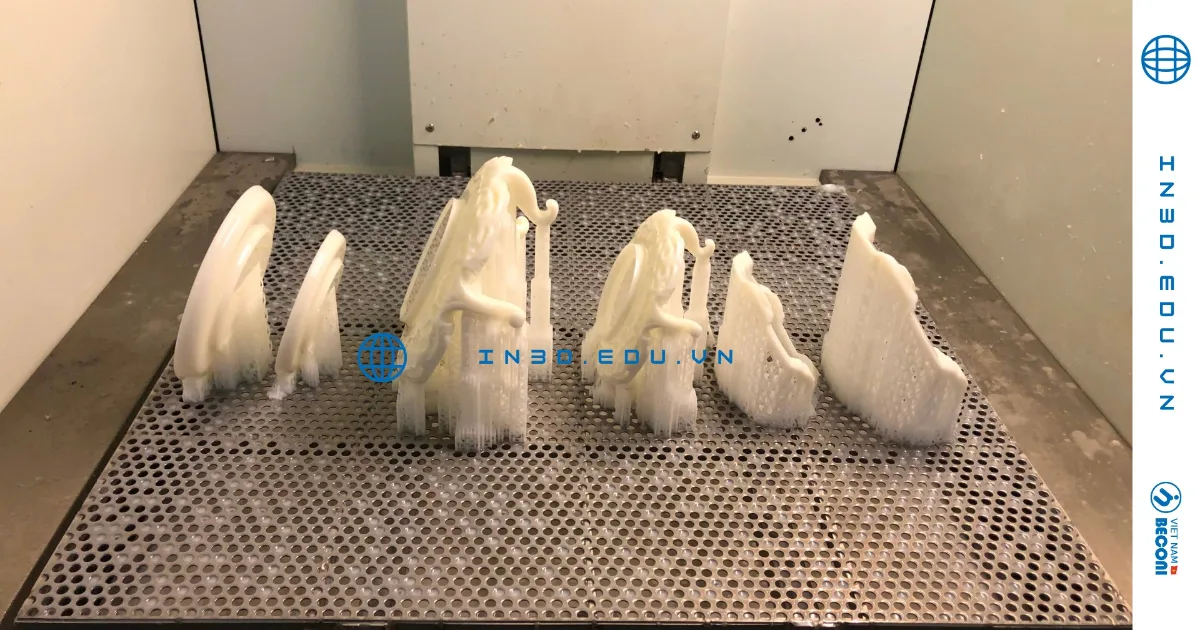
A typical gift order moves through three distinct stages. Stage one is design: turning an idea, a photo or a vector logo into a manufacturable 3D model. Stage two is pattern and mold making: printing the master, finishing its surface to mold-ready quality, then pouring the silicone mold. Stage three is repeat production: pouring the material, controlling cure time, demolding, finishing and packing. CT3D can take on the full chain or any single stage — for example, if you already have an original and only need it replicated.
| Item | Technical details | Notes |
|---|---|---|
| Input | Photos, sketches, AI/SVG/PDF logos, STL/OBJ/STEP/3MF files, physical samples | Physical samples can be digitized by 3D scanning |
| Master pattern | SLA/DLP resin 3D printing (25–100 micron layers) or FDM (100–300 micron layers), then sanded and primed | The master’s surface defines the surface of every casting |
| Mold | RTV silicone, block-poured or brush-on with a rigid mother mold | Number of mold parts depends on draft angles |
| Casting material | Polyresin, polystone (resin + stone powder), plaster, cold-cast faux metal | Selected by weight, durability and budget |
| Post-processing | Flash trimming, pinhole filling, priming, hand/airbrush painting, patina, gloss or matte clear coat | Color plating available for polyresin parts |
| Lead time | Quoted per file, quantity and finish level | Painted items need extra drying and inspection time |
Source: CT3D internal process and published 3D printing technology specifications.
How Cast Décor Is Made
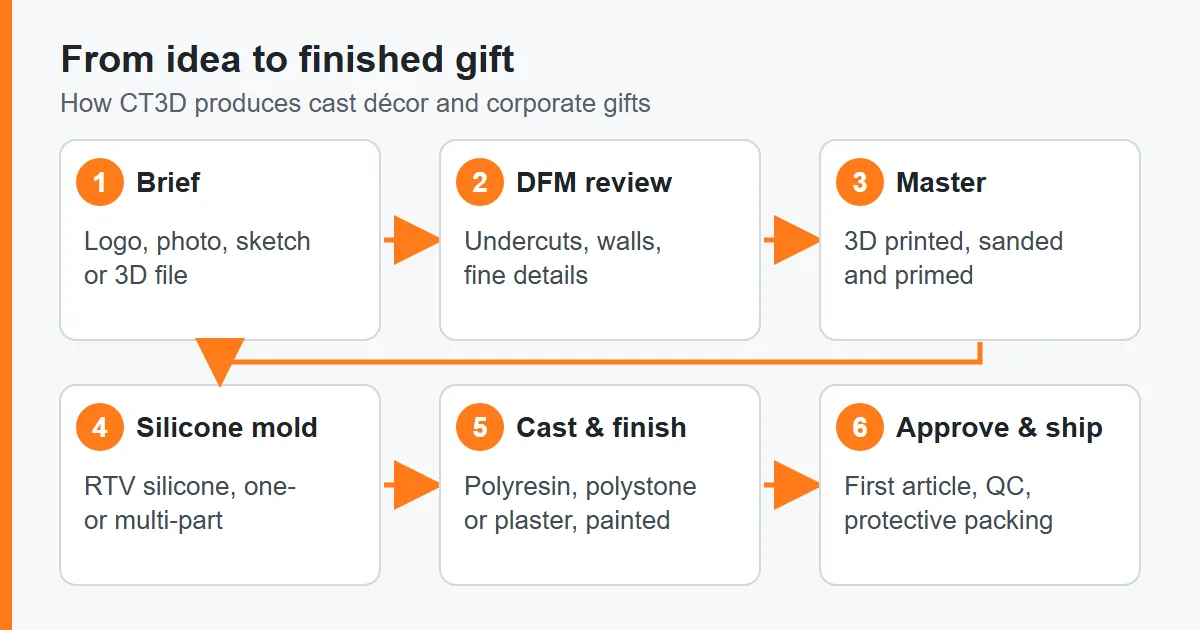
Every cast gift follows the same basic route. Knowing the steps helps you see where cost and lead time come from, and where your input matters most.
- 3D model: your logo, photo or idea is modeled in 3D, or an existing object is 3D scanned. You approve preview renders before anything is printed.
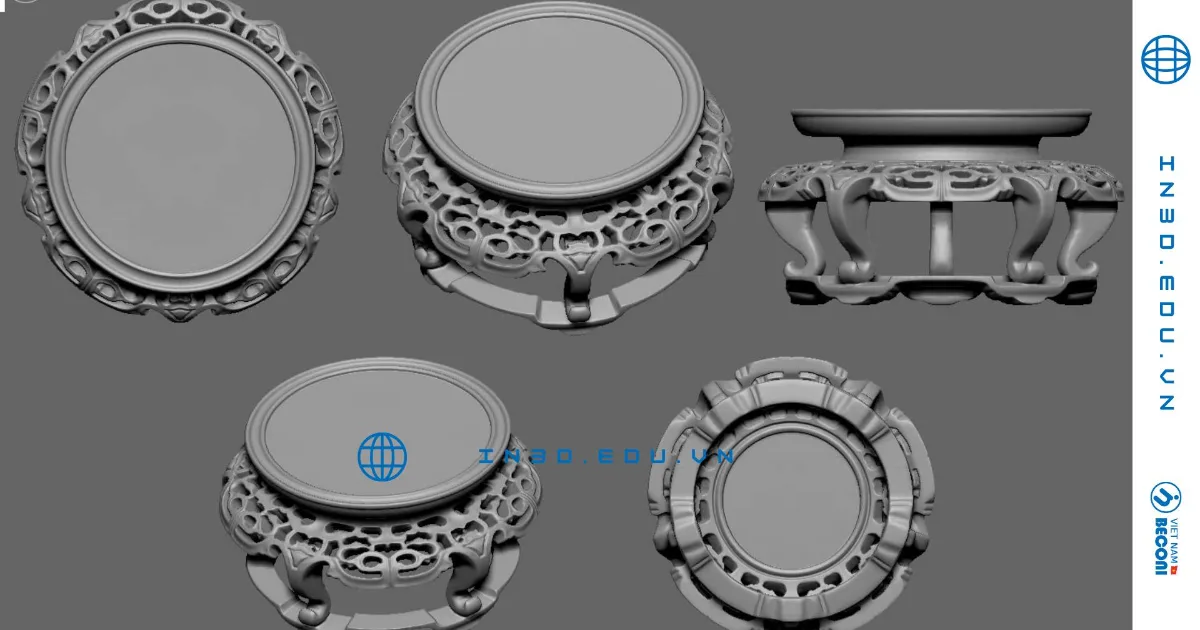
- Master pattern: the model is printed in resin or FDM, then sanded, primed and checked under raking light until the surface is mold-ready.
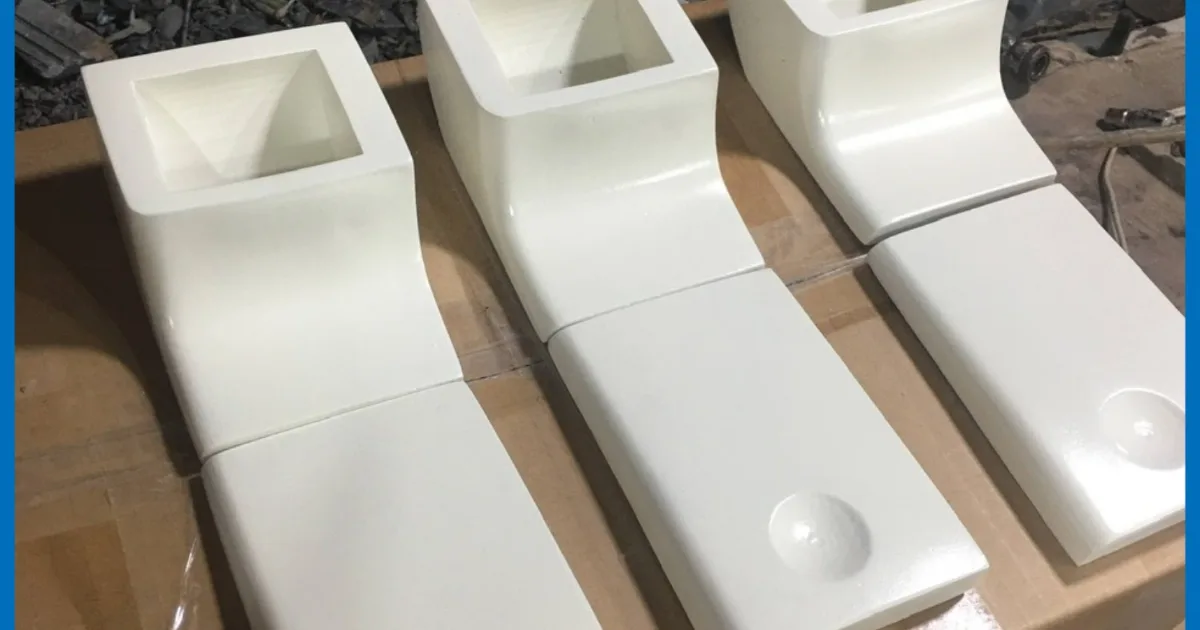
- Silicone mold: RTV silicone is poured around the master. Simple shapes use a one-piece mold; shapes with undercuts need a multi-part mold with a rigid mother mold.
- Casting: polyresin, polystone or plaster is mixed and poured. Thin first coats and slow pouring help avoid trapped air.
- Demolding and trimming: after curing, each piece is released, flash is trimmed and pinholes are filled.
- Finishing and packing: priming, painting, patina or cold-cast polishing, a protective clear coat, inspection and shock-proof packing.
Materials & Standards
Polyresin and polystone
Polyresin is a thermoset plastic — most commonly an unsaturated polyester resin mixed with a catalyst that cures at room temperature. When mineral filler such as stone powder is added, the result is called polystone: heavier in the hand, stone-like to the touch, and more impact resistant than plaster. Technically, this family reproduces fine detail extremely well, is less brittle, resists moisture and takes paint easily after surface preparation. The downsides are solvent odor during casting, which requires ventilation, and the need to control the catalyst ratio to avoid shrinkage or thermal cracking in thick sections.
Gypsum plaster
Casting plaster is calcium sulfate hemihydrate powder that recrystallizes and hardens when mixed with water. The water-to-powder ratio directly affects strength: more water makes it easier to pour but weaker and more porous. Plaster has a low material cost, a smooth white surface and is easy to hand paint, but it is brittle, absorbs moisture and is not suitable for outdoor use. For this reason CT3D usually recommends plaster for indoor display pieces, paint-it-yourself workshop gifts and small architectural models.
Cold-cast and faux-material effects
Cold casting means mixing metal powder (bronze, brass, aluminum) into the first resin layer in the mold, then polishing to reveal a metallic sheen. It gives a look and feel close to cast metal at a lower cost than true bronze casting. Pieces can also be painted to imitate wood, stone or ceramic using multi-layer paint and patina. Where a uniform metallic finish is required, polyresin parts can also be color-plated after a conductive primer coat.
| Criterion | Polyresin | Polystone | Plaster |
|---|---|---|---|
| Perceived weight | Light – medium | Heavy, stone-like | Medium, porous |
| Impact resistance | Good | Good | Low, edges chip easily |
| Moisture resistance | Good | Good | Poor unless sealed |
| Detail reproduction | Excellent | Good | Good |
| Material cost | Medium | Medium | Low |
Qualitative comparison based on common material properties, not laboratory measurements.
Design Guidelines for Cast Gifts
A few design choices make the difference between a gift that casts cleanly every time and one that needs rework. The values below are typical starting points for resin and plaster casting in silicone molds, not fixed limits; our engineers confirm them for your shape during the DFM review.
| Feature | Typical recommendation | Why it matters |
|---|---|---|
| Draft on vertical faces | Typically 1–3°, more for deep or textured walls | Helps the piece release and extends mold life |
| Undercuts | Keep them few and shallow where possible | Each deep undercut can add a mold part and a visible seam |
| Raised logos and text | Relief typically 0.5–1 mm or more; avoid hairline strokes | Shallow strokes fill with paint and look faint |
| Sharp edges | Add a small radius to outer edges | Sharp silicone edges tear; sharp cast edges chip, especially in plaster |
| Thick solid sections | Hollow the core or cast in stages | Large solid resin masses heat up while curing and can crack |
| Base and footprint | Flat, slightly recessed underside | Sits level on a desk and leaves room for felt pads or a label |
| Parting line | Place it along natural edges or hidden faces | Keeps the seam out of the main viewing angle |
| Logo artwork | Vector files (AI, SVG, PDF) | Gives crisp lettering when the logo is modeled in 3D |
Master Pattern and Silicone Mold Making
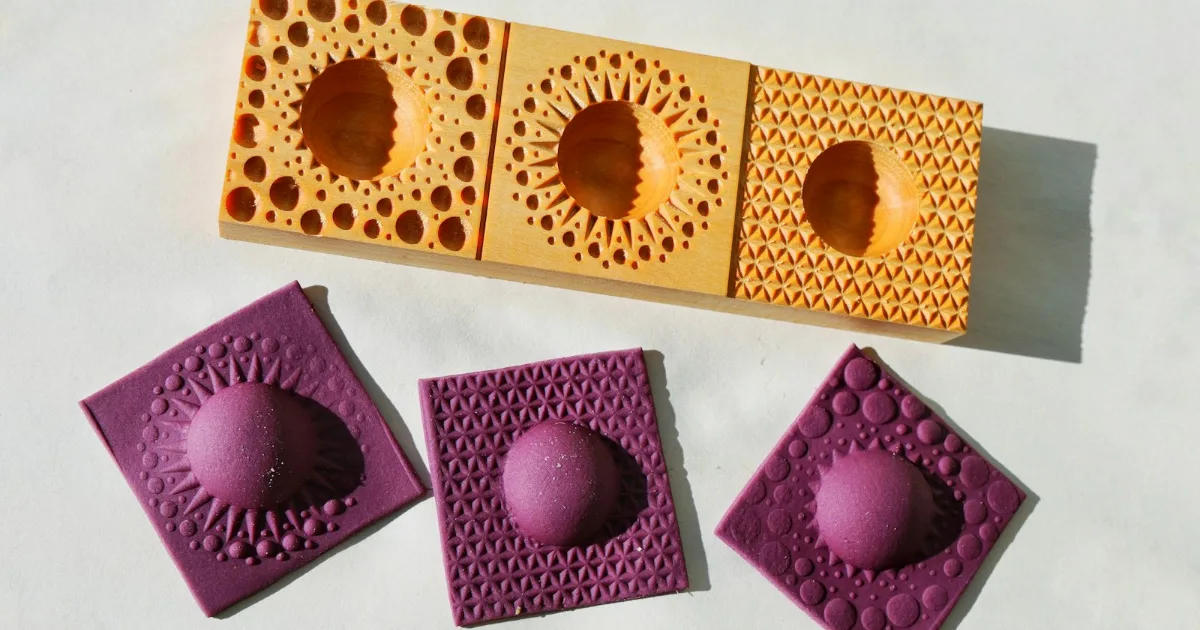
A casting can never be better than its master. That is why CT3D treats the master pattern as an engineered part: checking wall thickness, rounding overly sharp edges so the mold does not tear, adding draft angles on vertical faces, and placing the parting line so the seam falls where it is least visible. For raised logos or engraved text, the stroke height must be sufficient so paint does not fill in the detail. When the master is resin printed, the surface is sanded through progressively finer grits, primed and sanded again before molding. Whether to use a one-piece or two-part mold depends on the undercuts in the shape. You can read more about the silicone mold making and resin casting process, or how to make silicone molds from 3D printed masters, on our silicone molds page.
Finishing Options
The finish decides how a gift feels in the hand and how it looks on a shelf. The same mold can produce several finishes, so you can order a premium version and a standard version from one tooling investment.
| Finish | Description | Best for |
|---|---|---|
| Hand painting | Detail painting by brush over a primed surface | Characters, mascots, multi-color logos |
| Airbrush | Smooth gradients and even base coats | Soft color transitions, large surfaces |
| Patina | Layered paint and wash that ages the surface | Antique, stone or bronze looks |
| Cold-cast metal | Bronze, brass or aluminum powder in the first resin layer, polished to a sheen | Premium gifts with a real metallic feel |
| Color plating | Metallic plating over a conductive primer on polyresin parts | Uniform, bright metallic finishes |
| Faux wood, stone or ceramic | Multi-layer paint effects | Interior décor that must match a material palette |
| Gloss or matte clear coat | Protective top layer | Handling resistance and easier cleaning |
See our painting and plating page for more detail on surface preparation and coating systems.
Industry Applications
- Corporate and partner appreciation gifts: 3D brand symbols, paperweights, commemorative plaques and scale models of your products for the desk.
- Events, conferences and anniversaries: award pieces engraved with the event name or founding year; can be combined with custom 3D trophy production.
- Interiors, restaurants and showrooms: wall reliefs, decorative statues, planters and small feng shui objects.
- Retail and handicrafts: proprietary designs that need to be replicated in volume for shelves or online channels.
- Education and experiences: white plaster figures for participants to paint themselves in workshops.
Mold Casting vs Direct 3D Printing vs Hand Sculpting
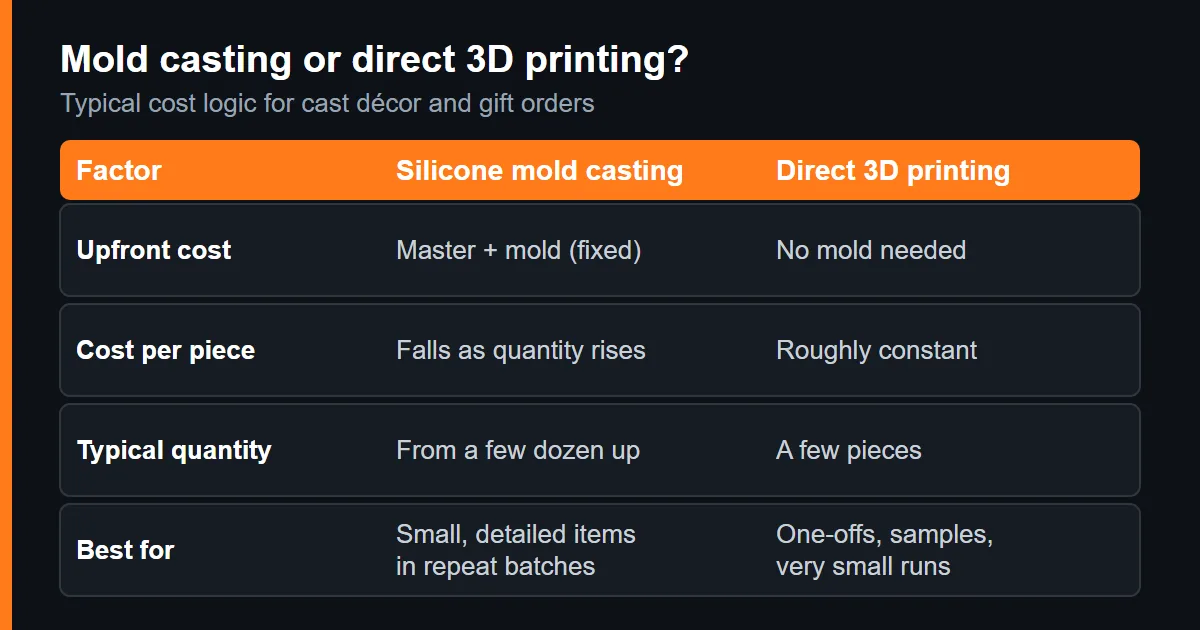
Cast décor is not always the right answer. The table compares the three routes buyers usually consider. It describes typical behavior, and the best choice always depends on your quantity, size and finish.
| Factor | Silicone mold casting | Direct 3D printing | Traditional hand sculpting |
|---|---|---|---|
| Upfront cost | Master + mold (fixed) | No mold | Sculpting labor for each original |
| Cost per piece | Falls as quantity rises | Roughly constant | High if every piece is made by hand |
| Typical quantity | From a few dozen pieces upward | One to a few pieces | One-offs |
| Piece-to-piece consistency | High – every piece comes from one mold | High – every piece comes from one file | Varies by artisan |
| Changing size | New master and mold | Scale the file | Sculpt again |
| Materials | Polyresin, polystone, plaster, cold-cast | Printing resins and plastics | Clay, plaster, stone, wood |
Quality Control for Gift Orders
With gifts, even a small surface defect can damage a brand’s image. CT3D controls quality at four points. First, the master: the surface is inspected under raking light to catch layer lines, sanding marks and uneven primer. Second, the mold: we check for torn edges, air bubbles trapped in the silicone and the fit between mold parts. Third, the casting: surface pinholes, sink marks in thick sections, warping of thin features, and how cleanly lettering and logos fill. Fourth, color: each piece is compared against the approved sample under the same lighting, and paint adhesion is checked on edges and corners. Non-conforming pieces are rejected or reworked before packing. The painting steps are described in more detail on our 3D printing, painting and plating page.
| Common defect | Technical cause | Corrective action |
|---|---|---|
| Surface pinholes | Air trapped during pouring, viscous material | Brush a thin first coat, pour slowly, vibrate the mold |
| Cracks in thick sections | Excessive exotherm during curing | Reduce catalyst, hollow the core, pour in stages |
| Crumbly, chalky plaster | High water ratio, not fully dried | Measure water accurately, dry fully before painting |
| Faint logo lettering | Strokes too shallow, worn mold | Increase relief height, track mold life |
| Paint peeling at edges | Residual mold release | Wash thoroughly, apply adhesion primer first |
Cost and Factors Affecting Unit Price
CT3D does not apply a fixed price list to cast décor because every design is different. Unit price is built from four cost groups: 3D design (if you do not have a file yet), the master pattern, the silicone mold, and the per-casting cost including material, finishing labor and paint. Master and mold costs are fixed, so as quantity rises, the mold cost per piece goes down. For very small quantities, 3D printing each piece directly is sometimes more economical than making a mold — see our 3D printing services. Our engineers compare both options and state the break-even point clearly in the quotation.
How to Order: From RFQ to Delivery
Ordering is straightforward even if you have never commissioned a cast product before. Your files are kept confidential, and we sign an NDA on request. A free manufacturability (DFM) review comes with every quote.
- Request for quotation (RFQ): send your concept, logo, reference photos or 3D files via our Contact form, Zalo or email, together with size, quantity and intended use.
- Design for manufacturability (DFM) review: our engineers assess undercuts, thickness and fine details, and suggest shape adjustments so the mold lasts longer and releases easily.
- Quotation: design, master pattern, mold and per-unit costs are itemized separately, with the delivery schedule.
- First Article Inspection (FAI): we produce a first fully painted sample so you can approve color, dimensions and hand feel.
- Series production: casting follows the approved sample; we track the number of pulls and replace the mold once detail starts to soften.
- Inspection and delivery: 100% visual inspection, shock-proof packaging; shipped within Vietnam by Viettel Post, Giao Hang Tiet Kiem, Vietnam Post or by air (1–3 days nationwide after completion), and by air for international orders.
Why Choose CT3D for Cast Décor and Gifts
- The whole chain under one roof: 3D design, 3D scanning, master printing, silicone molds, casting and painting – no hand-offs between suppliers.
- Engineered masters: draft, parting lines and logo depth are checked before the mold is made, so the mold lasts longer and castings stay crisp.
- Approval before production: you sign off a fully painted first article, and it becomes the reference for the whole batch.
- Transparent quotes: design, master, mold and unit costs are itemized, and we tell you when direct 3D printing would be cheaper.
- Clear communication: engineering support in English, by email, phone or Zalo, and a fast reply to quote requests.
Frequently Asked Questions (FAQ)
At what quantity should I make a mold instead of 3D printing each piece?
There is no universal number. When the part is small, highly detailed and the quantity runs from a few dozen upward, mold casting usually pays off. For just a few pieces, direct 3D printing followed by painting can be cheaper. CT3D will cost out both options based on your actual file.
How do polystone and plaster differ for corporate gifts?
Polystone feels heavier and is more impact and moisture resistant, making it suited to premium gifts. Plaster is inexpensive, smooth and white, and easy to paint, but it is brittle and needs a protective coating – best for indoor display items.
Can you add our company logo to the product?
Yes. The logo can be modeled raised or engraved directly on the master so it is cast in one piece, or painted or applied afterwards. Please send your logo in vector format for crisp lettering.
How many times can a silicone mold be used?
Mold life depends on the casting material, the complexity of the shape and how the parts are demolded. CT3D monitors detail quality throughout production and makes a new mold as soon as castings start to lose definition.
I don’t have a 3D file yet. Where do I start?
Send us photos, sketches or a physical sample. CT3D will model the file or 3D scan the object and send you preview renders for approval before making the master.
How do you make sure the colors match our brand?
Send your color references with the request. We paint a first article to those references and you approve it before series production. Every piece in the batch is then compared with the approved sample under the same lighting.
Can our design files be kept confidential?
Yes. Your files and designs are used only for your order, and we sign a non-disclosure agreement (NDA) on request before you send them.
Do you ship décor and gifts outside Vietnam?
Yes. Within Vietnam we deliver nationwide in 1–3 days after completion; international orders are shipped by air. Pieces are packed in shock-proof packaging, and we can discuss packing requirements for your destination when quoting.
Real Footage from the CT3D Workshop
Watch the video Large-format SLA 3D printing service with a smooth surface finish produced by CT3D to get a clearer picture of our process and product quality. More videos are available on the Che Tao Vlog – CT3D channel.
Contact CT3D – Send Your Files for a Fast Quote
Whether you have a 3D file, a 2D drawing, photos or just an idea, you can send it to CT3D. Our engineers will review your files, advise on technology and materials, and send a quotation with a delivery schedule. Files can be sent online (STL, STEP, IGES, OBJ).
- Email: [email protected] – [email protected]
- Phone / Zalo: +84 975 008 728 (Mr. Thai) – +84 985 936 728 (Mr. Dang), or use our Contact form
- Head office: Binh Duong, Vietnam.
- Workshops: Ho Chi Minh City, Vietnam.
- Other workshops and drop-off points: Can Tho, Da Nang, Bien Hoa, Ba Ria – Vung Tau, Hanoi, Hai Duong, Hai Phong. Delivery nationwide and international shipping.
- Website: ct3dgroup.com – in3d.edu.vn
CT3D – 3D design & prototyping: 3D printing, 3D scanning, reverse engineering, silicone mold making, painting and finishing, CNC machining, composite fabrication, plus 3D printers and 3D printing materials.
Ready to start your custom décor or gift project?
Send your logo, sketch, photos or 3D file and tell us the size, quantity and finish you need. We reply quickly with a free DFM review and an itemized quote.