
Large FRP Composite Installations Vietnam – Design & Build
Technical summary: CT3D delivers large-scale FRP composite installations (fiber-reinforced plastic) on a design & build basis: mascots, landscape features, relief panels, entrance gates and advertising icons. Forms are modeled in 3D, plugs are CNC-machined from EPS/XPS foam, then either molded or directly laminated with fiberglass and resin, gel coated and painted. Large pieces are split into modules at the workshop, transported, and assembled on site at project locations across Vietnam.
If you need a mascot for a festival, a giant product replica for a launch, a landscape feature for a resort or an entrance gate for an event, FRP composite gives you a large, light and weather-resistant form that can be shaped directly from a 3D file. Below we explain where composite makes sense, how a project is built, which materials and finishes are used, how to design for transport and outdoor exposure, and how to request a quote.
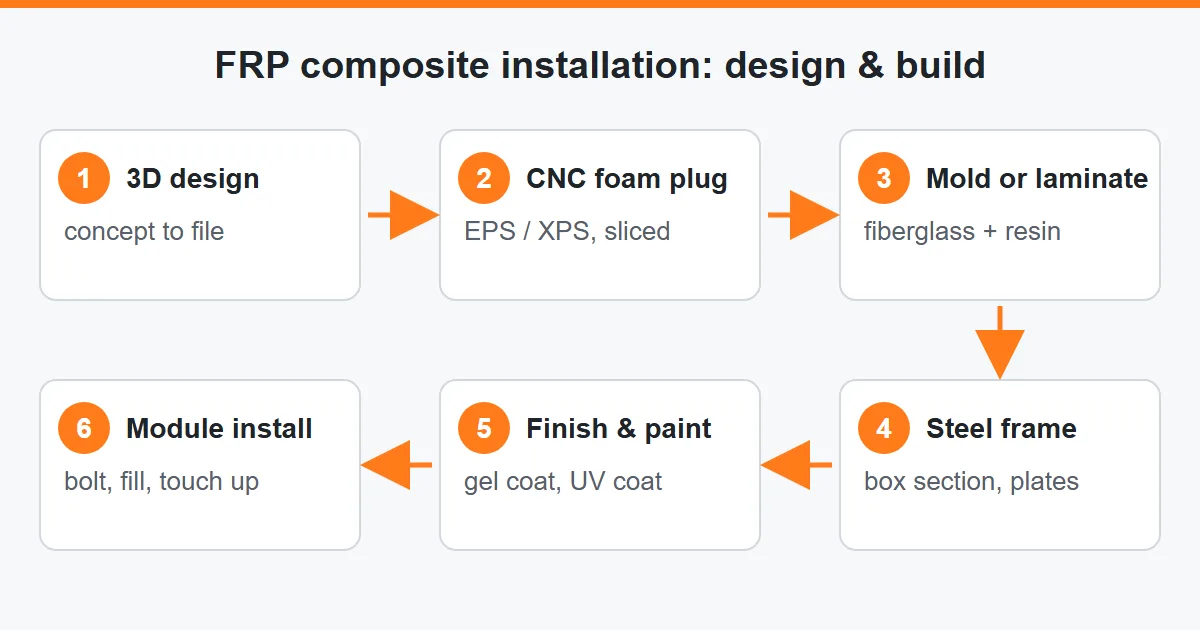
FRP composite installations at a glance
| Item | What CT3D offers |
|---|---|
| Project types | Mascots, landscape features, rockeries, relief panels, entrance gates, advertising icons, oversized product replicas |
| Contract model | Design & build: 3D design, fabrication, transport, on-site assembly and handover |
| Form making | 3D modeling or 3D scanning of maquettes; CNC-milled EPS/XPS foam or wood plugs; 3D printed small parts |
| Shell | Hand lay-up fiberglass (CSM, woven roving) with polyester, vinylester or epoxy resin; gel coat |
| Structure | Internal steel box-section frame with base plates for the foundation |
| Finishes | Automotive paint, faux stone, faux bronze patina, faux wood, UV-resistant clear coat |
| Large pieces | Split into modules at the workshop, bolted together on site, joints filled and touched up |
| Coverage | Project locations across Vietnam, supported by our Ho Chi Minh City workshop and drop-off points in many provinces |
Which projects is FRP composite best suited for?
A mascot several meters tall made of concrete or stone would be extremely heavy, requiring a large crane and a substantial foundation. The same form in composite is only a thin fiber-reinforced shell with an internal steel frame, so it is far lighter and easier to transport and erect. Beyond the weight advantage, FRP allows free-form shaping directly from 3D files, is water-resistant, and accepts a wide range of finishes: automotive paint, faux stone, faux bronze (patina) and faux wood.
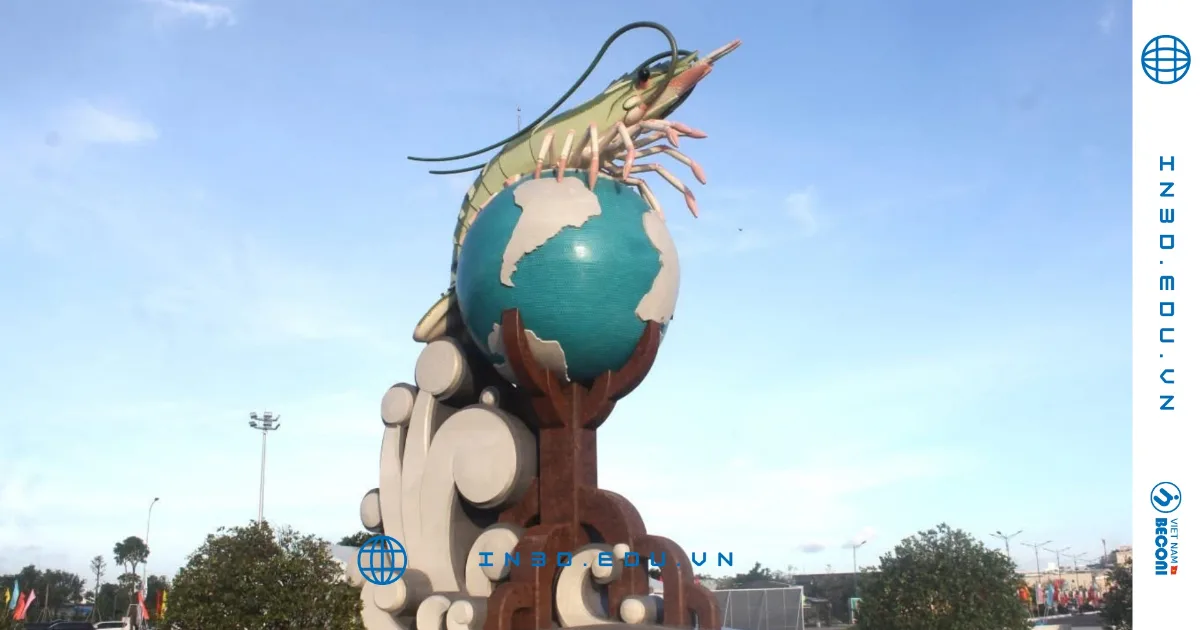
Composite is especially well suited to temporary or semi-permanent installations: festival and event decorations, tourist attractions, showrooms and cafés. For permanent outdoor installations, a UV-resistant coating system and a wind-rated structure must be designed accordingly. Among our sculptural projects, CT3D has published a giant Ca Mau shrimp model and a large reclining Buddha; see also our article on making mascots with CNC foam and composite.
FRP composite compared with other materials for large forms
| Criterion | FRP composite | Concrete or cast stone | Welded metal sheet |
|---|---|---|---|
| Weight | Light shell on a steel frame | Very heavy; needs cranes and large foundations | Medium to heavy |
| Free-form shapes | Excellent – made directly from 3D files via CNC foam plugs | Possible, but molds and formwork are complex | Best for geometric or faceted shapes |
| Transport | Split into light modules | Difficult for large pieces | Moderate |
| Finish options | Paint, faux stone, faux bronze, faux wood | Natural concrete or stone look | Paint, polished or brushed metal |
| Typical use | Mascots, events, attractions, showrooms | Permanent heavy monuments | Modern sculptures, signage |
This comparison reflects general characteristics of each material; the best choice depends on the site, the expected lifetime and the budget of your project.

Scope of work and key specifications
| Work item | Method | Technical notes |
|---|---|---|
| Form design | 3D modeling from concepts, photos or drawings; 3D scanning of small maquettes and scaling up | Form approved on file before fabrication |
| Plug making | CNC milling of EPS/XPS foam or wood; small parts can be 3D printed | Sliced into layers and assembled to suit machine size |
| Mold making (for multiple castings) | Multi-part FRP molds with flanges and locating pins | Draft angles required |
| Shell lamination / molding | Hand lay-up of fiberglass with polyester or vinylester resin | Shell thickness based on size and wind load |
| Internal structure | Steel box-section frame, base plates for foundation connection | Calculated for height and installation location |
| Surface finishing | Filling, sanding, priming, color coats, UV-resistant clear coat | Faux stone, bronze patina or wood grain finishes available |
Source: CT3D internal fabrication process. Specific parameters are defined for each project.
Design guidelines for large composite pieces
These general guidelines help a large FRP installation look right, travel safely and last. Our engineers apply them during the technical review.
- Plan the module split early: cut lines should follow natural edges (folds, color changes, base lines) so joints can be concealed after assembly, and each module must fit the transport vehicle and site access.
- Detail for viewing distance: a piece seen from 20 m needs bold forms; very fine detail is lost at that distance and adds cost.
- Draft angles for molded parts: when several copies will be made from FRP molds, surfaces need draft so the part can be released.
- Frame and foundation: height, exposure and installation location determine the steel frame and base plates; tall pieces in open areas need a wind-rated structure.
- Water and ventilation: outdoor shells typically include small drainage points so rainwater cannot collect inside.
- Maintenance access: if lighting or electrics are built in, plan a hatch or removable panel.
- Color under real light: colors are chosen from sample boards; outdoor colors should be checked in daylight before full-scale painting.
Materials and standards
Resin matrix
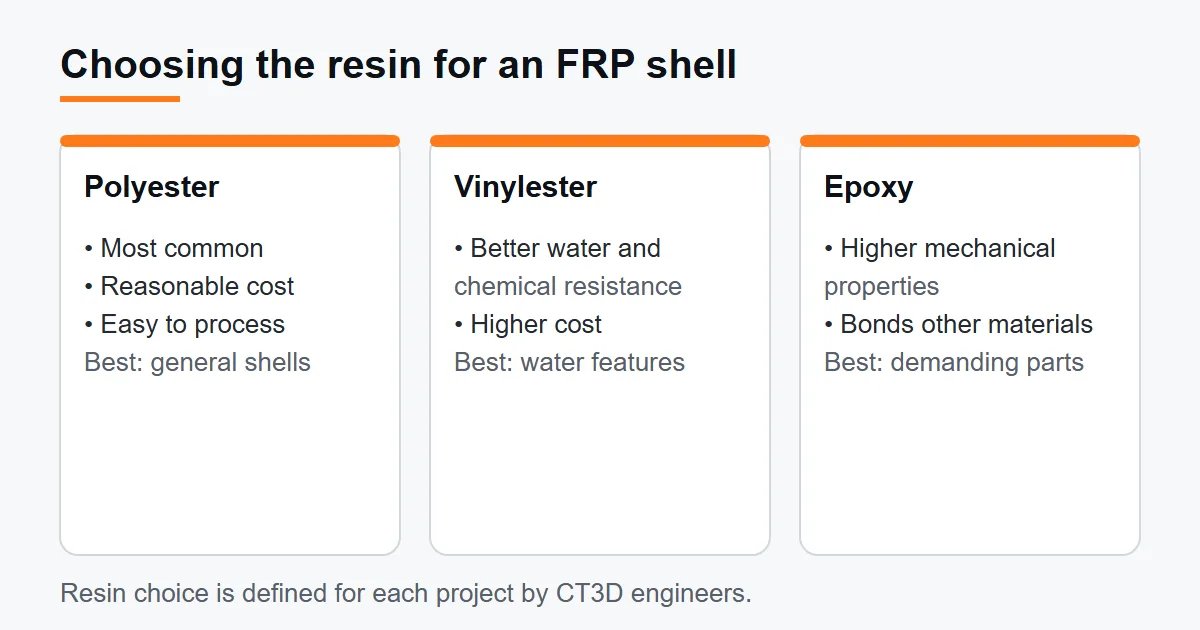
Unsaturated polyester resin is the most common choice thanks to its reasonable cost and ease of processing. Vinylester offers better chemical and water resistance and is used for elements in frequent contact with water. Epoxy is used when higher mechanical properties or bonding to other materials are required.
Reinforcement
Chopped strand mat (CSM) forms a base layer that conforms easily to complex profiles; woven roving adds tensile strength in load-bearing areas. The number of plies and the lay-up schedule determine the stiffness of the shell.
Gel coat and coatings
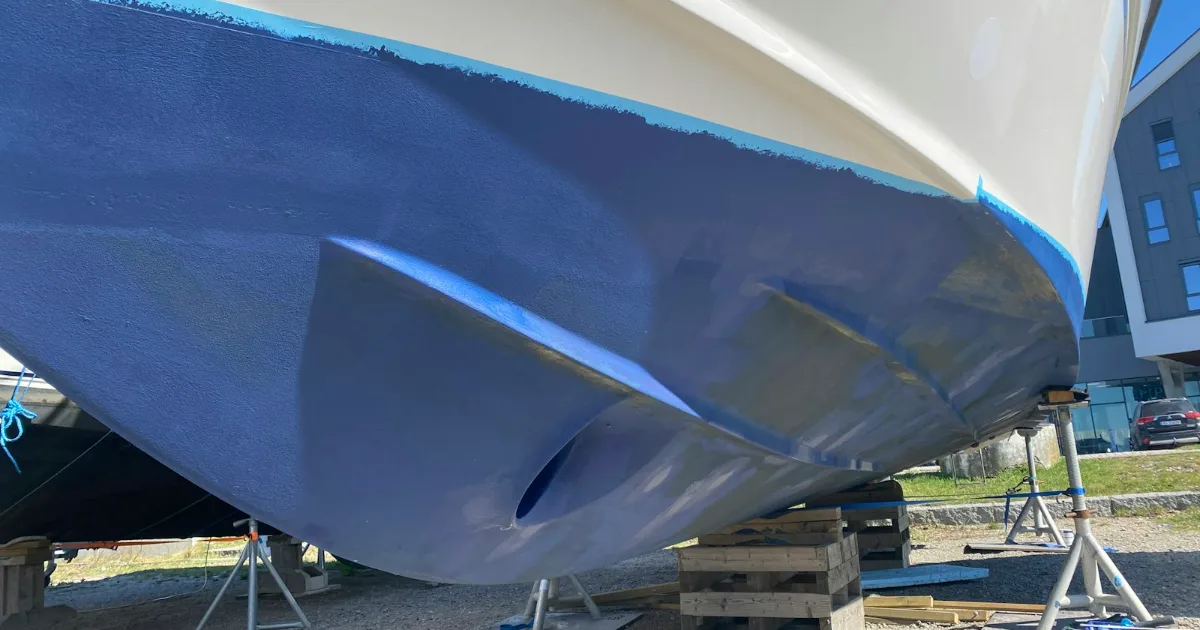
Gel coat is the surface resin layer that protects the fibers and provides a base for paint. Outdoors, topcoats must be UV-resistant to limit fading and chalking. Colors and effects are selected from sample boards with the customer before full-scale painting.
Foam and wood plugs
EPS is light, inexpensive and fast to mill, but certain solvents in polyester resin dissolve it, so a barrier coat must be applied before lamination. XPS is finer and holds detail better. Learn more about CNC foam cutting and how CNC machining is used for sculptural forms.
Finishing options
| Finish | Appearance | Best for |
|---|---|---|
| Automotive paint | Bright, smooth, glossy colors | Mascots, brand icons, product replicas |
| Faux stone | Textured stone look without the weight | Rockeries, landscape features, relief panels |
| Faux bronze (patina) | Metallic bronze tones with aged highlights | Statues and commemorative pieces on a composite budget |
| Faux wood | Wood grain effect | Gates, signage and themed decor |
| UV-resistant clear coat | Protective top layer | All outdoor pieces, to limit fading and chalking |
Workflow for composite projects
- Request for quotation (RFQ): send your concept, reference images, dimensions, installation location and key dates.
- Survey and technical review: assessment of the site, transport route and foundation anchor points; definition of the module split so joints can be concealed.
- 3D design and quotation: form approval on file; confirmation of materials, colors and schedule.
- Workshop production: CNC plug milling, FRP lamination or molding, steel frame welding, finishing of each module.
- Pre-shipment inspection: full dry fit where conditions allow; color and joint checks.
- Transport, installation and acceptance: impact-protected packing, on-site assembly, joint treatment, paint touch-up and handover.
Industry applications
- Tourism and leisure: mascots, landscape features, rockeries, photo spots.
- Advertising and retail: oversized product replicas, brand icons, event entrance gates.
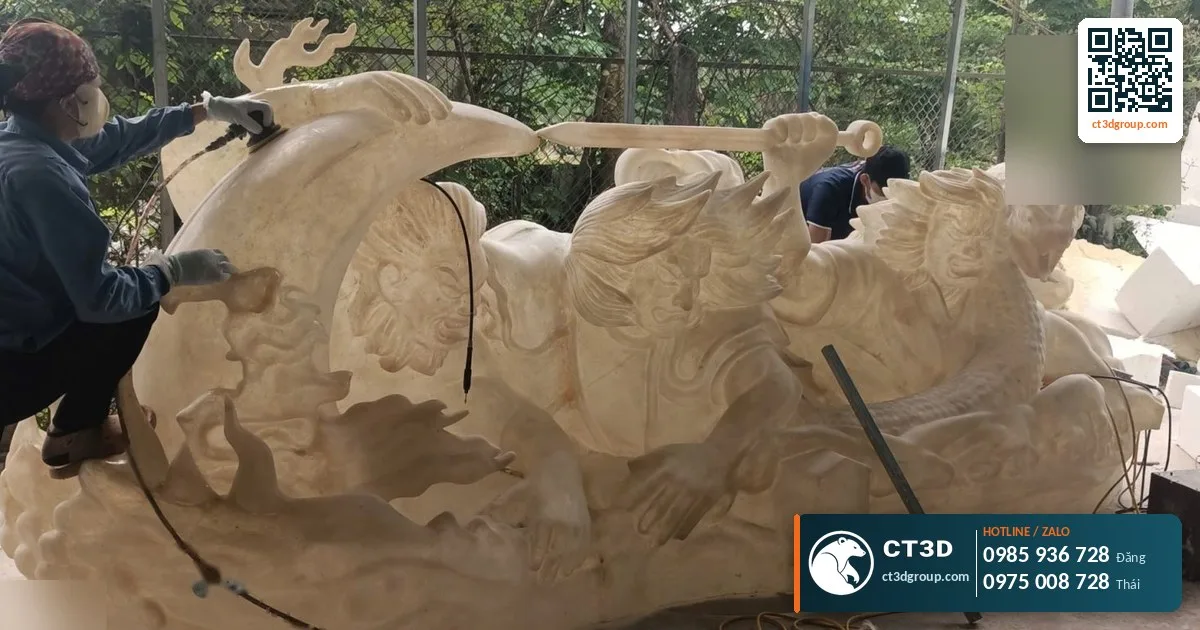
- Religious and cultural: statues and relief panels; see also our composite FRP statues and our article on 3D printed religious statues.
- Restaurants, cafés and showrooms: decor elements built around a unique concept.
- Municipalities and festivals: models of local specialties and regional emblems.

Indoor, outdoor or temporary?
| Use | What to plan for |
|---|---|
| Indoor (showrooms, cafés, lobbies) | Lighter shell and frame are usually enough; focus on finish quality and fire-safe placement of lighting |
| Temporary outdoor (festivals, events) | Quick assembly and disassembly, modules sized for repeated transport, weighted or anchored bases |
| Permanent outdoor (parks, resorts, gateways) | UV-resistant coating system, wind-rated frame, foundation base plates and a paint maintenance plan |
Quality control
- Form: CNC plug checked against the 3D file before lamination.
- Reinforcement: resin-to-fiber ratio controlled; rolled out to remove air bubbles and prevent blistering and delamination.
- Structure: steel frame welds and foundation base plates inspected.
- Surface: flatness, filler marks and color uniformity checked under natural light.
- On site: verticality, joints and post-installation paint touch-up checked.
Our special-effect painting techniques are described in our article on painting models.
Why choose CT3D for composite installations
- Digital form control: every shape is approved on a 3D file before any foam is cut.
- In-house CNC foam milling and 3D printing for plugs and small detailed parts.
- Design & build in one contract: design, plug, shell, frame, finish, transport and installation coordinated by one team.
- Modules planned for transport: cut lines placed where joints can be hidden on site.
- Nationwide reach: projects across Vietnam, supported by our workshops and drop-off points.
- Engineering support in English for international brands and agencies working in Vietnam.
Frequently asked questions (FAQ)
Is composite durable outdoors?
Yes, when properly designed: a shell with sufficient reinforcement, a wind-rated frame and a UV-resistant coating. Periodic paint maintenance helps keep colors vibrant longer.
How are very large models transported?
Models are split into modules at the workshop to fit the transport vehicle, with cut lines placed where they are easy to conceal. On site, the modules are bolted together, the joints are filled and the paint is touched up.
Does CT3D take on projects in distant locations?
Yes. In addition to our Ho Chi Minh City workshop and Binh Duong head office, CT3D has drop-off points in many provinces across Vietnam and supports on-site installation.
What do I need to prepare to get a quote?
Your concept or reference images, target dimensions, installation location and deadline. If you don’t have a design yet, CT3D will create a 3D file for your approval first.
Can you make several copies of the same mascot?
Yes. For multiple castings we make multi-part FRP molds with flanges and locating pins from the plug, so identical shells can be laminated. For a single piece, the shell can be laminated directly over the plug.
Which resin do you use?
Unsaturated polyester is the most common choice for cost and ease of processing. Vinylester is used for parts in frequent contact with water, and epoxy when higher mechanical properties or bonding to other materials are needed.
Can I approve the shape before production starts?
Yes. The form is approved on the 3D file before fabrication, and the CNC plug is checked against the file before lamination.
Can composite look like stone, bronze or wood?
Yes. Finishes include automotive paint, faux stone, faux bronze patina and faux wood, protected by a UV-resistant clear coat for outdoor use. Colors are chosen from sample boards before full-scale painting.
Videos from the CT3D workshop
Watch Creating a 4-meter Buddha statue master with 3D printing and CNC, produced by CT3D, to get a clearer picture of our process and product quality. More videos are available on our YouTube channel Chế Tạo Vlog – CT3D.
Have a mascot, gate or landscape feature in mind?
Send us your concept, reference images, target size, installation location and deadline. Our engineers will review the structure, module split and finish, and reply quickly with a quotation and schedule.
Contact CT3D – send your files for a fast quote
Whether you have a 3D file (STL, STEP, IGES, OBJ), a 2D drawing, photos or just an idea, you can send it to CT3D online. Our engineers will review your files, advise on process and materials, and send a quotation with a delivery schedule. We ship within Vietnam and internationally.
- Email: [email protected] – [email protected]
- Phone / Zalo: +84 975 008 728 (Mr. Thai) – +84 985 936 728 (Mr. Dang), or use our Contact form
- Head office: Binh Duong, Vietnam.
- Workshops: Ho Chi Minh City, Vietnam.
- Other workshops and drop-off points: Can Tho, Da Nang, Bien Hoa, Ba Ria – Vung Tau, Hanoi, Hai Duong, Hai Phong. Nationwide delivery and international shipping.
- Website: ct3dgroup.com – in3d.edu.vn
CT3D – 3D design & prototyping: 3D printing, 3D scanning, reverse engineering, silicone mold making, painting and finishing, CNC machining, composite installations, and supply of 3D printers and 3D printing resins and filaments.