
Custom Candle Jars & Vessels in Vietnam – Molds, Casting
Technical summary: CT3D develops custom candle vessels – jars, cups and tumblers – through a complete industrial design chain: CAD modeling with verified wax fill volume, SLA resin 3D printing of master patterns for a smooth surface, RTV silicone mold making, and low-volume casting in concrete, gypsum-polymer composites or casting resins. For glass or ceramic vessels, CT3D supplies 3D files and dimensionally accurate master patterns for the factory to make its production molds. Our engineers review the thermal safety of the design before quoting.
For a candle brand, the vessel is a large part of what customers see and pay for. A shape nobody else sells, a logo molded into the wall or a material such as raw concrete can lift a product line above off-the-shelf glass jars. CT3D helps candle brands, artisan studios and gift companies develop custom candle jars and vessels made in Vietnam – from the first sketch and a CAD model with the exact wax volume, to SLA master patterns, silicone molds and low-volume casting, or a ready-to-use package for a glass or ceramic factory.
Candle Vessel Development at a Glance
| Item | CT3D capability |
|---|---|
| Services | 3D industrial design · 1:1 appearance models · SLA master patterns · RTV silicone molds · low-volume casting · factory transfer packages |
| Cast vessel materials | Concrete and decorative cement, gypsum-polymer composites, casting resins (PU, epoxy) for lids, bases and outer sleeves |
| Glass and ceramic | Design, STEP files and dimensionally accurate master patterns for your factory |
| Molds | One-piece or multi-piece RTV silicone molds with a core for the vessel cavity |
| Economical quantity | Silicone molds from a few dozen pieces per design; very small runs can be 3D printed directly |
| Safety review | Wall and base thickness, mouth-to-height ratio, stability, rim shape, interior sealing |
| Input | Sketch, reference images, logo, target capacity – or CAD files (STL, STEP, IGES, OBJ) |
| Delivery | Within Vietnam 1–3 days after completion, workshop pick-up, or international shipping on request |

Scope of Work for Custom Candle Jar and Vessel Development
A candle vessel is more than packaging. It must withstand heat from the flame and molten wax for hours, stand stable and upright, never leak or crack – and still carry your brand identity. CT3D breaks each project into clear work packages so you can choose the right starting point.
| Work package | Input | Output |
|---|---|---|
| 3D industrial design | Concept, reference images, logo, target capacity | CAD files, renderings, pre-calculated inner volume |
| Appearance model | Approved CAD file | 1:1 scale 3D-printed model, optionally painted to simulate the final material |
| Master pattern for molding | CAD file with draft angles and parting lines | Sanded, primed SLA master ready for mold making |
| RTV silicone mold | Master pattern | One-piece or multi-piece mold with a core to form the vessel cavity |
| Low-volume production | Mold and selected material | Finished vessels with surface finishing and sealed interiors |
| Factory transfer package | Approved design | STEP files and master pattern for glass or ceramic factories to make molds |
Source: CT3D service portfolio for design, 3D printing and silicone mold making.
How It Works – From Idea to Finished Vessel
Most candle vessel projects follow six stages. You can join at any point: some clients arrive with only a mood board, others with a finished CAD file that just needs a master and a mold.
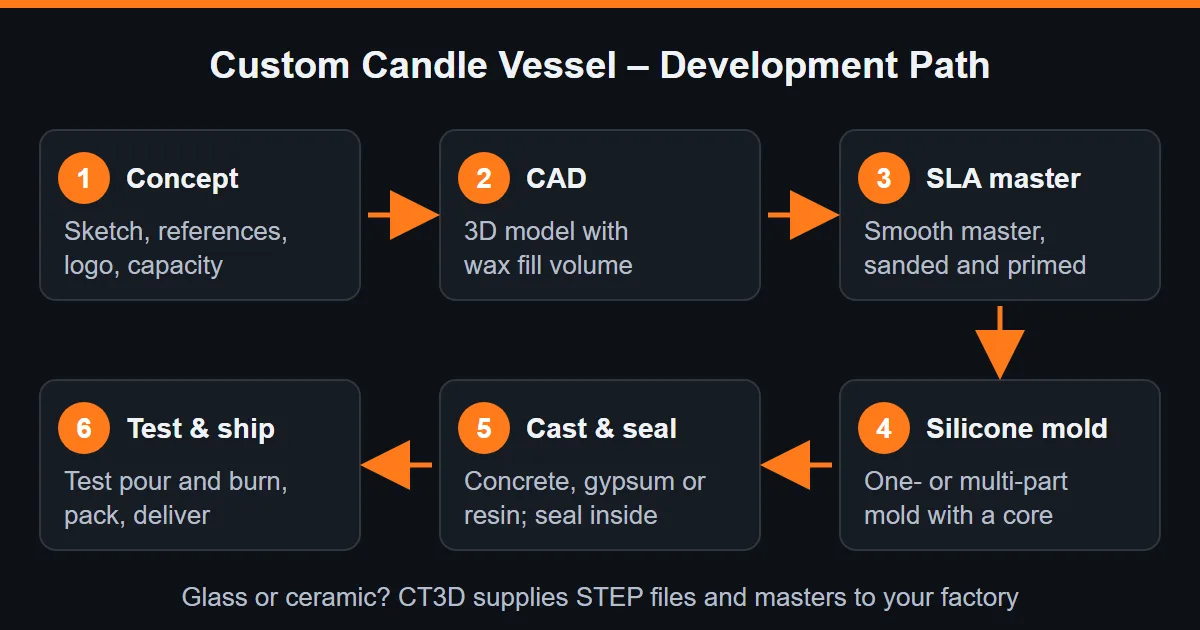
- Concept: sketches, reference images, logo and the capacity you want to sell.
- CAD model: the vessel is modeled with draft angles and parting lines, and the inner volume is calculated so wax and fragrance quantities are known in advance.
- SLA master: a smooth resin master is printed, sanded and primed; a painted 1:1 appearance model can be made first for approval.
- Silicone mold: a one-piece or multi-piece RTV silicone mold with a core forms the vessel cavity.
- Cast and seal: vessels are cast in the chosen material, finished, and sealed inside where the material is porous.
- Test and ship: test wax pours and test burns on representative samples, then impact-resistant packing and delivery.
Materials and Safety Criteria
| Vessel material | Advantages | Points to control |
|---|---|---|
| Concrete, decorative cement | Raw, heavy, good heat resistance, fits minimalist trends | Porous material; the interior must be sealed so wax and fragrance oils do not seep through |
| Gypsum-polymer composites | Crisp casting detail, smooth surface, easy to paint | Heat resistance must be evaluated and the interior fully sealed before pouring wax |
| Casting resins (PU, epoxy) | Lightweight, many colors, sharp relief patterns | Suited to lids, bases and outer decorative sleeves; should not be in direct contact with the flame |
| Glass, ceramic/porcelain | Heat resistant, premium look, common for luxury candles | Produced at specialized factories; CT3D handles design and master patterns |
Source: general material properties in the candle and decorative casting industries.
Safety design parameters our engineers review: wall and base thickness for heat dissipation, mouth diameter-to-height ratio so the flame does not sit too close to the wall, stability (low center of gravity, flat base) and rounded rims to prevent chipping. For porous materials, an interior sealing coat is mandatory.
Design for Molding (DFM) – What Determines Quality
- Draft angle: vessel walls need a slight taper so the core can be pulled easily without tearing the silicone mold.
- Undercuts and relief patterns: deep recessed patterns or ribs against the draw direction require multi-piece molds or a lower Shore A hardness silicone that flexes during demolding.
- Parting line: placed where it is least visible or along a decorative edge to reduce flash removal work.
- Logo: raised or debossed logos need a minimum depth to stay legible after casting and painting.
- Wax fill volume: CAD lets us calculate the exact inner capacity, so wax and fragrance quantities can be set right from the design stage.
Typical design values for cast candle vessels
These are general starting points; our engineers adjust them to your material, size and style during the free DFM review.
| Feature | Typical recommendation | Reason |
|---|---|---|
| Draft on inner walls | Typically 1–3° | The core releases without tearing the silicone |
| Wall thickness | Thicker for concrete and gypsum than for resin; typically 5 mm or more | Strength, heat spread and fewer cracks |
| Base | Flat, wide and slightly thicker than the walls | Stability and a low center of gravity |
| Mouth diameter | Wide enough that the flame stays clear of the wall | Limits wall temperature during burning |
| Rim | Rounded edge | Prevents chipping in use and in transit |
| Logo relief | Raised or debossed, typically 0.5 mm or deeper | Stays legible after casting and painting |
| Undercuts | Avoid, or plan a multi-piece mold | Keeps mold cost and demolding time down |
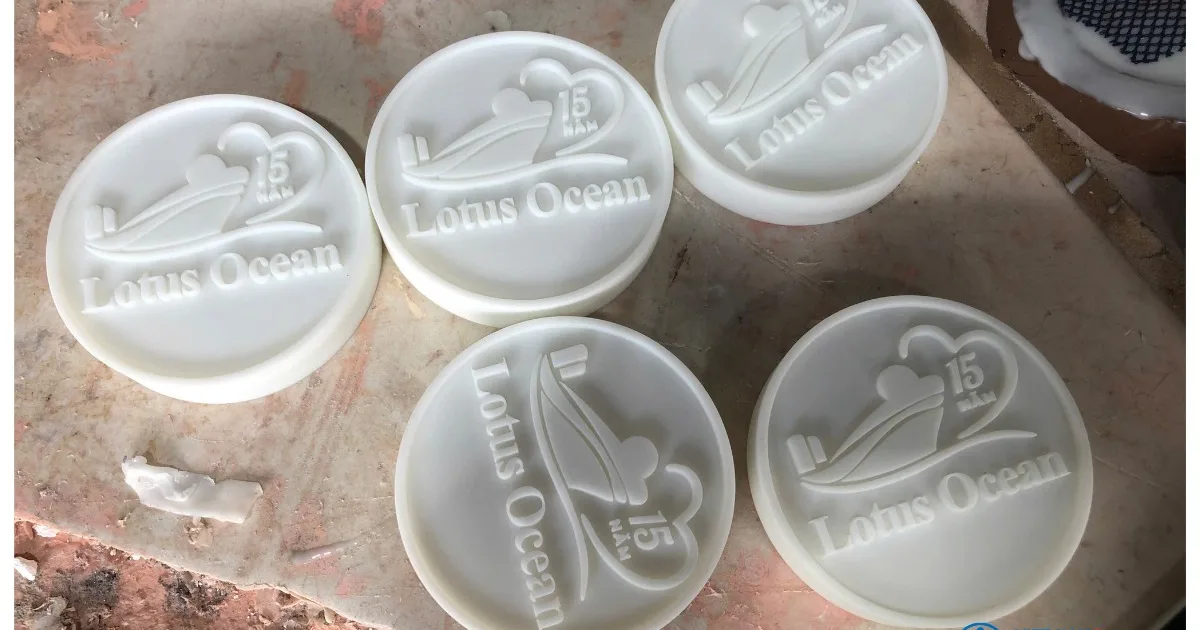
Resin-printed masters have a much smoother surface than FDM prints, which reduces sanding before mold making. See also our articles on making silicone molds from 3D-printed masters and on custom SLA resin 3D printing.
Silicone Molds for Candle Vessels
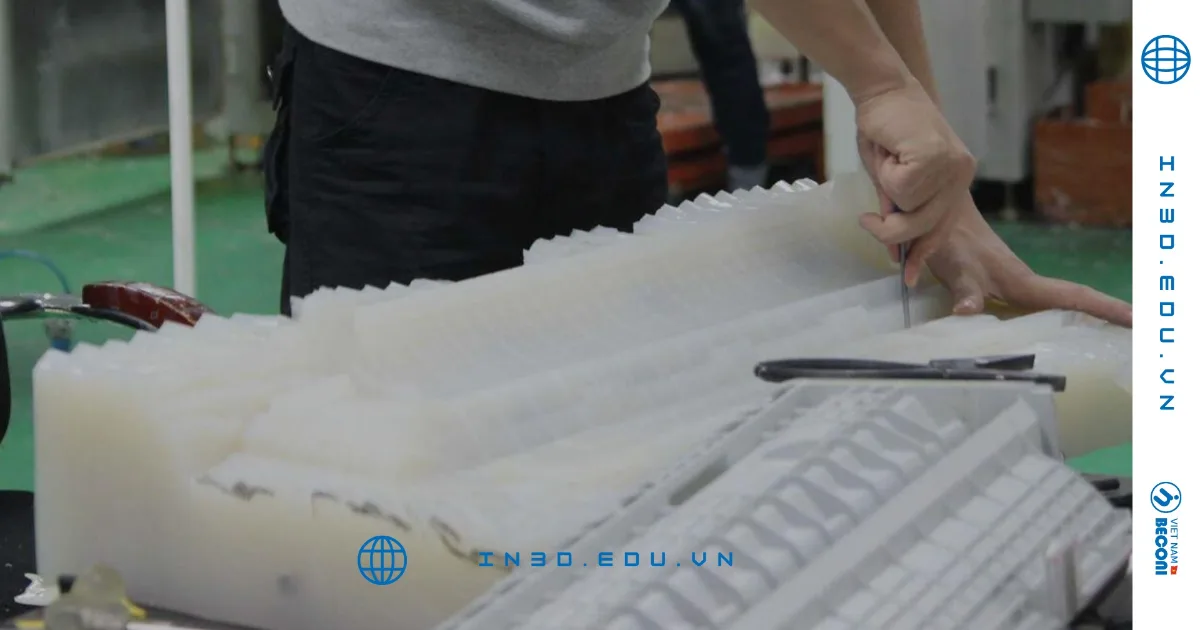
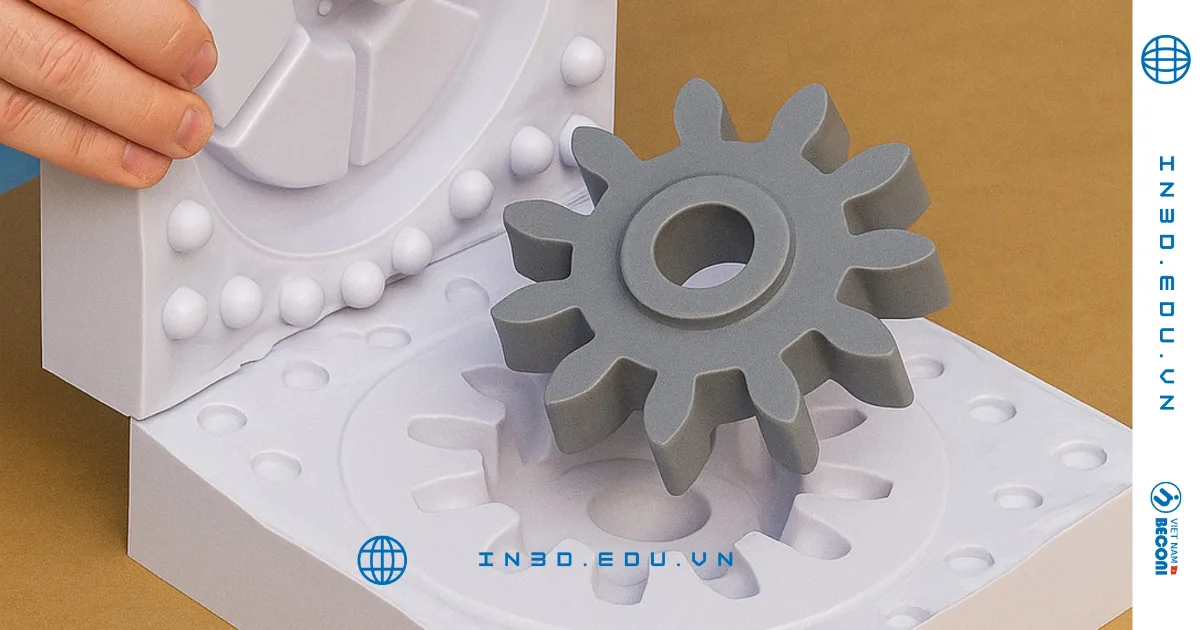
RTV silicone is the usual tooling for candle vessels in small and medium runs. It copies the surface of the master exactly, flexes to release relief patterns, and needs no steel tool. A typical vessel mold has an outer shell and a core that forms the cavity; deep patterns or undercuts call for a multi-piece mold or a softer silicone. Molds wear with use, so for longer runs we track tearing and detail loss and plan replacement molds ahead. Learn more about our silicone mold making and 3D-printed molds and rapid tooling.
Finishing Options
| Finish | Look | Suitable materials |
|---|---|---|
| Natural raw surface | Matte, minimal, slight texture | Concrete, decorative cement |
| Through-color | Pigment mixed into the material, recorded per batch | Concrete, gypsum-polymer, casting resins |
| Painted color | Solid or two-tone colors, matched to your brand | Gypsum-polymer, resin, sealed concrete |
| Faux stone or metallic effect | Stone, metal-look or aged effects | Gypsum-polymer, resin, concrete |
| Interior sealing coat | Invisible from outside; stops wax and oil seeping | Required for porous materials |
| Clear protective topcoat | Matte or gloss, easier to clean | Most cast materials |
For appearance models that look like the final product, see our painting and finishing service and industrial design.
Industry Applications
- Scented candle brands: exclusive vessel lines matched to your brand identity, with logos molded on the body.
- Artisan candle studios: upgrade from off-the-shelf jars to your own designs in moderate quantities using silicone molds.
- Corporate gifts, events and weddings: themed collections featuring names or event emblems.
- Spas, hotels and boutique hospitality: vessels coordinated with the interior, in concrete or faux stone.
- Distributors: new design development for mass production at glass or ceramic factories.
If you want appearance models with colors and textures close to the finished product, see our articles on painting 3D-printed models and on product presentation prototypes.
Choosing a Route: Stock Jar, 3D Print, Silicone Mold or Factory Tooling
| Factor | Off-the-shelf jar | 3D-printed sleeve or vessel | Silicone mold casting (CT3D) | Glass or ceramic factory mold |
|---|---|---|---|---|
| Unique design | No | Yes | Yes | Yes |
| Tooling | None | None | Master and silicone mold | Factory production mold |
| Typical quantity | Any | A few pieces | A few dozen and up per design | Large volumes |
| Materials | Glass, ceramic, tin | Resin (decorative sleeves, not in contact with the flame) | Concrete, gypsum-polymer, casting resin | Glass, ceramic/porcelain |
| CT3D role | – | Design and printing | Design, master, mold, casting, finishing | Design, STEP files and master patterns |
Quality Control
- First article inspection (FAI): the first cast piece is measured and checked for surface quality and sealing before the batch runs.
- Air bubbles and surface pinholes: material degassing and mold vibration for concrete casting; parts with pinholes on visible faces are rejected.
- Color consistency: colors are mixed per batch with recorded ratios to keep color stable between runs.
- Interior sealing: test wax pour, checking the exterior for seepage stains after cooling.
- Test burn: outer wall temperature and cracking are monitored on representative samples.
- Mold life: silicone molds are monitored for tearing and detail wear, with replacement molds planned ahead.
How to Order Custom Candle Vessels
- RFQ: send your concept, reference images, logo, capacity, preferred material and estimated quantity via our Contact form, Zalo or email.
- DFM review: our engineers assess castability and thermal safety, and recommend the material and number of mold pieces.
- Quotation: design, master pattern, mold and per-unit casting costs by quantity are itemized separately, with a schedule.
- Production: CAD modeling, appearance model printing, revisions, master printing, mold making, batch casting.
- QC: dimensional checks, color consistency and interior sealing; test wax pour and test burn on representative samples.
- Delivery: impact-resistant packaging, shipped within Vietnam in 1–3 days after completion or collected at our workshop; international shipping can be arranged on request.
Why Choose CT3D for Candle Vessels
- Design with numbers: the wax fill volume is calculated in CAD before anything is made.
- Thermal safety review: wall, base, mouth ratio and stability are checked before quoting.
- Smooth SLA masters: resin masters need far less sanding than FDM prints, so molds come out cleaner.
- Clear, itemized quotes: design, master, mold and per-piece casting costs are listed separately.
- Tested before delivery: first article inspection, test wax pours and test burns on representative samples.
Frequently Asked Questions
I only have an idea and no drawings. How do I start?
Send reference images and describe the capacity and style you want. CT3D builds the 3D model, sends renderings and prints a 1:1 physical model for approval before making the mold.
Does CT3D manufacture glass or ceramic candle jars?
CT3D handles the design, 3D files and master patterns; glass blowing or ceramic firing is done by specialized factories using these masters.
Will wax seep through a concrete candle vessel?
Concrete is porous, so the interior must be sealed. CT3D performs a test wax pour to check sealing before delivering the batch.
What quantity justifies a silicone mold?
Silicone molds make sense from a few dozen pieces per design upward. For very small quantities, decorative sleeves can be 3D printed directly; CT3D advises case by case.
Can my logo be molded into the vessel?
Yes. Raised or debossed logos are built into the CAD model and reproduced by the master and silicone mold. We give the logo enough depth to stay legible after casting and painting.
How do you make sure a vessel is safe to burn a candle in?
Our engineers review wall and base thickness, the mouth-to-height ratio, stability and rim shape at the design stage. Representative samples are then test-burned while we monitor outer wall temperature and cracking.
Can resin be used for the whole candle vessel?
Casting resins are best for lids, bases and decorative outer sleeves. They should not be in direct contact with the flame, so for the burning container we usually suggest concrete, a suitable composite, glass or ceramic.
Can you ship candle vessels overseas?
Yes. We pack vessels in impact-resistant packaging and deliver across Vietnam in 1–3 days after completion; international shipping can be arranged on request.
Real Footage from the CT3D Workshop
Watch the video Custom SLA 3D Printing and Painting by CT3D to get a clearer picture of our process and part quality. More videos are available on our channel Che Tao Vlog – CT3D.
Contact CT3D – Send Your Files for a Fast Quote
Whether you have 3D files, 2D drawings, photos or just an idea, send it to CT3D. Our engineers will review your files, advise on process and material, and send a quotation with lead time.
- Email: [email protected] – [email protected]
- Phone / Zalo: +84 975 008 728 (Mr. Thai) – +84 985 936 728 (Mr. Dang) – or use our Contact form
- Head office: Binh Duong, Vietnam.
- Workshops: Ho Chi Minh City, Vietnam (several locations).
- Other workshops and drop-off points: Can Tho, Da Nang, Bien Hoa, Ba Ria – Vung Tau, Hanoi, Hai Duong, Hai Phong. Nationwide delivery across Vietnam, with international shipping on request.
- Website: ct3dgroup.com – in3d.edu.vn
CT3D – 3D design & prototyping: 3D printing, 3D scanning, reverse engineering, silicone mold making, paint finishing, CNC machining, composite fabrication, and supply of 3D printers and 3D printing materials.
Ready to Create Your Own Candle Vessel?
Send your sketch, reference images, logo, target capacity and estimated quantity. We review the design free of charge and reply quickly with an itemized quote.