
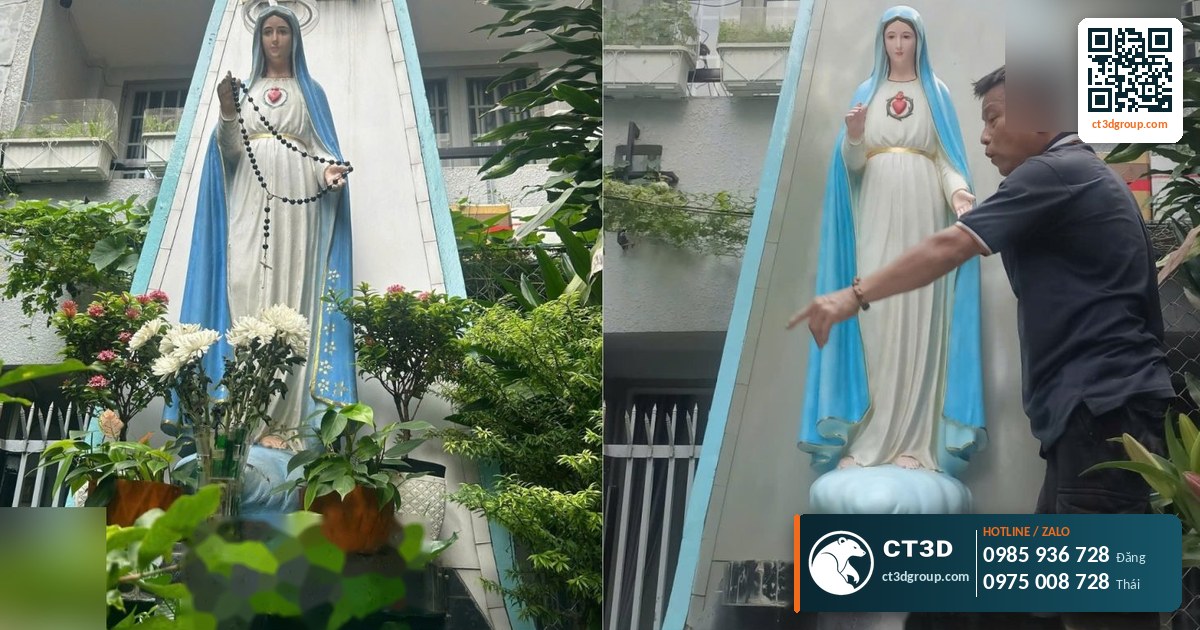
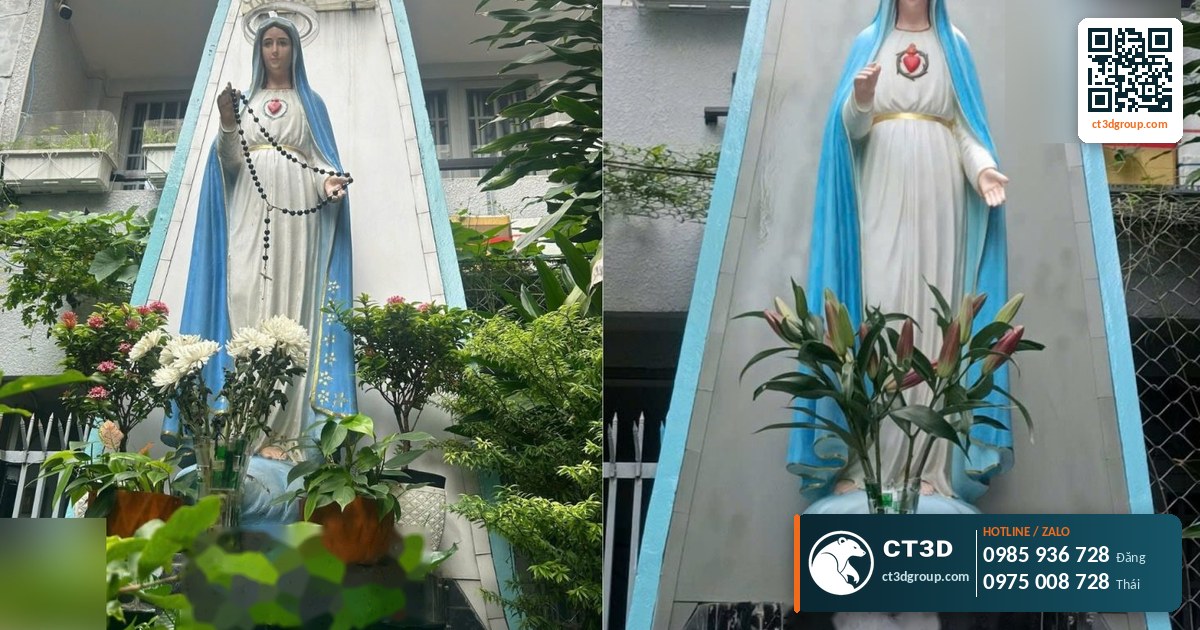
Quick answer: Religious statue 3D printing is a way to make statues of the Buddha, Jesus, the Virgin Mary and the saints with 3D printers instead of entirely by hand. Small statues under 30 cm are printed in one piece in resin; large statues are split into parts that fit resin printers up to 800×800×500 mm and then assembled, as with the 1 m tall Catholic statue CT3D printed in SLA. Layers of 25–100 micron and a tolerance of ±0.05–0.1 mm preserve facial features, clothing folds and hand gestures. Statues over 30 cm are quoted per file; for replication, molds are made from the printed master.
Parishes, pagodas, places of worship and statue workshops usually contact CT3D for three needs: making new statues from a reference model, restoring damaged old statues, and making masters to cast many identical statues. The difficulty with religious statues is not the printer; it is getting the proportions, posture and symbolic details exactly right, and making the statue durable enough to stand in a place of worship for many years. This article dives into the techniques specific to statues. For other types of models, see our pillar article on custom 3D model printing.
How does religious statue 3D printing differ from traditional sculpting?
The traditional method: an artisan sculpts a model in clay or plaster, makes a mold, and casts composite or cement. Every change in size means sculpting again from scratch. The face depends entirely on the sculptor’s skill.
With 3D printing: the figure is built as a digital file on a computer. From one file you can print a 30 cm, 60 cm or 1 m version with identical proportions. The face is refined on screen and renders are sent to the client for approval before printing. Once approved, the printer reproduces the file exactly, with deviations of only a few hundredths of a millimeter.
3D printing does not completely replace the artisan. The soul of the statue still comes from the digital sculptor and the painter. 3D printing only replaces the error-prone manual sculpting stage and the labor-intensive scaling-up stage.
Technical specifications for printing religious statues
| Item | Specification | What it means for the statue |
|---|---|---|
| Main technology | SLA/DLP resin | Smooth surface, clear facial features and robe folds |
| Layer thickness | 25–100 micron | The thinner the layer, the less sanding needed |
| SLA tolerance | ±0.05–0.1 mm | Parts fit together with small seams |
| Smallest detail | down to 0.05 mm | Prayer bead patterns, the Buddha’s spiral curls |
| Largest resin build volume | 800×800×500 mm | Very large single parts, fewer seams |
| Resin temperature during printing | 25–28 °C | Fewer torn layers and stray strands |
| Part tilt angle | 20–45° | Lower peel force, fewer failures on large parts |
| Print failure rate | below 5% | With temperature and tilt angle under control |
Source: CT3D technical documentation and resin workshop experience 2026.
A large build volume is an important advantage. The fewer pieces a statue is split into, the fewer seams need filling and the less likely joints are visible up close. For details on our large-format machines, read large-format resin 3D printing.
Correct proportions and symbols: the modeling stage
Buddha statues: proportions and details that must be right
Buddha statues follow widely recognized iconographic conventions: spiral curls, the ushnisha (the protuberance on top of the head), elongated earlobes, downcast eyes, a lotus-seated or reclining posture, and the mudra (hand gesture). One wrong finger in a mudra changes its meaning. That is why CT3D always asks clients for reference photos or a clear description of the figure (Shakyamuni, Amitabha, Guanyin, Medicine Buddha, etc.) and the hand position.
With reclining Buddhas, the challenge is great length combined with low height. Drawing on the large reclining Buddha CT3D has produced: split parts along the length, place cut lines at robe folds, and never cut through the face or hands.
Catholic statues: facial expression and garments
Statues of Jesus, the Virgin Mary and the saints are usually standing, with arms outstretched or hands joined, and long robes with many folds. Key points are a gentle facial expression, harmonious body proportions, and folds that drape naturally with gravity. The 1 m Catholic statue CT3D printed in SLA is an example: the head and hands were printed separately at fine layers to preserve detail, while the body was printed in large format to minimize seams.
Data sources for modeling
- A reference statue exists: 3D scan it, then edit and scale up. This is the fastest and most faithful method. See our 3D scanning service in Ho Chi Minh City.
- Only photos: digital sculpting based on multi-angle photos; at minimum front, both sides and back views are needed.
- A broken old statue: scan the remaining parts and rebuild what is missing. This process has its own article, statue restoration with 3D scanning; a notable case is the restoration of a statue of Our Lady of La Vang.
Scaling up statues: why cost does not increase linearly
This is something many clients overlook. When a statue is scaled up in height, the amount of material grows much faster:
- Double the height means 4 times the surface area (2²).
- Double the height means 8 times the solid volume (2³).
| Statue height | Scale factor vs 25 cm statue | Surface (paint quantity, sanding labor) | Volume if printed solid |
|---|---|---|---|
| 25 cm | ×1 | ×1 | ×1 |
| 50 cm | ×2 | ×4 | ×8 |
| 75 cm | ×3 | ×9 | ×27 |
| 100 cm | ×4 | ×16 | ×64 |
Source: geometric similarity (area scales with the square, volume with the cube of the scale factor).
That is why statues from about 30 cm up are always hollowed. When hollow with a fixed wall thickness, resin usage grows roughly with surface area (×16 for a 1 m statue vs 25 cm) rather than volume (×64). Hollow statues are also lighter, shrink less and crack less. Resin drain holes at the base or in hidden areas are mandatory so the liquid resin inside can be washed out. For wall thickness and drain hole rules, see designing files for resin printing.
This is also why market price lists only go up to the 20–30 cm resin group (3–7 million VND, ≈ US$115–270; indicative market rates, not CT3D pricing), while anything above 30 cm is quoted “per file”. Every large statue has a different pose, degree of hollowing and part count.
Choosing materials based on where the statue will be placed
| Option | Best for | Advantages | Notes |
|---|---|---|---|
| Direct resin print + paint | Indoor statues, altars, one to a few statues | Sharpest detail, fastest | Avoid prolonged direct sunlight; needs a UV-protective coating |
| Printed master → silicone mold → polyresin casting | Many identical small to medium statues | Cost per statue falls as quantity rises | Initial mold making takes time |
| Printed master → mold → composite | Large outdoor statues | Better resistance to sun and rain, can be reinforced with fiberglass | Requires specialized outdoor paint |
| CNC foam + composite coating | Very large statues several meters tall | Not limited by printer build volume | Facial details are usually 3D printed separately and attached |
Source: CT3D service capabilities (resin printing, silicone molds, CNC foam machining, composite fabrication).
For outdoor statues, CT3D generally does not recommend a direct resin print as the final statue. Instead, the print is used as a master to make a mold and cast composite. See our composite statue production capabilities. For the mold process, see making a silicone mold from a 3D print.
Splitting and assembling large statues
Part-splitting principles
- Never cut through the face, hands or mudra. These are the areas viewers look at most closely.
- Place cut lines at robe folds, belts, collars and the base: seams that follow natural contours are hard to see.
- Each part must fit the build volume and still be tiltable 20–45°. A part that just fits but cannot be tilted is more prone to failure.
- Add locating pins and holes so parts align correctly without shifting.
Example: a 1 m statue
A 1,000 mm tall statue exceeds the 500 mm height and 800 mm side of the build volume, so at minimum it must be split by height. In practice, a 1 m standing statue is usually split into: head, two arms, upper body, lower body and base. The head and hands are printed separately at fine layers for maximum sharpness; the body is printed in large format. After assembly, seams are filled, sanded and primed in multiple coats until the joins disappear.
Internal reinforcement
Tall hollow statues that are top-heavy (outstretched arms, a large head) should have an internal reinforcing core: a metal tube or rod running through the body into the base, or extra material poured into the base to lower the center of gravity. This keeps the statue stable and hard to knock over during cleaning.

Common defects in 3D printed religious statues
| Defect | Cause | Fix |
|---|---|---|
| Face looks “off”, not serene | Modeled from too few photo angles, insufficient review | Review multi-angle renders before printing; refine the eyes and mouth corners |
| Seams appear after a few months | Hasty seam filling, materials expanding differently | Bond with resin-compatible adhesive, fill in multiple layers, seal with primer |
| Cracked base | Liquid resin trapped inside a hollow statue with no drain holes | Drill drain holes, wash thoroughly, cure fully under UV |
| White paint yellowing | Direct sunlight, no protective coating | Apply a UV-resistant topcoat; place under a roof |
| Large part fails during printing | Large layer area, insufficient supports | Tilt 20–45°, keep resin at 25–28 °C, add supports |
Source: CT3D workshop experience.
Statue finishing: porcelain white, faux bronze, metallic gold
Religious statues have several popular paint styles: single-color porcelain white, faux bronze (red bronze, patinated bronze), metallic gold, faux stone, and traditionally colored robes. Market rates of 200,000–500,000 VND (≈ US$8–19) per piece for single-color painting and 600,000–2 million VND (≈ US$23–77) per piece for airbrushing apply to small models; large statues are priced by surface area and complexity. Prices are indicative. For faux bronze and faux stone techniques, read painting 3D printed models. The washing, curing and sanding steps before painting are covered in resin print post-processing.
CT3D’s religious statue production process
- Send your materials: photos of the reference statue, a 3D file, or bring the statue to our workshop for scanning. Send via our website, Zalo or email.
- Confirm requirements: figure, posture, height, placement (indoor/outdoor), paint colors, quantity.
- Engineering review: build or edit the file, propose part splits, hollowing and reinforcement, and estimate materials.
- Quote with lead time, plus renders for approving the face, hands and garments.
- Production: printing, post-processing, assembly, filling and painting; for replication, mold making and casting.
- Delivery: small statues ship via Viettel Post, Giao Hang Tiet Kiem, Vietnam Post or air freight; large statues are delivered to your site or picked up at the workshop. Nationwide within 1–3 days of completion.
Checklist before ordering a statue
- Reference photos clearly showing the face and hands, from at least 4 angles.
- Statue height and base height (if any).
- Placement: indoors, outdoors, covered or not.
- Paint style and color reference photos.
- Quantity and required date (feast day, inauguration).
Real-world applications
Published CT3D projects include the restoration of a statue of Our Lady of La Vang, a large reclining Buddha, and a 1 m tall Catholic statue printed in SLA. 3D printing is also well suited to small statues for home altars, holiday gift statues, masters for polyresin statue foundries, and scaled-down statues for clients to approve before the full-size version is made. Approving a 20–30 cm version first is a cost-saving approach: if the face needs changes, you only edit the file and reprint the small version instead of remaking the large statue. For an overview of other model types, see our article on custom 3D model printing.
FAQ about religious statue 3D printing
Can a 3D printed Buddha statue have correct proportions and the right mudra?
Yes, if the file is modeled from clear reference photos and the client carefully reviews renders before printing. The printer reproduces the file with a tolerance of about ±0.05–0.1 mm.
Can resin-printed statues be placed outdoors?
Not recommended for long-term use in direct sunlight. Outdoor statues should use the print as a master, then a mold, composite casting and outdoor paint.
How tall can a statue be printed in one piece?
It depends on the pose; CT3D’s largest resin build volume is 800×800×500 mm. Taller statues or those with wide outstretched arms are split into parts and assembled.
How much does it cost to 3D print a religious statue?
Statues over 30 cm are quoted per file because cost depends on hollowing, part count and painting. The market rate for 20–30 cm resin statues is 3–7 million VND (≈ US$115–270), not CT3D pricing.
Can you make many identical statues?
Yes. CT3D prints one master, makes a silicone mold and then casts polyresin or composite copies.
Real footage from the CT3D workshop
Watch the video Making a 4-meter Buddha statue master with 3D printing and CNC by CT3D to get a clearer picture of the process and product quality. More videos are available on the Che Tao Vlog – CT3D channel.
Contact CT3D – send your file, get a fast quote
Whether you have a 3D file, a 2D drawing, photos or just an idea, you can send it to CT3D. Our engineers will check the file, advise on technology and materials, and send a quote with a delivery time.
- Email: [email protected] – [email protected]
- Hotline / Zalo: +84 975 008 728 (Mr. Thai) – +84 985 936 728 (Mr. Dang), or use our contact form
- Head office: Binh Duong.
- Workshops in Ho Chi Minh City: Linh Trung (Thu Duc), Tam Binh (Thu Duc), District 6 (former).
- Other workshops and drop-off points: Can Tho, Da Nang, Bien Hoa, Ba Ria – Vung Tau, Hanoi, Hai Duong, Hai Phong. Nationwide delivery.
- Website: ct3dgroup.com – in3d.edu.vn
CT3D – 3D design & prototyping: 3D printing, 3D scanning, reverse engineering, silicone mold making, paint finishing, CNC machining, composite fabrication, and supply of 3D printers and 3D printing resins.
Danh sách cửa hàng:
CT3D là đơn vị cung cấp trọn gói các dịch vụ thiết kế và sản xuất theo yêu cầu tại TP.HCM và khu vực lân cận (Bình Dương, Đồng Nai, Long An…). Với năng lực khép kín từ thiết kế 3D, in 3D (FDM, resin/SLA, SLS, in 3D kim loại), scan 3D – thiết kế ngược, làm khuôn, đúc composite – poly resin – poly stone đến gia công CNC và sơn màu hoàn thiện, CT3D đồng hành cùng khách hàng qua toàn bộ quy trình – từ ý tưởng, bản vẽ hay sản phẩm mẫu đến thành phẩm hoàn chỉnh. Dù bạn cần tạo mẫu nhanh, sản xuất số lượng, chế tác tượng – mô hình – quà tặng hay linh kiện kỹ thuật, đội ngũ CT3D sẽ tư vấn công nghệ và vật liệu phù hợp, đảm bảo sản phẩm sắc nét, đúng yêu cầu và tối ưu chi phí. Khách hàng tại TP.HCM và vùng lân cận có thể trao đổi trực tiếp, gửi file online và nhận sản phẩm thuận tiện, hỗ trợ cả đơn gấp lẫn dự án số lượng.
CT3D cung cấp trọn gói các dịch vụ thiết kế và sản xuất theo yêu cầu, phục vụ khách hàng tại Hà Nội và các tỉnh lân cận (Bắc Ninh, Hưng Yên, Hải Phòng, Vĩnh Phúc…). Với năng lực khép kín từ thiết kế 3D, in 3D (FDM, resin/SLA, SLS, in 3D kim loại), scan 3D – thiết kế ngược, làm khuôn, đúc composite – poly resin – poly stone đến gia công CNC và sơn màu hoàn thiện, CT3D đồng hành cùng khách hàng qua toàn bộ quy trình – từ ý tưởng, bản vẽ hay sản phẩm mẫu đến thành phẩm hoàn chỉnh. Quy trình làm việc thuận tiện: bạn gửi file 3D hoặc mô tả ý tưởng qua online, đội ngũ CT3D tư vấn công nghệ – vật liệu, báo giá nhanh và giao hàng tận nơi tại Hà Nội. Dù bạn cần tạo mẫu nhanh, sản xuất số lượng, chế tác tượng – mô hình – quà tặng hay linh kiện kỹ thuật, CT3D đều đáp ứng với sản phẩm sắc nét, đúng yêu cầu và tối ưu chi phí.

