
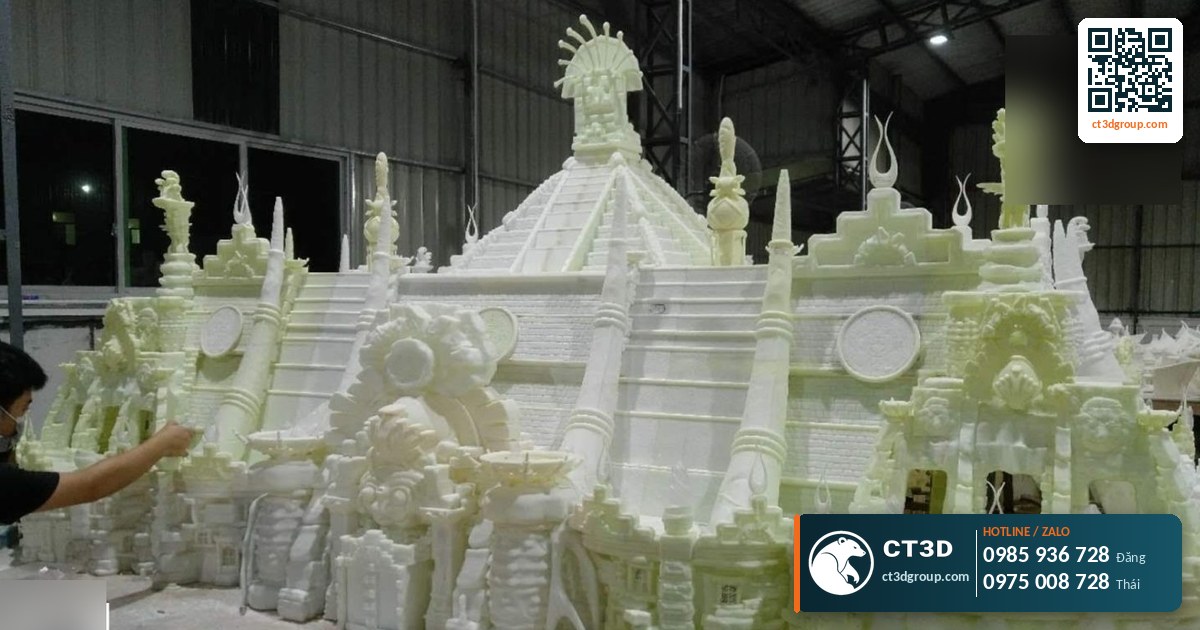
Quick answer: Large-format resin 3D printing means SLA printing on machines with a build volume of up to 800 × 800 × 500 mm, making it possible to produce statues and large product models in one piece or with very few joints, at 25–100 micron layers and a tolerance of ±0.05–0.1 mm. Large models are almost always hollowed into a shell a few millimeters thick to save resin, reduce cracking and cut weight. 2026 Ho Chi Minh City market rates: a 20–30 cm resin model costs about 3–7 million VND (≈ US$115–270); over 30 cm is quoted per file (not CT3D prices).
When a customer needs a half-meter statue, a 1:1 scale product model or a trade show display piece, the first question is always: can it be printed in one piece, or does it have to be split and assembled? The larger the model, the more the engineering challenges differ from small prints: peel forces, resin weight, shrinkage stress, UV curing and transport. This article analyzes those challenges. For an overview of resin technologies, materials and prices, see our pillar article on resin 3D printing.
What Can an 800 × 800 × 500 mm Large-Format Resin Printer Produce?
A build volume of 800 × 800 × 500 mm means a model can be up to 800 mm wide in both horizontal directions and up to 500 mm tall in the build direction. If a model is taller than 500 mm but narrow, it can be laid down or tilted to use the 800 mm dimension. That is why a statue about 700 mm tall can still be printed in one piece when laid down, depending on its shape.
This build size is suited to:
- Large statues and reliefs: religious statues, portrait statues, mascots, and masters for composite or bronze casting.
- 1:1 scale product models: machine housings, vehicle light assemblies, household appliances, and medical devices for demonstration.
- Architectural models and site models: highly detailed building massing with few joints.
- Mold masters: for silicone molds and composite molds for large products.
For models larger than the build volume, CT3D splits the model into modules, prints them separately and assembles them with locating pins. CT3D’s published projects include a 1 m tall Catholic statue printed in SLA, a large reclining Buddha, the restoration of an Our Lady of La Vang statue, and a Ca Mau shrimp model.
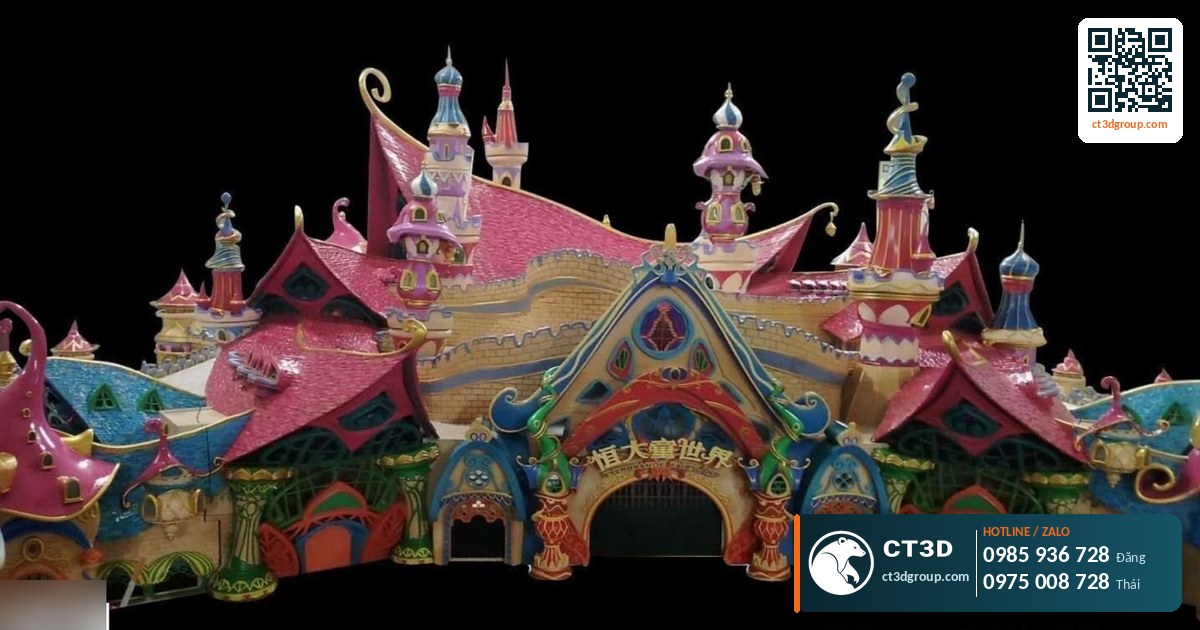
Large-Format Resin Printing Specifications
| Parameter | Value | Notes |
|---|---|---|
| Maximum build volume | 800 × 800 × 500 mm | Larger models are split into modules and assembled |
| SLA layer thickness | 25–100 microns | Large models are usually printed at 50–100 microns to balance print time |
| SLA tolerance | ±0.05–0.1 mm | On large models, cumulative shrinkage also plays a role |
| Smallest detail | Down to 0.05 mm | Preserves drapery folds, facial features, raised lettering |
| Model tilt angle | 20–45° | Reduces the area of each layer and the peel force |
| Resin temperature | 25–28 °C | Large resin vats need uniform temperature control |
| Resin print failure rate | Below 5% | Thanks to tilting and resin temperature control |
Source: CT3D technical documentation.
Why Must Large Resin Models Be Hollowed? A Weight Calculation
Liquid resin has a density of about 1.1–1.2 g/cm³, slightly heavier than water. Small models can be printed solid without issue, but large solid prints face three problems: they are very heavy, use a lot of resin, and are prone to cracking from bulk shrinkage during curing.
Take a bust with a solid volume of about 25 liters (25,000 cm³) and a surface area of about 0.5 m² (5,000 cm²):
| Option | Resin volume | Weight (≈1.15 g/cm³) | Raw resin cost (0.8–3 million VND/kg ≈ US$31–115/kg) |
|---|---|---|---|
| Solid print | ≈ 25,000 cm³ | ≈ 28.8 kg | ≈ 23–86 million VND (≈ US$885–3,300) |
| Hollowed, 3 mm shell | ≈ 5,000 × 0.3 = 1,500 cm³ | ≈ 1.7 kg | ≈ 1.4–5.2 million VND (≈ US$54–200) |
| Hollowed, 4 mm shell + ribs | ≈ 2,200 cm³ | ≈ 2.5 kg | ≈ 2–7.6 million VND (≈ US$77–290) |
Source: illustrative calculation; raw resin prices are indicative 2026 Ho Chi Minh City market rates, not CT3D prices. Excludes supports, machine time and post-processing.
On material cost alone, hollowing saves more than 90% – not to mention that a lighter model is easier to transport and install. That is why, when we receive a file for a large statue, the first thing CT3D engineers do is hollow it and lay out the drain holes.
Drain holes and vent holes
A hollow model must have a resin drain hole at the lowest point during printing and a vent hole at the highest point. Without them, the hollow interior acts like a “suction cup”: each time the build plate rises, the vacuum inside pulls hard on the model walls, causing layer tearing or cracks. Liquid resin trapped inside can also seep out later and cause cracking. Holes are usually placed on the base or in a spot hidden when the piece is displayed, then plugged. Detailed guidance on wall thickness and drain holes is in our article on resin print file design.
Print in One Piece or Split into Modules?
Peel force – the enemy of large models
On vat-based resin printers, each freshly cured layer sticks to the bottom of the vat and must be “peeled” off as the build plate rises. The peel force is proportional to the layer’s cross-sectional area. Large models have large cross-sections, so the peel force is very high and can tear the model off its supports, rip layers apart or cause “spaghetti” failures. How to reduce it: tilt the model 20–45° so each layer’s cross-section is smaller, hollow it, and place dense supports in load-bearing areas.
When to print in one piece
- The model fits within 800 × 800 × 500 mm once tilted.
- The surface must be seamless, with no joints on the main faces (face, drapery).
- The model will be used as a mold master and needs a uniform surface.
When to split into modules
- The model exceeds the build volume or is too tall to print tilted.
- The model has long protrusions (arms, spears, wings) that can break during printing and transport.
- It must be shipped long distances and installed on site.
- You want to run several machines in parallel to shorten lead time.
When splitting into modules, CT3D cuts along the model’s natural lines (drapery folds, arm joints, contours) to hide the seams, adds locating pins and holes for accurate alignment, then bonds, fills, sands and paints so the seams disappear.
| Criterion | One-piece print | Modular print and assembly |
|---|---|---|
| Surface | Seamless | Has seams, which can be filled and painted |
| Print failure risk | One failure loses the whole model | A failure means reprinting only one module |
| Lead time | One machine runs for a long time | Several machines run in parallel |
| Transport | Bulky, needs a large crate | Compact, assembled on site |
| Maximum size | Limited by the build volume | Virtually unlimited |
Source: CT3D production experience.
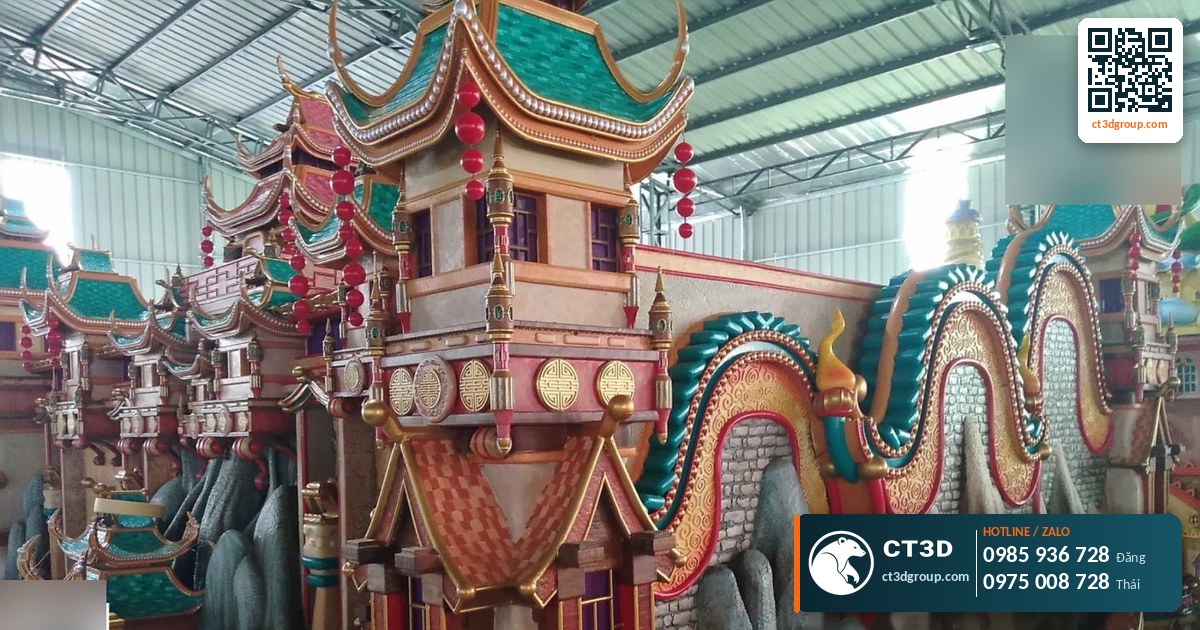
Common Large-Format Resin Printing Problems and How to Fix Them
| Problem | Cause | Fix |
|---|---|---|
| Model collapses mid-print | Weak supports, high peel force, large cross-section | Tilt the model, add supports in load-bearing areas, hollow it |
| Layer tearing or delamination | Suction cup effect, cold resin | Vent holes, keep resin at 25–28 °C |
| Cracks after a few days | Trapped liquid resin, shrinkage stress | Drain holes, thorough internal washing, even curing |
| Warping of large flat surfaces | Uneven UV curing, thin walls without ribs | Add ribs, cure while rotating from several sides |
| Misaligned seams | No locating pins, shrinkage differences between modules | Locating pins and holes, print all modules from the same resin batch |
| Breakage during transport | Thin protrusions, inadequate packaging | Detach protrusions, wooden crates, foam padding |
Source: CT3D production experience.
A general analysis of collapsed prints, “spaghetti” failures and layer tearing is in our article on common resin 3D printing problems.
How Is Post-Processing Different for Large Resin Models?
Small models can be dipped in a wash tank and placed in a UV curing box. Large models cannot. They must be washed with spray bottles and brushes, including the hollow interior via the drain holes. UV curing requires high-power lamps or rotating exposure from several sides to cure evenly; if one side cures more than the other, the model will warp. Then come support removal, sanding, seam filling, priming and painting. The detailed wash, cure, sand and paint process is in our article on resin print post-processing.
As for lead time, market norms are: 1–3 days for typical models from ready files; 3–7 days if modeling is needed; 7–14 days with painting. Large-format models with a painted finish usually fall into the longest group because of print time, paint drying time and inspection.
Case Example: A 1 m Religious Statue
For a statue 1 m tall – exceeding the 500 mm height and possibly even the 800 mm dimension when laid down – the typical approach is: (1) get a 3D file from the sculptor or from a 3D scan of the original statue; (2) hollow the shell and add internal ribs; (3) split into 2–4 modules along drapery folds, at the waist or at the base; (4) print each module in SLA, tilted 20–45°; (5) assemble with locating pins, then fill and sand the seams; (6) apply the finished paint. If many copies of the statue are needed, the print serves as a master for making a mold and casting in composite or polyresin. See also our article on 3D printing religious statues.
Checklist for Ordering Large-Format Resin Printing from CT3D
- 3D file (STL, OBJ, 3MF, STEP). If you only have a physical statue or photos, CT3D offers 3D scanning and modeling.
- Final dimensions (height × width × depth) and scale relative to the file.
- One-piece print or assembly acceptable; which faces must not have seams.
- Finish: raw, primed or fully painted.
- Delivery location, whether on-site installation is needed, and the deadline.
CT3D process: send file → technical requirements → engineering review, hollowing and weight calculation → quote with lead time → production → door-to-door delivery or pick-up at the workshop. Nationwide delivery in 1–3 days after completion; large models are crated with foam padding. See the large-format SLA printing service at in3d.edu.vn or our large-format 3D printing page. If you are comparing large-format resin with other resin options, read our pillar article on resin 3D printing.
Frequently Asked Questions
What is the largest size CT3D’s resin printers can produce?
The resin build volume goes up to 800 × 800 × 500 mm. Larger models are split into modules, printed separately, then assembled with locating pins and the seams finished.
Are large resin statues heavy?
If hollowed, they are quite light. For example, a statue with a solid volume of 25 liters would weigh nearly 29 kg printed solid, but hollowed with a 3 mm shell it uses only about 1.7 kg of resin.
How long does large-format resin printing take?
At market norms: 1–3 days for typical models from ready files, 3–7 days if modeling is needed, 7–14 days with painting. Large-format painted models usually take longer.
How much does large-format resin printing cost?
2026 Ho Chi Minh City market rates: a 20–30 cm resin model costs about 3–7 million VND (≈ US$115–270); over 30 cm is quoted per file. These are not CT3D prices and are indicative only.
Will the seams show on a statue printed in several parts?
If the model is cut along its natural lines, with locating pins, and the seams are filled, sanded and painted properly, they are virtually invisible.
Real Footage from the CT3D Workshop
Watch the video Large-format SLA 3D printing with a smooth surface, produced by CT3D, to get a clearer picture of the process and the quality of the finished parts. More videos are available on our channel Che Tao Vlog – CT3D.
Contact CT3D – Send Your File, Get a Fast Quote
Whether you have a 3D file, a 2D drawing, photos or just an idea, you can send it to CT3D. Our engineers will check the file, recommend the right technology and material, and send you a quote with a lead time.
- Email: [email protected] – [email protected]
- Hotline / Zalo: +84 975 008 728 (Mr. Thai) – +84 985 936 728 (Mr. Dang), or use our contact form
- Head office: Binh Duong.
- Workshops in Ho Chi Minh City: Linh Trung (Thu Duc), Tam Binh (Thu Duc), and former District 6.
- Other workshops and drop-off points: Can Tho, Da Nang, Bien Hoa, Ba Ria – Vung Tau, Hanoi, Hai Duong, Hai Phong. Nationwide delivery.
- Website: ct3dgroup.com – in3d.edu.vn
CT3D – 3D design & prototyping: 3D printing, 3D scanning, reverse engineering, silicone mold making, painting and finishing, CNC machining, composite fabrication, and supply of 3D printers and 3D printing materials.
Danh sách cửa hàng:
CT3D là đơn vị cung cấp trọn gói các dịch vụ thiết kế và sản xuất theo yêu cầu tại TP.HCM và khu vực lân cận (Bình Dương, Đồng Nai, Long An…). Với năng lực khép kín từ thiết kế 3D, in 3D (FDM, resin/SLA, SLS, in 3D kim loại), scan 3D – thiết kế ngược, làm khuôn, đúc composite – poly resin – poly stone đến gia công CNC và sơn màu hoàn thiện, CT3D đồng hành cùng khách hàng qua toàn bộ quy trình – từ ý tưởng, bản vẽ hay sản phẩm mẫu đến thành phẩm hoàn chỉnh. Dù bạn cần tạo mẫu nhanh, sản xuất số lượng, chế tác tượng – mô hình – quà tặng hay linh kiện kỹ thuật, đội ngũ CT3D sẽ tư vấn công nghệ và vật liệu phù hợp, đảm bảo sản phẩm sắc nét, đúng yêu cầu và tối ưu chi phí. Khách hàng tại TP.HCM và vùng lân cận có thể trao đổi trực tiếp, gửi file online và nhận sản phẩm thuận tiện, hỗ trợ cả đơn gấp lẫn dự án số lượng.
CT3D cung cấp trọn gói các dịch vụ thiết kế và sản xuất theo yêu cầu, phục vụ khách hàng tại Hà Nội và các tỉnh lân cận (Bắc Ninh, Hưng Yên, Hải Phòng, Vĩnh Phúc…). Với năng lực khép kín từ thiết kế 3D, in 3D (FDM, resin/SLA, SLS, in 3D kim loại), scan 3D – thiết kế ngược, làm khuôn, đúc composite – poly resin – poly stone đến gia công CNC và sơn màu hoàn thiện, CT3D đồng hành cùng khách hàng qua toàn bộ quy trình – từ ý tưởng, bản vẽ hay sản phẩm mẫu đến thành phẩm hoàn chỉnh. Quy trình làm việc thuận tiện: bạn gửi file 3D hoặc mô tả ý tưởng qua online, đội ngũ CT3D tư vấn công nghệ – vật liệu, báo giá nhanh và giao hàng tận nơi tại Hà Nội. Dù bạn cần tạo mẫu nhanh, sản xuất số lượng, chế tác tượng – mô hình – quà tặng hay linh kiện kỹ thuật, CT3D đều đáp ứng với sản phẩm sắc nét, đúng yêu cầu và tối ưu chi phí.

