
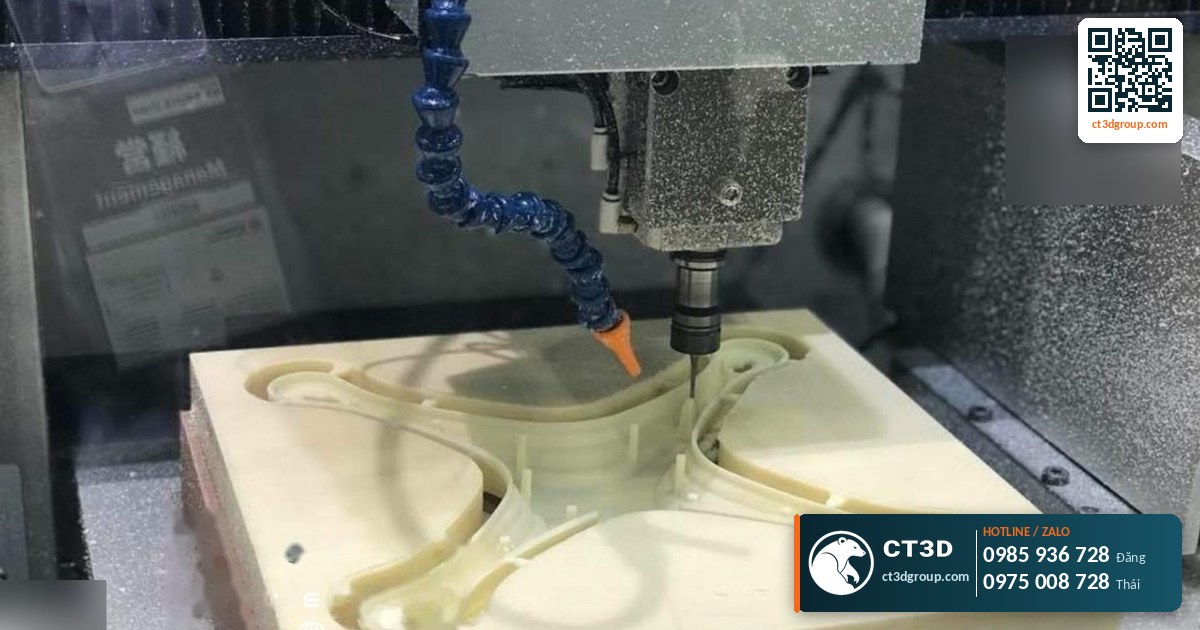
Quick answer: Metal 3D printing (SLM) vs CNC machining is not an either/or choice; the two complement each other. Choose 3D printing when a part has complex geometry, internal channels, needs lightweighting, is needed in small quantities, or when most of a solid billet would be cut away. SLM printing at CT3D achieves ±0.02 mm, a surface roughness of 6–10 µm, and up to 90% less scrap. Choose CNC when the part is a simple prismatic block, needs very smooth mating surfaces, or is made in large quantities. Most precision metal printed parts still need their mating surfaces CNC machined.
When customers ask CT3D “should this part be printed or milled?”, the answer is almost never one word. Some parts are far cheaper to mill. Some are nearly impossible to mill. And many need both: print the near-net shape, then CNC the critical surfaces. This article helps you evaluate your part before sending the file. If you are not yet familiar with SLM, you may want to read our overview of metal 3D printing first. Here CT3D focuses only on comparing the two methods, estimating cost and combining them.
Different principles: additive vs subtractive
CNC is a subtractive process. The machine starts from a solid billet and the tool cuts away the excess. Every surface must be reachable by the tool. Internal corners always have a radius equal to the tool radius. Deep holes, curved internal channels and enclosed cavities are very difficult or impossible.
SLM 3D printing is an additive process. The machine spreads a thin layer of metal powder, a laser melts the required areas, then the next layer is spread. The part grows from the bottom up. Internal geometry is hardly limited by tool access. However, shallow overhangs need supports, and the surface has a certain roughness from adhered powder particles.
These two principles lead to completely different cost structures, which is the key to choosing correctly. Our article What is CNC machining? explains CNC basics if you need them.
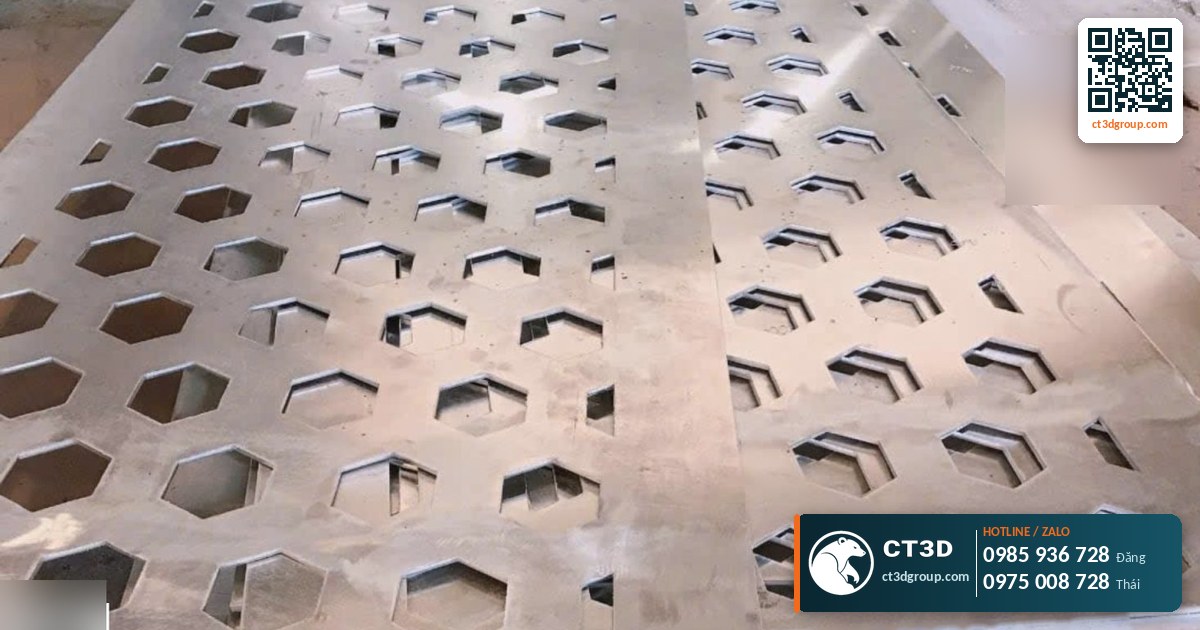
Metal 3D printing vs CNC compared criterion by criterion
| Criterion | SLM metal 3D printing (CT3D) | CNC machining |
|---|---|---|
| Principle | Additive, layer by layer | Subtractive, from billet |
| Accuracy | ±0.02 mm | Very high, depends on machine and fixturing |
| Surface roughness | 6–10 µm as printed | Much lower, can achieve a polished finish |
| Complex shapes, internal channels | Possible | Very limited |
| Scrap | Up to 90% less than machining | Depends on billet-to-part ratio |
| Minimum quantity | From 1 part | From 1 part, but programming and fixturing costs are spread over few parts |
| Part size | 250×250×300 mm (modular joining possible) | Depends on machine travel |
| Material strength | Equal to or 10–15% higher than casting | Per rolled/forged stock |
| Hard-to-machine materials (titanium, Inconel) | Little effect on print time | Rapid tool wear, slow cutting |
| Post-processing | Stress relief, base plate removal, CNC of mating faces, bead blasting, polishing | Usually just deburring and surface treatment |
Source: SLM specifications from CT3D capability documentation 2026; CNC characteristics based on general machining knowledge.
How are 3D printing and CNC costs built up?
CT3D does not give specific figures here, because both metal printing and CNC are quoted per file. But understanding the cost structure lets you compare for yourself.
What drives SLM printing cost?
In short: Print cost ≈ V × powder price + H × machine-hour rate + setup cost + post-processing.
- V is the part volume plus supports. The smaller the volume, the less powder is used.
- H is machine hours. H depends mainly on the volume to be laser-scanned and the number of layers. Layer count is determined by part height, so a tall part runs longer than a short part of the same volume.
- Many small parts can be nested in one build, sharing recoating time. This is how unit cost drops with larger orders.
The key point: with 3D printing, complexity barely increases cost. Between a solid block and a hollow lattice block of the same height, the hollow one is usually cheaper because it has less volume.
What drives CNC cost?
CNC cost ≈ billet price + programming + fixturing + cutting time × machine-hour rate + tooling.
- Billet price is based on the bounding block, not the finished part.
- Cutting time increases with the amount of material removed and how hard the material is to cut.
- Every re-clamping or flip adds time and potential error.
- Programming and fixturing are fixed costs spread over the quantity. The higher the quantity, the cheaper CNC becomes per part.
Billet-to-part ratio: a quick decision metric
The aerospace industry uses a “buy-to-fly” ratio: the weight of raw material purchased divided by the weight of the finished part. You can use a similar approach. Divide the bounding box volume (length × width × height) by the part volume in your CAD software. If the ratio is low, close to 1, the part is essentially a solid block and CNC usually wins. If the ratio is high, most of the billet will end up as chips. Then 3D printing has a clear advantage, especially with expensive, hard-to-machine materials like titanium and Inconel.
Example: an L-shaped bracket with thin ribs. Its bounding box is very large compared with its actual volume. If milled, almost the entire billet is cut away. If printed, you only pay for the bracket volume plus supports. Conversely, a thick, solid round flange has a ratio near 1, so milling or turning makes sense.
Five questions to decide between printing and milling
- Does the part have internal channels, enclosed cavities or internal lattice structures? Yes → 3D printing is almost the only option.
- Is the bounding-box-to-part ratio high? High → lean toward printing.
- Is the material hard to machine? Titanium, Inconel, hardened tool steel → printing has the advantage.
- What is the quantity? A few to a few dozen → printing is usually competitive. Hundreds or thousands of simple parts → CNC or casting.
- Are there surfaces that need very tight tolerances or a high polish? Yes → whether printed or not, those surfaces still need CNC.
If three of the five answers point toward printing, CT3D usually recommends printing combined with CNC on the mating surfaces.
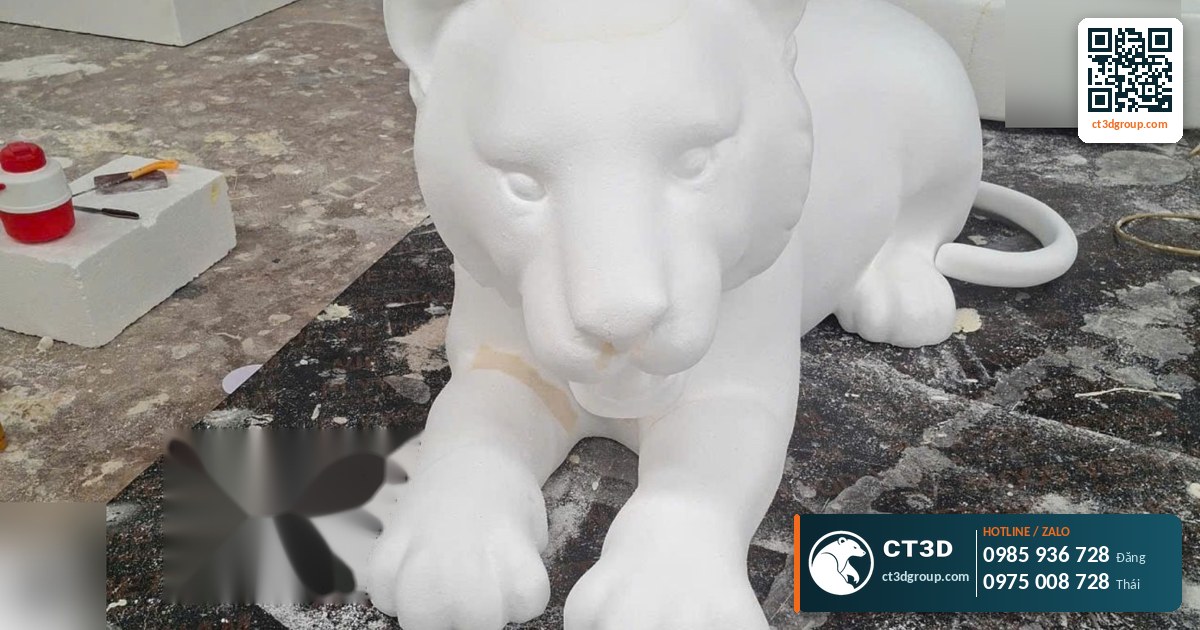
Combining 3D printing and CNC: the optimal hybrid workflow
This is the most common approach for functional metal parts. The idea is simple: print for shape, machine for precision.
Step 1 – Design machining allowances
In the CAD file, the engineer marks mating faces, dowel holes, threads and sealing faces. These surfaces get extra stock so there is material left for the cutter after printing. Small precision holes are usually printed undersize, then drilled and reamed. Threads are usually not printed directly; instead a pilot hole is printed and then tapped.
Step 2 – Design datum surfaces for fixturing
Printed parts often have freeform shapes that are hard to clamp in a vise. Add clamping tabs or flat datum surfaces, which can be cut off after machining. Skipping this step is the leading reason post-print CNC takes too long and goes out of tolerance.
Step 3 – Stress relieve before removing from the build plate
Printed parts contain residual stress. If cut from the plate immediately, the part may warp. If machined before stress relief, dimensions may shift after heat treatment. The correct order is print → stress relief → remove from plate → CNC. Step-by-step details are in metal 3D printing post-processing.
Step 4 – CNC and inspection
Machine the marked surfaces. Check dimensions with measuring instruments or by 3D scanning and comparing with CAD. CT3D offers 3D inspection services (scan-to-CAD comparison, GD&T).
| Feature on the part | Print as-is | Print + CNC |
|---|---|---|
| Non-mating external surfaces | Yes (bead blast for an even finish) | Not needed |
| Internal fluid channels | Yes | CNC only the inlet and outlet |
| Surfaces mating with other parts | No | Yes |
| Bearing bores, dowel holes | No | Yes, print undersize then ream |
| Threads | Not recommended | Print a pilot hole, then tap |
| Sealing faces (gaskets, O-rings) | No | Yes |
| Lightweight lattice structures | Yes | Cannot be machined |
Source: CT3D SLM post-processing workflow.
Common mistakes when comparing 3D printing and CNC
- Printing a file designed for CNC as-is. Parts designed for milling are usually solid blocks, and printing a solid block is the most expensive option. Optimize the design: hollow it out and remove non-load-bearing material. See our guide on design for metal 3D printing (DfAM).
- Expecting printed surfaces to be as smooth as milled ones. 6–10 µm roughness is an as-printed surface, not a mating surface. It must be machined or polished.
- Comparing the price of a single part only. Compare total cost: number of parts consolidated into one, assembly time, inventory, import lead time.
- Forgetting machining allowances. Printing to nominal size and then milling leaves the mating surface undersize.
- Ignoring print orientation. Orientation affects supports, downskin roughness and cost. Discuss it with the engineer first.
Real-world application scenarios
Part consolidation. An assembly of several milled, welded or bolted parts can be combined into a single printed part with 3D printing, reducing joints, leak points and assembly time.
Low-volume spare parts. Imported spare parts have long lead times and high prices. Metal 3D printing from a single part can cut spare part import costs by up to 40%. If you have no drawings, see our workflow for spare part recovery with 3D scanning and metal printing.
Titanium and Inconel parts. These materials are hard to cut and the scrap is expensive. Printing the near-net shape and milling only the necessary surfaces saves both stock and tooling. See also titanium Ti6Al4V 3D printing.
Simple parts in large quantities. For example bushings, shafts and flanges. CT3D will recommend CNC milling or turning, not printing. We advise based on the problem, not on the technology we sell.
To learn more about our metal printing capabilities, see the metal 3D printing service page on in3d.edu.vn.
How to send a request to CT3D
- Send a STEP file (preferred) or STL via our website, Zalo or email. Include a 2D drawing if there are tolerances.
- Specify material, quantity, which surfaces need to be precise and the operating environment.
- Engineers analyze the file and recommend printing, milling or a combination; they calculate the volume.
- Quote per file with lead time.
- Confirmation and production: printing, post-processing, CNC, inspection.
- Nationwide delivery within 1–3 days of completion, or pickup at the workshop.
In short, the right question is not “print or mill?” but “which features to print and which to mill?”. For specific advice, send your file to CT3D’s metal 3D printing team.
Frequently asked questions
Is metal 3D printing as accurate as CNC?
SLM printing at CT3D achieves ±0.02 mm with 6–10 µm roughness. CNC still produces smoother, tighter mating surfaces, so critical mating surfaces are usually machined after printing.
When is metal 3D printing cheaper than CNC?
When the part is complex, has internal channels, a high billet-to-part ratio, a hard-to-machine material and a low quantity. For simple solid parts in large quantities, CNC is usually cheaper.
Can metal printed parts be CNC machined afterwards?
Yes. SLM printed parts are almost fully dense and machine like conventional stock. Leave machining allowance and design datum surfaces for fixturing.
Should threads be printed directly?
Not recommended for precision threads. Print a pilot hole, then tap or thread-turn afterwards.
Does CT3D handle both printing and CNC?
Yes. CT3D offers metal printing with post-processing including CNC of mating surfaces, polishing, bead blasting and plating. Quoted per file.
Real footage from the CT3D workshop
Watch the video Metal, SLA, MJP lost-wax and PA12 3D printing by CT3D to get a clearer picture of the process and product quality. More videos are available on the Che Tao Vlog – CT3D channel.
Contact CT3D – send your file, get a fast quote
Whether you have a 3D file, a 2D drawing, photos or just an idea, you can send it to CT3D. Our engineers will check the file, advise on technology and materials, and send a quote with a delivery time.
- Email: [email protected] – [email protected]
- Hotline / Zalo: +84 975 008 728 (Mr. Thai) – +84 985 936 728 (Mr. Dang), or use our contact form
- Head office: Binh Duong.
- Workshops in Ho Chi Minh City: Linh Trung (Thu Duc), Tam Binh (Thu Duc), District 6 (former).
- Other workshops and drop-off points: Can Tho, Da Nang, Bien Hoa, Ba Ria – Vung Tau, Hanoi, Hai Duong, Hai Phong. Nationwide delivery.
- Website: ct3dgroup.com – in3d.edu.vn
CT3D – 3D design & prototyping: 3D printing, 3D scanning, reverse engineering, silicone mold making, paint finishing, CNC machining, composite fabrication, and supply of 3D printers and 3D printing resins.
Danh sách cửa hàng:
CT3D là đơn vị cung cấp trọn gói các dịch vụ thiết kế và sản xuất theo yêu cầu tại TP.HCM và khu vực lân cận (Bình Dương, Đồng Nai, Long An…). Với năng lực khép kín từ thiết kế 3D, in 3D (FDM, resin/SLA, SLS, in 3D kim loại), scan 3D – thiết kế ngược, làm khuôn, đúc composite – poly resin – poly stone đến gia công CNC và sơn màu hoàn thiện, CT3D đồng hành cùng khách hàng qua toàn bộ quy trình – từ ý tưởng, bản vẽ hay sản phẩm mẫu đến thành phẩm hoàn chỉnh. Dù bạn cần tạo mẫu nhanh, sản xuất số lượng, chế tác tượng – mô hình – quà tặng hay linh kiện kỹ thuật, đội ngũ CT3D sẽ tư vấn công nghệ và vật liệu phù hợp, đảm bảo sản phẩm sắc nét, đúng yêu cầu và tối ưu chi phí. Khách hàng tại TP.HCM và vùng lân cận có thể trao đổi trực tiếp, gửi file online và nhận sản phẩm thuận tiện, hỗ trợ cả đơn gấp lẫn dự án số lượng.
CT3D cung cấp trọn gói các dịch vụ thiết kế và sản xuất theo yêu cầu, phục vụ khách hàng tại Hà Nội và các tỉnh lân cận (Bắc Ninh, Hưng Yên, Hải Phòng, Vĩnh Phúc…). Với năng lực khép kín từ thiết kế 3D, in 3D (FDM, resin/SLA, SLS, in 3D kim loại), scan 3D – thiết kế ngược, làm khuôn, đúc composite – poly resin – poly stone đến gia công CNC và sơn màu hoàn thiện, CT3D đồng hành cùng khách hàng qua toàn bộ quy trình – từ ý tưởng, bản vẽ hay sản phẩm mẫu đến thành phẩm hoàn chỉnh. Quy trình làm việc thuận tiện: bạn gửi file 3D hoặc mô tả ý tưởng qua online, đội ngũ CT3D tư vấn công nghệ – vật liệu, báo giá nhanh và giao hàng tận nơi tại Hà Nội. Dù bạn cần tạo mẫu nhanh, sản xuất số lượng, chế tác tượng – mô hình – quà tặng hay linh kiện kỹ thuật, CT3D đều đáp ứng với sản phẩm sắc nét, đúng yêu cầu và tối ưu chi phí.

