
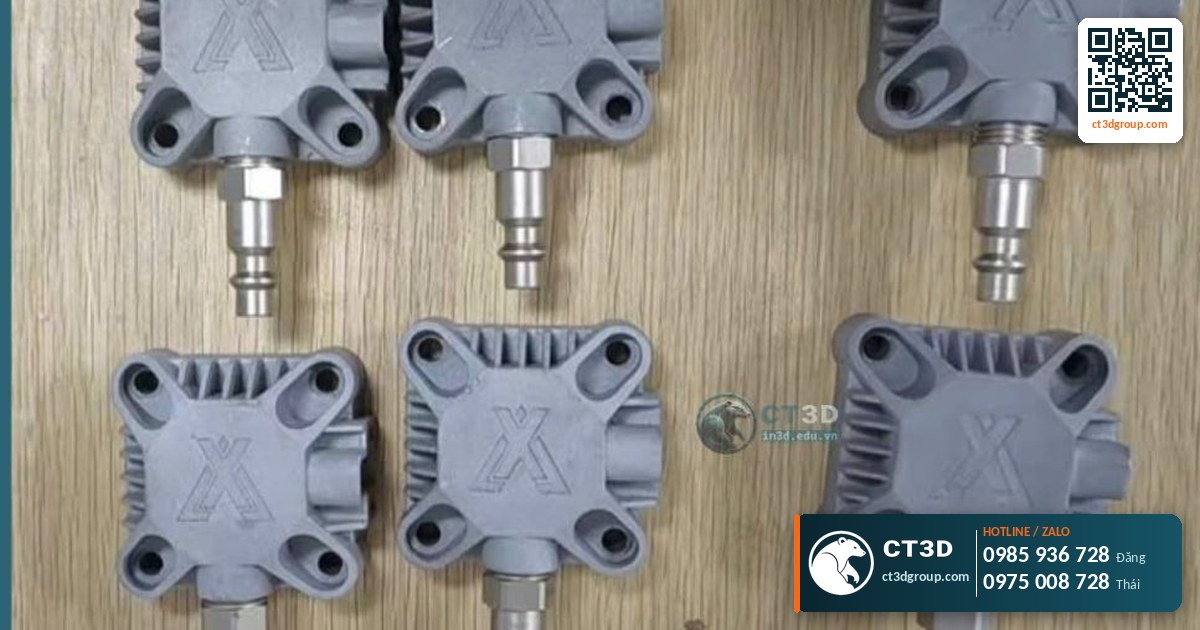
Quick answer: SLM (Selective Laser Melting) metal 3D printing uses a laser to fully melt thin layers of metal powder, producing dense metal parts that can be used just like cast or CNC-machined parts. At CT3D, SLM printing achieves an accuracy of about ±0.02 mm, an as-printed surface roughness of about 6–10 µm and a build volume of 250 × 250 × 300 mm (modular joining is possible for larger parts). Common materials: 316L stainless steel, AlSi10Mg aluminum, Ti6Al4V titanium, copper, Inconel, CoCr and 17-4PH steel. Tensile strength is equal to or 10–15% higher than cast metal. Prices are quoted per file, depending on powder type, volume, build height and post-processing.
In recent years, the question I hear most from factory engineers is: “This part can’t be CNC machined, casting needs a mold, and we only need a few pieces – is there another way?” The answer is often metal 3D printing. This article explains custom SLM metal 3D printing as simply as possible: what it is, which materials can be printed, how accurate it is, how it is priced and when to use it instead of CNC or casting. It is part of CT3D’s 3D printing article series; for a cost overview see our 2026 3D printing price guide, and for a technology comparison see how FDM, SLA, MJF/SLS and SLM differ.
1. What is SLM metal 3D printing?
SLM stands for Selective Laser Melting. An SLM machine works on a fairly simple principle:
- The machine spreads a very thin layer of metal powder (a few tens of microns) over the build plate.
- A high-power laser scans the exact cross-section of the part, fully melting the powder in that area, which then solidifies.
- The build plate lowers by one layer, a new layer of powder is spread and the laser scans again.
- This repeats for thousands of layers until the part is complete. The whole process takes place in an inert gas chamber (argon or nitrogen) to prevent the metal from oxidizing.
Because the powder is fully melted rather than just fused together, SLM parts are almost 100% dense, with mechanical properties equal to or better than cast parts. Some sources call a similar technology DMLS (Direct Metal Laser Sintering). For customers, the two names are practically interchangeable.

2. CT3D metal 3D printing specifications
| Specification | Value |
|---|---|
| Technology | SLM (laser melting of metal powder), German-standard machines |
| Accuracy | About ±0.02 mm |
| As-printed surface roughness | About 6 – 10 µm |
| Build volume | 250 × 250 × 300 mm, modular joining for larger parts |
| Tensile strength | Equal to or about 10 – 15% higher than cast metal |
| Quantity | From 1 part |
| Post-processing | Stress-relief annealing, build plate removal, CNC machining of mating surfaces, bead blasting, polishing, plating |
Source: CT3D metal 3D printing service specifications published on in3d.edu.vn.
3. Common metal 3D printing materials
CT3D can print more than 20 different metal grades. Below are the materials customers ask about most, and how to choose.
3.1. 316L stainless steel
Stainless steel with good corrosion resistance, easy to weld and polish. Used for food equipment, chemical and marine components, fixtures and high-end decorative parts. It is the “default” material when a customer needs a durable metal part with no special requirements. Besides 316L there are 304L, 316Ti, 420 and 17-4PH (a precipitation-hardening stainless steel, harder, used for load-bearing parts).
3.2. AlSi10Mg aluminum
Light, excellent heat dissipation, good mechanical properties after heat treatment. Used for housings, heat sinks with complex cooling channels, drone and automotive parts and components that need weight reduction. AlSi12, AlSi7Mg and the high-strength aluminum alloy Scalmalloy are also available.
3.3. Ti6Al4V titanium
Very high strength-to-weight ratio, good corrosion resistance and biocompatibility. Used in medical (implants, instruments), aerospace, motorsport and high-end sporting goods. Ti Grade 2 and Ti6Al7Nb are also available.
3.4. Copper and copper alloys
Pure copper (Cu), CuCrZr and CuNiSiCr offer excellent electrical and thermal conductivity. Used for electrodes, heat exchangers and mold cooling components.
3.5. Tool and mold steels
Maraging 18Ni300, H13, M2, D2. Used for mold cores and injection mold inserts with conformal cooling channels that shorten cycle times, cutting tools and wear-resistant parts.
3.6. Heat-resistant superalloys
Inconel 625, Inconel 718, Hastelloy X, C-22, C-276. Withstand very high temperatures and highly corrosive environments; used for turbines, combustion chambers, furnace parts and chemical equipment.
3.7. Cobalt-chrome and special metals
CoCr, CoCrMo and CoCrW are used in dental and medical applications. Tungsten (W), molybdenum (Mo) and the magnesium alloys AZ91D and WE43 are also available for specialized applications.
4. How is metal 3D printing priced?
This is the number one question. Unlike FDM plastic printing, which can be priced per gram, metal printing is almost always quoted per file. There is currently no public, standardized metal printing price list in Vietnam, because two parts of the same weight can differ in price several times over. The factors that determine price are:
- Metal powder type: 316L stainless steel and AlSi10Mg aluminum are common and more affordable. Titanium, Inconel, copper and special alloys are significantly more expensive.
- Part volume and weight: more metal means more powder and longer laser scanning time.
- Build height: the machine prints layer by layer, so taller parts mean more layers and longer machine time. Laying a part flat is usually cheaper than standing it up.
- Supports and complexity: parts with many inclined faces and overhangs need more supports, costing extra powder and removal labor.
- Post-processing: stress-relief annealing, wire EDM removal from the build plate, CNC machining of mating surfaces, bead blasting, mirror polishing, plating.
- Quantity and build nesting: printing many parts in one build shares machine time and setup costs, significantly lowering the unit price.
- Lead time: rush orders that need a dedicated build carry a surcharge.
For the most accurate quote, send a STEP file (rather than STL) with a 2D drawing marking surfaces with tight tolerances, the required surface roughness and the material.
5. Metal 3D printing vs CNC machining vs casting
Metal printing does not completely replace CNC or casting. Each method has its own sweet spot. This table helps you choose quickly:
| Criterion | SLM metal 3D printing | CNC machining | Casting |
|---|---|---|---|
| Suitable quantity | 1 – a few hundred parts | 1 – thousands | Hundreds – tens of thousands |
| Complex shapes, internal channels | Excellent | Limited (tools cannot reach) | Possible, but molds are complex and expensive |
| Mold required | No | No | Yes |
| Material waste | Very little, excess powder is reused | High (stock is cut away) | Moderate |
| Mating surface accuracy | ±0.02 mm, mating surfaces usually CNC finished | Very high | Lower, needs secondary machining |
| Time to first part | A few days | A few days | A few weeks (mold making) |
According to figures published by CT3D, compared with traditional methods metal printing can cut material waste by up to 90% and reduce imported spare part costs by up to 40% in many cases. The benefits are greatest for complex parts, low quantities or discontinued spare parts. See also CNC machining vs 3D printing in manufacturing.
In practice, the best approach is often a combination: SLM printing to create the complex geometry, followed by CNC machining of mating surfaces, threaded holes and flanges to achieve the tightest tolerances. CT3D handles both steps in a single workflow.
6. Real-world applications of metal 3D printing
6.1. Replacement and discontinued spare parts
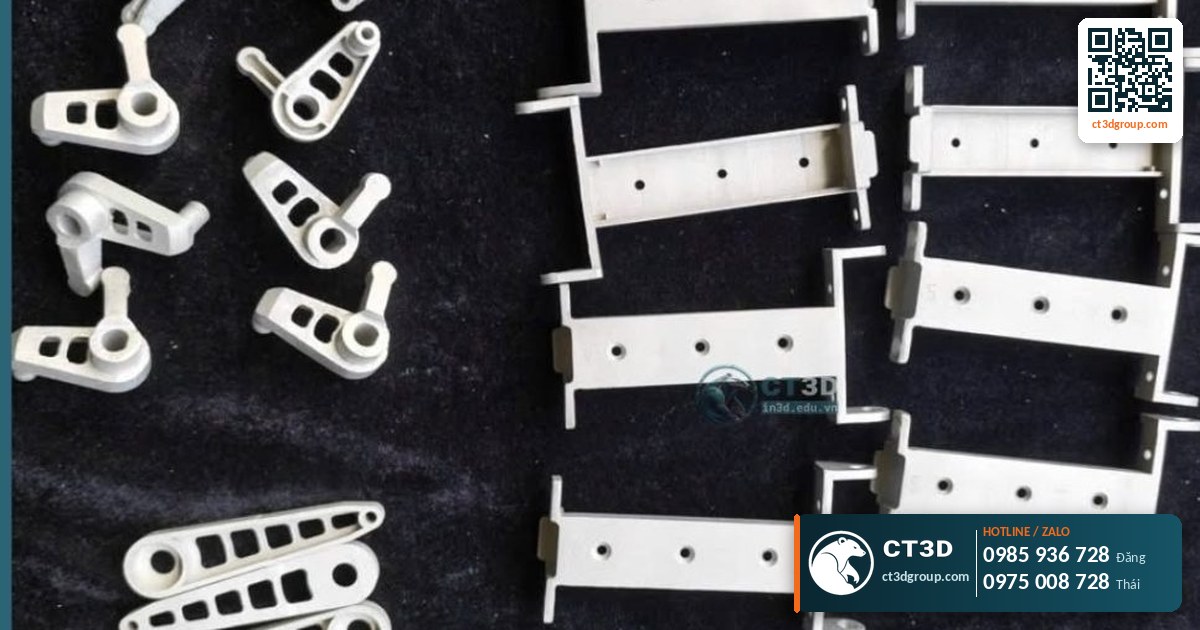
Factories with older machines often have broken parts that the manufacturer no longer sells. The workflow: 3D scan the broken part, reverse engineer it into a CAD file, correct the worn areas, print it in metal and CNC the mating surfaces. The machine is back running in a few days instead of waiting months for imports.
6.2. Injection molds with conformal cooling channels
Cooling channels that follow the mold cavity surface provide even cooling, reduce warping and shorten cycle times. Channels like these cannot be drilled by CNC; only metal printing can produce them.
6.3. Metal jigs and fixtures
Complex, lightweight fixtures that can integrate vacuum suction channels and internal air lines.
6.4. Lightweight components for automotive, drones and equipment
Lattice structures or topology-optimized designs reduce weight while keeping enough strength. AlSi10Mg aluminum and titanium are popular choices.
6.5. Medical and dental
CoCr dental frameworks, surgical instruments and titanium implant prototypes based on patient CT data.
6.6. Jewelry, art and premium gifts
Stainless steel, copper and titanium pieces with intricate patterns, raised logos and custom metal trophies – combined with CT3D’s 3D trophy manufacturing service for awards and events.
7. Design guidelines for better, cheaper metal prints
- Minimum wall thickness: about 0.4–1 mm depending on material and wall height. Walls that are too thin tend to warp.
- Self-supporting angles: surfaces inclined more than about 45° from horizontal usually need no support. Designing sensible angles reduces supports and cost.
- Horizontal holes: small horizontal round holes (roughly under 8 mm diameter) can be self-supporting. Larger holes should use a teardrop shape or accept supports.
- Internal channels: must have exit holes so excess powder can be removed.
- Machining allowance: leave 0.3–0.5 mm on surfaces that will be CNC finished.
- Send STEP files: they preserve exact geometry, making it easier for engineers to evaluate the part and program post-process CNC.
If you are not sure whether your design can be printed, just send the file. CT3D engineers will suggest changes before printing to avoid costly failed builds.
8. CT3D’s metal 3D printing workflow
- Intake: STEP/STL file, 2D drawing, physical sample or broken part.
- Technical evaluation: material selection, printability check and design change proposals if needed.
- Quote: clearly stating material, quantity, post-processing, guaranteed tolerances and lead time.
- Build preparation: optimal orientation, supports, and nesting with other parts to optimize cost.
- SLM printing in an inert gas atmosphere.
- Stress-relief annealing right after printing so the part does not warp when removed from the plate.
- Plate removal and support cutting, bead blasting for cleaning.
- Finishing: CNC machining of mating surfaces, thread tapping, polishing and plating as required.
- Inspection: dimensional measurement, optionally 3D scanning against the original file. Critical parts can undergo non-destructive testing.
- Door-to-door delivery nationwide.
9. Why do companies choose CT3D for metal 3D printing?
- More than 12 years in 3D printing, 3D scanning and prototyping.
- ±0.02 mm accuracy, German-standard SLM machines, more than 20 material grades.
- One-stop service: 3D scanning, reverse engineering, metal printing, CNC machining and 3D inspection. Customers do not have to coordinate multiple suppliers.
- Orders from a single part, suitable for both R&D and factory maintenance.
- Wide workshop network: Binh Duong, Ho Chi Minh City (Linh Trung, Tam Binh, former District 6), Bien Hoa, Ba Ria – Vung Tau, Can Tho, Da Nang, Hanoi, Hai Duong and Hai Phong – close to major industrial parks such as VSIP, My Phuoc, Bien Hoa, Long Thanh and Phu My.
In-depth material guides (in Vietnamese): 316L stainless steel 3D printing, titanium 3D printing, AlSi10Mg aluminum 3D printing.
5 common misconceptions about metal 3D printing
In consultations I come across many misconceptions that lead customers either to expect too much or to overlook a very suitable solution. Here are the five most common.
Misconception 1: “Metal printing means printing plastic and painting it metallic”
No. SLM printing produces real, dense metal parts that can be welded, machined and heat treated like conventional metal. If you only need a display model that looks metallic, printing in plastic and applying a faux-metal paint or plating is much cheaper.
Misconception 2: “Metal prints come out with a shiny surface”
The as-printed surface has a roughness of about 6–10 µm and feels slightly rough. A mirror finish requires additional polishing. Precision mating surfaces usually need CNC finishing. Specify which surfaces need finishing so the quote is correct from the start.
Misconception 3: “Metal printing is always more expensive than CNC”
For simple parts like shafts, plates and blocks, CNC is usually cheaper. But for parts with internal channels, organic shapes, many curved surfaces, or parts that would otherwise be assembled from several pieces, metal printing can be cheaper and faster because it needs fewer fixtures and setups and no welding.
Misconception 4: “Only small parts can be printed”
A single build is 250 × 250 × 300 mm, enough for most machine parts. Larger parts can be split into modules and joined. Many large parts can also be redesigned so the complex section is metal printed and the simple section CNC machined, then assembled.
Misconception 5: “You need a complete CAD file to print”
Not necessarily. If you only have the old part, CT3D can 3D scan it and rebuild the CAD file. If you only have a 2D drawing, our engineers model it in 3D from the drawing. This is charged separately but gives you a file you can use long term.
3 real situations customers often face
Situation 1: A production line stops because of one broken part
The part was a complex stainless steel gripper on an imported packaging machine. The manufacturer quoted a spare part lead time of several weeks. Solution: 3D scan the broken part, reassemble the broken pieces digitally, build a CAD model, print in 316L stainless steel and CNC the shaft bores. The machine was back running far sooner than waiting for the import.
Situation 2: An R&D company needs 5 aluminum heat sink housings
The housing has many thin fins and curved internal air channels. Casting would need a mold, which is not worthwhile for 5 units. CNC cannot produce the curved channels. Solution: print in AlSi10Mg, nesting all 5 parts in one build to lower the unit price, then bead blast to clean the surface.
Situation 3: A mold shop wants to shorten cycle times
The plastic part is thick and the cycle time long due to slow cooling. Solution: print a mold insert in mold steel with conformal cooling channels that follow the part surface, then CNC machine and polish the cavity. The part cools more evenly and warps less.
Checklist for a metal 3D printing request
- 3D file in STEP (preferred) or STL format.
- 2D drawing with tolerances on critical dimensions, surface roughness and threads.
- Required material, or a description of operating conditions: temperature, chemical environment, loads.
- Current quantity and expected annual volume.
- Finishing requirements: bead blasting, polishing, plating, heat treatment.
- Required delivery date and delivery address.
Quality inspection after metal printing
For metal parts used in machinery, quality inspection is a step that cannot be skipped. CT3D can measure dimensions with mechanical gauges, 3D scan the part and compare it with the original file to find deviations, and check fits against mating parts. For critical parts, customers can request non-destructive testing to detect internal porosity. Measurement results are delivered with the parts so the customer’s QC department can accept them easily.
10. Frequently asked questions about metal 3D printing
Are metal 3D printed parts as strong as conventional metal?
Yes. SLM parts are dense metal, with tensile strength equal to or about 10–15% higher than cast parts. After appropriate heat treatment, they can be used in real operating conditions.
How much does metal 3D printing cost?
It is quoted per file, depending on powder type, volume, build height, supports and post-processing. Send a STEP file for an accurate quote.
Which materials can be metal 3D printed?
316L, 304L and 17-4PH stainless steels, AlSi10Mg aluminum, Ti6Al4V titanium, copper, CuCrZr, H13 and maraging mold steels, Inconel 625/718, CoCr and many other grades.
What is the largest metal build size?
250 × 250 × 300 mm per build. Larger parts can be split into modules and welded or mechanically assembled.
How accurate is metal printing?
About ±0.02 mm. Mating surfaces with demanding requirements are usually CNC finished after printing.
Do you print single parts?
Yes. CT3D prints from a single part, suitable for prototypes and replacement parts.
In-depth articles on this topic
Read more detailed technical analyses from the CT3D team:
- 316L, 17-4PH and 304L stainless steel 3D printing: grade selection, ±0.02 mm tolerance, applications
- AlSi10Mg aluminum 3D printing: light at 2.67 g/cm³, 10–15% stronger than cast, design tips
- Ti6Al4V titanium 3D printing: 45% lighter than stainless steel, ±0.02 mm, HIP and applications
- CuCrZr copper 3D printing: electrodes, inductors, heat sinks with cooling channels
- Inconel 625/718 and Hastelloy 3D printing: superalloys rated up to 1,200 °C
- Conformal cooling 3D printed molds: H13 and maraging inserts at ±0.02 mm
- Metal 3D printing vs CNC: how to choose and when to combine them
- Recovering discontinued spare parts with 3D scanning and metal printing
- Metal 3D print post-processing: annealing, wire EDM, CNC, bead blasting, plating
- Design for metal 3D printing (DfAM): 45° angles, holes, thin walls, lattices
Real footage from the CT3D workshop
Watch the video Metal 3D printing service by CT3D to get a clearer picture of the process and product quality. More videos are available on our channel Che Tao Vlog – CT3D.
Contact CT3D – send your file, get a fast quote
Whether you have a 3D file, a 2D drawing, photos or just an idea, you can send it to CT3D. Our engineers will review the file, recommend the right technology and material, and send a quote with the delivery lead time.
- Email: [email protected] – [email protected]
- Hotline / Zalo: +84 975 008 728 (Mr. Thai) – +84 985 936 728 (Mr. Dang), or our contact form
- Head office: Binh Duong.
- Workshops in Ho Chi Minh City: Linh Trung (Thu Duc), Tam Binh (Thu Duc), District 6 (former).
- Other workshops and drop-off points: Can Tho, Da Nang, Bien Hoa, Ba Ria – Vung Tau, Hanoi, Hai Duong, Hai Phong. Nationwide delivery.
- Website: ct3dgroup.com – in3d.edu.vn
CT3D – 3D design & prototyping: 3D printing, 3D scanning, reverse engineering, silicone mold making, painting and finishing, CNC machining, composite fabrication, and supply of 3D printers and 3D printing materials.
Danh sách cửa hàng:
CT3D là đơn vị cung cấp trọn gói các dịch vụ thiết kế và sản xuất theo yêu cầu tại TP.HCM và khu vực lân cận (Bình Dương, Đồng Nai, Long An…). Với năng lực khép kín từ thiết kế 3D, in 3D (FDM, resin/SLA, SLS, in 3D kim loại), scan 3D – thiết kế ngược, làm khuôn, đúc composite – poly resin – poly stone đến gia công CNC và sơn màu hoàn thiện, CT3D đồng hành cùng khách hàng qua toàn bộ quy trình – từ ý tưởng, bản vẽ hay sản phẩm mẫu đến thành phẩm hoàn chỉnh. Dù bạn cần tạo mẫu nhanh, sản xuất số lượng, chế tác tượng – mô hình – quà tặng hay linh kiện kỹ thuật, đội ngũ CT3D sẽ tư vấn công nghệ và vật liệu phù hợp, đảm bảo sản phẩm sắc nét, đúng yêu cầu và tối ưu chi phí. Khách hàng tại TP.HCM và vùng lân cận có thể trao đổi trực tiếp, gửi file online và nhận sản phẩm thuận tiện, hỗ trợ cả đơn gấp lẫn dự án số lượng.
CT3D cung cấp trọn gói các dịch vụ thiết kế và sản xuất theo yêu cầu, phục vụ khách hàng tại Hà Nội và các tỉnh lân cận (Bắc Ninh, Hưng Yên, Hải Phòng, Vĩnh Phúc…). Với năng lực khép kín từ thiết kế 3D, in 3D (FDM, resin/SLA, SLS, in 3D kim loại), scan 3D – thiết kế ngược, làm khuôn, đúc composite – poly resin – poly stone đến gia công CNC và sơn màu hoàn thiện, CT3D đồng hành cùng khách hàng qua toàn bộ quy trình – từ ý tưởng, bản vẽ hay sản phẩm mẫu đến thành phẩm hoàn chỉnh. Quy trình làm việc thuận tiện: bạn gửi file 3D hoặc mô tả ý tưởng qua online, đội ngũ CT3D tư vấn công nghệ – vật liệu, báo giá nhanh và giao hàng tận nơi tại Hà Nội. Dù bạn cần tạo mẫu nhanh, sản xuất số lượng, chế tác tượng – mô hình – quà tặng hay linh kiện kỹ thuật, CT3D đều đáp ứng với sản phẩm sắc nét, đúng yêu cầu và tối ưu chi phí.

