
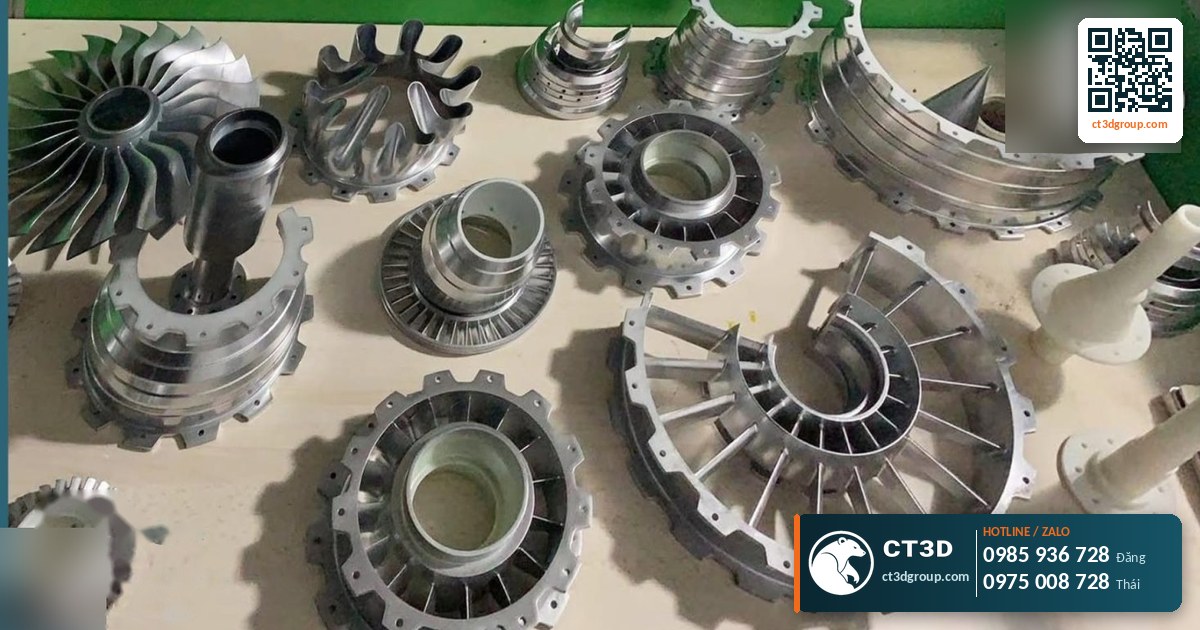
Quick answer: CuCrZr copper 3D printing means printing a copper–chromium–zirconium alloy by SLM to make welding electrodes, induction coils, heat sinks and mold inserts with cooling channels. CuCrZr retains copper’s high electrical and thermal conductivity but becomes much stronger and harder after aging. At CT3D, our German-standard SLM machines achieve ±0.02 mm accuracy, 6–10 µm roughness and a 250×250×300 mm build volume, with orders from a single part; materials include Cu, CuCrZr and CuNiSiCr. Price: quoted per file.
Copper is among the best electrical and thermal conductors in engineering, but also one of the hardest materials to print. As part of our series on metal 3D printing, this article explains why copper is so “picky” about lasers, why the CuCrZr alloy is used instead of pure copper, and how to design electrodes and heat sinks to take full advantage of the geometric freedom of 3D printing.
If your application needs light weight more than maximum thermal conductivity, AlSi10Mg aluminum 3D printing will be a better fit. For steel mold inserts, see 3D-printed conformal cooling mold inserts.
Why Is Copper 3D Printing Harder Than Stainless Steel or Titanium?
There are two main physical reasons.
1. Copper strongly reflects infrared laser light
Most SLM machines use fiber lasers with a wavelength of about 1,070 nm (infrared). At this wavelength, solid copper reflects most of the energy and absorbs only a small fraction. This means that at the same laser power, copper receives far less energy than steel. The reflected energy can also affect the machine’s optics. That is why some machines dedicated to copper use green or blue lasers (shorter wavelengths), which copper absorbs much better.
2. Copper conducts heat too well
Pure copper has a thermal conductivity of about 400 W/m·K, more than 20 times that of stainless steel. Heat from the melt pool is drawn away very quickly into the powder bed and previously printed layers. The melt pool is hard to sustain and may not fully melt, causing porosity and poor layer bonding.
Alloys such as CuCrZr have slightly lower thermal conductivity than pure copper and absorb the laser slightly better, so they print more reliably. In addition, this alloy can be precipitation-hardened by heat treatment – a major advantage.
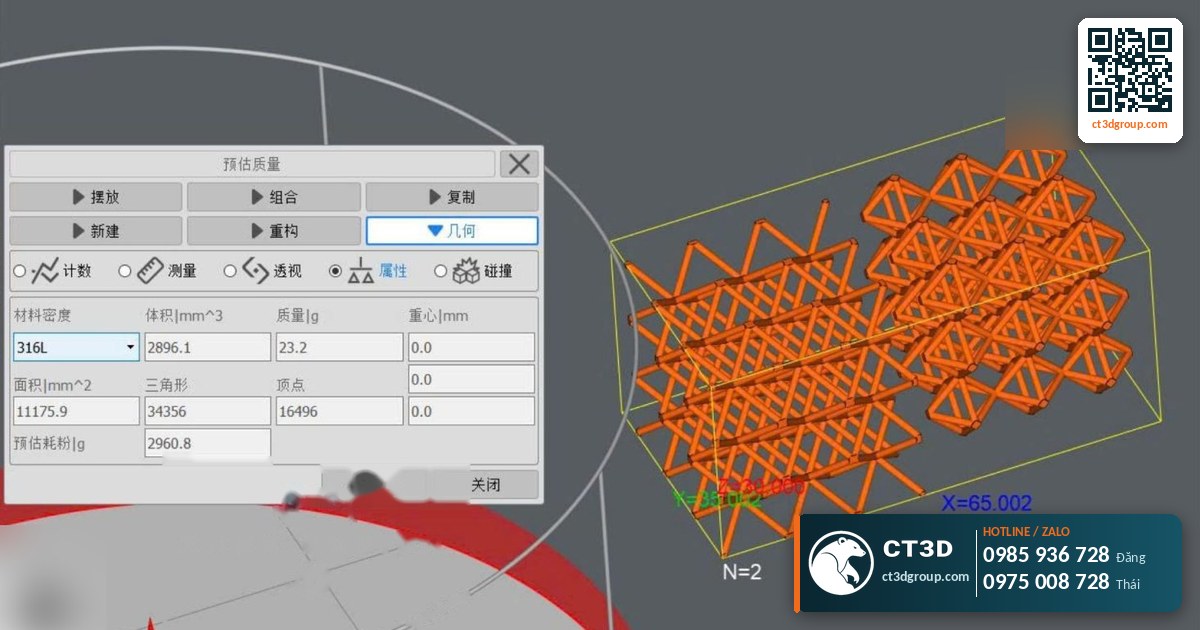
What Is CuCrZr? The Precipitation-Hardening Mechanism
CuCrZr is copper containing a small amount of chromium (typically below about 1.2%) and zirconium (typically below about 0.2%). At high temperature, Cr and Zr dissolve into the copper matrix. During aging at moderate temperature, they precipitate as very fine particles.
These particles have two effects at once:
- Increased strength and hardness: the fine particles impede dislocation movement.
- Restored electrical conductivity: while Cr and Zr remain dissolved, they “disturb” the crystal lattice and reduce conductivity. Once they precipitate as particles, the copper matrix is cleaner and conducts well again.
As a result, aged CuCrZr typically reaches an electrical conductivity of about 70–85% IACS (IACS: a scale relative to annealed standard copper = 100%), while retaining hardness and resistance to softening at higher temperatures than pure copper. That is why CuCrZr has long been the standard material for spot-welding electrodes in the automotive industry. Actual values depend on print and heat treatment parameters, so testing is needed for sensitive applications.
Specifications and Comparison of 3D-Printed Copper Materials
| Parameter | Value at CT3D |
|---|---|
| Technology | SLM, German-standard machines, inert gas chamber |
| Accuracy | ±0.02 mm |
| As-printed surface roughness | 6–10 µm |
| Build volume | 250×250×300 mm (modular assembly for larger parts) |
| Copper materials | Cu, CuCrZr, CuNiSiCr |
| Post-processing | Annealing/aging, CNC of mating faces, bead blasting, polishing, plating |
| Quantity | From 1 part |
Source: CT3D SLM metal 3D printing service technical documentation, 2026.
| Material | Electrical/thermal conductivity | Strength, hardness | Printability | Suitable applications |
|---|---|---|---|---|
| Cu (pure copper) | Highest | Low, soft | Most difficult | Induction coils, busbars where maximum conductivity is needed |
| CuCrZr | High (after aging) | Medium – high, stays hard at elevated temperature | Better than pure copper | Welding electrodes, heat sinks, mold inserts, combustion chambers |
| CuNiSiCr | Medium | High | Good | Parts needing more strength and wear resistance, still better thermal conductivity than steel |
| For comparison: AlSi10Mg | Much lower than copper | Medium | Good | Heat sinks that must be lightweight |
| For comparison: 316L stainless | Low | Medium | Very good | Not suitable where heat conduction is needed |
Source: CT3D SLM material catalog; relative rankings based on general materials knowledge.
Advanced Applications: Electrodes, Induction Coils, Heat Sinks
Welding electrodes and torches with cooling channels
Spot-welding electrodes heat up very quickly when high current passes through them. Conventional electrodes are usually water-cooled through a single straight drilled hole. 3D printing lets water channels run close to the working surface, branch out and spiral around the electrode tip. Heat is removed more effectively, the tip softens and deforms less, and the interval between tip dressings is extended. For electrodes with special shapes made for a specific product, printing from a single part is a clear advantage.
High-frequency induction hardening coils (inductors)
Conventional induction coils are bent and brazed from copper tubing by hand. Complex shapes are hard to reproduce accurately, and joints are weak points. 3D printing creates monolithic coils with internal water channels and a more precise gap to the workpiece. The result is a more consistent hardened zone from one coil replacement to the next.
Heat sinks and heat exchangers
For power electronics, lasers and high-power LEDs, copper heat sinks with pin fins, lattice structures and internal micro-channels increase the heat-exchange area within the same volume. 3D printing enables shapes that milling or extrusion cannot produce.
Copper mold inserts for hot spots
In plastic injection molds, slender cores and deep ribs often create local hot spots that lengthen cycle time. CuCrZr inserts with conformal cooling channels remove heat quickly. Note that copper is softer than mold steel, so wear must be evaluated for glass-fiber-filled plastics.
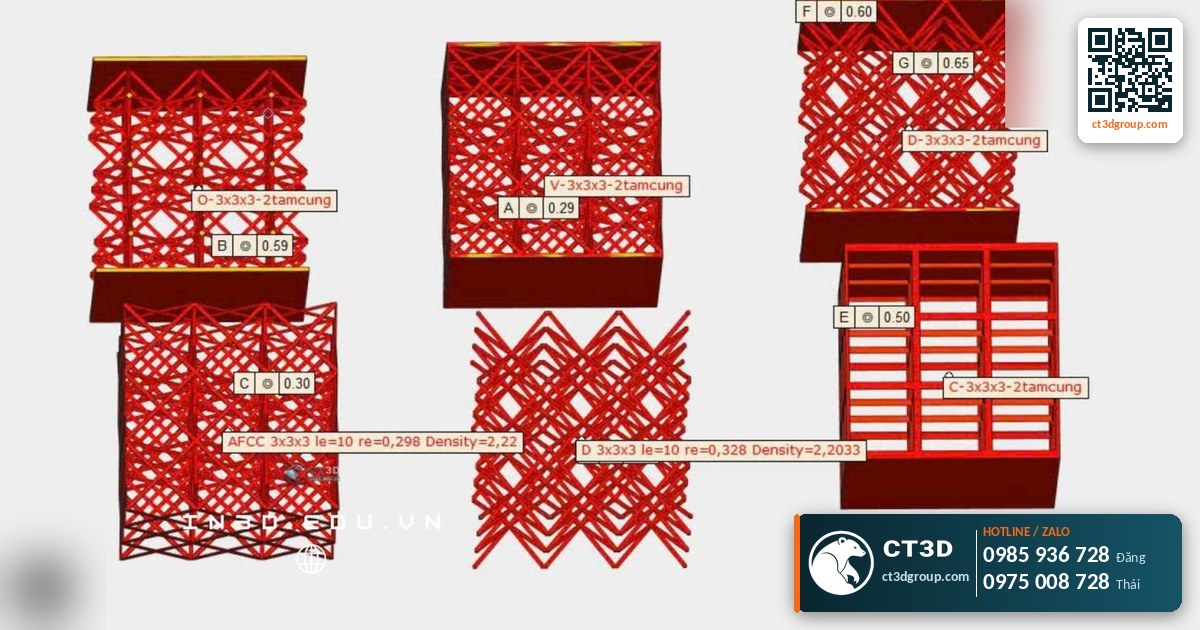
Worked Example: Electrode Mass and Water Channel Cross-Section
A CuCrZr electrode tip has a volume of 18 cm³. The density of copper is about 8.9 g/cm³ (general knowledge):
- Mass ≈ 18 × 8.9 ≈ 160 g.
- With an internal water channel 4 mm in diameter and 120 mm in total length, channel volume ≈ 3.14 × 2² × 120 ≈ 1,508 mm³ ≈ 1.5 cm³. The remaining metal volume is about 16.5 cm³, with a mass of about 147 g.
- The distance from the channel wall to the working surface must be balanced by the engineer: too thin and it may break through as the tip wears or is dressed; too thick and cooling suffers.
Note: large-diameter horizontal round channels may sag at the top during printing. Switching to a teardrop or diamond cross-section makes the channel self-supporting. Channels must have exit holes so powder can be fully removed – any copper powder left inside will obstruct water flow.
Common Copper 3D Printing Defects and How to Fix Them
| Defect | Cause | Solution |
|---|---|---|
| Lower electrical conductivity than expected | Not aged, residual porosity | Age with the correct cycle, optimize print parameters |
| Porosity, poor layer bonding | Insufficient laser energy due to reflection and heat conduction | Copper-specific parameters, choose CuCrZr over Cu where possible |
| Water channels clogged with powder | Small channels, sharp bends, no exit holes | Increase diameter, radius the bends, add exit holes, clean with air and vibration |
| Water leaking through channel walls | Walls too thin, interconnected porosity | Increase wall thickness, pressure-test after production |
| Poor electrical contact surface | As-printed roughness, surface oxide | CNC machine or polish the contact face |
| Copper tarnishes | Natural oxidation | Polish, apply protective plating if appearance matters |
Source: CT3D SLM post-processing experience; general copper materials knowledge.
How to Order Copper 3D Printing at CT3D and Checklist
- Send your file in STEP (preferred) or STL/OBJ/3MF via our website, Zalo, email or our contact form.
- Technical requirements: priority on electrical or thermal conductivity, operating temperature, coolant flow rate and pressure, electrical contact surfaces.
- Engineering review: choose Cu, CuCrZr or CuNiSiCr; check water channels, powder exit holes and build orientation.
- Quote based on the file, including lead time.
- Production: SLM printing, heat treatment, channel cleaning, CNC of mating faces, bead blasting, polishing.
- Delivery nationwide within 1–3 days of completion.
Checklist: Do you have drawings of the existing electrode/coil? If you only have the physical part, CT3D can perform 3D scanning and reverse engineering. What is the water connection thread size? Is pressure testing required? How many replacements per year?
For finish machining after printing, see what is CNC machining and how it differs from 3D printing. The metal 3D printing service page on in3d.edu.vn (in Vietnamese) has more material photos. For a full process overview, see our pillar article on metal 3D printing.
Frequently Asked Questions
Can pure copper be 3D printed?
Yes, CT3D offers Cu. However, pure copper is hard to print because it reflects the laser and conducts heat away too quickly, so many applications choose CuCrZr to balance conductivity, strength and printability.
How conductive is 3D-printed CuCrZr?
After aging, CuCrZr typically reaches about 70–85% IACS depending on the process. For sensitive applications, test a sample to measure actual values.
Why do 3D-printed electrodes cool better?
Because the water channels can run close to the working surface, branch out and follow the shape – something impossible with straight drilling.
How much does CuCrZr copper 3D printing cost?
CT3D quotes per file, based on volume, build height, heat treatment and machining. Orders start from a single part.
Can 3D-printed copper replace steel mold inserts?
In areas that need fast heat removal, yes, but copper is softer than mold steel. For glass-fiber-filled plastics or abrasive areas, consider H13 or maraging steel.
Real Footage from the CT3D Workshop
Watch the Metal, SLA, MJP lost-wax and PA12 3D printing video produced by CT3D to get a clearer picture of our process and product quality. More videos are available on our Chế Tạo Vlog – CT3D channel.
Contact CT3D – Send Your File for a Fast Quote
Whether you have a 3D file, a 2D drawing, photos or just an idea, you can send it to CT3D. Our engineers will check the file, recommend the right technology and material, and send you a quote with a lead time.
- Email: [email protected] – [email protected]
- Hotline / Zalo: +84 975 008 728 (Mr. Thai) – +84 985 936 728 (Mr. Dang), or use our contact form
- Head office: Binh Duong.
- Workshops in Ho Chi Minh City: Linh Trung (Thu Duc), Tam Binh (Thu Duc), former District 6.
- Other workshops and drop-off points: Can Tho, Da Nang, Bien Hoa, Ba Ria – Vung Tau, Hanoi, Hai Duong, Hai Phong. Nationwide delivery.
- Website: ct3dgroup.com – in3d.edu.vn
CT3D – 3D design & prototyping: 3D printing, 3D scanning, reverse engineering, silicone mold making, painting and finishing, CNC machining, composite fabrication, plus 3D printers and 3D printing resins.
Danh sách cửa hàng:
CT3D là đơn vị cung cấp trọn gói các dịch vụ thiết kế và sản xuất theo yêu cầu tại TP.HCM và khu vực lân cận (Bình Dương, Đồng Nai, Long An…). Với năng lực khép kín từ thiết kế 3D, in 3D (FDM, resin/SLA, SLS, in 3D kim loại), scan 3D – thiết kế ngược, làm khuôn, đúc composite – poly resin – poly stone đến gia công CNC và sơn màu hoàn thiện, CT3D đồng hành cùng khách hàng qua toàn bộ quy trình – từ ý tưởng, bản vẽ hay sản phẩm mẫu đến thành phẩm hoàn chỉnh. Dù bạn cần tạo mẫu nhanh, sản xuất số lượng, chế tác tượng – mô hình – quà tặng hay linh kiện kỹ thuật, đội ngũ CT3D sẽ tư vấn công nghệ và vật liệu phù hợp, đảm bảo sản phẩm sắc nét, đúng yêu cầu và tối ưu chi phí. Khách hàng tại TP.HCM và vùng lân cận có thể trao đổi trực tiếp, gửi file online và nhận sản phẩm thuận tiện, hỗ trợ cả đơn gấp lẫn dự án số lượng.
CT3D cung cấp trọn gói các dịch vụ thiết kế và sản xuất theo yêu cầu, phục vụ khách hàng tại Hà Nội và các tỉnh lân cận (Bắc Ninh, Hưng Yên, Hải Phòng, Vĩnh Phúc…). Với năng lực khép kín từ thiết kế 3D, in 3D (FDM, resin/SLA, SLS, in 3D kim loại), scan 3D – thiết kế ngược, làm khuôn, đúc composite – poly resin – poly stone đến gia công CNC và sơn màu hoàn thiện, CT3D đồng hành cùng khách hàng qua toàn bộ quy trình – từ ý tưởng, bản vẽ hay sản phẩm mẫu đến thành phẩm hoàn chỉnh. Quy trình làm việc thuận tiện: bạn gửi file 3D hoặc mô tả ý tưởng qua online, đội ngũ CT3D tư vấn công nghệ – vật liệu, báo giá nhanh và giao hàng tận nơi tại Hà Nội. Dù bạn cần tạo mẫu nhanh, sản xuất số lượng, chế tác tượng – mô hình – quà tặng hay linh kiện kỹ thuật, CT3D đều đáp ứng với sản phẩm sắc nét, đúng yêu cầu và tối ưu chi phí.

