
Quick answer: Aluminum AlSi10Mg 3D printing produces aluminum–silicon–magnesium alloy parts using SLM technology. The parts are lightweight (density about 2.67 g/cm³, roughly 1/3 that of stainless steel), conduct heat well, and have tensile strength equal to or 10–15% higher than cast aluminum of the same alloy. At CT3D, our German-standard SLM machines achieve ±0.02 mm tolerance, 6–10 µm roughness and a 250×250×300 mm build volume, printing from a single part. Ideal for heat sinks, lightweight brackets, drone and automotive parts. Pricing: quoted per file.
When a customer needs to reduce the weight of a metal part while keeping it rigid, my first question is: “Have you tried aluminum?” Among metal 3D printing materials, AlSi10Mg is the most widely used aluminum alloy. This article explains why 3D printed aluminum is a “casting” alloy rather than the familiar 6061 or 7075, how it is heat-treated, how to design to exploit its light weight, and what to avoid.
If the operating environment involves salt or harsh chemicals, see our article on stainless steel 316L 3D printing. If you need something light but even stronger, see titanium Ti6Al4V 3D printing.
What is AlSi10Mg, and why does aluminum 3D printing use a casting alloy?
AlSi10Mg is an aluminum alloy containing about 9–11% silicon (Si) and about 0.2–0.45% magnesium (Mg). It was originally a casting alloy. The reason: silicon makes the alloy very fluid with a narrow solidification range, so it is less prone to cracking as the molten metal cools and shrinks.
In SLM printing, each tiny melt pool melts and solidifies in a split second. Wrought aluminum alloys such as 6061 and 7075 have a wide solidification range, and when printed they are very prone to hot cracking (cracks that form while the metal is still solidifying). That is why the metal 3D printing industry uses Al-Si casting alloys such as AlSi10Mg, AlSi12 and AlSi7Mg – alloys that “like” rapid solidification.
Magnesium provides strengthening: with suitable heat treatment, Mg and Si form very fine Mg2Si phases in the aluminum matrix, making the alloy harder and stronger.
Specific challenges of laser printing aluminum
- Aluminum strongly reflects laser light and conducts heat quickly: heat “runs away” from the melt pool, so higher laser power than for stainless steel is needed to achieve full melting.
- Aluminum powder oxidizes and absorbs moisture easily: oxide films on powder particles and moisture are the main causes of gas porosity. Powder must be stored dry, and the build chamber must be inert.
- Fine aluminum powder is combustible: the workshop must have metal powder safety procedures – not every shop can do this.
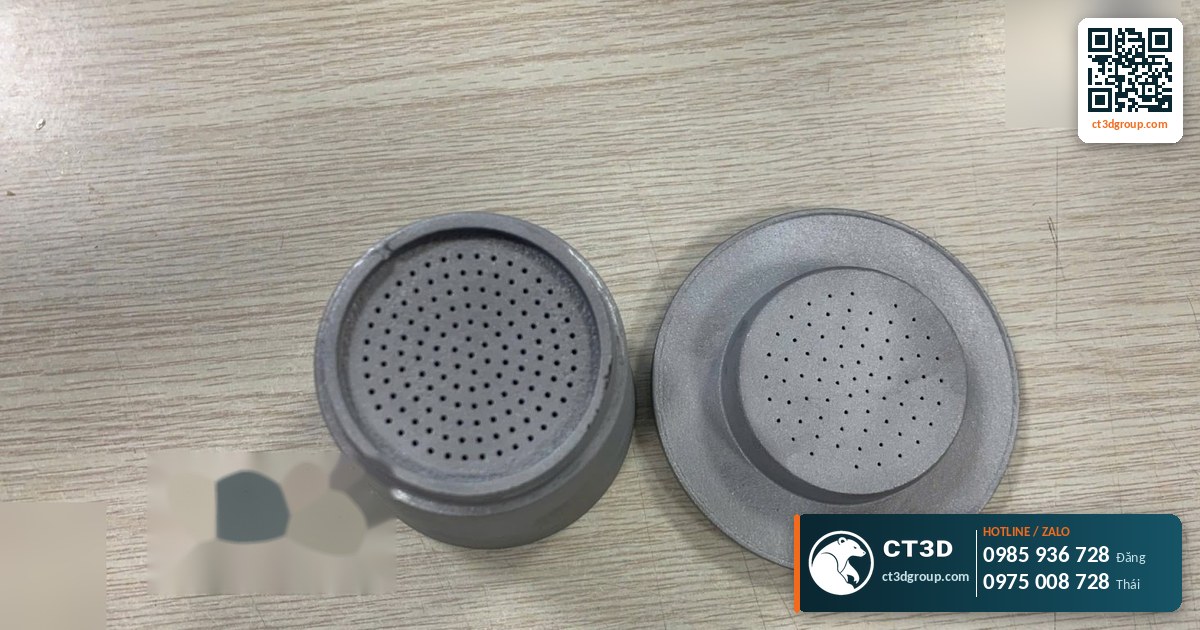
Aluminum AlSi10Mg 3D printing specifications at CT3D
| Parameter | Value | Notes |
|---|---|---|
| Technology | SLM, German-standard machines | Inert gas chamber |
| Tolerance | ±0.02 mm | Precision mating faces should be CNC finished |
| As-printed surface roughness | 6–10 µm | Bead blasting for a uniform matte finish |
| Build volume | 250×250×300 mm | Modular joining for larger parts |
| Tensile strength | Equal to or 10–15% higher than castings | Compared with cast parts of the same alloy |
| Density | About 2.67 g/cm³ | General materials data |
| Other aluminum alloys | AlSi12, AlSi7Mg, Scalmalloy | Selected by mechanical requirements |
| Post-processing | Stress relieving, CNC, bead blasting, polishing, anodizing/plating | As required |
Source: CT3D SLM metal 3D printing service technical documentation, 2026; density per general materials data.
Comparing AlSi10Mg with other 3D printable aluminum alloys
| Alloy | Characteristics | When to choose |
|---|---|---|
| AlSi10Mg | Balance of strength, printability and Mg-based strengthening | The default choice for most aluminum parts |
| AlSi12 | Near-eutectic composition, excellent fluidity, prints thin walls well | Thin-walled parts, heat sinks; printability prioritized over strength |
| AlSi7Mg | Less silicon, tougher after heat treatment | Parts needing more elongation and better impact resistance |
| Scalmalloy | Al-Mg-Sc alloy developed specifically for 3D printing, very high strength | Aerospace, motorsport, where maximum strength-to-weight is needed |
Source: CT3D SLM material catalog; properties per general aluminum metallurgy knowledge.
Note: 3D printed aluminum cannot fully replace wrought 7075 in terms of strength. If an old drawing specifies 7075, discuss it with our engineers to recheck the safety factor, or consider Scalmalloy or titanium.
Heat treating AlSi10Mg: stress relief or T6?
Many customers skip this part, yet it determines the final mechanical properties.
As-built condition
Right after printing, AlSi10Mg has an extremely fine microstructure: aluminum surrounded by a very fine silicon network. Strength and hardness are quite high, but the part contains significant residual stress and has low elongation. If cut from the build plate without stress relief, it may warp.
Stress relieving
Annealing at a moderate temperature (typically around 300 °C for about 2 hours, per common practice) reduces residual stress and increases ductility, at the cost of some strength. CT3D applies this step by default before removing parts from the build plate.
T6 heat treatment
T6 consists of solution treatment at high temperature, rapid quenching and then artificial aging. For 3D printed aluminum, T6 coarsens the fine silicon network, so strength is sometimes lower than as-built, but properties become more uniform and ductile. T6 should only be chosen when clearly required by a standard or drawing.
My recommendation: if you need strength, keep the stress-relieved condition. If you need toughness and directional uniformity, talk to us to select the appropriate heat treatment.
Worked example: converting a stainless bracket to 3D printed aluminum
A sensor bracket on a robot is currently made of stainless steel, with a volume of 60 cm³:
- Stainless steel (about 8.0 g/cm³): 60 × 8.0 = 480 g.
- AlSi10Mg (about 2.67 g/cm³): 60 × 2.67 ≈ 160 g – roughly 2/3 lighter.
- Because aluminum has a lower elastic modulus than steel (about 70 GPa vs. about 190–200 GPa), the same shape in aluminum deflects about 2.7–2.9 times more. Compensate by increasing rib height, using box sections or applying topology optimization.
- After topology optimization, the volume might grow to 75 cm³ but still weigh only about 200 g – less than half the stainless version, and stiff enough.
Lower mass lets the robot accelerate faster and reduces motor load. This is a typical problem that aluminum 3D printing solves better than CNC milling, because topology-optimized shapes are often very difficult to mill.
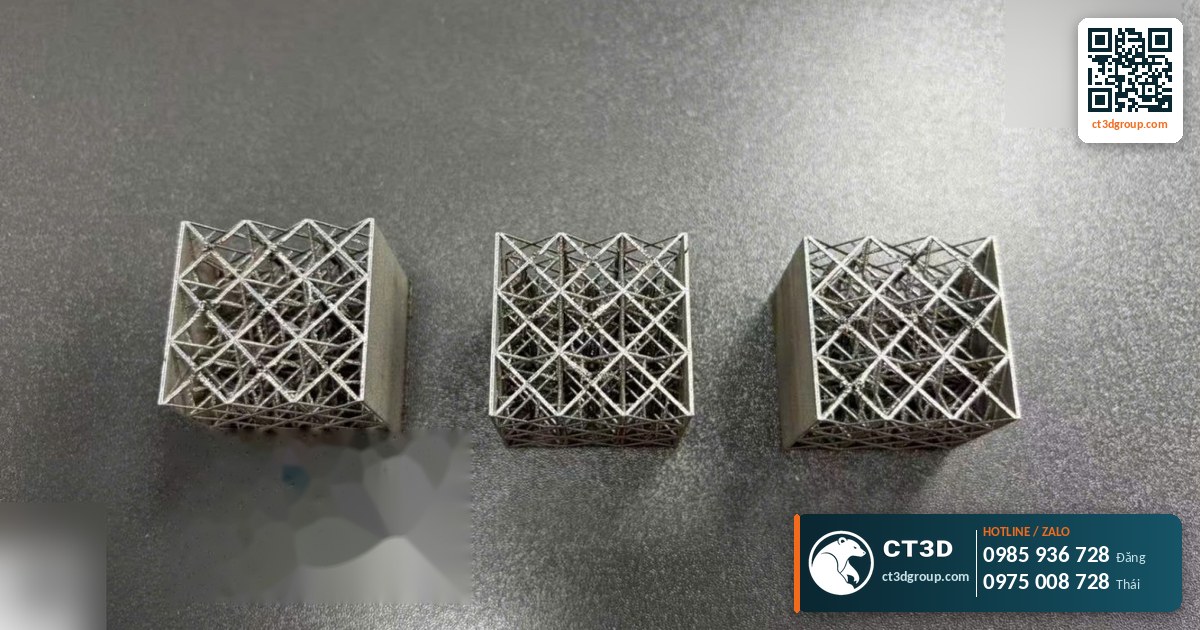
Designing aluminum parts for 3D printing: exploiting light weight and thermal conductivity
Heat sinks and heat exchangers
Aluminum conducts heat well, so AlSi10Mg is ideal for heat sink housings, cold plates with internal water channels and lattice heat exchangers. 3D printing enables pin fins, spiral fins and gyroid lattice fins that casting or milling cannot produce. Note: AlSi10Mg’s thermal conductivity is lower than pure aluminum because of its high silicon content. If you need even higher conductivity, see our article on copper CuCrZr 3D printing.
Internal channels and powder escape holes
Internal channels must have powder escape holes. Channels that are too small, too long or have many sharp bends are hard to clear of powder. Horizontal round channels should be changed to teardrop or diamond cross-sections so they are self-supporting, with no internal supports needed.
Overhangs and thin walls
The general SLM rule: surfaces inclined at about 45° or more from the build plate are usually self-supporting. Shallower surfaces need supports, which leave marks requiring machining. Walls that are too thin easily distort from heat. Detailed design rules are covered in our metal 3D printing design guide (DfAM).
Common AlSi10Mg printing problems and how to fix them
| Problem | Cause | Fix |
|---|---|---|
| Internal gas porosity | Moist powder, oxides on powder particles | Dry the powder, strict powder management, suitable laser parameters |
| Warping when removed from the plate | Residual stress not relieved | Stress-relieve before cutting |
| Excessive deflection under load | Design kept the same shape as the steel part | Enlarge rib sections, apply topology optimization |
| Powder trapped in channels | Small channels, no escape holes | Add escape holes, increase channel diameter |
| Rough, uneven surface color | Adhering powder particles, support marks | Bead blasting, polishing, anodizing |
| Aluminum threads wear out quickly | Soft aluminum, threads assembled and disassembled repeatedly | Use thread inserts (Helicoil) or stainless inserts |
Source: CT3D SLM production and post-processing experience.
How to order aluminum 3D printing from CT3D
- Send your file: STEP preferred; STL/OBJ/3MF also accepted, via our website, Zalo, email or our contact form.
- Technical requirements: loads, operating temperature, mating surfaces, anodizing/plating requirements.
- File review: our engineers calculate volume, weight, orientation, supports and CNC allowances.
- Quote: quoted per file, with production lead time.
- Production: SLM printing, stress relieving, removal from the plate, CNC of mating faces, bead blasting, surface treatment.
- Delivery: door-to-door or workshop pickup, nationwide within 1–3 days after completion.
Quick checklist: Do you have a 3D file (if not, CT3D offers 3D scanning and reverse engineering)? Which surfaces are mating faces? Are there threaded holes? Is T6 heat treatment required? Do you need colored anodizing? What quantity?
Real-world applications of aluminum AlSi10Mg 3D printing
- Drones and UAVs: frame connectors, camera mounts, parts that must be light.
- Cars, motorcycles and racing: manifold prototypes, brackets, housings, small-batch custom parts.
- Power electronics: heat sink housings, cold plates with water channels.
- Automation: robot grippers and lightweight jaws to speed up cycle times.
- Prototypes of cast parts: checking assembly before making die-casting tooling. According to CT3D, metal printing reduces material waste by up to 90% compared with milling from billet.
You can also visit our aluminum AlSi10Mg 3D printing service page. To compare costs with other technologies, see 3D printing technologies compared: FDM, SLA, MJF, SLM. A service overview is available in our pillar article on metal 3D printing.
Frequently asked questions
Is 3D printed aluminum strong?
Yes. According to CT3D documentation, SLM parts have tensile strength equal to or 10–15% higher than cast parts. However, aluminum is less stiff than steel, so cross-sections need to be redesigned when replacing a steel part.
Can 6061 or 7075 aluminum be 3D printed?
These alloys are prone to hot cracking in SLM printing, so they are rarely used. CT3D prefers AlSi10Mg, AlSi12, AlSi7Mg and Scalmalloy – alloys suited to the printing process.
Can 3D printed aluminum parts be anodized?
Yes. Because of the high silicon content, anodized color is usually grayer than on wrought aluminum, and bright colors are hard to achieve. Bead blast before anodizing for a uniform surface.
How much does aluminum AlSi10Mg 3D printing cost?
CT3D quotes per file, based on volume, build height, supports and post-processing. We print from a single part.
What temperature can 3D printed aluminum withstand?
Aluminum alloys generally lose significant strength during prolonged service at elevated temperatures (typically from about 150–200 °C upward). For hotter parts, consider stainless steel, titanium or Inconel.
Video from the CT3D workshop
Watch the video Metal, SLA, MJP wax and PA12 3D printing by CT3D to get a clearer picture of our process and product quality. More videos are available on our channel Che Tao Vlog – CT3D.
Contact CT3D – send your file, get a fast quote
Whether you have a 3D file, a 2D drawing, photos or just an idea, you can send it to CT3D. Our engineers will check the file, recommend the right technology and material, and send you a quote with a delivery lead time.
- Email: [email protected] – [email protected]
- Hotline / Zalo: +84 975 008 728 (Mr. Thai) – +84 985 936 728 (Mr. Dang), or use our contact form
- Head office: Binh Duong.
- Workshops in Ho Chi Minh City: Linh Trung (Thu Duc), Tam Binh (Thu Duc), former District 6.
- Other workshops and drop-off points: Can Tho, Da Nang, Bien Hoa, Ba Ria – Vung Tau, Hanoi, Hai Duong, Hai Phong. Nationwide delivery.
- Website: ct3dgroup.com – in3d.edu.vn
CT3D – 3D design & prototyping: 3D printing, 3D scanning, reverse engineering, silicone mold making, painting and finishing, CNC machining, composite fabrication, plus 3D printers and 3D printing materials.
Danh sách cửa hàng:
CT3D là đơn vị cung cấp trọn gói các dịch vụ thiết kế và sản xuất theo yêu cầu tại TP.HCM và khu vực lân cận (Bình Dương, Đồng Nai, Long An…). Với năng lực khép kín từ thiết kế 3D, in 3D (FDM, resin/SLA, SLS, in 3D kim loại), scan 3D – thiết kế ngược, làm khuôn, đúc composite – poly resin – poly stone đến gia công CNC và sơn màu hoàn thiện, CT3D đồng hành cùng khách hàng qua toàn bộ quy trình – từ ý tưởng, bản vẽ hay sản phẩm mẫu đến thành phẩm hoàn chỉnh. Dù bạn cần tạo mẫu nhanh, sản xuất số lượng, chế tác tượng – mô hình – quà tặng hay linh kiện kỹ thuật, đội ngũ CT3D sẽ tư vấn công nghệ và vật liệu phù hợp, đảm bảo sản phẩm sắc nét, đúng yêu cầu và tối ưu chi phí. Khách hàng tại TP.HCM và vùng lân cận có thể trao đổi trực tiếp, gửi file online và nhận sản phẩm thuận tiện, hỗ trợ cả đơn gấp lẫn dự án số lượng.
CT3D cung cấp trọn gói các dịch vụ thiết kế và sản xuất theo yêu cầu, phục vụ khách hàng tại Hà Nội và các tỉnh lân cận (Bắc Ninh, Hưng Yên, Hải Phòng, Vĩnh Phúc…). Với năng lực khép kín từ thiết kế 3D, in 3D (FDM, resin/SLA, SLS, in 3D kim loại), scan 3D – thiết kế ngược, làm khuôn, đúc composite – poly resin – poly stone đến gia công CNC và sơn màu hoàn thiện, CT3D đồng hành cùng khách hàng qua toàn bộ quy trình – từ ý tưởng, bản vẽ hay sản phẩm mẫu đến thành phẩm hoàn chỉnh. Quy trình làm việc thuận tiện: bạn gửi file 3D hoặc mô tả ý tưởng qua online, đội ngũ CT3D tư vấn công nghệ – vật liệu, báo giá nhanh và giao hàng tận nơi tại Hà Nội. Dù bạn cần tạo mẫu nhanh, sản xuất số lượng, chế tác tượng – mô hình – quà tặng hay linh kiện kỹ thuật, CT3D đều đáp ứng với sản phẩm sắc nét, đúng yêu cầu và tối ưu chi phí.

