
Quick answer: Four 3D printing technologies dominate today’s service market. FDM is the cheapest, with 100–300 micron layers and a tolerance of ±0.1–0.3 mm – good for prototypes, fixtures and large models. SLA/resin is the smoothest, with 25–100 micron layers and ±0.05–0.1 mm – good for statues, figures and presentation models. MJF/SLS uses PA12 nylon powder, with 80–120 micron layers and about ±0.05–0.15 mm, needs no supports and suits functional engineering parts and low-volume production. SLM prints real metal at about ±0.02 mm, suited to spare parts, molds and industrial components. In this comparison of 3D printing technologies, the choice comes down to four questions: what is it for, how strong must it be, how good must it look, and what is your budget?
Newcomers to 3D printing are often confused by the alphabet soup: FDM, FFF, SLA, DLP, LCD, SLS, MJF, SLM, DMLS, PolyJet, Binder Jetting… In reality, for 90% of needs you only need to understand four main technology groups. This article compares FDM, SLA, MJF/SLS and SLM on the criteria customers care about most: surface quality, accuracy, strength, materials, size, speed and price. It is part of CT3D’s 3D printing article series. For specific costs, read the 2026 3D printing price guide. To go deeper into each technology, read SLA resin 3D printing and SLM metal 3D printing.
1. Quick comparison table of 4 3D printing technologies
| Criterion | FDM | SLA / Resin | MJF / SLS | SLM (metal) |
|---|---|---|---|---|
| Principle | Extrudes molten plastic filament | UV light cures liquid resin | Fuses/sinters plastic powder | Laser melts metal powder |
| Layer height | 100 – 300 microns | 25 – 100 microns | 80 – 120 microns | A few tens of microns |
| Typical tolerance | ±0.1 – 0.3 mm | ±0.05 – 0.1 mm | ±0.05 – 0.15 mm | About ±0.02 mm |
| Surface | Visible layer lines | Very smooth | Slightly rough, uniform color | 6 – 10 µm roughness, needs finishing |
| Main materials | PLA, PETG, ABS, ASA, TPU, nylon, carbon fiber | Standard, tough, clear, high-temp, castable resins | PA12 (nylon 12), PA11 | Stainless steel, aluminum, titanium, copper, Inconel, mold steel |
| Supports needed | Yes, for overhangs | Yes | No (powder is self-supporting) | Yes |
| Mechanical strength | Fair, depends on print orientation | Depends on resin; standard resin is brittle | Good, fairly isotropic | Very high, equal to or better than cast metal |
| Cost | Lowest | Medium, 1.5–2.5× FDM | Medium – high | Highest |
| Best for | Prototypes, fixtures, large models, student projects | Statues, figures, jewelry, presentation models | Engineering parts, assemblies, low-volume production | Spare parts, molds, medical, aerospace |
Technical data from CT3D’s technology documentation published on in3d.edu.vn. Actual values also depend on the machine, material and part geometry.

2. FDM – the most common and cheapest 3D printing technology
2.1. How does FDM work?
FDM (Fused Deposition Modeling, also called FFF) works like a computer-controlled hot glue gun. Plastic filament is fed into the nozzle, melted at about 190–260 °C depending on the plastic, and extruded as fine beads that stack into layers. After each layer, the bed lowers or the nozzle rises slightly to print the next one.
2.2. Advantages
- Lowest cost. At CT3D, PLA and PETG start at 650 VND/gram (≈ US$0.025) and ABS at 1,000 VND/gram (≈ US$0.04).
- Wide material range: from easy-to-print PLA to UV-resistant ASA, flexible TPU, and strong nylon and carbon fiber filaments.
- Large parts can be printed on large-format industrial FDM machines.
- Fast turnaround, ideal for multiple design iterations.
2.3. Disadvantages
- Visible layer lines; sanding is needed for a smooth finish.
- Strength in the vertical direction (between layers) is weaker than horizontally.
- Difficult to print very fine details below about 0.4 mm.
2.4. When should you use FDM?
Form prototypes, preliminary fit checks, jigs and fixtures for production lines, low-volume enclosures, student project models, large architectural massing models and outdoor parts (in ASA). To understand how to lower FDM costs, read what is infill.
3. SLA / Resin – the technology for the smoothest surfaces
3.1. How does SLA work?
An SLA machine has a vat of liquid photopolymer resin. A UV laser (SLA), projector (DLP) or LCD screen (MSLA) exposes the exact shape of each layer, curing the resin in that area. The build platform lifts the part layer by layer. After printing, the part is washed of excess resin and UV cured to full hardness.
3.2. Advantages
- The smoothest surface among common technologies, with details down to 0.05 mm.
- Tolerance of about ±0.05–0.1 mm; DLP can reach ±0.03–0.08 mm.
- Clear, castable, high-temperature and flexible resins are available.
- CT3D runs large-format machines up to 800 × 800 × 500 mm.
3.3. Disadvantages
- About 1.5–2.5 times more expensive than FDM.
- Standard resin is brittle and not suitable for impact-loaded parts.
- Can yellow and become more brittle in prolonged sunlight without a protective coating.
3.4. When should you use SLA?
Statues, figures, character models, jewelry, dental work, product presentation models, silicone mold masters and clear parts. See details in our article on custom SLA resin 3D printing.
4. MJF / SLS – the technology for functional plastic parts
4.1. How do MJF and SLS work?
Both use plastic powder, most commonly PA12 (nylon 12). The machine spreads a thin layer of powder over the whole build area. With SLS, a laser scans and sinters the powder where the part is. With MJF (Multi Jet Fusion), print heads jet a heat-absorbing agent onto the part area, then a heat lamp passes over the entire layer, fusing the powder in that area. Unfused powder surrounds and supports the part, so no supports are needed.
4.2. Advantages
- No supports, so very complex shapes, interlocking parts and print-in-place hinges are possible.
- Good, fairly isotropic strength, usable as real assembly parts.
- Many parts can be stacked in the build chamber, ideal for low-volume production of dozens to hundreds of parts.
- Accuracy of CT3D’s MJP/MJF PA12 service is about ±0.05 mm.
4.3. Disadvantages
- Slightly rough surface, gray or white by default; other colors require dyeing or painting.
- Fewer material options than FDM.
- Printing a single part is sometimes less economical than FDM.
4.4. When should you use MJF/SLS?
End-use housings, air ducts, clips, snap fits, hinges, robot and drone parts, durable fixtures, plastic replacement parts and low-volume production when you are not ready to invest in injection molds. Learn more (in Vietnamese): MJP/MJF PA12 3D printing service, or see our industrial 3D printing page.
5. SLM – metal 3D printing
5.1. How does SLM work?
Similar to SLS but using metal powder and a more powerful laser that fully melts the powder in an inert gas chamber. The result is a dense metal part.
5.2. Advantages
- Real metal, with tensile strength equal to or about 10–15% higher than cast metal.
- Accuracy of about ±0.02 mm, with a 250 × 250 × 300 mm build volume at CT3D.
- Internal channels and lightweight lattice structures that CNC cannot produce.
- Up to 90% less material waste than traditional subtractive machining.
5.3. Disadvantages
- The highest cost among 3D printing technologies.
- Requires post-processing: stress-relief annealing, plate removal, CNC machining of mating surfaces, polishing.
5.4. When should you use SLM?
Discontinued spare parts, complex low-volume machine parts, mold inserts with conformal cooling channels, medical and dental components, and lightweight automotive and drone parts. Details in our article on custom SLM metal 3D printing.
6. Other technologies you may hear about
- PolyJet: jets droplets of resin and cures them with UV, printing multiple colors and hardnesses in one part. Suited to high-end presentation models and medical models.
- Binder Jetting: jets a binder onto powder (sand, metal, gypsum). Used to print sand casting molds and full-color models.
- Wax printing: prints precise wax patterns for lost-wax casting in jewelry and dentistry.
- DMLS: another name for laser-based metal printing, very close to SLM.
CT3D can advise on and source these technologies when a project requires them.
7. Choosing a 3D printing technology with 4 questions
Question 1: What is the part for?
- Just to see the shape or roughly check dimensions → FDM.
- Display, photography, customer presentations → SLA/resin.
- Assembly, end use, load-bearing → MJF/SLS or FDM engineering plastics.
- Replacing a metal part → SLM.
Question 2: How strong must it be?
Impacts and drops → FDM ABS/PETG, MJF PA12, tough resin. Heat → ASA, high-temperature resin, metal. Heavy loads and wear → metal or carbon fiber filament.
Question 3: How good must it look?
Smooth straight off the printer → SLA. Sanding and painting acceptable → FDM. Uniform color and a technical surface → MJF dyed black.
Question 4: Quantity and budget?
1–5 pieces on a limited budget → FDM. Dozens to hundreds of engineering parts → MJF/SLS. Many identical statues or models → printed master + silicone mold. Thousands of pieces → consider injection molding or CNC machining.
8. Technology choices for 6 real products
| Product | Recommended technology | Why |
|---|---|---|
| Prototype electronics enclosure, 2 units | FDM PETG or ABS | Cheap, strong enough, quick design changes |
| 30 cm Buddha statue as a mold master | Standard SLA resin | Smooth, keeps facial detail, less sanding |
| 200 plastic clips for a production line | MJF PA12 | Strong, consistent, high-volume nesting |
| Stainless steel gripper for a discontinued packaging machine | 3D scan + SLM 316L + CNC | Real metal, original geometry, fast turnaround |
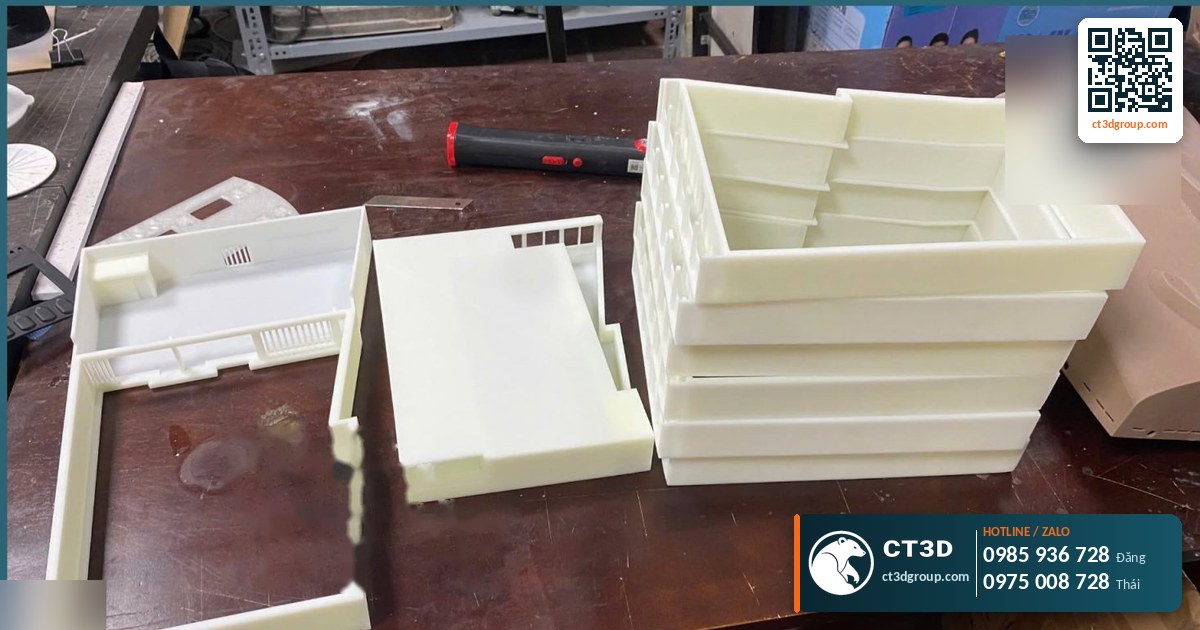
| 1/50 scale townhouse model | FDM for masses, resin for railings and ornaments | Balances price and detail |
| 2.5 m event mascot | CNC foam + composite + 3D printed details | Large, light, durable, cost-effective |

9. Common mistakes when choosing a 3D printing technology
- Choosing resin for load-bearing parts: standard resin looks great but is brittle, and snap fits break easily. Choose tough resin or MJF instead.
- Choosing FDM for advertising photography: layer lines show clearly under studio lights. Either print in resin or budget for sanding and painting.
- Metal printing simple parts: shafts, bushings and flat plates are usually cheaper by CNC.
- Comparing only price per gram: a low price with thick layers, low infill and no post-processing may not meet requirements. Compare like-for-like parameters.
- Ignoring print orientation: the same FDM part printed upright or flat can differ significantly in strength. Tell the engineer the load direction.
10. How does CT3D help you choose a technology?
CT3D operates industrial FDM, large-format SLA, MJF/SLS PA12 and SLM metal systems, plus 3D scanning, reverse engineering, 3D inspection, silicone mold making, painting and finishing, CNC machining and composite fabrication. Because we have all the technologies in-house, CT3D engineers give objective advice based on your needs rather than pushing one type of machine. Just send the file and describe the intended use, and CT3D will propose 1–2 options with prices to compare.
With more than 12 years in operation, CT3D has its head office in Binh Duong, 3 workshops in Ho Chi Minh City (Linh Trung, Tam Binh, former District 6) and workshops and drop-off points in Can Tho, Da Nang, Bien Hoa, Ba Ria – Vung Tau, Hanoi, Hai Duong and Hai Phong. Customers in Ho Chi Minh City can see our 3D printing service in Ho Chi Minh City; customers in the north can see our 3D printing service in Hanoi. For display models, see custom 3D model printing.
3D printing materials by technology: which plastic to choose?
After choosing a technology, the next step is choosing a material. Here is a summary of the materials CT3D uses most often and their key properties, to make conversations with our engineers easier.
| Material | Technology | Strengths | Weaknesses |
|---|---|---|---|
| PLA | FDM | Cheap, easy to print, many colors, low warping | Poor heat resistance, softens in a hot car |
| PETG | FDM | Tough, water resistant, less brittle | Prone to fine stringing on the surface |
| ABS | FDM | Impact resistant, fair heat resistance, can be plated | Prone to shrinkage on large parts |
| ASA | FDM | UV resistant, colorfast outdoors | More expensive than ABS |
| TPU | FDM | Rubber-like flexibility and elasticity | Slow to print, hard to print small details |
| Nylon, carbon fiber filament | FDM | Stiff, strong, wear resistant | Expensive, absorbs moisture |
| Standard resin | SLA | Smoothest, most affordable resin | Brittle |
| Tough / ABS-like resin | SLA | Smooth and tougher than standard resin | 30–50% more expensive |
| Clear resin | SLA | Transparent after polishing | Needs extra finishing work |
| PA12 | MJF/SLS | Strong, consistent, no supports, end-use ready | Slightly rough surface, gray color |
| 316L stainless steel | SLM | Corrosion resistant, weldable, polishes well | Heavy, many times more expensive than plastics |
| AlSi10Mg aluminum | SLM | Light, excellent heat dissipation | Needs heat treatment for good mechanical properties |
| Ti6Al4V titanium | SLM | Light yet very strong, biocompatible | Expensive |
If you want to print in-house, CT3D also supplies 3D printers and all kinds of 3D printing materials (PLA, PETG, ABS, ASA, TPU filaments and resins), with guidance on print settings for each material.
Speed and lead time by technology
Lead time depends on the technology, size, quantity and post-processing. Typical lead times for medium-sized orders with a ready file:
- FDM: small parts can be done the same day; standard orders take 1–3 days.
- SLA/resin: 2–4 days for small parts, plus a few days for painted finishes.
- MJF/SLS: usually 3–6 days, because of build nesting, printing and cooling of the powder chamber.
- SLM metal: usually 5–10 days or more, due to heat treatment, plate removal and CNC finishing.
Orders that need modeling or 3D scanning take additional time. Nationwide shipping usually adds 1–3 days. If you are in a hurry, state your required date and our sales team will schedule machines and propose a suitable plan.
Summary: one sentence per technology
- FDM: cheap, fast, strong enough – ideal for prototypes and fixtures.
- SLA/resin: the best looking and smoothest – ideal for statues, figures and presentation models.
- MJF/SLS: end-use engineering plastics – ideal for assembly parts and low-volume production.
- SLM: real metal – ideal for spare parts, molds and industrial components.
Not sure what to choose? Just send your file and describe the intended use, and CT3D engineers will advise you free of charge.
Advice from CT3D’s engineering team
If this is your first time making a product with 3D printing, start with a low-cost FDM print to check dimensions and assembly. Once the shape is right, move to a more expensive technology such as resin, MJF or metal for the final part. This step-by-step approach saves significant money, because each design revision on an FDM print costs only a fraction of a revision on a metal part. Also, keep working with the same engineer at your print shop; they will get to know your product and give increasingly precise advice project after project.
11. Frequently asked questions
Which 3D printing technology is the cheapest?
FDM. At CT3D, PLA and PETG start at 650 VND/gram (≈ US$0.025) and ABS at 1,000 VND/gram (≈ US$0.04).
Which 3D printing technology looks best?
SLA/resin gives the smoothest surface, with 25–100 micron layers and detail down to 0.05 mm.
Which 3D printing technology is the strongest?
SLM metal is the strongest. Among plastics, MJF/SLS PA12 and FDM carbon fiber filament offer good strength.
What is the difference between MJF and SLS?
Both use PA12 powder and need no supports. SLS uses a laser that scans point by point; MJF jets a heat-absorbing agent and uses a heat lamp across the whole layer, which is usually faster and gives a more uniform surface.
Should I print my model in FDM or resin?
Small models that need detail and must look good straight away: resin. Large models on a budget where sanding and painting are acceptable: FDM.
Should I use 3D printing instead of CNC?
3D printing excels at complex shapes, low quantities and speed. CNC excels at simple parts, very tight tolerances and higher quantities. In many cases the two should be combined.
In-depth articles on this topic
Read more detailed technical analyses from the CT3D team:
- What is FDM 3D printing? Principle, 0.1–0.3 mm layers, pros and cons
- What is SLA 3D printing? UV laser principle, 25–100 micron layers and specs
- MJF PA12 3D printing: mechanism, ±0.05 mm tolerance and design rules
- What is SLS 3D printing? Laser sintering of plastic powder, 80–120 micron layers, applications
- FDM vs resin 3D printing: 9 criteria for the right choice, tolerances, costs
- MJF vs SLS: PA12 powder printing, ±0.05 mm tolerance – how to choose?
- 3D printing or injection molding: draft angles, tolerances, bridge tooling
- 3D printed jigs & fixtures: material selection, 3-2-1 design, 1–3 day delivery
- FDM 3D printing materials: PLA, ABS, PETG, ASA, TPU, nylon, CF – how to choose
- 3D printing accuracy & tolerances: ±0.02–0.3 mm, designing fit clearances
Real footage from the CT3D workshop
Watch the video Metal, SLA, MJP castable wax and PA12 3D printing by CT3D to get a clearer picture of the process and product quality. More videos are available on our channel Che Tao Vlog – CT3D.
Contact CT3D – send your file, get a fast quote
Whether you have a 3D file, a 2D drawing, photos or just an idea, you can send it to CT3D. Our engineers will review the file, recommend the right technology and material, and send a quote with the delivery lead time.
- Email: [email protected] – [email protected]
- Hotline / Zalo: +84 975 008 728 (Mr. Thai) – +84 985 936 728 (Mr. Dang), or our contact form
- Head office: Binh Duong.
- Workshops in Ho Chi Minh City: Linh Trung (Thu Duc), Tam Binh (Thu Duc), District 6 (former).
- Other workshops and drop-off points: Can Tho, Da Nang, Bien Hoa, Ba Ria – Vung Tau, Hanoi, Hai Duong, Hai Phong. Nationwide delivery.
- Website: ct3dgroup.com – in3d.edu.vn
CT3D – 3D design & prototyping: 3D printing, 3D scanning, reverse engineering, silicone mold making, painting and finishing, CNC machining, composite fabrication, and supply of 3D printers and 3D printing materials.
Danh sách cửa hàng:
CT3D là đơn vị cung cấp trọn gói các dịch vụ thiết kế và sản xuất theo yêu cầu tại TP.HCM và khu vực lân cận (Bình Dương, Đồng Nai, Long An…). Với năng lực khép kín từ thiết kế 3D, in 3D (FDM, resin/SLA, SLS, in 3D kim loại), scan 3D – thiết kế ngược, làm khuôn, đúc composite – poly resin – poly stone đến gia công CNC và sơn màu hoàn thiện, CT3D đồng hành cùng khách hàng qua toàn bộ quy trình – từ ý tưởng, bản vẽ hay sản phẩm mẫu đến thành phẩm hoàn chỉnh. Dù bạn cần tạo mẫu nhanh, sản xuất số lượng, chế tác tượng – mô hình – quà tặng hay linh kiện kỹ thuật, đội ngũ CT3D sẽ tư vấn công nghệ và vật liệu phù hợp, đảm bảo sản phẩm sắc nét, đúng yêu cầu và tối ưu chi phí. Khách hàng tại TP.HCM và vùng lân cận có thể trao đổi trực tiếp, gửi file online và nhận sản phẩm thuận tiện, hỗ trợ cả đơn gấp lẫn dự án số lượng.
CT3D cung cấp trọn gói các dịch vụ thiết kế và sản xuất theo yêu cầu, phục vụ khách hàng tại Hà Nội và các tỉnh lân cận (Bắc Ninh, Hưng Yên, Hải Phòng, Vĩnh Phúc…). Với năng lực khép kín từ thiết kế 3D, in 3D (FDM, resin/SLA, SLS, in 3D kim loại), scan 3D – thiết kế ngược, làm khuôn, đúc composite – poly resin – poly stone đến gia công CNC và sơn màu hoàn thiện, CT3D đồng hành cùng khách hàng qua toàn bộ quy trình – từ ý tưởng, bản vẽ hay sản phẩm mẫu đến thành phẩm hoàn chỉnh. Quy trình làm việc thuận tiện: bạn gửi file 3D hoặc mô tả ý tưởng qua online, đội ngũ CT3D tư vấn công nghệ – vật liệu, báo giá nhanh và giao hàng tận nơi tại Hà Nội. Dù bạn cần tạo mẫu nhanh, sản xuất số lượng, chế tác tượng – mô hình – quà tặng hay linh kiện kỹ thuật, CT3D đều đáp ứng với sản phẩm sắc nét, đúng yêu cầu và tối ưu chi phí.

