
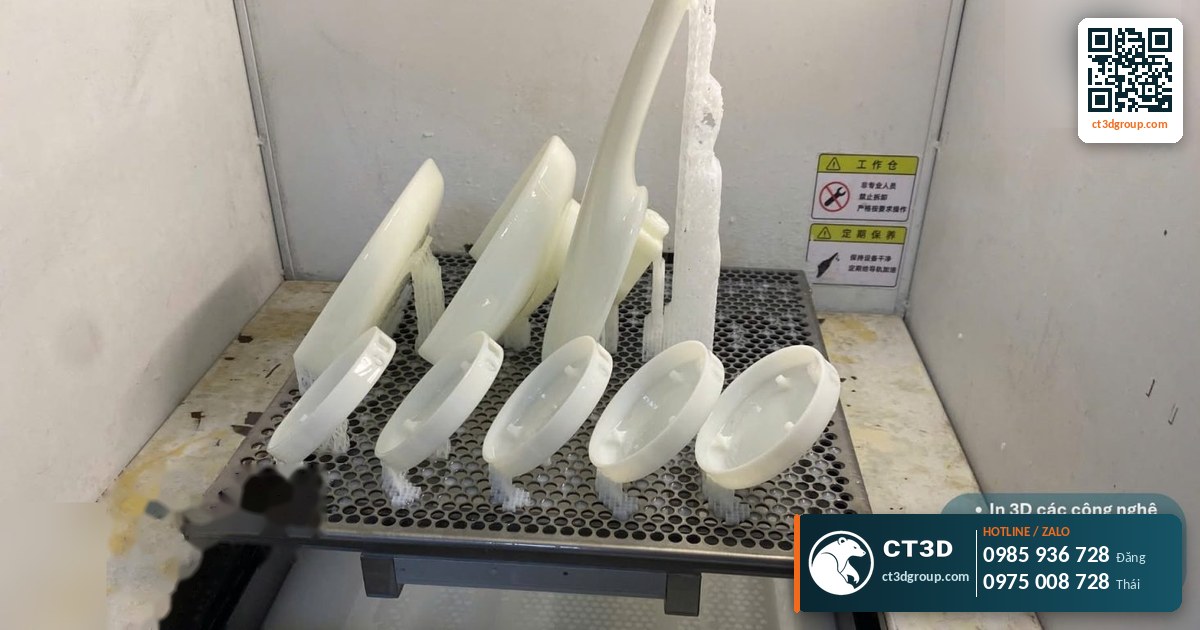
Quick answer: 3D printing prices in Binh Duong and Dong Nai for companies in industrial parks such as VSIP, My Phuoc, Bien Hoa and Long Thanh are calculated by the actual grams of plastic used and the material. CT3D’s indicative 2026 rates: PLA and PETG from 650 VND/g (≈ US$0.025/g), ABS from 1,000 VND/g (≈ US$0.04/g), ASA from 2,000 VND/g (≈ US$0.08/g), and carbon fiber–filled filament from 2,750 VND/g (≈ US$0.11/g). Orders under 50 g are subject to a minimum charge; orders over 500 g or volume orders are quoted as projects. CT3D is headquartered in Binh Duong with a workshop in Bien Hoa, and ships nationwide within 1–3 days after printing.
Most of CT3D’s customers in Binh Duong and Dong Nai are not individuals buying a one-off toy. They are factory maintenance teams, engineering departments and continuous-improvement (Kaizen) teams. They need an urgent replacement jig, a worn plastic gear, a sensor cover, or a prototype before committing to tooling. This article does not repeat our general price list – for that, see CT3D’s 3D printing price guide. Instead, it explains in depth how a manufacturer in an industrial park should budget for 3D printing, choose materials for the shop-floor environment, and avoid the mistakes that drive costs up.
Why 3D printing prices for industrial-park factories differ from hobby printing
Same machine, same spool of filament – yet a factory part usually costs more than a display model. The reason lies in the technical requirements, not the delivery address. There are four main differences.
- Higher mechanical requirements: jigs must withstand clamping force, impact and vibration. Engineers have to add more perimeters (walls, i.e. the outer shells of the part) and raise the infill (the internal core density). More plastic means more grams, and the per-gram price rises accordingly.
- Harsher environments: near dryers, near motors, outdoors, in contact with oil. PLA is cheap but softens at around 55–60 °C, so many parts must move to ABS, ASA or carbon fiber–filled filament. Material unit prices can differ by a factor of 3–4.
- Fit tolerances: parts must fit existing shafts, bushings and bolts. FDM has a tolerance of roughly ±0.1–0.3 mm, so many mounting holes need to be drilled or reamed afterwards, or compensated in the print file. That is post-processing work.
- Corporate procedures: formal quotations, order confirmations, VAT invoices and delivery receipts. These take processing time but do not increase the per-gram rate.
Once you understand these four factors, it becomes clear why two quotes for “the same jig” can differ. One supplier prints it in PLA at 15% infill; another prints it in ASA at 50% infill with 4 perimeters. The first is cheaper, but it may deform after a single shift next to a dryer.

Indicative FDM 3D printing prices for companies in Binh Duong and Dong Nai
CT3D applies the same price list to customers in Binh Duong, Dong Nai, Ho Chi Minh City and other provinces. Prices are based on the actual grams after our engineers slice the model (slicing: software that divides the 3D model into printable layers and calculates the plastic weight).
| Material | CT3D indicative price 2026 | Heat resistance (typical reference) | Typical factory uses |
|---|---|---|---|
| PLA | from 650 VND/g (≈ US$0.025/g) | softens at around 55–60 °C | Form-check models, gauges in air-conditioned rooms, labels, trays |
| PETG | from 650 VND/g (≈ US$0.025/g) | around 70–80 °C | Covers, guide channels, parts needing flexibility and water resistance |
| ABS | from 1,000 VND/g (≈ US$0.04/g) | around 90–100 °C | Electrical enclosures, jigs near motors, parts to be plated or painted |
| ASA | from 2,000 VND/g (≈ US$0.08/g) | around 90–100 °C, UV resistant | Outdoor parts, canopies, signage, externally mounted sensors |
| Carbon fiber–filled filament | from 2,750 VND/g (≈ US$0.11/g) | depends on the base polymer | Rigid jigs, robot grippers, parts that must be light with minimal deflection |
Source: CT3D indicative FDM price list 2026 (prices are indicative); temperatures are typical engineering values for each plastic and are only meant to guide material selection.
Weight rules: orders under 50 g are subject to a minimum charge; 50–500 g are charged by gram and material; over 500 g or volume orders are quoted as projects. Post-processing (sanding, painting, plating), rush service and 3D modeling are charged separately. For details on per-gram pricing, see our article on PLA 3D printing cost per gram.
Choosing materials for the shop-floor environment: how to avoid paying twice
The most expensive mistake I see among industrial-park customers is choosing a cheap material for a hot environment. The part prints nicely and fits well, but warps after a few days and has to be reprinted in another plastic. The total cost doubles, not counting machine downtime. Here is how I categorize applications when advising customers.
Drying, injection molding, and areas near motors and heat lamps
Surface temperatures often exceed 60 °C. PLA and PETG should not be used. Choose ABS or ASA. If the part is both hot and load-bearing, consider carbon fiber–filled filament. When conditions are too extreme, FDM may no longer be suitable, and CT3D will recommend another technology such as metal 3D printing, quoted per file.
Assembly, packaging and cleanroom areas
Room temperature, light loads. PLA or PETG is sufficient. This is where 3D printing is cheapest for a factory: component placement gauges, divider trays, light conveyor guide rails. PETG is tougher than PLA and less likely to snap when dropped, so I usually prefer PETG when the unit price is similar.
Outdoors, canopies and parking areas
UV radiation causes many plastics to fade and become brittle. ASA was developed to weather better than ABS. ASA costs twice as much as ABS, but its outdoor service life is clearly better, so it is worth the money for long-term parts.
Parts exposed to oil and chemicals
Each oil or solvent affects plastics differently. I always ask customers to state the exact chemical name in their request. CT3D usually prints a small test sample for you to soak on site before printing in volume. A test sample costs far less than the risk of an entire batch failing.
Cost examples for 3 typical industrial-park scenarios
The examples below use CT3D’s “from” prices to show how the calculation works. The final price is always based on the actual file, because the weight after slicing may differ from the estimate.
| Scenario | Material | Estimated weight | Printing (from price) | Possible extras |
|---|---|---|---|---|
| Component placement gauge for an assembly line | PETG | 180 g | 180 × 650 = 117,000 VND (≈ US$4.50) | None, if the as-printed surface is acceptable |
| Clamping jig near an injection molding machine | ABS | 320 g | 320 × 1,000 = 320,000 VND (≈ US$12.30) | Reaming mounting holes, sanding contact faces |
| Outdoor sensor cover | ASA | 90 g | 90 × 2,000 = 180,000 VND (≈ US$6.90) | Paint coating if an identification color is required |
| Lightweight robot gripper | Carbon fiber–filled filament | 150 g | 150 × 2,750 = 412,500 VND (≈ US$15.90) | 3D modeling if only a 2D drawing is available |
Source: calculated from CT3D’s indicative 2026 FDM rates; weights are illustrative examples, not actual orders. Prices are indicative.
As the table shows, material drives the price more than size does. A small ASA cover can cost almost as much as a large PETG gauge. So don’t choose the “most premium” material for every part – choose the right grade for each location.
Technical factors that increase or reduce plastic weight
Because pricing is per gram, anything that changes the weight changes the price. These are the “levers” CT3D engineers use to optimize cost while maintaining strength.
- Infill: the core density. 15–20% is enough for display parts; 30–50% for load-bearing jigs. Raising infill from 20% to 50% can significantly increase weight, depending on how much of the part is core. See also our article on infill density and how it affects cost and strength.
- Number of perimeters: impact resistance and clamping strength depend heavily on the shell. In many cases, going from 2 to 4 perimeters is more effective than raising infill – and uses less plastic.
- Supports: structures that hold up overhangs. Supports are plastic too, are charged by the gram, and leave marks that need sanding. Orienting the part correctly can reduce supports considerably.
- Print orientation: FDM parts are weakest perpendicular to the layers. For screw lugs, engineers orient the part so that tensile loads run along the layers rather than pulling them apart.
- Over-designed geometry: files exported from CAD are usually 100% solid. Hollowing out non-load-bearing areas, adding fillets and stiffening ribs reduces weight while keeping the part rigid.
Common mistakes when companies order 3D printing – and how to fix them
| Problem | Cause | Solution |
|---|---|---|
| Mounting holes too tight for the shaft | FDM shrinkage, ±0.1–0.3 mm tolerance; small holes tend to print undersize | Specify fit dimensions clearly; CT3D compensates in the file or reams after printing |
| Part warps after a few days in use | PLA/PETG chosen for a hot location | Declare the operating temperature; switch to ABS/ASA |
| Screw lug breaks | Wrong print orientation, layer separation | Reorient, add perimeters, add ribs or use threaded inserts |
| Slow quotation | Only photos supplied, missing dimensions | Send a STEP/STL file or a dimensioned drawing; otherwise 3D scanning or modeling is needed |
| Costs rise due to reprints | No test sample before volume printing | Print one sample, test-fit it, adjust the file, then print the batch |
Source: FDM tolerances from CT3D technical documentation; causes and solutions compiled from our order-handling experience.
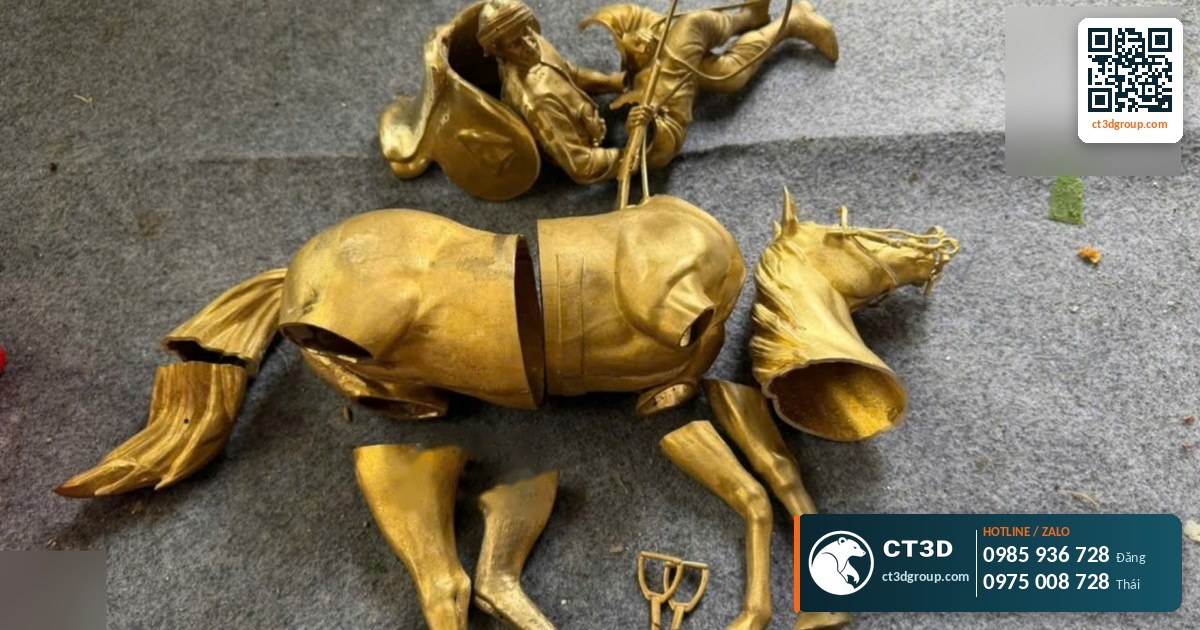
When an old part is broken and no drawing exists, the solution is 3D scanning followed by reverse engineering. CT3D offers this service – see our article on 3D scanning and reverse engineering services. Modeling costs are charged separately from printing.
How to order 3D printing in Binh Duong and Dong Nai
CT3D has its head office in Binh Duong and a workshop in Bien Hoa, so industrial-park customers in both provinces can work with us in person or send files online. The process has 6 steps.
- Send your file: STL, STEP, OBJ or 3MF via our website, Zalo or email. STEP is preferred because it preserves exact geometry and is easy to edit.
- State your technical requirements: quantity, operating environment (temperature, outdoors, chemicals), critical fit dimensions, color, and required delivery date.
- Engineering file review: we check for mesh errors, wall thickness and print orientation, and calculate the plastic weight.
- Quote with lead time: printing, post-processing and modeling (if any) are itemized separately.
- Confirmation and production: for assembly parts, we recommend printing a test sample first.
- Delivery: door-to-door delivery or pickup at the workshop. Shipping via Viettel Post, Giao Hang Tiet Kiem or Vietnam Post; nationwide delivery within 1–3 days after completion.
Checklist for a fast quote
- 3D file (STEP preferred) or a dimensioned 2D drawing.
- Photos of the old part installed on the machine (for replacements).
- Maximum operating temperature, and whether the part is used outdoors.
- Loads: clamping, impact, vibration, static load.
- Mandatory fit dimensions and desired tolerances.
- Current quantity and expected reorders.
- Invoicing details and the recipient at the industrial-park gate.
Lead times for industrial-park customers and how to shorten them
Actual lead time depends on three stages: file preparation, printing and post-processing. Based on typical Ho Chi Minh City market conditions in 2026 (not a CT3D commitment): ready-to-print files usually take 1–3 days; files that need modeling take 3–7 days; painted parts take 7–14 days. Rush service in 3–4 days carries a surcharge of about +30%, and 1–2 days about +50%. The factors that affect print time are analyzed in detail in our article on 3D printing time and machine-hour cost.
To shorten lead times without paying rush fees, you can: send a STEP file instead of photos; accept an as-printed surface for technical parts; split large parts into several pieces printed in parallel on multiple machines; and keep a few spares of frequently failing parts in stock at the factory.
Real-world applications of 3D printing in industrial-park factories
The part groups below are what manufacturers typically order. I list them by application, without reference to specific customers.
- Jigs and fixtures: locating gauges, drill jigs, labeling jigs, inspection fixtures. The advantage is that the file can be edited and reprinted quickly when the product model changes.
- Spare parts: light-duty plastic gears, small pulleys, handles, covers, pipe clamps. Useful when original parts must be imported with long wait times.
- Prototypes before tooling: checking form and assembly with the real sub-assembly before investing in an injection mold.
- Safety and guarding: gear covers, splash guards, connector housings.
- Kaizen and 5S tools: shadow trays for tools, holders, instruction boards.
For machine housings and industrial parts that require a uniform black finish, you can also explore the industrial black ABS 3D printing service on in3d.edu.vn. When quantities grow to dozens or hundreds of parts, the question becomes volume discounts and the break-even point versus injection molding – see our article on high-volume 3D printing and low-volume production.
Working with a workshop near your industrial park vs. in Ho Chi Minh City
Many customers ask whether to order from a workshop near the factory or in Ho Chi Minh City. In terms of per-gram price, CT3D applies a single price list. The differences lie mainly in communication and logistics.
| Criteria | Binh Duong head office / Bien Hoa workshop | Ho Chi Minh City workshops |
|---|---|---|
| Per-gram print price | CT3D standard price list | CT3D standard price list |
| Bringing old parts in to measure and inspect | Convenient for customers in Binh Duong and Dong Nai | Convenient for customers in Ho Chi Minh City |
| Sending files online | Same via website, Zalo, email | Same via website, Zalo, email |
| Delivery | Door-to-door or workshop pickup | Door-to-door or workshop pickup |
Source: CT3D workshop network and pricing policy.
Customers in Ho Chi Minh City can read our article on 3D printing prices in Ho Chi Minh City to learn about our Linh Trung, Tam Binh and District 6 workshops.
Frequently asked questions
Is 3D printing cheaper in Binh Duong than in Ho Chi Minh City?
At CT3D, the per-gram rate is the same: PLA and PETG from 650 VND/g, ABS from 1,000 VND/g, ASA from 2,000 VND/g. The only differences are post-processing fees, rush surcharges and delivery arrangements.
Can companies in industrial parks receive a VAT invoice?
Yes. CT3D is a registered company (CT3D Production Trading Services Co., Ltd., tax code 3703413302). Send your invoicing details when confirming the order and our engineer will include them in the quotation.
What plastic should be used for a jig next to an injection molding machine?
Hot locations call for ABS or ASA instead of PLA, because PLA softens at around 55–60 °C. If the part needs to be stiff and light, consider carbon fiber–filled filament from 2,750 VND/g.
How can I get a quote with no drawing, only the old part?
Send photos and the main dimensions, or bring the part in for 3D scanning and reverse engineering. The modeling fee is charged separately, and then the print price is calculated.
How long until I receive my parts?
Based on market norms, ready files typically take 1–3 days, and files that need modeling 3–7 days. CT3D delivers nationwide within 1–3 days after printing and states the exact lead time in the quotation.
For a complete guide to costs across all technologies (FDM, resin, MJF, metal), read CT3D’s comprehensive 3D printing price guide.
Video from the CT3D workshop
Watch the video SLA 3D printing in Ho Chi Minh City by CT3D to get a clearer picture of our process and product quality. More videos are available on our channel Che Tao Vlog – CT3D.
Contact CT3D – send your file, get a fast quote
Whether you have a 3D file, a 2D drawing, photos or just an idea, you can send it to CT3D. Our engineers will check the file, recommend the right technology and material, and send you a quote with a delivery lead time.
- Email: [email protected] – [email protected]
- Hotline / Zalo: +84 975 008 728 (Mr. Thai) – +84 985 936 728 (Mr. Dang), or use our contact form
- Head office: Binh Duong.
- Workshops in Ho Chi Minh City: Linh Trung (Thu Duc), Tam Binh (Thu Duc), former District 6.
- Other workshops and drop-off points: Can Tho, Da Nang, Bien Hoa, Ba Ria – Vung Tau, Hanoi, Hai Duong, Hai Phong. Nationwide delivery.
- Website: ct3dgroup.com – in3d.edu.vn
CT3D – 3D design & prototyping: 3D printing, 3D scanning, reverse engineering, silicone mold making, painting and finishing, CNC machining, composite fabrication, plus 3D printers and 3D printing materials.
Danh sách cửa hàng:
CT3D là đơn vị cung cấp trọn gói các dịch vụ thiết kế và sản xuất theo yêu cầu tại TP.HCM và khu vực lân cận (Bình Dương, Đồng Nai, Long An…). Với năng lực khép kín từ thiết kế 3D, in 3D (FDM, resin/SLA, SLS, in 3D kim loại), scan 3D – thiết kế ngược, làm khuôn, đúc composite – poly resin – poly stone đến gia công CNC và sơn màu hoàn thiện, CT3D đồng hành cùng khách hàng qua toàn bộ quy trình – từ ý tưởng, bản vẽ hay sản phẩm mẫu đến thành phẩm hoàn chỉnh. Dù bạn cần tạo mẫu nhanh, sản xuất số lượng, chế tác tượng – mô hình – quà tặng hay linh kiện kỹ thuật, đội ngũ CT3D sẽ tư vấn công nghệ và vật liệu phù hợp, đảm bảo sản phẩm sắc nét, đúng yêu cầu và tối ưu chi phí. Khách hàng tại TP.HCM và vùng lân cận có thể trao đổi trực tiếp, gửi file online và nhận sản phẩm thuận tiện, hỗ trợ cả đơn gấp lẫn dự án số lượng.
CT3D cung cấp trọn gói các dịch vụ thiết kế và sản xuất theo yêu cầu, phục vụ khách hàng tại Hà Nội và các tỉnh lân cận (Bắc Ninh, Hưng Yên, Hải Phòng, Vĩnh Phúc…). Với năng lực khép kín từ thiết kế 3D, in 3D (FDM, resin/SLA, SLS, in 3D kim loại), scan 3D – thiết kế ngược, làm khuôn, đúc composite – poly resin – poly stone đến gia công CNC và sơn màu hoàn thiện, CT3D đồng hành cùng khách hàng qua toàn bộ quy trình – từ ý tưởng, bản vẽ hay sản phẩm mẫu đến thành phẩm hoàn chỉnh. Quy trình làm việc thuận tiện: bạn gửi file 3D hoặc mô tả ý tưởng qua online, đội ngũ CT3D tư vấn công nghệ – vật liệu, báo giá nhanh và giao hàng tận nơi tại Hà Nội. Dù bạn cần tạo mẫu nhanh, sản xuất số lượng, chế tác tượng – mô hình – quà tặng hay linh kiện kỹ thuật, CT3D đều đáp ứng với sản phẩm sắc nét, đúng yêu cầu và tối ưu chi phí.

