
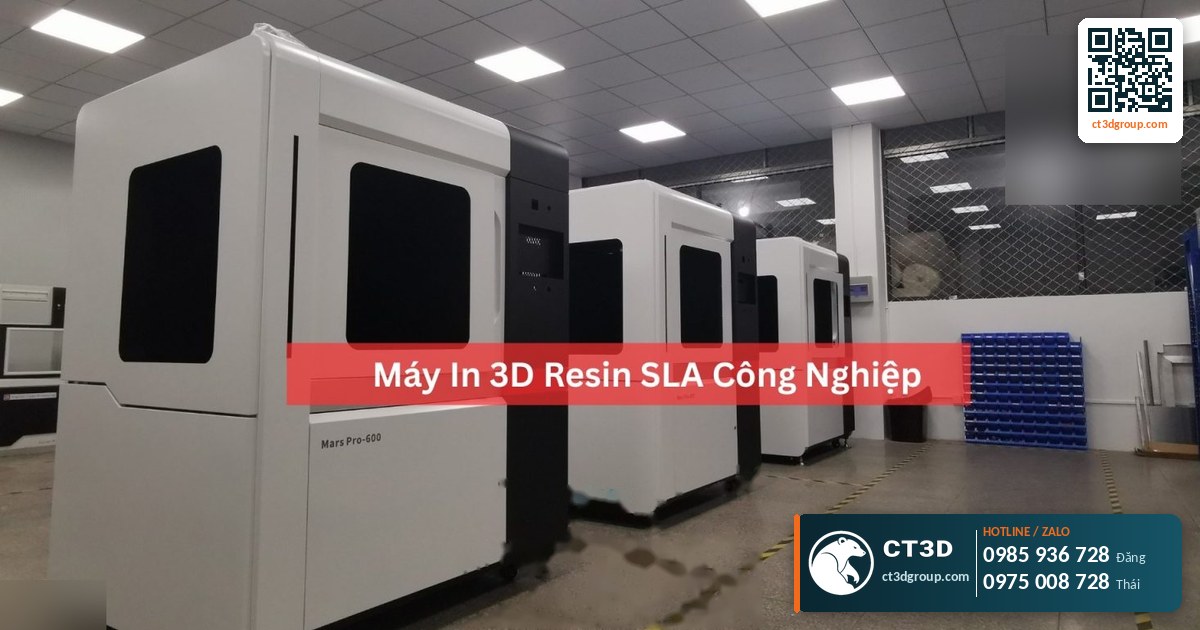
Quick answer: SLA vs DLP vs LCD – all three are resin 3D printing technologies that cure liquid resin with UV light; the difference is the light source. SLA uses a laser that scans point by point, with a tolerance of about ±0.05–0.1 mm, and excels at large models and smooth surfaces. DLP uses a projector that exposes the whole layer at once, with a tolerance of about ±0.03–0.08 mm, fast and sharp for small models. LCD uses a screen to mask the light; it is low cost, and its resolution depends on pixel size. All three print 25–100 micron layers.
Many customers send files to CT3D and ask: “Should I print in SLA or DLP – and is LCD worse?” The honest answer: it depends on the model size, the level of detail required and the quantity. This article takes a deep look at how each technology works, with a specification table, worked calculations and real machine-selection scenarios. For an overview of pricing and materials, see CT3D’s pillar article on resin 3D printing.
What are SLA, DLP and LCD? What the three resin printing technologies share
All three belong to the vat photopolymerization family. Put simply, the machine has a vat of liquid resin containing a photoinitiator. When exposed to UV light of the right wavelength, the resin molecules link together and harden into a thin layer. The build platform moves up (or down) by one layer thickness, and the machine exposes the next layer. Repeating this for hundreds or thousands of layers produces the finished part.
The difference lies in how light is delivered to the resin:
- SLA (stereolithography): a UV laser steered by two rotating galvo mirrors traces the outline and fill of each layer in turn – like coloring with a very fine pen.
- DLP (Digital Light Processing): a projector with a digital micromirror device (DMD) chip projects the entire layer image onto the bottom of the vat – like printing with a stamp: the whole layer cures at once.
- LCD (also called MSLA – masked SLA): an array of UV LEDs shines evenly upward through an LCD screen. The screen turns pixels transparent where resin should cure and dark elsewhere. It is also a “stamp”, but the stamp is a screen.
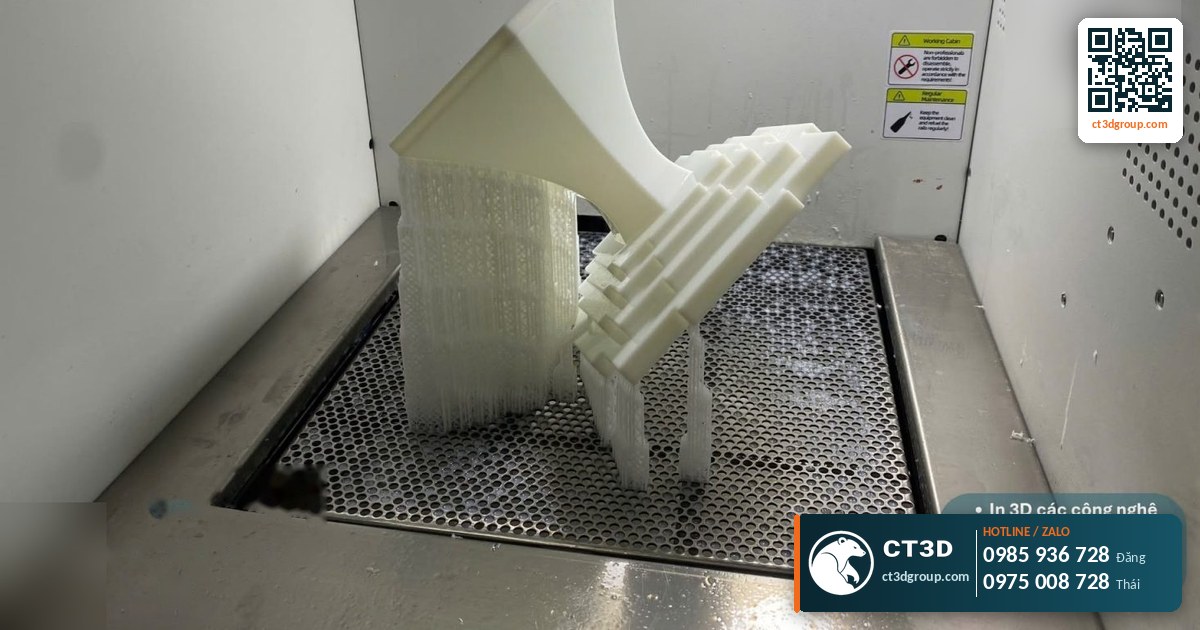
Because they share the same chemistry, all three share the same advantages: much smoother surfaces than FDM and sharp fine detail, making them ideal for display models, jewelry, dental work and small precision parts. They also share the same drawbacks: they need supports, require alcohol washing and UV curing after printing, and the resin is sensitive to temperature and light.
SLA vs DLP vs LCD specification comparison table
| Criterion | SLA (laser) | DLP (projector) | LCD / MSLA (screen) |
|---|---|---|---|
| Light source | UV laser, point scanning | Projector with DMD micromirror chip | UV LED array + masking LCD screen |
| How a layer is cured | Line by line | Whole layer at once | Whole layer at once |
| Layer height | 25–100 microns | 25–100 microns | Typically 25–100 microns |
| Dimensional tolerance | ±0.05–0.1 mm | ±0.03–0.08 mm | Depends on screen pixel size and calibration |
| Horizontal (XY) resolution | Set by laser spot diameter | Set by projected pixel size | Set by screen pixel size |
| Build volume | Easy to scale up (CT3D up to 800×800×500 mm) | Usually small – medium | Small to medium |
| Speed with many parts | Slows as layer area increases | Almost constant | Almost constant |
| Main consumables | Resin vat, laser | Resin vat, projector light source | LCD screen, FEP film in the vat |
| Strengths | Large models, uniform surfaces, engineering parts | Small, sharp, consistent details | Low investment cost, flexible |
Source: CT3D technical documentation (layer height, SLA/DLP tolerances, build volume); light source characteristics based on general technology principles.
In-depth analysis: why does the same resin give different quality?
What determines the horizontal (XY) resolution of SLA, DLP and LCD?
The layer height (Z axis) of the three technologies is nearly identical. The big difference is in horizontal (XY) resolution.
- SLA: XY resolution depends on the laser spot diameter. The laser draws continuous curves without pixel-grid “jaggies”, so SLA’s curved edges and round surfaces are usually smooth and consistent across the whole build area.
- DLP and LCD: each layer image is a grid of square pixels (voxels – 3D pixels). Diagonal edges and arcs are approximated by small steps. The smaller the pixel, the finer the steps. Slicers usually apply anti-aliasing to slightly soften edges for a smoother surface.
Worked example of pixel size: suppose an LCD screen has 3,840 pixels across a print area about 134 mm wide. Each pixel ≈ 134 ÷ 3,840 ≈ 0.035 mm, or about 35 microns. If a DLP projector with 1,920 pixels covers an area 96 mm wide, each pixel ≈ 96 ÷ 1,920 = 0.05 mm (50 microns). This is an illustration of the calculation, not the specification of a particular machine. The key point: at the same resolution, the larger the build area, the larger the pixels and the less sharp the detail. That is why large-format DLP/LCD machines struggle to match the sharpness of small ones.
Print speed: when is SLA slower than DLP/LCD?
With DLP and LCD, the exposure time per layer is almost fixed, regardless of whether the layer contains 1 part or 20. Print time depends mainly on the part height and layer thickness.
With SLA, the laser must scan the entire area to be cured. The more solid area in a layer, the longer the scan. Illustrative example: a 50 mm tall part at 0.05 mm layers → 50 ÷ 0.05 = 1,000 layers. On a DLP/LCD machine, if each layer takes a few seconds of exposure plus platform movement, the total time is almost the same whether there is 1 part or 10 on the platform. On an SLA machine, 10 parts means the laser scans many times more area per layer. On the other hand, SLA handles large, tall, one-piece parts better because it is not limited by the size of a screen or projector.
Light uniformity and dimensional accuracy
SLA’s laser delivers consistent energy at every scanned point, so curing is uniform across the build area. With DLP, projector light can be stronger in the center and weaker at the edges; good machines include uniformity calibration. With LCD, light must pass through the screen, which absorbs some of it, so the LED array must be designed for even illumination. If light is uneven, parts at the edge of the platform may cure less than those in the center, causing dimensional deviation or weak support adhesion.
In addition, all resin technologies experience over-cure: light spreads beyond the intended area, making small holes shrink and small pins swell. Engineers must compensate dimensions in the software or the file to achieve fit tolerances.
Materials: which technology can print engineering resins?
In principle, the resin must match the wavelength and intensity of the light source. Many common DLP and LCD machines use 405 nm light; SLA lasers may use 355 nm or 405 nm depending on the system. Engineering resins (tough, high-temperature, clear, castable for jewelry) usually have higher viscosity, need more energy and require accurate exposure settings. At CT3D, the resin range includes tough, clear, high-temperature, engineering, flexible and castable resins, as well as ABS-like, PA12-like, light-transmitting clear and wax resins. Our engineers choose the right machine for each resin rather than sticking to one technology.
Should you choose SLA, DLP or LCD for each type of product?
| Product type | Preferred technology | Technical reason |
|---|---|---|
| Statues and large models over 30 cm that must be one piece | Large-format SLA | Build volume up to 800×800×500 mm, uniform surface, fewer joints |
| Jewelry, castable patterns, parts under 5 cm | DLP | Small pixels, ±0.03–0.08 mm tolerance, sharp fine detail |
| Dental models, high-volume dental arches | DLP or LCD | Many parts at once; time does not increase with quantity |
| Figures and collectible models of 10–20 cm | LCD or DLP | Good detail at a reasonable cost |
| Prototype housings, engineering assembly parts | SLA or DLP | Consistent surfaces, good fit tolerances |
| Clear parts that need polishing | SLA | Fewer pixel marks, easier to polish to clarity |
Source: CT3D production experience; specifications from CT3D technical documentation.
For clear parts, see our article on clear resin 3D printing. For jewelry casting patterns, see wax and castable resin patterns for jewelry casting.
Common problems with each technology and how to fix them
- Pixel lines and stair-stepping on curved surfaces (DLP/LCD): caused by the pixel grid. Fix: enable anti-aliasing, tilt the part 20–45° so the steps are evenly distributed, and lightly sand after printing.
- Less sharp parts at the edge of the platform (DLP/LCD): caused by uneven light. Fix: place critical parts in the central area and calibrate the light source regularly.
- Very long print times with many parts (SLA): because the laser has to scan more area. Fix: move high-volume small parts to DLP/LCD and keep SLA for large parts.
- Failed prints and layer separation (all three): caused by high peel forces from the vat floor, insufficient supports or cold resin. Fix: keep the resin at 25–28 °C, add supports and reduce the cross-sectional area by tilting the part. See details in common resin 3D printing problems.
- Small holes closing up, small pins swelling (all three): caused by over-cure. Fix: compensate tolerances in the file and check a test print before batch production.
With resin temperature control and proper part orientation, CT3D keeps its resin print failure rate below 5%.
How CT3D chooses a resin technology for your order
- File intake: send STL, STEP, OBJ or 3MF via the website, Zalo, email or our contact form. If you are unsure about formats, see what is an STL file.
- Requirements: real size, purpose (display, assembly, casting, dental), level of detail, quantity, color and whether painting is needed.
- Engineers analyze the file: checking thin walls and drain holes, calculating resin volume and choosing SLA, DLP or LCD.
- Quote with lead time: clearly stating the technology, resin type and layer height.
- Production: printing, washing, UV curing, support removal and finishing.
- Delivery: door-to-door or workshop pickup, with nationwide delivery 1–3 days after completion.
Checklist for choosing the right technology: the largest dimension of the part; the smallest detail that must be visible (e.g. 0.3 mm raised lettering); whether it mates with other parts; whether it needs to be clear, heat resistant or tough; quantity; deadline.
Real-world scenarios
Scenario 1 – A 1 m statue: CT3D has printed a 1 m Catholic statue with SLA. At this size, large-format SLA allows printing in few pieces with few joints and a uniform surface for painting. DLP/LCD would require splitting it into many small pieces.
Scenario 2 – 30 ring casting patterns: each pattern is under 3 cm and needs sharp prongs and ornamentation. DLP is the sensible choice: the whole platform prints in one run, taking almost the same time as a single ring.
Scenario 3 – A small batch of 15 cm figures: LCD or DLP both work. The 2026 Ho Chi Minh City market price for a 10–15 cm standard resin model is about 800,000 – 2.5 million VND (≈ US$31–96) (indicative market level, not CT3D’s price). Actual prices depend on volume and difficulty; CT3D quotes per file.
To order industrial resin printing, see the high-resolution SLA resin 3D printing page on in3d.edu.vn (in Vietnamese), or compare more broadly with FDM, MJF and SLM in our article 3D printing technologies compared.
In short: SLA excels at large builds and uniform surfaces; DLP excels at small details and consistency; LCD excels at cost and batches of small parts. For pricing, materials and our full service, return to CT3D’s article on custom resin 3D printing.
Frequently asked questions about SLA, DLP and LCD
Which of SLA, DLP and LCD gives the best print quality?
No single technology is best for every part. DLP is usually sharpest on small parts (±0.03–0.08 mm tolerance). SLA is the most uniform and smooth on large parts (±0.05–0.1 mm). LCD delivers good quality when pixels are small and the machine is well calibrated.
Is LCD printing the same as SLA printing?
LCD is sometimes called MSLA (masked SLA), but its light source is completely different: LCD uses UV LEDs and a masking screen, while traditional SLA uses a point-scanning laser.
Why choose DLP or LCD for many small parts?
Because DLP and LCD expose the whole layer at once, the time per layer stays the same whether there is 1 part or many. SLA has to scan each part, so time increases with area.
What layer height is enough for resin printing?
All three technologies print 25–100 micron layers. Display models typically use 50 microns; jewelry and small parts use 25 microns; large parts where speed matters can use 100 microns.
Can CT3D print with SLA, DLP and LCD?
Yes. CT3D prints SLA/DLP/LCD resin with build volumes up to 800×800×500 mm, and chooses the technology for each file to balance quality, time and cost.
Real footage from the CT3D workshop
Watch the video High-precision 3D printing – SLA resin by CT3D to get a clearer picture of the process and product quality. More videos are available on our channel Che Tao Vlog – CT3D.
Contact CT3D – send your file, get a fast quote
Whether you have a 3D file, a 2D drawing, photos or just an idea, you can send it to CT3D. Our engineers will review the file, recommend the right technology and material, and send a quote with the delivery lead time.
- Email: [email protected] – [email protected]
- Hotline / Zalo: +84 975 008 728 (Mr. Thai) – +84 985 936 728 (Mr. Dang), or our contact form
- Head office: Binh Duong.
- Workshops in Ho Chi Minh City: Linh Trung (Thu Duc), Tam Binh (Thu Duc), District 6 (former).
- Other workshops and drop-off points: Can Tho, Da Nang, Bien Hoa, Ba Ria – Vung Tau, Hanoi, Hai Duong, Hai Phong. Nationwide delivery.
- Website: ct3dgroup.com – in3d.edu.vn
CT3D – 3D design & prototyping: 3D printing, 3D scanning, reverse engineering, silicone mold making, painting and finishing, CNC machining, composite fabrication, and supply of 3D printers and 3D printing materials.
Danh sách cửa hàng:
CT3D là đơn vị cung cấp trọn gói các dịch vụ thiết kế và sản xuất theo yêu cầu tại TP.HCM và khu vực lân cận (Bình Dương, Đồng Nai, Long An…). Với năng lực khép kín từ thiết kế 3D, in 3D (FDM, resin/SLA, SLS, in 3D kim loại), scan 3D – thiết kế ngược, làm khuôn, đúc composite – poly resin – poly stone đến gia công CNC và sơn màu hoàn thiện, CT3D đồng hành cùng khách hàng qua toàn bộ quy trình – từ ý tưởng, bản vẽ hay sản phẩm mẫu đến thành phẩm hoàn chỉnh. Dù bạn cần tạo mẫu nhanh, sản xuất số lượng, chế tác tượng – mô hình – quà tặng hay linh kiện kỹ thuật, đội ngũ CT3D sẽ tư vấn công nghệ và vật liệu phù hợp, đảm bảo sản phẩm sắc nét, đúng yêu cầu và tối ưu chi phí. Khách hàng tại TP.HCM và vùng lân cận có thể trao đổi trực tiếp, gửi file online và nhận sản phẩm thuận tiện, hỗ trợ cả đơn gấp lẫn dự án số lượng.
CT3D cung cấp trọn gói các dịch vụ thiết kế và sản xuất theo yêu cầu, phục vụ khách hàng tại Hà Nội và các tỉnh lân cận (Bắc Ninh, Hưng Yên, Hải Phòng, Vĩnh Phúc…). Với năng lực khép kín từ thiết kế 3D, in 3D (FDM, resin/SLA, SLS, in 3D kim loại), scan 3D – thiết kế ngược, làm khuôn, đúc composite – poly resin – poly stone đến gia công CNC và sơn màu hoàn thiện, CT3D đồng hành cùng khách hàng qua toàn bộ quy trình – từ ý tưởng, bản vẽ hay sản phẩm mẫu đến thành phẩm hoàn chỉnh. Quy trình làm việc thuận tiện: bạn gửi file 3D hoặc mô tả ý tưởng qua online, đội ngũ CT3D tư vấn công nghệ – vật liệu, báo giá nhanh và giao hàng tận nơi tại Hà Nội. Dù bạn cần tạo mẫu nhanh, sản xuất số lượng, chế tác tượng – mô hình – quà tặng hay linh kiện kỹ thuật, CT3D đều đáp ứng với sản phẩm sắc nét, đúng yêu cầu và tối ưu chi phí.

