
Concept to 3D Design – From Sketch or Photo to CAD File
Technical summary: Concept to 3D design (concept-to-CAD) is CT3D’s service for turning a verbal description, hand sketch, reference photo or similar product into a manufacturable 3D model. Unlike reverse engineering (which starts from a physical sample) or design from drawings (where dimensions already exist), here our engineers must define the specifications themselves: bounding dimensions, wall thickness, assembly clearances, material and manufacturing process. The result is an STL/STEP file that has passed DfAM/DFM checks and, if required, a 3D printed sample you can hold and test.
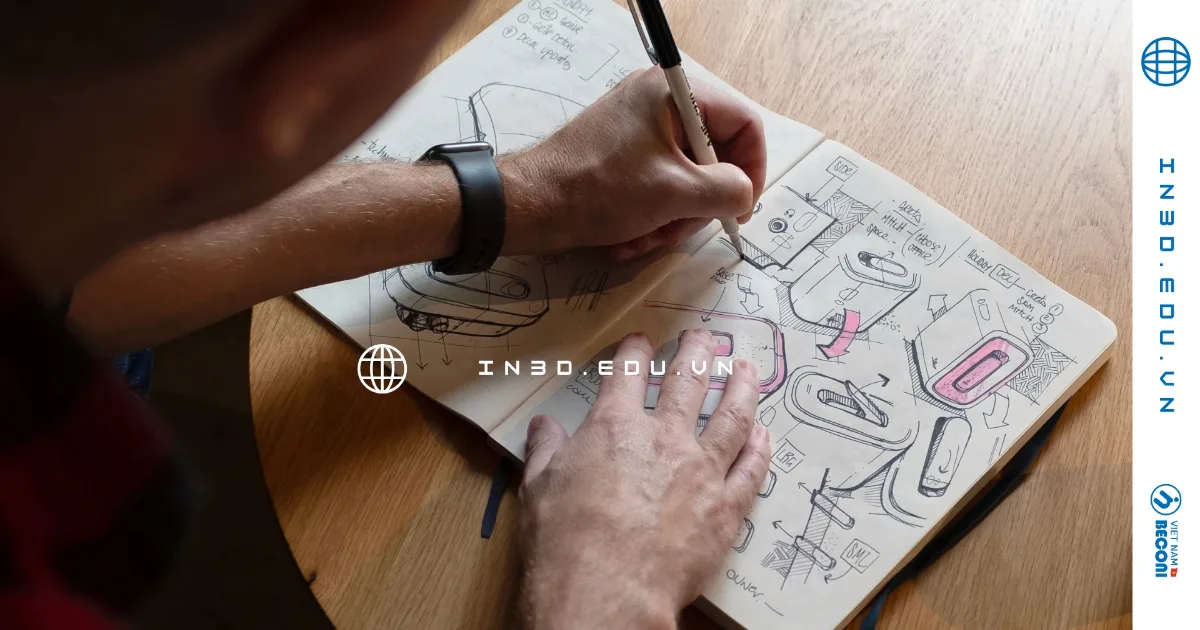
Many good products start as a sentence, a napkin sketch or a photo of something similar. Our concept to 3D design service is built for that stage: CT3D engineers ask about function first, propose dimensions and materials, share simple renders to lock proportions, and then develop a detailed model that is checked for manufacturability. Because we also run FDM and resin 3D printing in-house, you can hold a test sample of your idea before committing to tooling. Describe your idea for a fast quote; we sign an NDA on request before detailed discussions.
Concept to 3D Design at a Glance
| Accepted inputs | Verbal description, text message, hand sketch, reference photos, similar product, concept art or three-view drawings |
|---|---|
| What we define | Bounding box, wall thickness, assembly clearances, infill, build orientation, material and process |
| Milestones | Massing renders, detailed model with DFM review, printed prototype, acceptance |
| Deliverables | STL/STEP files that have passed DfAM/DFM checks, plus a 3D printed sample if required |
| Prototype options | PLA, PETG, ABS, ASA, TPU, nylon and carbon-fiber-filled plastics; SLA/DLP resin; PA12 via MJF/SLS |
| Next steps | Low-volume 3D printing, silicone molds with PU casting, or files prepared for injection molding |
Accepted Inputs for Concept to 3D Design and Their Definition Level
The clearer the idea, the shorter the iteration loop. CT3D classifies inputs by definition level to estimate the workload right from the quotation stage:
| Input type | Definition level | What our engineers need to add |
|---|---|---|
| Verbal description, text message | Low | Concept sketches, proposed dimensions, several feedback rounds |
| Hand sketch with dimensions | Medium | Complete the geometry, choose fillet radii and wall thickness |
| Photos of a reference product | Medium | Derive scale from known dimensions, rebuild the form |
| Multi-angle photos + overall dimensions | Fairly high | Mainly modeling and manufacturability checks |
| Concept art / three-view drawings | High | Modeling, splitting into sections, print file preparation |

Source: CT3D internal classification used when assessing design requests.

Scope of Work
From description to model
When a customer only has a description – for example “a phone holder that clamps onto bicycle handlebars and rotates 90 degrees” – our engineers ask functional questions before shape questions: what load must it carry, will it be used indoors or outdoors, does it need quick release? Based on the answers we select the material (e.g. ASA for outdoor use because it resists UV better than PLA) and the mechanism (swivel joint, locking pin), and only then start modeling.
From images to model
With photos, the biggest challenge is scale. Photos contain perspective distortion, so engineers need at least one real dimension as a reference. Straight-on (orthographic-like) photos with a ruler or familiar object alongside significantly reduce scale errors.

From a similar product to a new version
Sometimes customers want “something like this, but bigger and with an extra compartment”. CT3D can 3D scan the reference product as a framework and then design the changes; the new design must be clearly distinct to avoid intellectual property risks.
Technical Specifications Defined During the Design Process
An idea becomes a product once the following parameters are defined in numbers:
| Parameter | Why it matters | How CT3D defines it |
|---|---|---|
| Bounding box | Determines build volume, cost and whether splitting is needed | Based on intended use, compared with machine capacity |
| Wall thickness | Stiffness, weight, print time | Based on the target material and process |
| Assembly clearance | Whether parts fit together | Based on process tolerance: FDM ±0.1–0.3 mm, SLA ±0.05–0.1 mm |
| Infill density | Balances strength and cost in FDM | Based on expected load |
| Build orientation | Affects anisotropy, surface finish, supports | Chosen during print file preparation |
Source: CT3D process specifications 2026; common DfAM principles. Read more in our article on infill and its effect on strength.
How It Works: Iterative Design Workflow
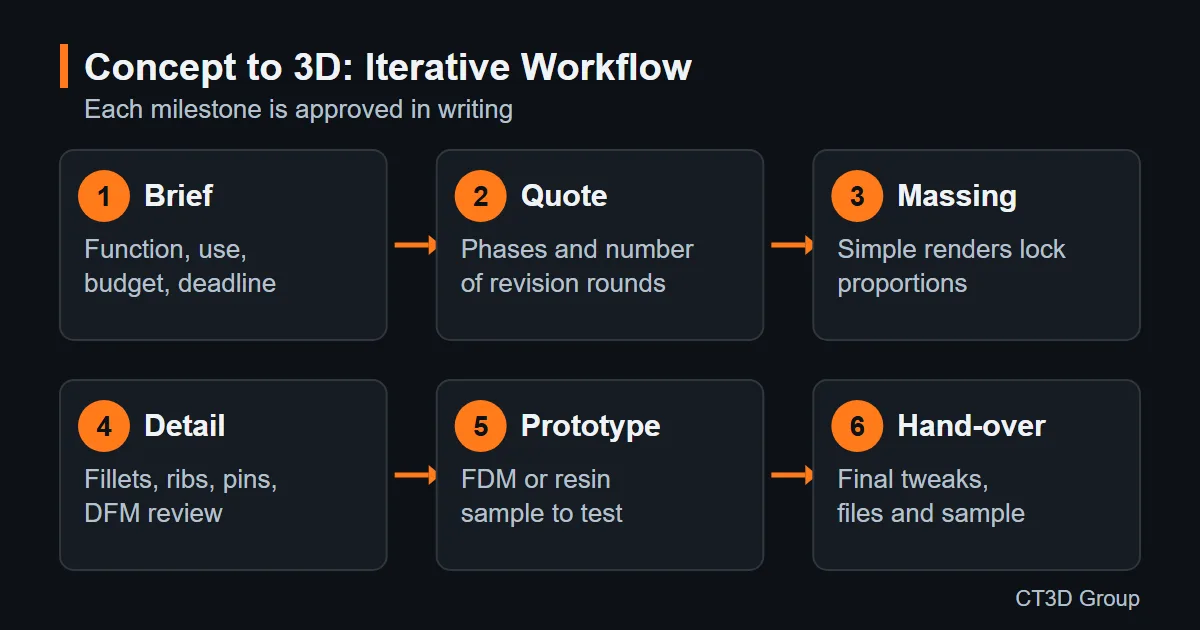
- RFQ: send your description, photos or sketches via our Contact form, Zalo or email; state the intended use and quantity.
- Requirement brief: our engineers clarify function, operating environment, budget and deadline.
- Quotation: split by phase – massing, detailed modeling, production preparation – including the number of revision rounds covered.
- Massing: simple renders are shared to lock in proportions and layout.
- Detailed modeling and DFM review: fillets, ribs, pins and text are added; overhangs and thin walls are checked.
- Prototype and acceptance: an FDM or resin sample is printed for hands-on testing; final tweaks are made; files and samples are delivered to your door or collected at our workshop.
Indicative pricing for FDM test prints at CT3D starts from 650 VND/g (≈ US$0.025/g) for PLA and PETG; a minimum charge applies to orders under 50 g. Prices are indicative only; see also our guide to 3D modeling costs for printing and our FDM 3D printing service.

Recommended Materials by Purpose
| Purpose | Recommended material | Why |
|---|---|---|
| Form and proportion checks | PLA | Low cost, fast to print, good enough to evaluate dimensions |
| Light-load parts that need toughness | PETG or ABS | Tougher than PLA for handling and assembly tests |
| Outdoor use | ASA | UV- and heat-stable |
| High-load parts, fixtures | Carbon-fiber-filled plastics, nylon, or PA12 via MJF/SLS | Higher stiffness and strength |
| Display models with smooth surfaces | SLA/DLP resin at 25–100 micron layers | Fine detail, followed by painting and finishing |
| Flexible parts, cushions | TPU or flexible resin | Elastic behavior |
How to Brief Us for the Best Result
These general tips help any designer understand an idea faster and reduce revision rounds:
- Start with the job, not the look. What must it hold, carry or protect? Where will it be used – indoors, outdoors, in water, near heat?
- Give at least one real dimension. A measured length, the size of the object it must fit, or a ruler in your photos removes scale guesswork.
- Shoot straight-on photos. Front, side and top views reduce perspective distortion compared with angled snapshots.
- List the must-haves and nice-to-haves. For example: must clip onto a 22–32 mm tube; nice to have a quick release.
- Share the quantity and budget. Ten units and ten thousand units lead to different materials and processes.
- Mention deadlines early – events, trade fairs or investor meetings shape the schedule.
Industry Applications
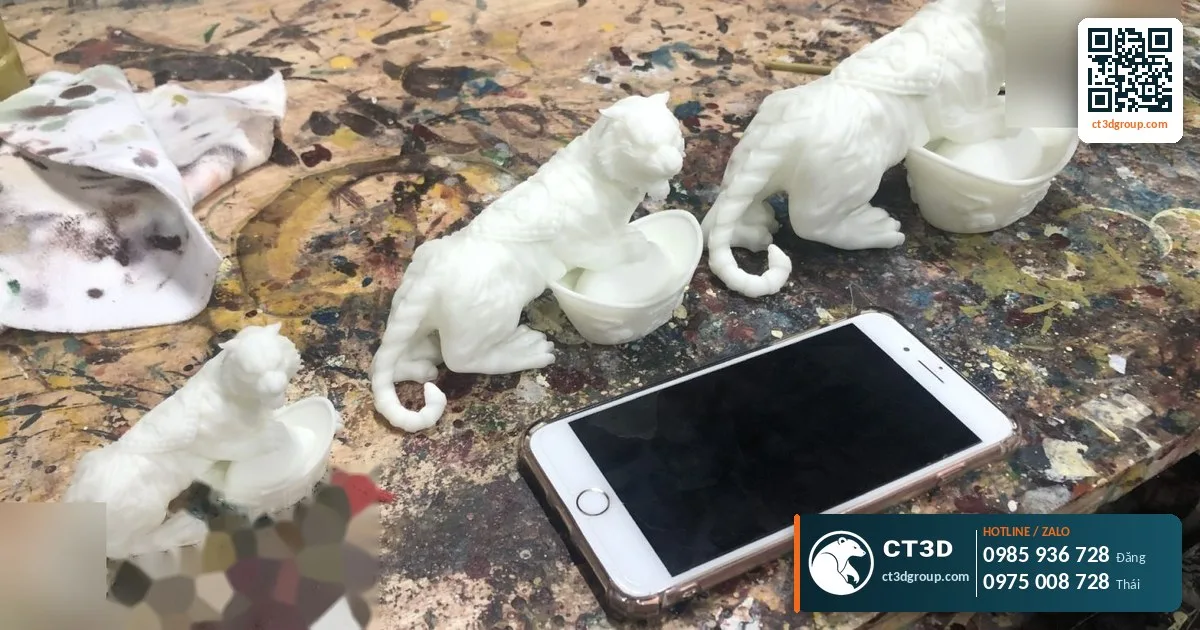
Customers who typically order concept-to-CAD work include: independent inventors who need a prototype for a patent filing or fundraising; manufacturers who need an auxiliary part not available on the market; advertising agencies who need giant product replicas, 3D logos or mascots; corporate gift suppliers who need trophies and commemorative medals matching a brand identity; and lecturers and students who need illustrative models for projects. For presentation models, see also our article on product presentation prototypes and our decor and corporate gifts service.
Concept to 3D vs. Other Design Routes
| Criteria | Concept to 3D design | Reverse engineering | Design from drawings |
|---|---|---|---|
| Starting point | Description, sketch, photo or similar product | A physical sample | Drawings with dimensions |
| Who defines the specifications | CT3D engineers, confirmed with you | Measured from the sample | Already given |
| Typical iterations | Several, planned in the quote | Few – mainly confirming nominal sizes | Few |
| Prototype role | Essential to validate the idea | Recommended for a trial fit | Recommended before tooling |
| Service page | This page | Reverse engineering | 3D CAD design |
Quality Control
Vague ideas easily lead to mismatched expectations. CT3D reduces this risk by confirming each milestone in writing: approved renders, a table of key specifications and a change log between versions. Technically, the final file is checked for a watertight mesh, minimum wall thickness, assembly clearances and units. The printed sample is re-measured with calipers at critical dimensions; if deviations exceed process tolerance, the cause (material shrinkage, print orientation) is analyzed and corrected in the file.
How to Order
- Describe your idea with any sketches or photos through the Contact form, email or Zalo; we can sign an NDA first.
- Clarify the brief – function, environment, budget, quantity and deadline.
- Approve the phased quote, including revision rounds and any test prints.
- Review renders and the prototype, then receive the final STL/STEP files and sample.
Why CT3D for Concept to 3D Design
- Function-first questions before any modeling, so the design solves the real problem.
- Written milestones – approved renders, a key-specification table and a change log keep expectations aligned.
- Prototype in-house – FDM and resin printing, PA12 and finishing without changing suppliers.
- A path to production – low-volume printing, silicone molds with PU casting or injection-molding files.
- Confidential by default – designs are not used or published without consent; NDA on request; engineering support in English.
Frequently Asked Questions
Will my idea be kept confidential?
Yes. CT3D never uses or publishes customer designs without consent and can sign a non-disclosure agreement (NDA) before detailed discussions.
What if I don’t know the exact dimensions?
Our engineers will propose dimensions based on function and common usage standards, then print a test sample so you can check it in practice.
How many revision rounds are reasonable?
The number of rounds is agreed in the quotation. In general, finalizing the massing stage carefully significantly reduces revisions during detailing.
Can you produce quantities once the design is finished?
Yes. Depending on volume, CT3D recommends low-volume 3D printing, silicone molds with PU casting, or preparing files for injection molding.
What can I send as a starting point?
A written description, a hand sketch, photos of a reference product, multi-angle photos with overall dimensions, or concept art and three-view drawings. The more defined the input, the shorter the iteration loop – but even a short description is enough to start.
Will I get a physical prototype?
If you order one, yes. At the prototype stage an FDM or resin sample is printed so you can test size, fit and feel; critical dimensions are re-measured with calipers and the file is corrected if deviations exceed the process tolerance.
Can you base my design on an existing product?
Yes. CT3D can 3D scan a reference product as a framework and design your changes on top of it. The new design must be clearly distinct from the original to avoid intellectual property risks.
How is concept to 3D design priced?
The quotation is split by phase – massing, detailed modeling and production preparation – and states how many revision rounds are included. Test prints are charged separately; indicative FDM pricing starts from 650 VND/g for PLA and PETG, with a minimum charge for orders under 50 g.
See also: making silicone molds from 3D printed masters, and our silicone mold making service.
Watch: Real Footage from the CT3D Workshop
Watch the video 3D Scanning Service – CT3D Scan 3D to see our process and output quality first-hand. More videos are available on our channel Che Tao Vlog – CT3D (in Vietnamese).
Contact CT3D – Send Your Files for a Fast Quote
Whether you have a 3D file, 2D drawings, photos or just an idea, you can send it to CT3D. Our engineers will review your files (STL, STEP, IGES, OBJ), advise on technology and materials, and send a quotation with the delivery schedule.
- Email: [email protected] – [email protected]
- Phone / Zalo: +84 975 008 728 (Mr. Thai) – +84 985 936 728 (Mr. Dang), or use our Contact form
- Head office: Binh Duong, Vietnam.
- Workshops: Ho Chi Minh City, Vietnam (three locations).
- Other workshops and drop-off points: Can Tho, Da Nang, Bien Hoa, Ba Ria – Vung Tau, Hanoi, Hai Duong, Hai Phong. Nationwide delivery within Vietnam; international shipping on request.
- Website: ct3dgroup.com – in3d.edu.vn
CT3D – 3D design & prototyping: 3D printing, 3D scanning, reverse engineering, silicone mold making, painting & finishing, CNC machining, composite fabrication, plus 3D printers and 3D printing resins.
Turn Your Idea into a Real Part
Describe your idea, send a sketch or a photo, and tell us how it will be used. Our engineers will reply quickly with questions, a phased quote and a schedule.