
Quick answer: The PETG 3D printing cost at CT3D for 2026 starts from 650 VND/g (≈ US$0.025/g), the same as PLA, charged by the actual weight including supports. Ho Chi Minh City market rates: standard PETG/PLA printing at 0.2 mm layers costs about 1,200–1,800 VND/g (≈ US$0.05–0.07/g); load-bearing prints with 30–50% infill about 1,800–2,800 VND/g (≈ US$0.07–0.11/g) (not CT3D prices). PETG is tougher than PLA, withstands heat up to about 70–80 °C, and handles moisture and mild chemicals well – ideal for functional parts.
When a customer needs a part that will “actually be used” rather than just looked at, PETG is usually the first material we recommend. The reason: at CT3D, PETG starts at the same price as PLA, but its impact resistance and heat resistance are clearly better. This article looks at PETG from an engineering perspective: material structure, print settings, typical defects and how to design to get the most out of it. The overall pricing picture is in our pillar article on 3D printing prices.
What Is PETG and Why Is It Tougher Than PLA?
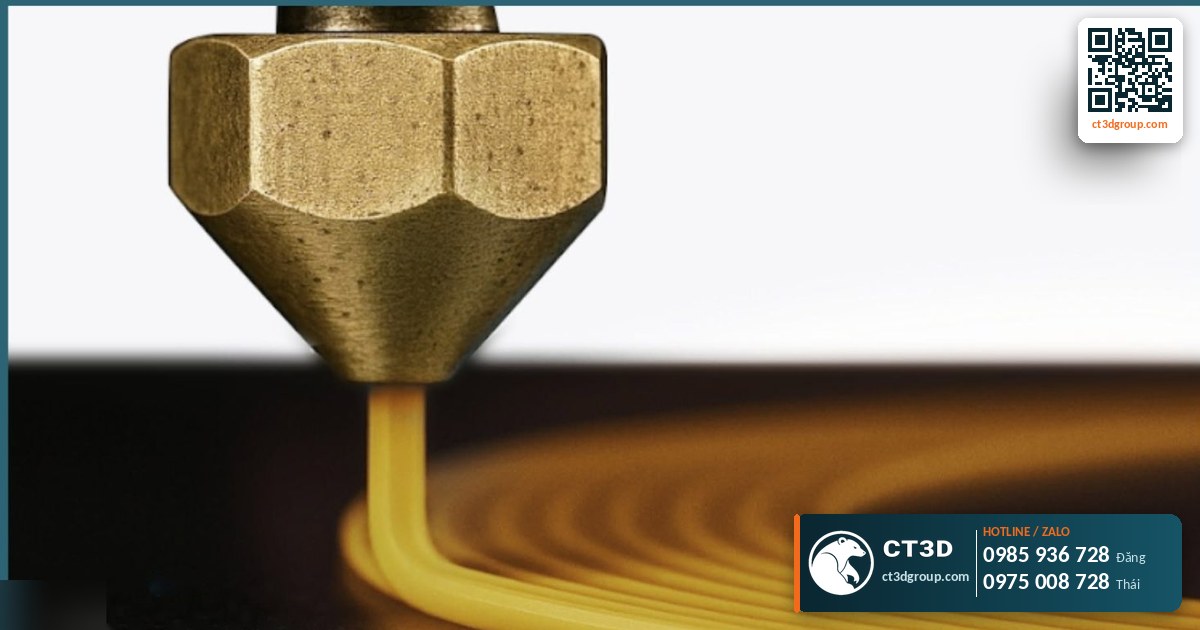
PETG is PET (the plastic used for water bottles) modified with glycol – the “G” stands for glycol. Glycol inserts itself into the polymer chain and makes the plastic hard to crystallize. As a result, PETG stays amorphous: clearer, more flexible and easy to extrude through a nozzle without becoming brittle like pure PET.
Compared with PLA, PETG’s polymer chains are more flexible. Under impact, PETG bends and absorbs energy before breaking; PLA is stiff but brittle and tends to snap suddenly. This difference matters for parts with snap-fits, clips, hooks or parts that are often dropped.
PETG Specifications and 3D Printing Cost vs. PLA and ABS
| Criterion | PLA | PETG | ABS |
|---|---|---|---|
| Printing price at CT3D (indicative, 2026) | From 650 VND/g (≈ US$0.025/g) | From 650 VND/g (≈ US$0.025/g) | From 1,000 VND/g (≈ US$0.04/g) |
| Raw filament (Ho Chi Minh City market) | ~250,000 VND/kg (≈ US$9.6/kg) | ~320,000 VND/kg (≈ US$12.3/kg) | ~350,000 VND/kg (≈ US$13.5/kg) |
| Typical nozzle temperature | 190–220 °C | 230–250 °C | 230–250 °C |
| Bed temperature | 50–60 °C | 70–85 °C | 90–110 °C |
| Softening temperature (approx.) | 55–60 °C | About 80 °C | About 100 °C |
| Density (approx.) | 1.24 g/cm³ | 1.27 g/cm³ | 1.04 g/cm³ |
| Impact toughness | Low, brittle | Good | Good |
| Warping | Low | Low | High |
| Moisture and mild chemical resistance | Medium | Good | Medium – good |
Source: CT3D indicative prices 2026; Ho Chi Minh City market rates 2026; print settings are common filament manufacturer values and may vary by brand. USD figures are indicative at 1 USD ≈ 26,000 VND.
Worth noting: PETG is slightly denser than PLA. For the same model, PETG weighs about 2–3% more than PLA. At the same starting unit price, the difference in total cost is almost negligible.
In Depth: Where Does PETG Sit Between PLA and ABS?
Service temperature
PLA softens at about 55–60 °C. PETG softens at about 80 °C and works reliably up to about 70 °C. ABS is around 100 °C. This means PETG handles most “slightly warm” situations: adapter enclosures, brackets inside electrical cabinets, parts in a car trunk. But PETG cannot replace ABS for parts right next to motors or high heat sources.
Print stability
PETG shrinks far less than ABS, hardly needs an enclosed chamber and has little odor. So large, long prints in PETG carry less risk of layer cracking than ABS. That is why PETG pricing stays close to PLA.
Layer adhesion
PETG bonds between layers very well. PETG parts rarely split along layer lines under tension in the Z direction – the typical weak point of FDM printing. With PLA, layer lines are the first place to break.
Surface accuracy
This is where PETG loses to PLA. PETG is stringy and tends to leave fine strings between parts of the model, and sharp edges are not as crisp as with PLA. For display models with fine details, PLA or resin still looks better.
Cost Example: The Same Snap Clip Printed in PLA and PETG
Suppose you need 10 pipe clamp sets, each about 25 g according to the slicer, for a total of 250 g.
| Option | Weight | Illustrative print cost (from CT3D unit price) | In-use risk |
|---|---|---|---|
| PLA | ~250 g | From about 162,500 VND (≈ US$6.25) | Clips break easily after repeated snapping, soften in hot places |
| PETG | ~256 g (~2–3% heavier) | From about 166,400 VND (≈ US$6.40) | Clips flex well and can be snapped repeatedly |
| ABS | ~210 g (~16% lighter) | From about 210,000 VND (≈ US$8.10) | Tough and more heat resistant, but harder to print |
Source: CT3D illustrative calculation; actual prices are quoted per file.
The difference between PLA and PETG is only a few thousand VND, but clip lifespan is completely different. This is a case where PETG almost always wins. See how weight is calculated in detail in PLA 3D printing cost per gram.
Designing Parts for PETG Printing: Engineering Notes
- Snap-fits: PETG is more elastic than PLA, but you should still design snap arms 1.2–2 mm thick with a fillet at the root to distribute stress.
- Fit clearance: because PETG tends to bulge slightly at edges, leave a bit more clearance than with PLA, typically 0.2–0.4 mm depending on the machine. See also 3D printing accuracy and tolerances.
- Screw threads: PETG holds self-tapping threads better than PLA. For threads that are assembled repeatedly, use heat-set inserts.
- Supports: PETG bonds to supports quite firmly and is harder to clean up than PLA. Orient the part to minimize supports on cosmetic faces.
- Thin watertight walls: for a watertight box, use 3–4 perimeters and thick top/bottom skins; PETG’s good layer adhesion makes it more watertight than PLA.
Common PETG Printing Defects and How to Fix Them
| Defect | Cause | Solution |
|---|---|---|
| Stringing between parts of the model | PETG is stringy and oozes during travel moves | Optimize retraction, lower temperature by 5–10 °C, dry the filament |
| Rough surface with small bubbles | PETG absorbs moisture from the air | Dry filament before printing, store sealed with desiccant |
| Sticks too hard to the bed, damages bed coating | PETG bonds very strongly to PEI surfaces | Use a suitable release layer, adjust first-layer gap |
| Supports hard to remove, leave marks | Good layer adhesion also means good support adhesion | Increase support gap, change build orientation |
| Small edges rounded, not crisp | Flexible plastic, weak part cooling | Slow down on small features, consider PLA or resin |
Source: FDM machine operating experience of CT3D engineers.
The hot, humid climate of Ho Chi Minh City and southern Vietnam makes PETG’s moisture absorption more noticeable. At our workshop, CT3D stores filament in sealed boxes and dries it before important prints.
Is PETG Food Safe?
This is a very common question. Virgin PETG resin is commonly used for food packaging. However, FDM-printed parts have tiny grooves between layers where bacteria can lodge and that are hard to clean. Colorants, additives and the nozzle also play a role. For these reasons, we do not recommend FDM-printed PETG parts for direct, long-term food contact unless a suitable surface coating and certification are in place. For packaging display models and form-study trays, PETG is an excellent fit.
Real-World Applications of PETG 3D Printing
- Jigs, clamps and gauges in factories: impact resistant and tolerant of light oils. See also 3D-printed jigs and fixtures.
- Electronics enclosures and junction boxes: handle humidity and warmth, no enclosed chamber needed.
- Household replacement parts: hooks, connectors, caps, light-duty gears.
- Packaging and bottle mockups: clear PETG can print semi-translucent form models.
- Motorcycle and bicycle accessories: phone holders and small covers with limited direct sun exposure.
If the part will sit in the sun long-term or near high heat, see ABS and ASA 3D printing cost. If you need higher stiffness and strength, see carbon fiber and nylon 3D printing cost.
Checklist for Choosing PETG Before Ordering
- Does the part need to withstand impact, snapping or light bending? Yes → prefer PETG.
- Is the maximum operating temperature below about 70 °C? Yes → PETG will do.
- Will the part sit outdoors in the sun for years? Yes → consider ASA.
- Does the model need sharp edges and details under 1 mm for display? Yes → PLA or resin looks better.
- Are precise fits required? Send a drawing with mating dimensions so our engineers can compensate for tolerances.
PETG Printing Process at CT3D
Send your STL, STEP, OBJ or 3MF file via our website, Zalo, email or our contact form, along with your technical requirements. CT3D engineers analyze the file, calculate the actual weight, recommend build orientation and settings, and then send a quote with lead time. Once confirmed, the workshop produces the parts and delivers them to your door, or you can pick them up at the workshop. Nationwide delivery takes 1–3 days after completion via Viettel Post, Giao Hang Tiet Kiem, Vietnam Post or air freight. The market standard for orders with a ready file is 1–3 days; rush orders carry a surcharge.
See also the FDM price list on in3d.edu.vn’s FDM 3D printing price page (in Vietnamese), or get the full cost picture across all technologies in our 3D printing price guide.
Tips to Reduce PETG Printing Cost for Quantities
When you need many identical PETG parts, a few simple steps can cut costs significantly. First, consolidate the full quantity into one order so our engineers can fill the build plate and reduce machine setup time per part. Typical market volume discounts: 10–30 pieces about 10–15% off; 30–100 pieces about 20–25% off; over 100 pieces about 25–35% off. Second, choose infill and wall count based on the actual load rather than leaving overly dense defaults. Third, if the part has a large flat face, place it on the bed so almost no supports are needed. Fourth, accept 0.2 mm layers for functional parts; thinner layers are only needed for cosmetic exterior surfaces. For orders over 500 g or large quantities, CT3D provides a project quote to optimize cost for you.
Frequently Asked Questions
How much does PETG 3D printing cost per gram?
At CT3D, the indicative 2026 PETG printing price starts from 650 VND/g (≈ US$0.025/g), the same as PLA. Market rates for standard printing are about 1,200–1,800 VND/g (≈ US$0.05–0.07/g), and for load-bearing prints about 1,800–2,800 VND/g (≈ US$0.07–0.11/g).
Should I choose PETG or PLA?
Choose PETG for functional parts that need toughness, moisture resistance and heat resistance up to about 70 °C. Choose PLA for display models that need crisp details and easy finishing.
What temperature can PETG withstand?
PETG softens at about 80 °C and works reliably up to about 70 °C – higher than PLA at about 55–60 °C, but lower than ABS/ASA at about 100 °C.
Can PETG be used outdoors?
PETG handles moisture well and can be used outdoors to a moderate degree. For years of direct sun exposure, ASA offers better color and UV stability.
Why do PETG prints have stringing?
PETG is stringy and absorbs moisture, so it tends to ooze during travel moves. Drying the filament and tuning retraction and temperature will reduce this.
Real Footage from the CT3D Workshop
Watch the Large-format liquid resin 3D printing for rapid prototyping video produced by CT3D to get a clearer picture of our process and product quality. More videos are available on our Chế Tạo Vlog – CT3D channel.
Contact CT3D – Send Your File for a Fast Quote
Whether you have a 3D file, a 2D drawing, photos or just an idea, you can send it to CT3D. Our engineers will check the file, recommend the right technology and material, and send you a quote with a lead time.
- Email: [email protected] – [email protected]
- Hotline / Zalo: +84 975 008 728 (Mr. Thai) – +84 985 936 728 (Mr. Dang), or use our contact form
- Head office: Binh Duong.
- Workshops in Ho Chi Minh City: Linh Trung (Thu Duc), Tam Binh (Thu Duc), former District 6.
- Other workshops and drop-off points: Can Tho, Da Nang, Bien Hoa, Ba Ria – Vung Tau, Hanoi, Hai Duong, Hai Phong. Nationwide delivery.
- Website: ct3dgroup.com – in3d.edu.vn
CT3D – 3D design & prototyping: 3D printing, 3D scanning, reverse engineering, silicone mold making, painting and finishing, CNC machining, composite fabrication, plus 3D printers and 3D printing resins.
Danh sách cửa hàng:
CT3D là đơn vị cung cấp trọn gói các dịch vụ thiết kế và sản xuất theo yêu cầu tại TP.HCM và khu vực lân cận (Bình Dương, Đồng Nai, Long An…). Với năng lực khép kín từ thiết kế 3D, in 3D (FDM, resin/SLA, SLS, in 3D kim loại), scan 3D – thiết kế ngược, làm khuôn, đúc composite – poly resin – poly stone đến gia công CNC và sơn màu hoàn thiện, CT3D đồng hành cùng khách hàng qua toàn bộ quy trình – từ ý tưởng, bản vẽ hay sản phẩm mẫu đến thành phẩm hoàn chỉnh. Dù bạn cần tạo mẫu nhanh, sản xuất số lượng, chế tác tượng – mô hình – quà tặng hay linh kiện kỹ thuật, đội ngũ CT3D sẽ tư vấn công nghệ và vật liệu phù hợp, đảm bảo sản phẩm sắc nét, đúng yêu cầu và tối ưu chi phí. Khách hàng tại TP.HCM và vùng lân cận có thể trao đổi trực tiếp, gửi file online và nhận sản phẩm thuận tiện, hỗ trợ cả đơn gấp lẫn dự án số lượng.
CT3D cung cấp trọn gói các dịch vụ thiết kế và sản xuất theo yêu cầu, phục vụ khách hàng tại Hà Nội và các tỉnh lân cận (Bắc Ninh, Hưng Yên, Hải Phòng, Vĩnh Phúc…). Với năng lực khép kín từ thiết kế 3D, in 3D (FDM, resin/SLA, SLS, in 3D kim loại), scan 3D – thiết kế ngược, làm khuôn, đúc composite – poly resin – poly stone đến gia công CNC và sơn màu hoàn thiện, CT3D đồng hành cùng khách hàng qua toàn bộ quy trình – từ ý tưởng, bản vẽ hay sản phẩm mẫu đến thành phẩm hoàn chỉnh. Quy trình làm việc thuận tiện: bạn gửi file 3D hoặc mô tả ý tưởng qua online, đội ngũ CT3D tư vấn công nghệ – vật liệu, báo giá nhanh và giao hàng tận nơi tại Hà Nội. Dù bạn cần tạo mẫu nhanh, sản xuất số lượng, chế tác tượng – mô hình – quà tặng hay linh kiện kỹ thuật, CT3D đều đáp ứng với sản phẩm sắc nét, đúng yêu cầu và tối ưu chi phí.

