
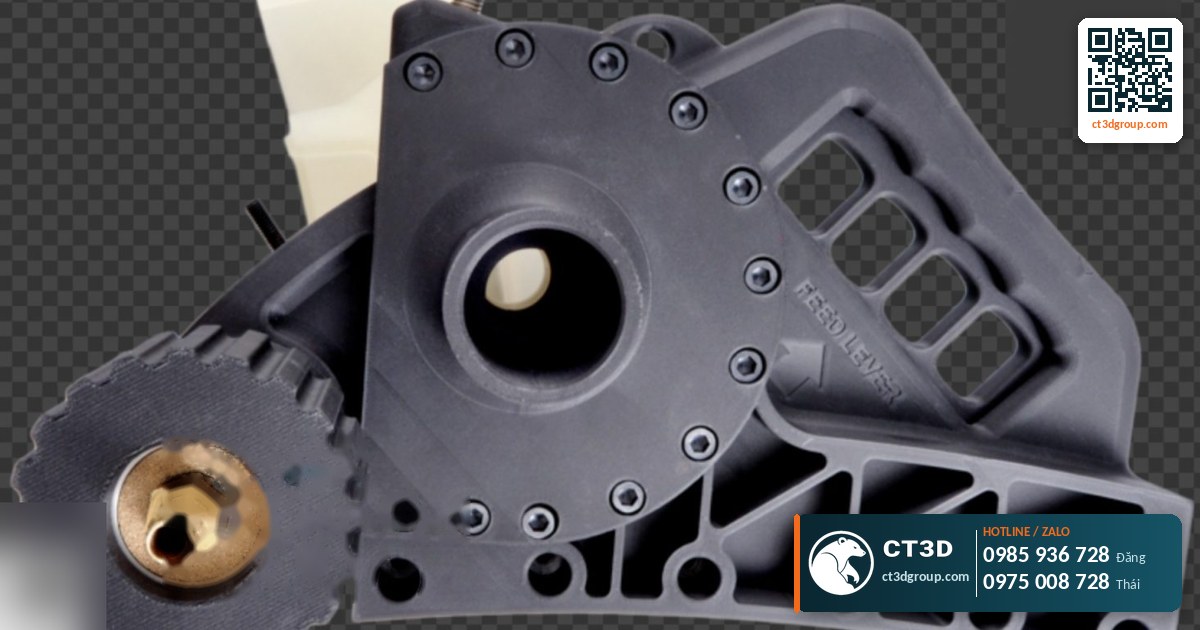
Quick answer: The 2026 indicative price for carbon fiber 3D printing (FDM) at CT3D starts from 2,750 VND/g (≈ US$0.11/g), charged on the actual weight including supports. Nylon FDM printing and PA12 printing on MJF/SLS are quoted per file, because the cost depends on size, quantity and complexity. Raw nylon filament sells for about 900,000 VND/kg (≈ US$35/kg) in Ho Chi Minh City, roughly 3.6 times the price of PLA. In return, carbon fiber delivers high stiffness and minimal warping, while nylon offers toughness and wear resistance – a good fit for jigs, fixtures, gears and load-bearing parts.
Factory customers often send us parts such as robot grippers, welding fixtures, inspection gauges and replacement gears. The question is always the same: “Is a printed plastic part strong enough, and how much will it cost?” This article focuses on the high-performance engineering materials for FDM – nylon and carbon fiber reinforced plastics – and covers how they carry loads, what they cost, and when to switch to MJF or metal. For an overview of pricing across all technologies, see our pillar article on 3D printing prices.
What Are Carbon Fiber and Nylon 3D Printing Materials?
Nylon (PA – Polyamide)
Nylon is a semi-crystalline engineering plastic with hydrogen bonds between its polymer chains. These bonds give nylon excellent toughness, fatigue resistance (it withstands repeated bending) and wear resistance, along with a low coefficient of friction. That is why nylon is the classic material for gears, bushings and hinges. The most common grades are PA6 and PA12. The weakness: nylon is highly hygroscopic. Once it absorbs moisture, it becomes softer and changes dimensions, and wet filament bubbles during printing and leaves a poor surface.
Carbon Fiber Reinforced Plastics (CF)
These are base polymers (usually PLA, PETG, nylon, ABS or ASA) compounded with chopped carbon fibers. Carbon fiber is extremely stiff; added to plastic, it makes parts more rigid, less prone to deflection under load, and less prone to shrinkage and warping during printing. The surface has an attractive matte black finish that hides layer lines well. Note: short fibers increase stiffness far more than impact strength, and some CF grades are actually more brittle than their base polymer.
Common names include PLA-CF, PETG-CF, PA-CF (carbon fiber nylon), ABS-CF and ASA-CF. PA-CF is the most popular choice for industrial parts because it combines the toughness of nylon with the stiffness of carbon fiber.
Carbon Fiber and Nylon 3D Printing Cost: Prices and Specs
Prices below are indicative and may change with order size and part geometry.
| Material / technology | Indicative price | Typical accuracy | Key strengths |
|---|---|---|---|
| Carbon fiber FDM (CT3D) | From 2,750 VND/g (≈ US$0.11/g) | FDM ±0.1–0.3 mm | Stiff, minimal warping, attractive matte surface |
| Nylon FDM (CT3D) | Quoted per file | FDM ±0.1–0.3 mm | Tough, wear- and fatigue-resistant |
| PA12 MJF/MJP (CT3D) | Quoted per file | ±0.05 mm | Uniform in all directions, no supports needed |
| PA12 SLS | Quoted per file | ±0.05–0.15 mm, 80–120 micron layers | Complex geometry, no supports needed |
| Raw PA nylon filament (market) | ~900,000 VND/kg (≈ US$35/kg) | – | Material cost reference |
| Raw PLA filament (market, for comparison) | ~250,000 VND/kg (≈ US$9.60/kg) | – | Reference |
Sources: CT3D indicative FDM prices 2026; technology specs from CT3D documentation; raw filament prices based on the Ho Chi Minh City market in 2026, not CT3D prices.
Why Are Carbon Fiber and Nylon Prints Several Times More Expensive Than PLA?
1. Expensive material
Raw nylon costs about 900,000 VND/kg (≈ US$35/kg) versus about 250,000 VND/kg (≈ US$9.60/kg) for PLA. Carbon fiber reinforced grades cost even more than the same base polymer.
2. Nozzle wear
Carbon fiber is abrasive. A standard brass nozzle wears out very quickly, widening the orifice and throwing off the flow rate and dimensions. Printers must use hardened steel or other wear-resistant nozzles, which cost more to replace.
3. Strict drying and storage
Nylon absorbs moisture aggressively, especially in the hot, humid climate of southern Vietnam. Filament must be thoroughly dried before printing and fed from a dry box. Skip this step and the parts come out bubbled, brittle and with poor mechanical properties – in other words, defective, sometimes without any visible sign.
4. Higher print temperatures, lower speeds
Nylon is typically printed at around 240–270 °C and requires a heated bed and careful warping control. Print speeds are usually lower than for PLA to ensure good layer bonding, so each gram takes more machine time.
Load Analysis: The Z-Axis Weakness and How to Design Around It
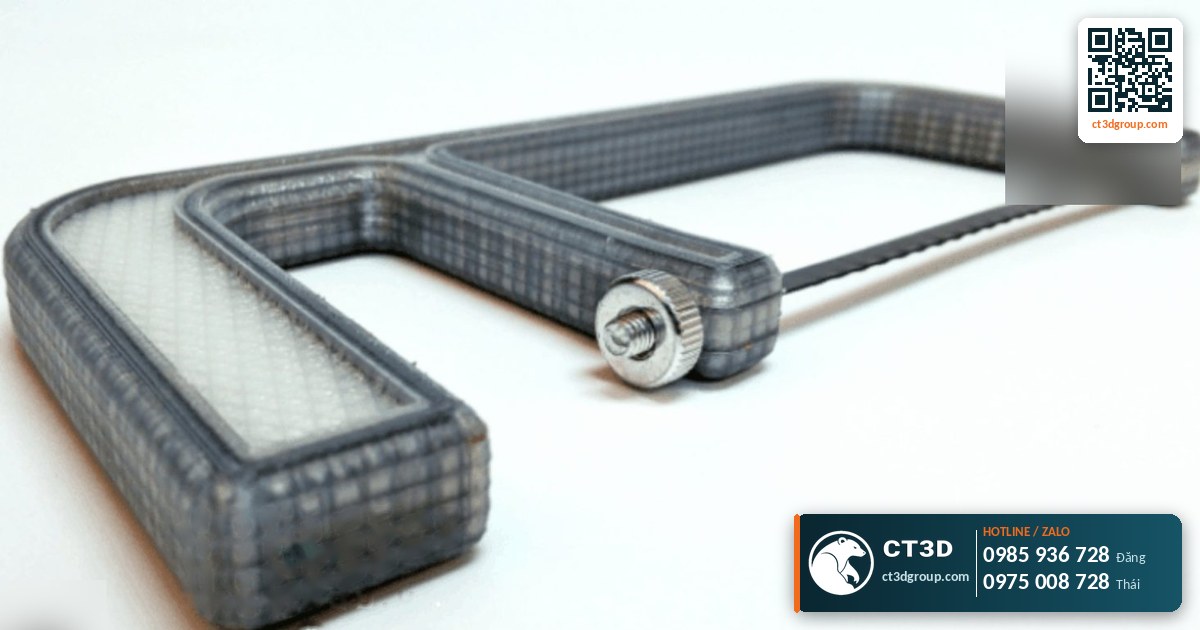
Every FDM part is anisotropic: it is strong along the extruded roads (X and Y axes) but weaker in the layer-stacking direction (Z axis), because adjacent layers are only fused together by heat. With carbon fiber filaments, the fibers align along the extrusion path, so the anisotropy is even more pronounced: very stiff along the fibers, but there are no fibers “stitching” the layers together.
In practice, a lever arm printed flat on the bed will be stiff and strong; the same lever printed upright can snap along a layer line under a much smaller load. That is why, when analyzing a load-bearing file, CT3D engineers always ask: which direction does the load act in?
- Orient the part so the main tensile/bending stresses lie in the XY plane.
- Increase the number of perimeters (3–5 walls) – the walls carry most of the bending load.
- Use 30–50% infill for load-bearing parts; gyroid or triangular patterns give uniform stiffness.
- Add fillets to inside corners where the cross-section changes to avoid sharp stress concentrations.
- For heavily loaded screw holes, use heat-set inserts or through-bolts rather than relying on plastic threads alone.
When a part is loaded in several directions at once, MJF or SLS with PA12 is the better choice: mechanical properties are more uniform across directions, accuracy is ±0.05 mm (MJF), and no supports are needed. See our article on MJF PA12 3D printing.
Choosing a Material for Load-Bearing Parts
| Main requirement | Suggested material | Why |
|---|---|---|
| Stiff, low deflection, lightweight (grippers, sensor brackets) | PETG-CF, PA-CF | Carbon fiber boosts stiffness and reduces warping |
| Friction and wear (gears, bushings) | Nylon, PA-CF | Low friction, good fatigue resistance |
| Flexibility and impact resistance (snap fits, soft clamps) | Nylon, PETG | Tough, can flex |
| Multi-directional loads, higher quantities | PA12 MJF/SLS | Uniform properties, ±0.05 mm, quoted per file |
| High temperatures, very heavy loads | SLM metal | ±0.02 mm, tensile strength equal to or 10–15% higher than castings |
| Form and fit checks only | PLA, PETG | Low cost, from 650 VND/g (≈ US$0.025/g) at CT3D |
Sources: CT3D technology documentation; material properties based on general engineering knowledge.
Worked Example: Costing a Carbon Fiber Fixture
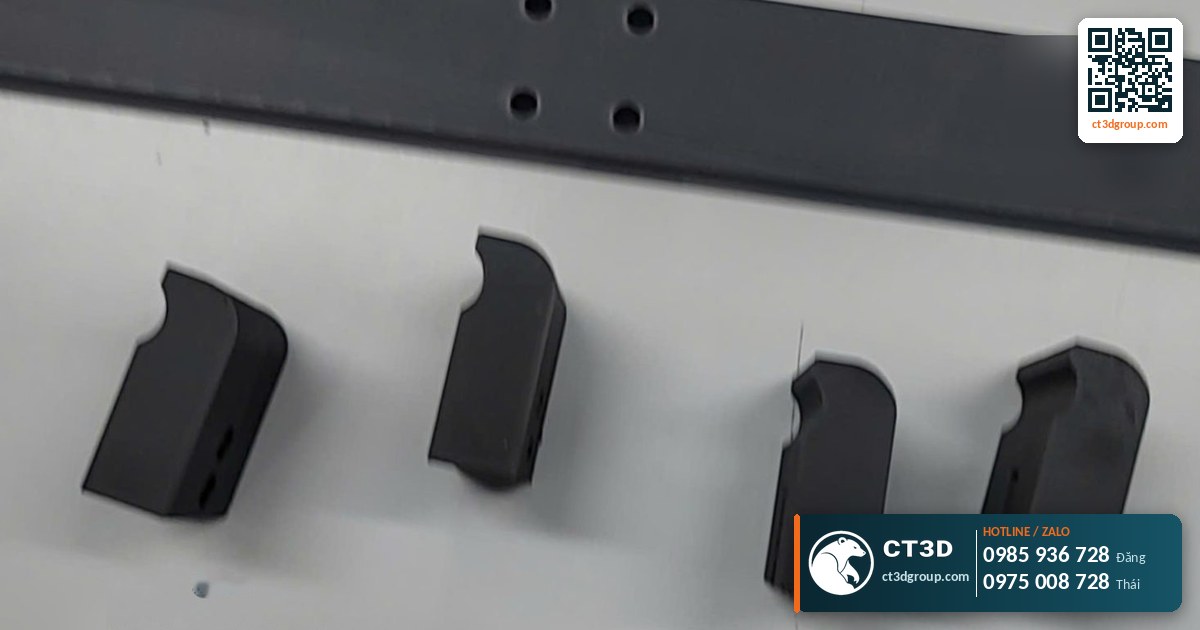
Suppose you need a locating fixture for parts on a conveyor, and the slicer reports 180 g (including 15 g of supports) in carbon fiber material.
- Illustrative print cost at CT3D: 180 g × from 2,750 VND/g = from about 495,000 VND (≈ US$19).
- The same design in PLA: 180 g × from 650 VND/g = from about 117,000 VND (≈ US$4.50) (the actual weight differs slightly due to different material densities).
That is roughly a 4× difference. The right question is: will a PLA fixture survive the shop-floor environment (impacts, oil, heat from machines)? If a PLA fixture fails after a few weeks and the line has to stop for a replacement, a few hundred thousand dong is trivial. On the other hand, if you only need to check the mounting position once, print in PLA first, freeze the design, and then print the final version in carbon fiber. This is the cost-saving approach I usually recommend. Learn more in our article on 3D printed jigs and fixtures.
Common Problems and How to Fix Them
| Problem | Cause | Fix |
|---|---|---|
| Nylon parts bubbled, rough surface, brittle | Moisture in the filament | Dry the filament thoroughly, print from a dry box |
| Hole sizes drift from print to print | Nozzle worn wider by carbon fiber | Use a hardened nozzle, inspect it regularly |
| Parts crack along layer lines during assembly | Print orientation wrong relative to the load | Reorient the part to the load direction, add more walls |
| Nylon parts warp | Shrinkage of a semi-crystalline polymer | Heated bed, adhesion layer, choose PA-CF to reduce shrinkage |
| Nylon dimensions change after a few days | Plastic absorbs moisture from the air | Allow tolerance; consider PA12 MJF if stability is critical |
Source: operating experience of CT3D engineers.
When Should You Switch from Plastic to Metal?
Carbon fiber and nylon are excellent within their range, but they have limits on temperature and load. If a part sees continuous high temperatures or heavy impact loads, or is safety-critical, you should consider SLM metal 3D printing: CT3D prints from a single part, with ±0.02 mm accuracy and tensile strength equal to or 10–15% higher than castings. Metal parts are also quoted per file. Service details are available at the metal 3D printing service at in3d.edu.vn or on our SLM metal 3D printing page.
Process and Checklist for Ordering Load-Bearing Parts
- Send a STEP file (preferred, so tolerances can be adjusted) or STL, OBJ, 3MF via our website, Zalo or email.
- Describe the load: how much force, in which direction, whether there is impact, and whether the part will be assembled and disassembled often.
- Describe the environment: maximum temperature, humidity, oil and grease, chemicals.
- State the quantity and which mating features need to be accurate.
- CT3D engineers analyze the part, recommend the material and print orientation, calculate the actual weight and send a quote with lead time.
- Confirm, we produce, and deliver to your door or you collect at the workshop; nationwide delivery in 1–3 days after completion.
If your part does not need carbon fiber performance, see PETG 3D printing cost or ABS and ASA 3D printing cost. For the full cost picture, read our guide to 3D printing prices.
Frequently Asked Questions
How much does carbon fiber 3D printing cost?
At CT3D, carbon fiber FDM printing starts from 2,750 VND/g (≈ US$0.11/g) in 2026, based on the actual weight including supports. Orders over 500 g or larger quantities receive a project quote.
How much does nylon 3D printing cost?
CT3D quotes nylon FDM and PA12 MJF/SLS printing per file. Raw nylon filament alone costs about 900,000 VND/kg (≈ US$35/kg) on the market, so the cost is significantly higher than PLA.
Is carbon fiber filament stronger than nylon?
Carbon fiber makes parts stiffer with less deflection. Nylon is tougher, with better impact and wear resistance. PA-CF combines both properties.
Why do FDM parts often break along layer lines?
Because the bond between layers is weaker than the bond along each extruded road. Reorient the part so the main load lies in the XY plane and increase the number of walls.
When should I choose MJF PA12 instead of FDM nylon?
When you need uniform mechanical properties in all directions, accuracy of about ±0.05 mm, complex geometry or larger quantities of identical parts.
Real Footage from the CT3D Workshop
Watch the video High-precision 3D printed threads, produced by CT3D, to get a clearer picture of the process and the quality of the finished parts. More videos are available on our channel Che Tao Vlog – CT3D.
Contact CT3D – Send Your File, Get a Fast Quote
Whether you have a 3D file, a 2D drawing, photos or just an idea, you can send it to CT3D. Our engineers will check the file, recommend the right technology and material, and send you a quote with a lead time.
- Email: [email protected] – [email protected]
- Hotline / Zalo: +84 975 008 728 (Mr. Thai) – +84 985 936 728 (Mr. Dang), or use our contact form
- Head office: Binh Duong.
- Workshops in Ho Chi Minh City: Linh Trung (Thu Duc), Tam Binh (Thu Duc), and former District 6.
- Other workshops and drop-off points: Can Tho, Da Nang, Bien Hoa, Ba Ria – Vung Tau, Hanoi, Hai Duong, Hai Phong. Nationwide delivery.
- Website: ct3dgroup.com – in3d.edu.vn
CT3D – 3D design & prototyping: 3D printing, 3D scanning, reverse engineering, silicone mold making, painting and finishing, CNC machining, composite fabrication, and supply of 3D printers and 3D printing materials.
Danh sách cửa hàng:
CT3D là đơn vị cung cấp trọn gói các dịch vụ thiết kế và sản xuất theo yêu cầu tại TP.HCM và khu vực lân cận (Bình Dương, Đồng Nai, Long An…). Với năng lực khép kín từ thiết kế 3D, in 3D (FDM, resin/SLA, SLS, in 3D kim loại), scan 3D – thiết kế ngược, làm khuôn, đúc composite – poly resin – poly stone đến gia công CNC và sơn màu hoàn thiện, CT3D đồng hành cùng khách hàng qua toàn bộ quy trình – từ ý tưởng, bản vẽ hay sản phẩm mẫu đến thành phẩm hoàn chỉnh. Dù bạn cần tạo mẫu nhanh, sản xuất số lượng, chế tác tượng – mô hình – quà tặng hay linh kiện kỹ thuật, đội ngũ CT3D sẽ tư vấn công nghệ và vật liệu phù hợp, đảm bảo sản phẩm sắc nét, đúng yêu cầu và tối ưu chi phí. Khách hàng tại TP.HCM và vùng lân cận có thể trao đổi trực tiếp, gửi file online và nhận sản phẩm thuận tiện, hỗ trợ cả đơn gấp lẫn dự án số lượng.
CT3D cung cấp trọn gói các dịch vụ thiết kế và sản xuất theo yêu cầu, phục vụ khách hàng tại Hà Nội và các tỉnh lân cận (Bắc Ninh, Hưng Yên, Hải Phòng, Vĩnh Phúc…). Với năng lực khép kín từ thiết kế 3D, in 3D (FDM, resin/SLA, SLS, in 3D kim loại), scan 3D – thiết kế ngược, làm khuôn, đúc composite – poly resin – poly stone đến gia công CNC và sơn màu hoàn thiện, CT3D đồng hành cùng khách hàng qua toàn bộ quy trình – từ ý tưởng, bản vẽ hay sản phẩm mẫu đến thành phẩm hoàn chỉnh. Quy trình làm việc thuận tiện: bạn gửi file 3D hoặc mô tả ý tưởng qua online, đội ngũ CT3D tư vấn công nghệ – vật liệu, báo giá nhanh và giao hàng tận nơi tại Hà Nội. Dù bạn cần tạo mẫu nhanh, sản xuất số lượng, chế tác tượng – mô hình – quà tặng hay linh kiện kỹ thuật, CT3D đều đáp ứng với sản phẩm sắc nét, đúng yêu cầu và tối ưu chi phí.

