

Quick answer: SLM/DMLS metal 3D printing creates metal parts by using a laser to melt fine metal powder layer by layer inside an inert-gas chamber. The printed parts are fully dense and can be used just like conventionally machined components. With the German-standard SLM system at CT3D, accuracy reaches about ±0.02 mm, the build volume is 250 × 250 × 300 mm, and we can print from a single part in materials such as 316L stainless steel, AlSi10Mg aluminum and Ti6Al4V titanium. Metal printing has no fixed price list; CT3D quotes per file.
Many people hearing about “metal 3D printing” for the first time ask: is it real metal, or just plastic with a metallic coating? Can the printed part carry loads? This article is a beginner’s overview: it explains the terminology, how the machine works and when to use it. If you need detailed specifications, the full material table and ordering information, see CT3D’s in-depth article custom SLM metal 3D printing.
What Is Metal 3D Printing? An Everyday Explanation
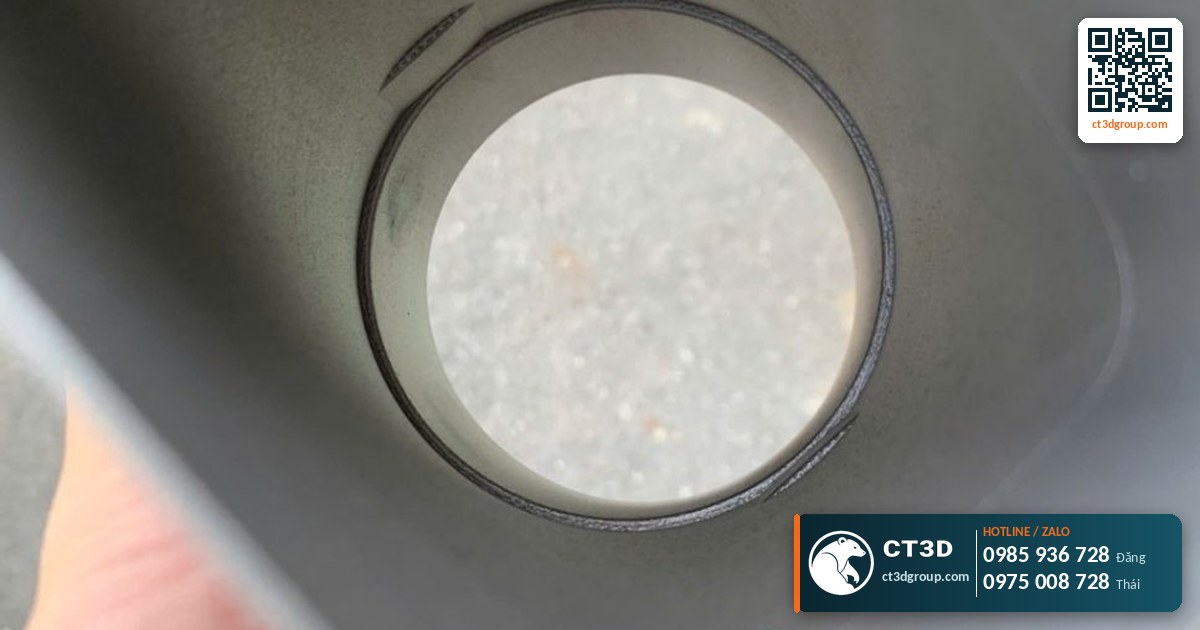
Imagine you are making a layer cake. Each tier is a very thin layer of powder. Instead of baking the whole cake, you use an extremely hot “pen” of light to draw on each layer of powder. Wherever the pen passes, the powder melts and fuses into solid metal. Wherever it does not, the powder stays loose. Once a layer is done, the machine spreads a fresh layer of powder on top and draws again. Repeat thousands of times and you have a finished metal part.
That “pen” is the laser. The “powder” is metal powder as fine as flour, with particles only a few tens of microns across. The whole process takes place in a sealed chamber filled with inert gas (usually argon or nitrogen) so the molten metal does not oxidize or burn.
The key point: this is 100% real metal, not plastic mixed with metal powder or plastic painted to look like metal. Printed parts can be drilled, tapped, welded, heat treated and polished just like ordinary steel or aluminum parts.
SLM vs DMLS: What’s the Difference? Key Terms for Beginners
As you research, you will come across many acronyms. In practice they all belong to the same family of technologies, called Powder Bed Fusion (PBF). The differences lie mainly in naming and in how fully the powder is melted.
| Term | Full name | In simple terms |
|---|---|---|
| SLM | Selective Laser Melting | The laser fully melts the metal powder, producing a dense, solid part. |
| DMLS | Direct Metal Laser Sintering | An original trade name referring to “sintering” the powder; today DMLS machines also melt the powder almost completely, so it is generally considered equivalent to SLM. |
| LPBF | Laser Powder Bed Fusion | The standards-based umbrella term covering both SLM and DMLS. |
| Support | Support structure | Sacrificial metal that holds the part and conducts heat away; it is cut off after printing. |
| Build plate | Base plate | A thick metal plate the part “grows” from; the part must be cut off after printing. |
| Stress relief | Stress-relief annealing | Heating the part in a furnace to release the stresses caused by rapid melting and cooling, preventing distortion. |
Source: compiled from common additive manufacturing terminology and CT3D technical documentation.
In short: when a customer says “SLM printing”, “DMLS printing” or “laser metal printing”, CT3D understands it as the same need. What matters more than the name is which material, what the part is for, and what tolerance is required.
What Steps Does a Metal 3D Printer Go Through?
To make it easy for beginners to picture, CT3D breaks the process into 6 simple steps:
- File preparation: the engineer receives the 3D file (STEP, STL…) and checks wall thickness, holes and overhang angles, then orients the part for printing and adds supports.
- Slicing: the software divides the model into thousands of thin layers, each a few tens of microns, and calculates the laser path.
- Loading powder and inert gas: the build chamber is flooded with inert gas to purge oxygen, and metal powder is loaded into the hopper.
- Printing layer by layer: a recoater blade spreads a thin layer of powder, and the laser scans and melts the required areas. The build plate lowers slightly and the next layer is spread. This repeats until the part is complete.
- Part removal and powder recovery: excess powder is vacuumed out and sieved for reuse. This is why metal printing saves material: CT3D documentation records up to 90% less scrap than machining from billet.
- Post-processing: stress relief, cutting the part from the build plate, removing supports, CNC machining of mating surfaces, bead blasting, and polishing or plating if needed.
Beginners often assume a part is ready to use straight off the printer. With metal, post-processing is almost always required. You should budget time and cost for it from the start.
What Materials Can Metal 3D Printing Use?
The list of printable metals is quite long. For beginners, CT3D suggests remembering 5 main groups, each with its own “personality”:
- Stainless steel: 316L, 304L, 17-4PH… Strong, highly corrosion resistant and reasonably priced. Used for jigs, machine parts and food-grade components.
- Aluminum: AlSi10Mg, AlSi12, Scalmalloy… Lightweight with good heat dissipation. Used for housings, brackets, heat sinks, and drone and vehicle parts.
- Titanium: Ti6Al4V, Ti Grade 2… Very light yet strong, and biocompatible. Used in medical, aerospace and motorsport applications.
- Copper and copper alloys: Cu, CuCrZr… High electrical and thermal conductivity. Used for electrodes and heat exchangers.
- Tool steels and superalloys: Maraging 18Ni300, H13, Inconel 625/718, Hastelloy… Heat and wear resistant. Used for mold inserts and hot-section parts.
The full material table (more than 30 materials) with suggested applications is in custom SLM metal 3D printing. If you are interested in a specific material, see 316L stainless steel 3D printing or Ti6Al4V titanium 3D printing.
Pros and Cons of Metal 3D Printing for Beginners
No technology is best for everything. Here is a balanced picture so you can judge for yourself.
Key Advantages
- Shapes that “cannot be machined”: curved internal channels, hollow lattice structures, and single-piece parts that replace multi-part assemblies.
- No tooling required: print from just one part. Ideal for prototypes, replacement parts and low-volume production.
- Good mechanical properties: according to CT3D documentation, tensile strength is equal to or about 10–15% higher than cast parts.
- Material savings: only the metal that is needed is used, and leftover powder is reused.
- Shorter supply chains: for imported spare parts, printing locally can cut costs by up to 40% (CT3D documentation figure, case dependent).
Drawbacks to Be Aware Of
- Much higher cost per part than plastic printing. For simple parts in large quantities, CNC machining or casting is usually cheaper.
- As-printed surfaces are slightly rough (around 6–10 µm); precision mating surfaces need additional machining.
- Size limits: a standard build volume is about 250 × 250 × 300 mm; larger parts must be split into modules and joined.
- Design must suit the process: arches and overhangs below about 45° need supports, and walls that are too thin tend to warp.
Metal 3D Printing vs CNC vs Casting: Which Should You Choose?
This is the question CT3D hears most often from newcomers. The table below is for general guidance only and does not replace advice based on your specific file.
| Criterion | Metal 3D printing | CNC machining | Casting |
|---|---|---|---|
| Suitable quantity | 1 to a few dozen parts | 1 to a few hundred | Hundreds and up |
| Complex shapes, hollow interiors | Excellent | Limited | Moderate |
| Molds / fixtures needed | No | Sometimes | Yes, high upfront cost |
| Surface after processing | Slightly rough, needs finishing | Excellent | Depends on the mold |
| Scrap | Very little | A lot (chips) | Little |
Source: CT3D consulting experience; for general guidance.
In practice, many parts are best made by combining methods: 3D print the complex geometry, then CNC machine the mating surfaces. A detailed analysis is in metal 3D printing vs CNC.
Where Is Metal 3D Printing Used? Easy-to-Grasp Examples
- Discontinued spare parts: an old machine breaks a gear, bushing or pump impeller that the manufacturer no longer sells. The worn part is 3D scanned, the file is rebuilt, and it is printed in metal. See the full process in spare part recovery with 3D scanning and metal printing.
- Mold inserts with conformal cooling channels: water channels that follow the product surface help injection molds cool faster and more evenly.
- Factory jigs and fixtures: small, complex parts that must resist wear.
- Medical and dental: patient-specific titanium frameworks, instruments and CoCr parts (subject to industry regulations).
- Jewelry and fine art: delicate metal parts with intricate patterns.
- R&D and universities: mechanical test specimens and research projects.
What Should Beginners Prepare Before Ordering Metal 3D Printing?
To get a fast and accurate quote, just prepare the following checklist:
- 3D file in STEP (preferred) or STL format. No file yet? Send 2D drawings, photos or a sample part for CT3D to scan and model.
- Desired material, or a description of the operating conditions: temperature, contact with seawater or chemicals.
- Which surfaces need precision fits and their tolerances, so the engineer can add machining allowance.
- Quantity and required delivery date.
- Finish requirements: bead blasting, polishing, plating…
The CT3D process has 6 steps: send your file via our website, Zalo, email or our contact form → state your technical requirements → our engineers analyze the file and calculate the volume → you receive a quote with a lead time → you confirm and we produce → door-to-door delivery or pickup at the workshop. Goods are delivered nationwide 1–3 days after completion.
Common Misconceptions About Metal 3D Printing
- “Printed metal is brittle and weak.” Not true. SLM parts are fully dense and, after stress relief, have good mechanical properties, often equal to or better than castings.
- “It comes off the printer shiny and beautiful.” Not quite. As-printed surfaces are slightly rough and need bead blasting or polishing if appearance matters.
- “Everything should be printed in metal.” No. Bolts, flat plates and simple plain shafts are far cheaper to machine or buy off the shelf.
- “You have to order large quantities.” No. CT3D prints from a single part.
Once you understand the overview and want to dive into specific specs, materials, build sizes and post-processing, continue with our in-depth article custom SLM metal 3D printing. To compare with plastic technologies (FDM, SLA, MJF), see 3D printing technologies compared: FDM, SLA, MJF, SLM. More service information is also available at in3d.edu.vn – metal 3D printing service (Vietnamese).
Frequently Asked Questions
Is metal 3D printing real metal?
Yes. SLM/DMLS melts pure metal or alloy powder into a fully dense solid. Parts can be drilled, threaded, welded and heat treated like conventional metal.
Which is better, SLM or DMLS?
For end users, the two names are practically equivalent; both belong to the laser powder bed fusion family. Quality depends far more on the machine, material and post-processing than on the name.
How accurate is metal 3D printing?
The SLM system at CT3D achieves about ±0.02 mm with a surface roughness of 6–10 µm. High-precision mating surfaces are CNC machined after printing.
How much does metal 3D printing cost?
There is no fixed price list, because cost depends on material, volume, build height, supports and post-processing. CT3D quotes per file and prints from a single part.
Can parts larger than the build volume be printed?
Yes. They can be split into modules, printed separately and then joined (by welding or bolting). Our engineers will advise on how to split the part to maintain strength.
Real Footage from the CT3D Workshop
Watch Metal 3D printing service, produced by CT3D, to get a clearer picture of the process and the quality of the finished parts. More videos are available on our YouTube channel Che Tao Vlog – CT3D.
Contact CT3D – Send Your File, Get a Fast Quote
Whether you have a 3D file, a 2D drawing, photos or just an idea, you can send it to CT3D. Our engineers will check the file, recommend the right technology and material, and send you a quote with a delivery lead time.
- Email: [email protected] – [email protected]
- Hotline / Zalo: +84 975 008 728 (Mr. Thai) – +84 985 936 728 (Mr. Dang), or use our contact form
- Head office: Binh Duong.
- Workshops in Ho Chi Minh City: Linh Trung (Thu Duc), Tam Binh (Thu Duc), former District 6.
- Other workshops and drop-off points: Can Tho, Da Nang, Bien Hoa, Ba Ria – Vung Tau, Hanoi, Hai Duong, Hai Phong. Nationwide delivery.
- Website: ct3dgroup.com – in3d.edu.vn
CT3D – 3D design & prototyping: 3D printing, 3D scanning, reverse engineering, silicone mold making, paint finishing, CNC machining, composite fabrication, and supply of 3D printers and 3D printing resins and filaments.
Danh sách cửa hàng:
CT3D là đơn vị cung cấp trọn gói các dịch vụ thiết kế và sản xuất theo yêu cầu tại TP.HCM và khu vực lân cận (Bình Dương, Đồng Nai, Long An…). Với năng lực khép kín từ thiết kế 3D, in 3D (FDM, resin/SLA, SLS, in 3D kim loại), scan 3D – thiết kế ngược, làm khuôn, đúc composite – poly resin – poly stone đến gia công CNC và sơn màu hoàn thiện, CT3D đồng hành cùng khách hàng qua toàn bộ quy trình – từ ý tưởng, bản vẽ hay sản phẩm mẫu đến thành phẩm hoàn chỉnh. Dù bạn cần tạo mẫu nhanh, sản xuất số lượng, chế tác tượng – mô hình – quà tặng hay linh kiện kỹ thuật, đội ngũ CT3D sẽ tư vấn công nghệ và vật liệu phù hợp, đảm bảo sản phẩm sắc nét, đúng yêu cầu và tối ưu chi phí. Khách hàng tại TP.HCM và vùng lân cận có thể trao đổi trực tiếp, gửi file online và nhận sản phẩm thuận tiện, hỗ trợ cả đơn gấp lẫn dự án số lượng.
CT3D cung cấp trọn gói các dịch vụ thiết kế và sản xuất theo yêu cầu, phục vụ khách hàng tại Hà Nội và các tỉnh lân cận (Bắc Ninh, Hưng Yên, Hải Phòng, Vĩnh Phúc…). Với năng lực khép kín từ thiết kế 3D, in 3D (FDM, resin/SLA, SLS, in 3D kim loại), scan 3D – thiết kế ngược, làm khuôn, đúc composite – poly resin – poly stone đến gia công CNC và sơn màu hoàn thiện, CT3D đồng hành cùng khách hàng qua toàn bộ quy trình – từ ý tưởng, bản vẽ hay sản phẩm mẫu đến thành phẩm hoàn chỉnh. Quy trình làm việc thuận tiện: bạn gửi file 3D hoặc mô tả ý tưởng qua online, đội ngũ CT3D tư vấn công nghệ – vật liệu, báo giá nhanh và giao hàng tận nơi tại Hà Nội. Dù bạn cần tạo mẫu nhanh, sản xuất số lượng, chế tác tượng – mô hình – quà tặng hay linh kiện kỹ thuật, CT3D đều đáp ứng với sản phẩm sắc nét, đúng yêu cầu và tối ưu chi phí.

