
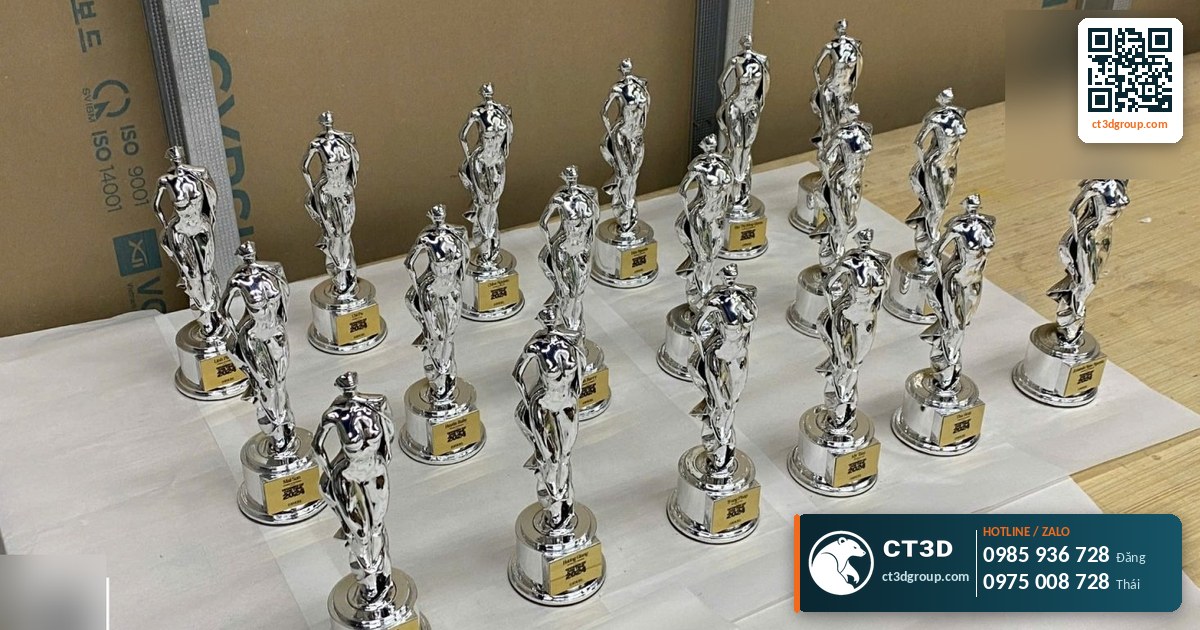
Quick answer: Making custom 3D trophies means modeling the trophy in 3D, printing each component in FDM (PLA from 650 VND/g (≈ US$0.025/g) at CT3D) or SLA resin (25–100 micron layers, ±0.05–0.1 mm tolerance), then sanding, priming, applying metallic gold/silver paint or plating, and mounting it on a base. With a ready file, an unpainted piece takes about 1–3 days; trophies with a painted finish usually take 7–14 days. Pricing is based on material weight plus post-processing, so CT3D quotes per file.
Many customers come to CT3D with the same situation: the company is about to host a tournament, an awards ceremony or an internal event and needs a trophy that carries the exact logo and mascot, not an off-the-shelf cast trophy everyone else has. Custom metal casting requires a dedicated mold, which is not economical for small quantities. This is exactly where 3D printing shines. This article is a deep-dive branch of our topic on custom 3D model printing, focusing on trophy-making techniques: structure, materials, cost calculation, common defects and how to fix them.
What are custom 3D trophies and how do they differ from traditional cast trophies?
A 3D trophy is shaped by 3D printing (building up material in thin layers) instead of being cast in a mold. Because no mold is needed, each trophy can have its own unique form: a dimensional logo, a team mascot, a character portrait, a scale model of the company’s product or a tournament emblem.
Traditional cast trophies (metal, crystal, bronze) suit large quantities and fixed designs. 3D printed trophies suit custom designs in quantities from one to a few dozen, or making a master before producing a mold for replication. Many organizations combine both: a 3D printed emblem on a wood, stone or metal base for a solid, weighty feel.
The 3-part structure of a 3D printed trophy
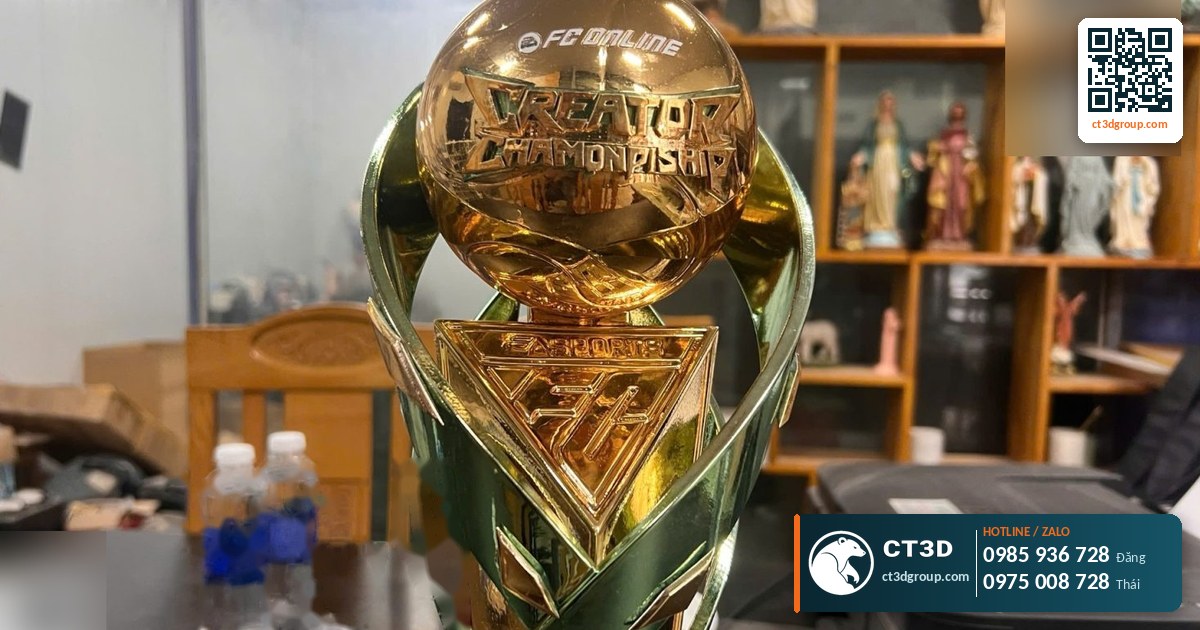
- Emblem (top of the trophy): logo, mascot, ball, star or figure. This part needs the highest detail and is usually printed in resin or fine-layer FDM.
- Body (column, handles, cup): supports the top section, so it needs sufficiently thick walls and locating pins.
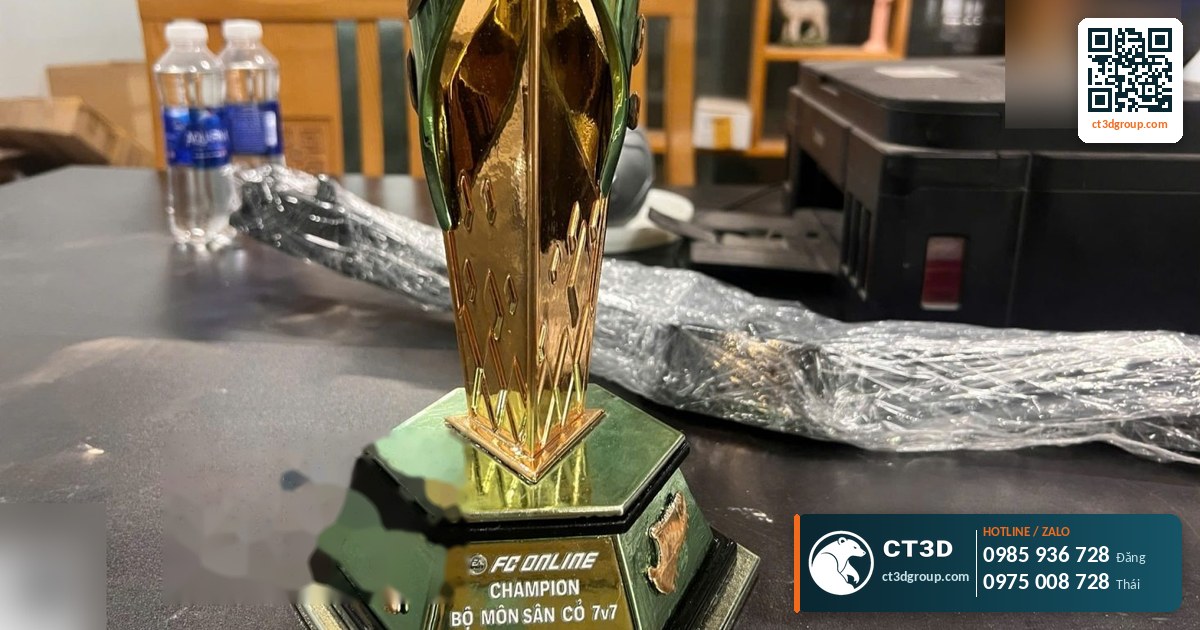
- Base: holds the nameplate and provides weight for stability. It can be 3D printed, CNC machined from wood, or combined with an engraved plate.
Splitting a trophy into several parts has three benefits: each part is printed in its optimal orientation (fewer supports, better surfaces); each part is painted its own color before assembly, so color boundaries are crisp; and if one part fails, only that part needs reprinting.
Which technology and material should you use for 3D printed trophies?
The choice depends on the trophy size, the level of detail in the emblem and the budget. The table below summarizes the specifications CT3D uses when advising customers.
| Technology | Layer thickness | Tolerance | Best for which part of the trophy |
|---|---|---|---|
| FDM (PLA, PETG, ABS) | 100–300 micron | ±0.1–0.3 mm | Body, base, large trophies, high-quantity orders on a budget |
| SLA resin | 25–100 micron | ±0.05–0.1 mm | Detailed emblems, small raised lettering, character faces |
| DLP resin | 25–100 micron | ±0.03–0.08 mm | Small details, badges, emblems mounted on the base |
| Large-format resin | 25–100 micron | ±0.05–0.1 mm | Large one-piece trophies or emblems, up to 800×800×500 mm |
Source: CT3D technology specifications 2026.
FDM: economical, durable, ideal for the body and base
FDM (Fused Deposition Modeling) extrudes molten plastic filament through a nozzle. PLA prints at about 190–220 °C, is easy to print, warps little, and is easy to sand and paint. For trophies kept indoors, PLA is the economical choice. If the trophy will be displayed near a window, in a car or in a hot place, switch to PETG or ABS, because PLA softens above about 55–60 °C. The drawback of FDM is visible layer lines, so thorough sanding and priming are needed for a metal-like gloss.
SLA/DLP resin: crisp detail for emblems
Resin is a liquid plastic that hardens under UV light. Layers as thin as 25 micron mean raised lettering, clothing folds and facial features are clearly defined straight off the printer, with little need for filler. Resin suits the top of the trophy and small badges. For large one-piece trophies, CT3D has large-format resin printers up to 800×800×500 mm; see large-format resin 3D printing. Resin parts need washing in alcohol, UV curing and support removal before painting; details are in resin print post-processing.
Should you cast metal from a 3D printed pattern?
If the customer needs a trophy in real bronze, a pattern can be printed in castable resin (which burns out cleanly during firing) and then cast using the lost-pattern method. This is commonly used for small parts such as badges and emblems mounted on the base. See castable resin patterns.
How is the cost of a custom 3D trophy calculated?
CT3D does not quote one flat price for every trophy, because two trophies of the same height can differ several-fold in plastic weight and painting labor. The basic formula:
Trophy cost ≈ (print weight × material unit price) + modeling cost (if any) + post-processing cost (sanding, painting, plating) + rush surcharge (if any)
- Print weight comes from the slicer and includes supports and infill (core density). Read more about how infill affects cost and strength.
- CT3D FDM material prices (indicative, 2026): PLA from 650 VND/g (≈ US$0.025/g), PETG from 650 VND/g, ABS from 1,000 VND/g (≈ US$0.04/g), ASA from 2,000 VND/g (≈ US$0.08/g). A minimum charge applies under 50 g; orders over 500 g receive a project quote.
- Post-processing: priced separately according to the finish level.
Example calculation: the body and base printed in PLA weigh 300 g. Printing: 300 × 650 = 195,000 VND (≈ US$7.50) at the starting price. Add the painted finish at the level you choose. The resin emblem is quoted per file. The final figure is only available after an engineer opens the file and slices it.
| Item | Ho Chi Minh City market range 2026 |
|---|---|
| Simple 3D modeling | from ~200,000 VND (≈ US$8) per model |
| Standard resin, 10–15 cm | 800,000 – 2.5 million VND (≈ US$31–96) |
| Standard resin, 20–30 cm | 3 – 7 million VND (≈ US$115–270) |
| Single-color paint | 200,000 – 500,000 VND (≈ US$8–19) per model |
| Multi-color airbrush | 600,000 – 2 million VND (≈ US$23–77) per model |
| Discount for 10–30 pcs / 30–100 pcs | −10–15% / −20–25% |
Source: compiled 2026 Ho Chi Minh City market rates – not a CT3D price list. Prices are indicative; CT3D quotes per file.
Tips to reduce cost when ordering multiple trophies
- Share the same body and base, changing only the emblem or nameplate for each place (champion, runner-up, third place). The file is modeled only once.
- Hollow the body with 2–3 mm walls instead of printing solid, cutting plastic weight significantly while staying sturdy.
- When quantities reach a few dozen, consider printing one master and making a silicone mold from the 3D print to cast resin copies.
- Order early to avoid rush surcharges. The market typically adds +30% for 3–4 day rush orders and +50% for 1–2 day rush orders.
What are the steps in CT3D’s 3D trophy production process?
- Concept intake: send your logo (vector AI, SVG or PDF preferred), sketches, reference photos, desired height, quantity and event date via our website, Zalo or email.
- 3D modeling: engineers build the model, split it into parts, and design locating pins and screw holes. You approve renders before printing.
- File analysis and quote: calculate weight, choose the technology for each part, and send a quote with lead time.
- 3D printing: the emblem is printed in resin or fine-layer FDM; the body and base in FDM.
- Post-processing: support removal, sanding, filling, priming, color or metallic paint, clear coat.
- Assembly and nameplate: gluing, screwing and attaching the engraved plate.
- Packing and delivery: each trophy is padded with foam and shipped via Viettel Post, Giao Hang Tiet Kiem, Vietnam Post or air freight; or picked up at the workshop.
Indicative lead times: 1–3 days with a ready file; 3–7 days if modeling is needed; 7–14 days with a painted finish. Nationwide delivery within 1–3 days of completion.
Trophy surface finishing: metallic paint, faux metal or plating?
The surface determines whether a trophy looks premium or looks like plastic. There are three main approaches:
| Option | Effect | Advantages | Notes |
|---|---|---|---|
| Metallic gold/silver/bronze paint | Matte to semi-gloss metallic sheen | Reasonable cost, suitable for many pieces | Requires careful priming and sanding, otherwise layer lines show |
| Chrome-effect paint | Mirror-like gloss | Very eye-catching | Requires a perfectly glossy base coat, labor intensive |
| Plating | A real metal layer on the surface | Feels like a metal trophy | Charged separately, needs a flawless base surface |
| Multi-color airbrush | Full-color mascots and characters | Shows detail, soft color gradients | Longer lead time |
Source: CT3D model finishing experience.
Technical details on priming, airbrushing and faux bronze/stone effects are in painting 3D printed models. If you need plating, see the 3D printing, plating and product painting service.
Common 3D trophy defects and how to fix them
| Defect | Cause | Fix |
|---|---|---|
| Trophy tips over or wobbles | High center of gravity, light or small base | Widen the base, print the base more solid, add a counterweight (steel, sealed sand) inside, or use a wood/stone base |
| Breaks at the neck | Slender body; print orientation puts layers horizontal at the stress point | Increase the neck cross-section, add a metal rod through the center, change print orientation |
| Layer lines visible after metallic paint | Metallic paint highlights every imperfection | Sand through progressive grits, apply 2–3 primer coats, fill low spots |
| Blurry logo lettering | Text too small or strokes thinner than the printer can resolve | Increase raised text height, minimum stroke about 0.5–1 mm for FDM; print small text in resin |
| Gaps during assembly | Print tolerance plus paint thickness on surfaces | Design joints with tolerance, mask mating surfaces when painting |
| PLA trophy deforms | Left in a car or near a heat source | Use PETG/ABS/ASA, advise the customer to store it somewhere cool |
Source: CT3D production experience; the stroke-width note reflects common practice in the FDM 3D printing industry.
For more on supports (structures holding up overhangs) and why they leave marks on the surface, see 3D printing supports explained.
Designing 3D printed trophies: parameters engineers need to know
Base-to-height ratio
The taller the trophy, the farther its center of gravity is from the base. In practice, the base should be wide and heavy enough that the trophy rights itself when tilted slightly. For trophies with an off-center emblem (a player kicking a ball, a flying mascot), the engineer must keep the top section’s center of gravity within the base footprint or add a counterweight to the base.
Wall thickness and assembly pins
Hollow body walls should be thick enough not to dent during sanding. Mating parts should have round or square locating pins so they do not shift when glued. For large trophies, leave screw holes or holes for a threaded rod running from the base into the body so it can be disassembled for transport.
Raised text and logos
Logos should be supplied as vectors so engineers can extrude them accurately. Raised or engraved text needs enough depth to remain legible after painting. Recipient nameplates are usually made as separate plates so each trophy’s name can be changed without reprinting the whole trophy.
File formats
If you already have a file, CT3D accepts STL, STEP, OBJ and 3MF. For the differences between formats, see What is an STL file?
Checklist for requesting a custom 3D trophy
- Logo in vector format or a high-resolution image.
- Sketch or reference photos of the desired style.
- Overall height and desired base size.
- Quantity for each award level and nameplate wording.
- Color and effect: metallic gold, silver, bronze, chrome, multi-color.
- Display environment: indoors, outdoors, near heat.
- Required delivery date and delivery address.
Real-world uses of 3D trophies
3D printed trophies are used for amateur and corporate sports tournaments, employee recognition ceremonies, partner appreciation awards, school innovation competitions, and commemorative awards shaped like a company’s flagship product. For trophies with large mascots or pieces used as stage displays, CT3D can combine CNC foam and composite as we do for mascots. For trophies featuring miniature characters, the technique is similar to custom 3D printed figures.
CT3D has more than 12 years of experience making models, statues and 3D printed products, with published projects including the restoration of a statue of Our Lady of La Vang, a large reclining Buddha, a 1 m tall Catholic statue printed in SLA, and a Ca Mau shrimp model. Our experience finishing statue surfaces is the foundation for making beautiful trophies. For an overview of other model types, return to our article on custom 3D model printing.
Frequently asked questions
How long does it take to make a 3D trophy?
With a ready file and no painting, about 1–3 days. If modeling is needed, 3–7 days. Trophies with a painted finish usually take 7–14 days depending on quantity and complexity.
Can you make just one 3D trophy?
Yes. 3D printing needs no mold, so we can make a single piece. When quantities reach a few dozen, CT3D will also advise on a silicone mold option to lower the cost per trophy.
Are 3D printed trophies durable?
Trophies printed in PLA, PETG, ABS or resin are durable enough for long-term display if designed with the right wall thickness and assembly pins. Avoid leaving PLA trophies in hot places such as inside a car.
How much does a custom 3D trophy cost?
Pricing is based on print weight (PLA at CT3D from 650 VND/g, ≈ US$0.025/g) plus modeling and painted finish. Because every design is different, CT3D quotes per file.
Can you make a gold trophy that looks like metal?
Yes. Options include metallic gold paint, chrome-effect paint or plating. The surface must be carefully sanded and primed so layer lines do not show.
Real footage from the CT3D workshop
Watch the video Custom SLA 3D printing and painting by CT3D to get a clearer picture of the process and product quality. More videos are available on the Che Tao Vlog – CT3D channel.
Contact CT3D – send your file, get a fast quote
Whether you have a 3D file, a 2D drawing, photos or just an idea, you can send it to CT3D. Our engineers will check the file, advise on technology and materials, and send a quote with a delivery time.
- Email: [email protected] – [email protected]
- Hotline / Zalo: +84 975 008 728 (Mr. Thai) – +84 985 936 728 (Mr. Dang), or use our contact form
- Head office: Binh Duong.
- Workshops in Ho Chi Minh City: Linh Trung (Thu Duc), Tam Binh (Thu Duc), District 6 (former).
- Other workshops and drop-off points: Can Tho, Da Nang, Bien Hoa, Ba Ria – Vung Tau, Hanoi, Hai Duong, Hai Phong. Nationwide delivery.
- Website: ct3dgroup.com – in3d.edu.vn
CT3D – 3D design & prototyping: 3D printing, 3D scanning, reverse engineering, silicone mold making, paint finishing, CNC machining, composite fabrication, and supply of 3D printers and 3D printing resins.
Danh sách cửa hàng:
CT3D là đơn vị cung cấp trọn gói các dịch vụ thiết kế và sản xuất theo yêu cầu tại TP.HCM và khu vực lân cận (Bình Dương, Đồng Nai, Long An…). Với năng lực khép kín từ thiết kế 3D, in 3D (FDM, resin/SLA, SLS, in 3D kim loại), scan 3D – thiết kế ngược, làm khuôn, đúc composite – poly resin – poly stone đến gia công CNC và sơn màu hoàn thiện, CT3D đồng hành cùng khách hàng qua toàn bộ quy trình – từ ý tưởng, bản vẽ hay sản phẩm mẫu đến thành phẩm hoàn chỉnh. Dù bạn cần tạo mẫu nhanh, sản xuất số lượng, chế tác tượng – mô hình – quà tặng hay linh kiện kỹ thuật, đội ngũ CT3D sẽ tư vấn công nghệ và vật liệu phù hợp, đảm bảo sản phẩm sắc nét, đúng yêu cầu và tối ưu chi phí. Khách hàng tại TP.HCM và vùng lân cận có thể trao đổi trực tiếp, gửi file online và nhận sản phẩm thuận tiện, hỗ trợ cả đơn gấp lẫn dự án số lượng.
CT3D cung cấp trọn gói các dịch vụ thiết kế và sản xuất theo yêu cầu, phục vụ khách hàng tại Hà Nội và các tỉnh lân cận (Bắc Ninh, Hưng Yên, Hải Phòng, Vĩnh Phúc…). Với năng lực khép kín từ thiết kế 3D, in 3D (FDM, resin/SLA, SLS, in 3D kim loại), scan 3D – thiết kế ngược, làm khuôn, đúc composite – poly resin – poly stone đến gia công CNC và sơn màu hoàn thiện, CT3D đồng hành cùng khách hàng qua toàn bộ quy trình – từ ý tưởng, bản vẽ hay sản phẩm mẫu đến thành phẩm hoàn chỉnh. Quy trình làm việc thuận tiện: bạn gửi file 3D hoặc mô tả ý tưởng qua online, đội ngũ CT3D tư vấn công nghệ – vật liệu, báo giá nhanh và giao hàng tận nơi tại Hà Nội. Dù bạn cần tạo mẫu nhanh, sản xuất số lượng, chế tác tượng – mô hình – quà tặng hay linh kiện kỹ thuật, CT3D đều đáp ứng với sản phẩm sắc nét, đúng yêu cầu và tối ưu chi phí.

