
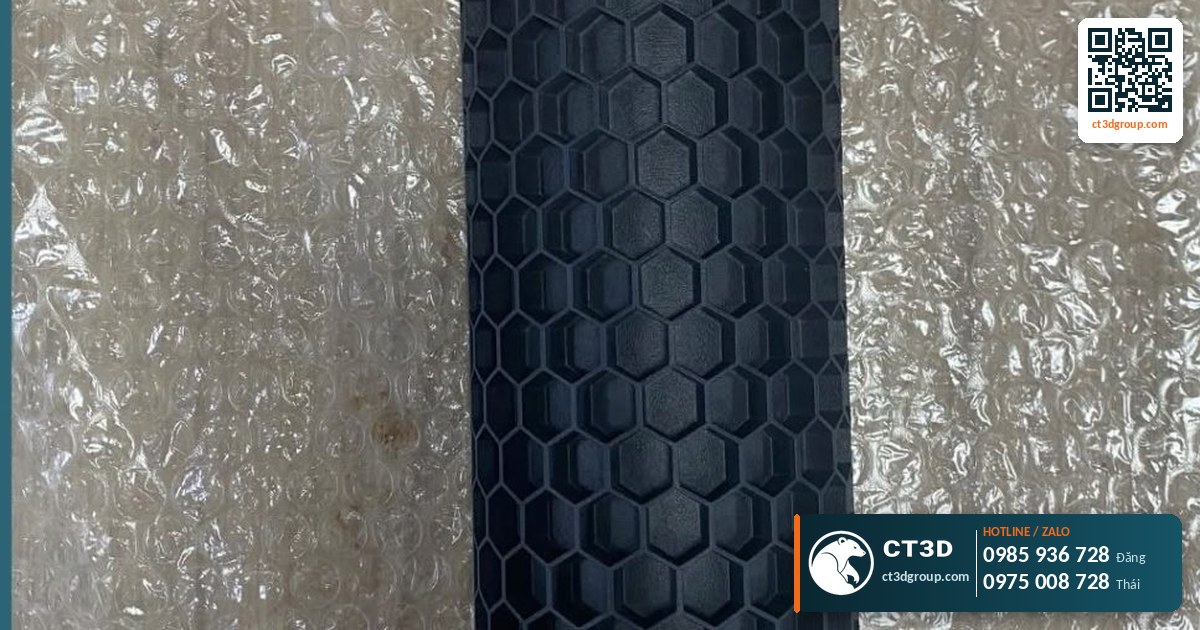
Quick answer: MJF (Multi Jet Fusion) PA12 3D printing builds parts in a bed of nylon PA12 powder: printheads jet a heat-absorbing agent onto the areas to be formed, then infrared lamps sweep across, melting and fusing the powder in those areas. MJF PA12 parts from CT3D achieve a tolerance of about ±0.05 mm, need no supports, have consistent strength and can be used as real end-use parts. MJF suits engineering parts, snap fits, device housings and low-volume production. MJF pricing: quoted per file.
Many mechanical engineers are used to FDM and resin printing but hit limits when they need plastic parts that are strong, accurate and geometrically complex all at once. MJF PA12 3D printing fills exactly that gap. This article takes a deep dive into MJF’s mechanism, specifications and specific design rules. To see MJF alongside FDM, SLA and SLM, see our pillar article on 3D printing technologies.
What Is MJF 3D Printing? How It Forms Parts in a Powder Bed
MJF belongs to the powder bed fusion family of technologies, alongside SLS. The difference lies in how energy is delivered. SLS uses a laser that scans line by line; MJF uses printheads combined with a heat lamp that sweeps the whole area. One layer cycle works as follows:
- Powder recoating: the recoater spreads a thin, even layer of PA12 powder across the entire build area. The build chamber is kept hot, close to the powder’s melting point, to reduce temperature differences.
- Jetting the fusing agent: printheads, similar to those in an inkjet paper printer, jet a dark liquid precisely onto the cross-section of that layer. This agent makes the jetted area absorb far more infrared energy than the surrounding powder.
- Jetting the detailing agent: a second liquid is jetted along the outer edge of the profile to cool it and stop heat spreading into the neighboring powder. This gives sharper edges and more accurate dimensions.
- Infrared fusing: the lamp sweeps the whole layer. Areas with fusing agent melt and fuse with the layer below; the remaining powder stays loose.
- Lower the platform and repeat until the full build height is complete.
Because the lamp sweeps the entire layer in one pass, the time per layer is almost independent of the number of parts in it. This is why MJF is so efficient when many parts are packed into one build.
Why doesn’t MJF need supports?
The unfused powder surrounding the part acts as a natural support. Overhangs, horizontal holes and curved internal channels are all supported by powder throughout the build. Engineers can stack parts in all three dimensions within the build chamber (called nesting) to make full use of the volume. After printing, there are no support marks to clean up.
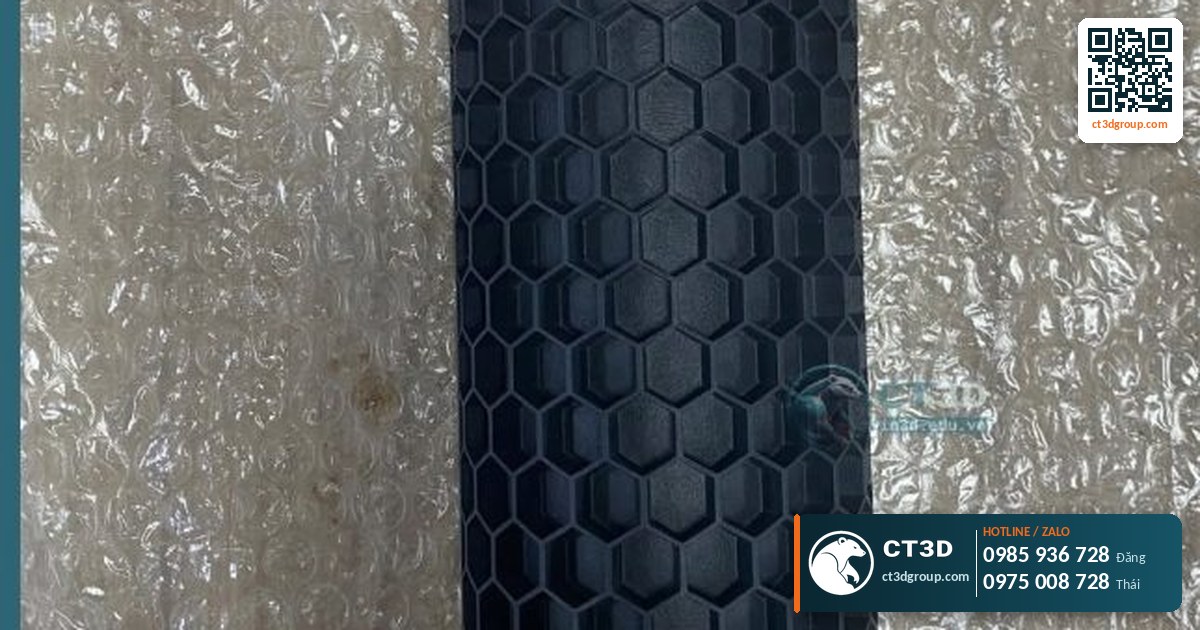
Why PA12?
PA12 (Polyamide 12, a type of nylon) is the most common MJF material thanks to these properties:
- Tough and impact resistant, better than standard resin; it does not snap suddenly.
- Low moisture absorption compared with many other nylons, so dimensions are more stable.
- Resistant to oils, greases and many chemicals – well suited to factory and automotive environments.
- Fairly uniform mechanical properties in all directions, because each layer area is fused as a whole – unlike FDM, which is clearly weaker in the layer-stacking direction.
- Living hinges and snap fits are possible thanks to the material’s toughness.
MJF parts come off the machine a natural gray because of the dark fusing agent. A uniform black is usually achieved by dyeing after printing.
MJF PA12 3D Printing Specifications
| Parameter | MJF PA12 | SLS PA12 (reference) | FDM (reference) |
|---|---|---|---|
| Dimensional tolerance | about ±0.05 mm | ±0.05–0.15 mm | ±0.1–0.3 mm |
| Layer thickness | Thin powder layers, same class as SLS | 80–120 microns | 100–300 microns |
| Supports needed | No | No | Yes (overhangs beyond about 45°) |
| Directional properties | Fairly uniform | Fairly uniform | Weak in the Z direction |
| As-printed surface | Fine matte texture, gray | Fine matte texture, white | Visible layer lines |
| Price | Quoted per file | Quoted per file | CT3D from VND 650/g (PLA, ≈ US$0.025/g) |
Source: CT3D technical documentation (tolerances, layer thickness, FDM prices 2026, indicative).
For a deeper look at the differences between the two powder technologies, see MJF vs. SLS and what is SLS 3D printing.
What Affects MJF Quality and Cost?
Part volume and build height
With MJF, print time depends mainly on the total stacked height of parts in the chamber, not the number of parts. So when printing many small parts, engineers pack them densely to share the machine cost across many products. Conversely, a long, tall part that spans many layers takes more time even if its volume is small. This is why CT3D quotes MJF per file: we need to look at the geometry, volume and nesting potential to price it correctly.
Wall thickness and solid sections
Very thick plastic sections retain a lot of heat, cool slowly and shrink unevenly, causing slight warping or sink marks. Designs should favor uniform walls, core out thick sections and add stiffening ribs instead of making them solid.
Cooling time
After printing, the whole powder cake must cool gradually before the parts are removed. Rushed cooling causes distortion. Cooling time is part of the lead time and should be factored into your schedule.
Part orientation in the chamber
Although properties are fairly uniform, orientation still affects the flatness of large faces and the roundness of holes. Engineers usually tilt large flat faces slightly and orient critical hole axes vertically to best preserve their shape.
Design Rules for MJF PA12 Parts
| Item | Common recommendation | Why |
|---|---|---|
| Minimum wall thickness | about 1 mm or more; long, tall walls should be thicker | Walls that are too thin warp easily and can break during depowdering |
| Clearance for moving parts | about 0.5 mm or more | Prevents the two surfaces from fusing together due to adhering powder |
| Powder escape holes for hollow parts | At least 2 holes, large enough to blow out powder | Trapped powder adds weight and is hard to clean |
| Embossed and engraved text | Stroke width and depth not too small | Adhering powder fills in fine lettering |
| Thick sections | Core out, use ribs | Reduces shrinkage and warping, saves material |
Source: common design recommendations for powder bed fusion; CT3D checks every file before printing.
For mating surfaces with tight requirements, read our article on 3D printing accuracy and tolerances to choose the clearance for each type of fit.
What Does MJF PA12 Post-Processing Involve?
- Depowdering: remove parts from the powder cake and clean off adhering powder with compressed air and brushes, especially inside holes and channels.
- Bead blasting: removes residual powder and creates a uniform surface.
- Black dyeing: gives a uniform black color and hides light scratches.
- Surface smoothing, painting, coating where aesthetics are important.
- Secondary operations: thread tapping, pressing in metal threaded inserts and reaming holes for precision fits.
Unfused powder is sieved and blended with fresh powder for reuse, reducing waste compared with technologies that need supports.
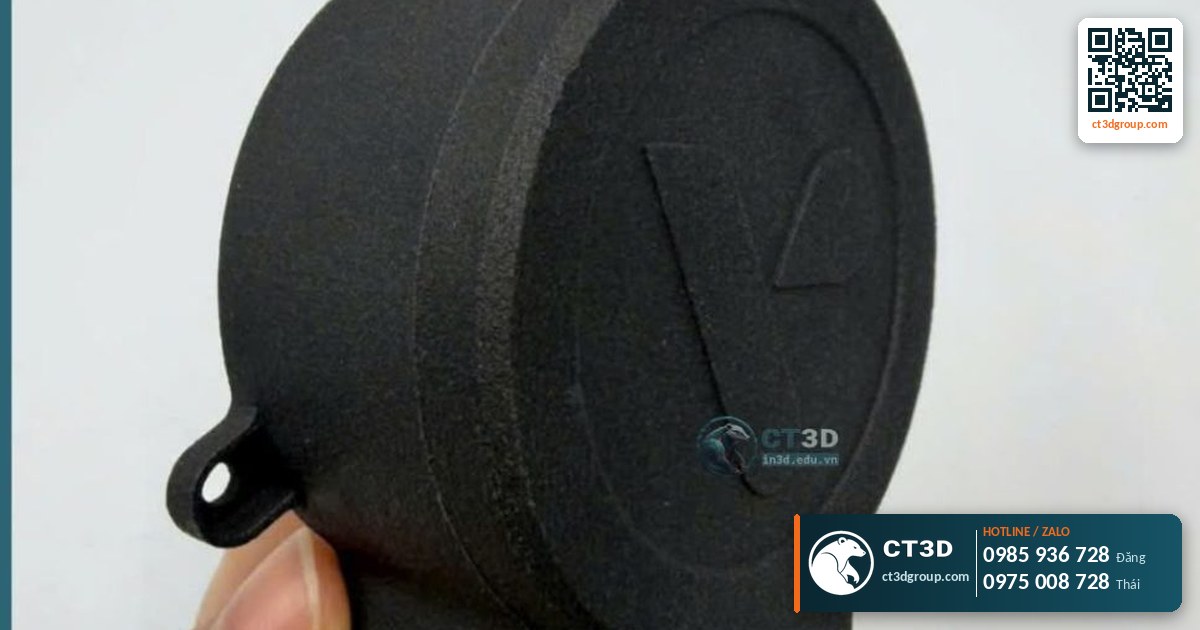
Common MJF Part Defects and How to Prevent Them
- Warping of large flat faces: caused by thick sections cooling unevenly. Fix with uniform walls, added ribs and tilting large faces.
- Powder trapped in closed channels: caused by missing escape holes. Add powder escape holes at the design stage.
- Pre-assembled parts fused together: clearance too small. Increase clearance per the recommendations.
- Holes smaller than designed: powder adhering to the hole walls. Compensate the dimension or ream after printing.
- Uneven color: as-printed parts vary in shade of gray depending on position. Dye black for uniformity.
When Should You Choose MJF PA12 Over FDM or Resin?
- End-use parts that need strength, toughness and impact resistance: MJF beats standard resin.
- Tight tolerances and uniform properties in all directions: MJF beats FDM 3D printing.
- Complex geometry, internal channels and print-in-place assemblies: MJF needs no supports, so it can do them.
- Quantities from a few dozen to a few hundred parts: nesting in one build lowers the cost per part. See high-volume 3D printing and low-volume production.
- Glossy, clear or highly cosmetic parts: choose SLA resin instead of MJF.
How to Order MJF PA12 Printing at CT3D
CT3D follows 6 steps: send your file (STL/STEP/OBJ/3MF via our website, Zalo, email or our contact form) → state your technical requirements → an engineer analyzes the file, calculates volume and nesting potential → quote with lead time → confirmation and production → delivery to your door or pickup at the workshop. Nationwide delivery within 1–3 days of completion.
Checklist to send with your file:
- A STEP file if available, so the engineer can measure mating dimensions accurately.
- Quantity for each part number.
- Mating locations and dimensions that must hold tight tolerances.
- Desired color: natural gray or dyed black.
- Whether threaded inserts or tapped threads are needed.
- Operating environment: temperature, oil and grease, chemicals, outdoor use.
Real-World Applications of MJF PA12 3D Printing
Factory fixtures and replacement parts: clamps, guide rails, robot grippers and production line parts that need durability and accuracy. See 3D-printed jigs & fixtures.
Low-volume electronics housings: sensor housings, control boxes, snap-fit covers – printed directly instead of waiting for tooling.
Air ducts and complex channels: MJF can print curved ducts and internal channels that are difficult with traditional methods.
Functional prototypes: test assemblies with mechanical properties close to real engineering plastic products.
See also the introduction to CT3D’s MJF PA12 3D printing service, or our page on multi-technology custom 3D printing. To compare MJF with FDM, SLA and SLM in one table, read our pillar article on 3D printing technologies.
Frequently Asked Questions
Is MJF PA12 3D printing accurate?
According to CT3D’s documentation, MJF/MJP PA12 parts achieve a tolerance of about ±0.05 mm, sufficient for most engineering mating parts.
Does MJF need supports?
No. The unfused powder surrounding the part acts as a support, so overhangs and internal channels can be printed and many parts can be stacked.
What color are MJF parts?
They come off the machine a natural gray. They are usually dyed black for a uniform color, and can be painted if another color is needed.
How much does MJF PA12 3D printing cost?
CT3D quotes per file, because cost depends on volume, height and nesting potential. Send us an STL or STEP file for a quote.
What is the difference between MJF and SLS?
Both print in a powder bed. SLS uses a laser that scans line by line; MJF uses printheads jetting a fusing agent and an infrared lamp that sweeps the whole layer.
Real Footage From the CT3D Workshop
Watch the video Metal, SLA, MJP Castable Wax and PA12 3D Printing by CT3D to get a clearer picture of the process and product quality. More videos are available on our YouTube channel Che Tao Vlog – CT3D.
Contact CT3D – Send Your File, Get a Fast Quote
Whether you have a 3D file, a 2D drawing, photos or just an idea, you can send it to CT3D. Our engineers will check the file, recommend the right technology and material, and send you a quote with a lead time.
- Email: [email protected] – [email protected]
- Hotline / Zalo: +84 975 008 728 (Mr. Thai) – +84 985 936 728 (Mr. Dang), or use our contact form
- Headquarters: Binh Duong.
- Workshops in Ho Chi Minh City: Linh Trung (Thu Duc), Tam Binh (Thu Duc), former District 6.
- Other workshops and drop-off points: Can Tho, Da Nang, Bien Hoa, Ba Ria – Vung Tau, Hanoi, Hai Duong, Hai Phong. Nationwide delivery across Vietnam.
- Website: ct3dgroup.com – in3d.edu.vn
CT3D – 3D design & prototyping: 3D printing, 3D scanning, reverse engineering, silicone mold making, finishing and painting, CNC machining, composite fabrication, plus 3D printers and 3D printing materials.
Danh sách cửa hàng:
CT3D là đơn vị cung cấp trọn gói các dịch vụ thiết kế và sản xuất theo yêu cầu tại TP.HCM và khu vực lân cận (Bình Dương, Đồng Nai, Long An…). Với năng lực khép kín từ thiết kế 3D, in 3D (FDM, resin/SLA, SLS, in 3D kim loại), scan 3D – thiết kế ngược, làm khuôn, đúc composite – poly resin – poly stone đến gia công CNC và sơn màu hoàn thiện, CT3D đồng hành cùng khách hàng qua toàn bộ quy trình – từ ý tưởng, bản vẽ hay sản phẩm mẫu đến thành phẩm hoàn chỉnh. Dù bạn cần tạo mẫu nhanh, sản xuất số lượng, chế tác tượng – mô hình – quà tặng hay linh kiện kỹ thuật, đội ngũ CT3D sẽ tư vấn công nghệ và vật liệu phù hợp, đảm bảo sản phẩm sắc nét, đúng yêu cầu và tối ưu chi phí. Khách hàng tại TP.HCM và vùng lân cận có thể trao đổi trực tiếp, gửi file online và nhận sản phẩm thuận tiện, hỗ trợ cả đơn gấp lẫn dự án số lượng.
CT3D cung cấp trọn gói các dịch vụ thiết kế và sản xuất theo yêu cầu, phục vụ khách hàng tại Hà Nội và các tỉnh lân cận (Bắc Ninh, Hưng Yên, Hải Phòng, Vĩnh Phúc…). Với năng lực khép kín từ thiết kế 3D, in 3D (FDM, resin/SLA, SLS, in 3D kim loại), scan 3D – thiết kế ngược, làm khuôn, đúc composite – poly resin – poly stone đến gia công CNC và sơn màu hoàn thiện, CT3D đồng hành cùng khách hàng qua toàn bộ quy trình – từ ý tưởng, bản vẽ hay sản phẩm mẫu đến thành phẩm hoàn chỉnh. Quy trình làm việc thuận tiện: bạn gửi file 3D hoặc mô tả ý tưởng qua online, đội ngũ CT3D tư vấn công nghệ – vật liệu, báo giá nhanh và giao hàng tận nơi tại Hà Nội. Dù bạn cần tạo mẫu nhanh, sản xuất số lượng, chế tác tượng – mô hình – quà tặng hay linh kiện kỹ thuật, CT3D đều đáp ứng với sản phẩm sắc nét, đúng yêu cầu và tối ưu chi phí.

