
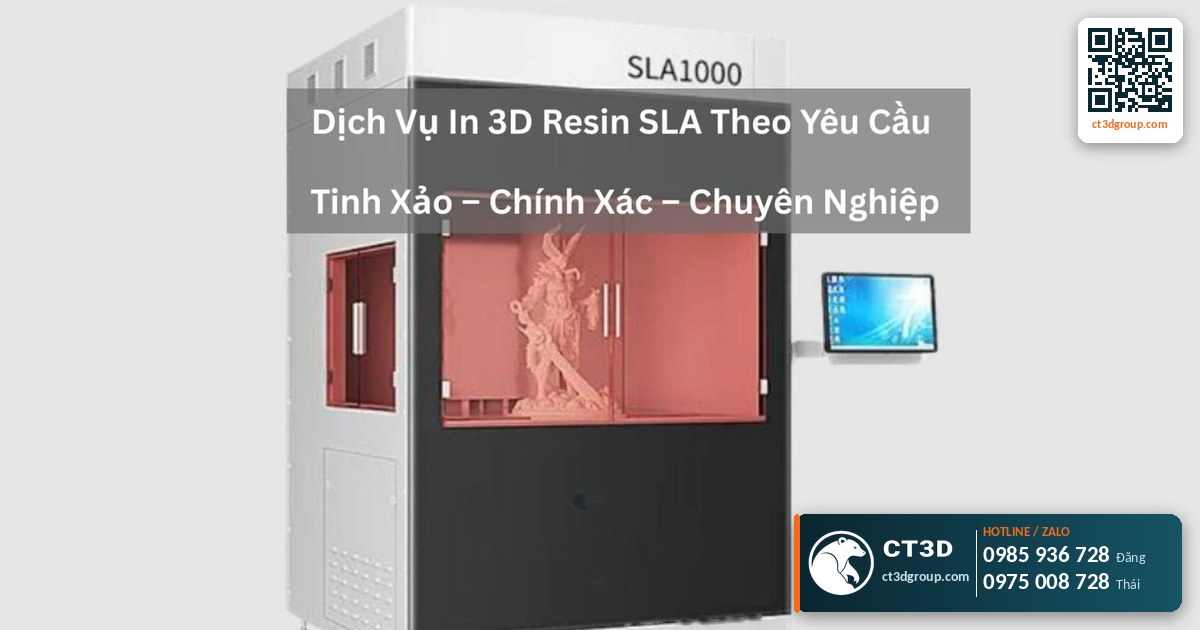
Quick answer: SLA 3D printing (stereolithography) is a technology that aims a UV laser into a vat of liquid resin. Wherever the light hits, the resin hardens into a thin layer of about 0.025–0.1 mm. Repeat that thousands of times and you get a finished object. SLA delivers smooth surfaces, crisp detail and tolerances of roughly ±0.05–0.1 mm, making it ideal for statues, figures, jewelry and product models. At CT3D, resin printing is quoted per file.
I wrote this article for readers exploring SLA for the first time, using simple words and everyday examples. If you want to go deeper into the laser mechanism, machine specifications and part optimization, read our in-depth article What is SLA 3D printing – UV laser principles and specs. When you are ready to order, custom SLA resin printing – materials and prices will help you choose a material and understand how quotes are calculated.
What Is SLA 3D Printing? A Quick Everyday Analogy
Imagine a basin of water that instantly freezes wherever you shine a flashlight. If you draw a circle on the surface with the light, a disc of ice appears. Lower the disc a little, draw a slightly smaller circle, then a smaller one again. After many passes, you have a cone.
SLA works in much the same way. The “basin of water” is a vat of resin, a light-sensitive liquid plastic. The “flashlight” is a very fine UV laser beam. Instead of freezing, the resin hardens through a chemical reaction called photopolymerization (the resin absorbs UV light and cross-links into solid plastic).
SLA was the first 3D printing technology, dating back to the 1980s. Today it is still the benchmark for parts that need a smooth finish and high detail.
Key Terms When Talking About SLA
- Resin: a light-sensitive liquid plastic that hardens when exposed to UV light.
- Photopolymerization: the reaction that turns liquid resin into a solid under light.
- Resin vat: the tray holding the resin, with a transparent bottom that lets light through.
- Build platform: where the part attaches; it lifts gradually after each layer.
- Supports: small pillars that hold the part during printing and are cut away afterward.
- Post-cure: additional UV exposure after printing so the part fully hardens.

How Does an SLA Printer Work? 5 Simple Steps
- File preparation: the 3D file is tilted and supports are added. In CT3D’s experience, tilting the part by about 20–45 degrees reduces the peel force on each layer and minimizes failures.
- Filling the vat: the resin is kept at a stable temperature. In the CT3D workshop, resin is held at around 25–28 °C for consistent printing.
- The laser draws each layer: galvanometer mirrors steer the laser to trace the exact shape of the layer. Resin where the beam hits solidifies.
- Move the platform, print the next layer: the platform shifts by exactly one layer height, fresh resin flows in, and the laser draws the next layer.
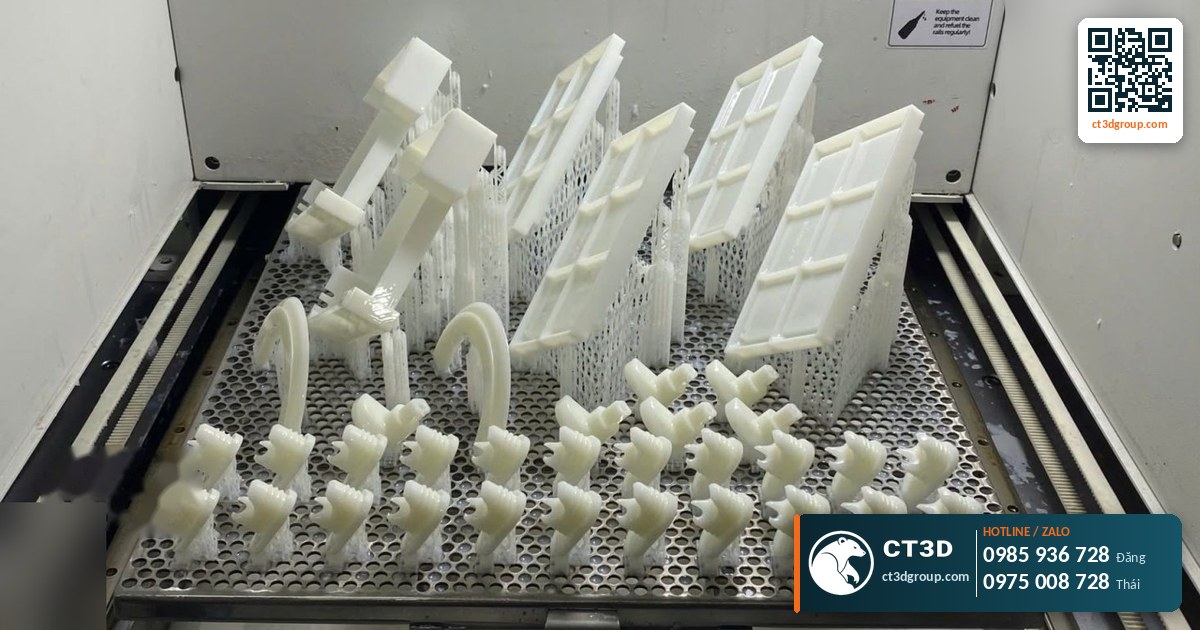
- Post-processing: remove the part, wash off excess resin, UV cure, cut the supports, sand and paint if needed.
Post-processing is critical with resin. Skip the washing or curing step and the part may stay tacky, soft or discolored. The detailed process is in resin print post-processing: washing and UV curing.
How Is SLA Different from FDM? A Beginner’s Comparison
This is the most common question. I have summarized it in the table below. More complete specifications are in FDM vs resin 3D printing.
| Criterion | SLA (resin) | FDM (filament) |
|---|---|---|
| Material | Liquid resin | Spools of PLA, PETG, ABS filament… |
| Layer height | 25–100 microns | 100–300 microns |
| Typical tolerance | ±0.05–0.1 mm | ±0.1–0.3 mm |
| Surface | Smooth, layer lines barely visible | Visible layer lines |
| Best for | Statues, figures, jewelry, appearance models | Prototypes, jigs, large parts |
| Cost | Higher | Lower |
Source: CT3D technical documentation.
In short: for beauty and fine detail, choose SLA; for low cost, large size and toughness, choose FDM. Based on the 2026 Ho Chi Minh City market, SLA printing typically costs about 1.5–2.5 times more than FDM (this is a market range, not CT3D’s price).
Are SLA, DLP and LCD the Same?
All three print with resin and UV light. The difference is the light source:
- SLA uses a single laser beam that traces line by line, like a pen.
- DLP uses a projector to expose an entire layer at once, like printing a photo.
- LCD (MSLA) uses an LCD screen as a light mask, also exposing a whole layer at once.
For beginners, the key point is that all three produce smoother surfaces than FDM. The differences in speed, resolution and build size are explained in SLA vs DLP vs LCD: what’s the difference.
What Is SLA 3D Printing Used For?
Statues, Figures and Art Models
Faces, fabric folds and small ornamental patterns are reproduced very clearly. CT3D has printed a 1 m tall Catholic statue in SLA and restored a statue of Our Lady of La Vang. For large statues, CT3D offers a resin build volume of up to 800 × 800 × 500 mm, allowing one-piece prints with fewer joints.
Product Models and Device Housings
Presentation models that need a flawless surface for photography and sales pitches, painted to look like the production part.
Jewelry and Metal Casting
Castable resin is used to make patterns for investment casting rings and pendants. See also castable resin patterns for jewelry.
Dental and Medical
Dental models, aligner trays and anatomical models use specialty resins. Our article dental and medical resin 3D printing has more examples.
Clear Parts
Clear resin can be polished and clear-coated for lamp prototypes, flow-visualization models and transparent housings. See clear resin 3D printing.
What Types of SLA Resin Are There?
As a beginner, you just need to know there is more than one kind of resin. CT3D offers standard resin, tough resin (ABS-like, Tough), clear, heat-resistant, engineering, flexible, castable and wax resins. Each has its own price and applications. The material selection table and surcharges by resin type are in custom SLA resin printing.
Common SLA Printing Problems Beginners Run Into
- Print failure / drop-off: the part falls off the build platform midway, usually due to weak supports or poor first-layer adhesion.
- “Spaghetti” strands: partially cured resin clumps into strings, usually because part of the model has detached.
- Layer separation: layers split apart, common when the cross-section is too large or the resin is too cold.
- Cracking after printing: thick solid parts, over-curing with UV, or hollowed parts without drain holes.
By controlling the tilt angle, resin temperature and supports, CT3D keeps its resin print failure rate below 5%. Fixes for each problem are in common resin 3D printing problems.
How Is SLA 3D Printing Priced?
SLA pricing depends on the resin volume, resin type, part height (which determines the number of layers and therefore machine time), supports and finish level. That is why CT3D quotes per file. To give you a sense of scale, the 2026 Ho Chi Minh City market range for standard resin (not CT3D’s price) is roughly 150,000–400,000 VND (≈ US$6–15) for parts under 5 cm, and 300,000–1,200,000 VND (≈ US$12–46) for parts 5–10 cm. These prices are indicative. Specialty resins carry a surcharge; clear resin, for example, adds 40–70%.
The full price list and detailed calculation method are in How much does 3D printing cost? 2026 price guide.
Ordering SLA Printing from CT3D: What to Send
- An STL/STEP/OBJ/3MF file, or photos and drawings (CT3D can build the file).
- Desired size and purpose: display, assembly, casting, transparency.
- Finish requirements: raw white, primed, or painted.
- Quantity and required delivery date.
Our engineers will check wall thickness, resin drain holes and part orientation, then send you a quote with a lead time. You can send everything via Zalo, email or our contact form. To learn more before ordering, read What is SLA 3D printing.
Frequently Asked Questions
What does SLA stand for?
SLA stands for stereolithography: using light to cure liquid resin layer by layer.
Are SLA prints strong?
Standard resin is rigid but more brittle than FDM plastics. For load-bearing parts, choose Tough/ABS-like resin.
Do SLA prints need painting?
Not necessarily. The surface is already smooth. Painting adds the color you want and hides support marks.
Can SLA print large parts?
Yes. CT3D prints large-format resin parts up to 800 × 800 × 500 mm. Larger parts are split into sections and joined.
How much does SLA printing cost?
CT3D quotes per file, because the price depends on volume, resin type, part height and finish.
Real Footage from the CT3D Workshop
Watch High-precision SLA resin 3D printing, produced by CT3D, to get a clearer picture of the process and the quality of the finished parts. More videos are available on our YouTube channel Che Tao Vlog – CT3D.
Contact CT3D – Send Your File, Get a Fast Quote
Whether you have a 3D file, a 2D drawing, photos or just an idea, you can send it to CT3D. Our engineers will check the file, recommend the right technology and material, and send you a quote with a delivery lead time.
- Email: [email protected] – [email protected]
- Hotline / Zalo: +84 975 008 728 (Mr. Thai) – +84 985 936 728 (Mr. Dang), or use our contact form
- Head office: Binh Duong.
- Workshops in Ho Chi Minh City: Linh Trung (Thu Duc), Tam Binh (Thu Duc), former District 6.
- Other workshops and drop-off points: Can Tho, Da Nang, Bien Hoa, Ba Ria – Vung Tau, Hanoi, Hai Duong, Hai Phong. Nationwide delivery.
- Website: ct3dgroup.com – in3d.edu.vn
CT3D – 3D design & prototyping: 3D printing, 3D scanning, reverse engineering, silicone mold making, paint finishing, CNC machining, composite fabrication, and supply of 3D printers and 3D printing resins and filaments.
Danh sách cửa hàng:
CT3D là đơn vị cung cấp trọn gói các dịch vụ thiết kế và sản xuất theo yêu cầu tại TP.HCM và khu vực lân cận (Bình Dương, Đồng Nai, Long An…). Với năng lực khép kín từ thiết kế 3D, in 3D (FDM, resin/SLA, SLS, in 3D kim loại), scan 3D – thiết kế ngược, làm khuôn, đúc composite – poly resin – poly stone đến gia công CNC và sơn màu hoàn thiện, CT3D đồng hành cùng khách hàng qua toàn bộ quy trình – từ ý tưởng, bản vẽ hay sản phẩm mẫu đến thành phẩm hoàn chỉnh. Dù bạn cần tạo mẫu nhanh, sản xuất số lượng, chế tác tượng – mô hình – quà tặng hay linh kiện kỹ thuật, đội ngũ CT3D sẽ tư vấn công nghệ và vật liệu phù hợp, đảm bảo sản phẩm sắc nét, đúng yêu cầu và tối ưu chi phí. Khách hàng tại TP.HCM và vùng lân cận có thể trao đổi trực tiếp, gửi file online và nhận sản phẩm thuận tiện, hỗ trợ cả đơn gấp lẫn dự án số lượng.
CT3D cung cấp trọn gói các dịch vụ thiết kế và sản xuất theo yêu cầu, phục vụ khách hàng tại Hà Nội và các tỉnh lân cận (Bắc Ninh, Hưng Yên, Hải Phòng, Vĩnh Phúc…). Với năng lực khép kín từ thiết kế 3D, in 3D (FDM, resin/SLA, SLS, in 3D kim loại), scan 3D – thiết kế ngược, làm khuôn, đúc composite – poly resin – poly stone đến gia công CNC và sơn màu hoàn thiện, CT3D đồng hành cùng khách hàng qua toàn bộ quy trình – từ ý tưởng, bản vẽ hay sản phẩm mẫu đến thành phẩm hoàn chỉnh. Quy trình làm việc thuận tiện: bạn gửi file 3D hoặc mô tả ý tưởng qua online, đội ngũ CT3D tư vấn công nghệ – vật liệu, báo giá nhanh và giao hàng tận nơi tại Hà Nội. Dù bạn cần tạo mẫu nhanh, sản xuất số lượng, chế tác tượng – mô hình – quà tặng hay linh kiện kỹ thuật, CT3D đều đáp ứng với sản phẩm sắc nét, đúng yêu cầu và tối ưu chi phí.

