
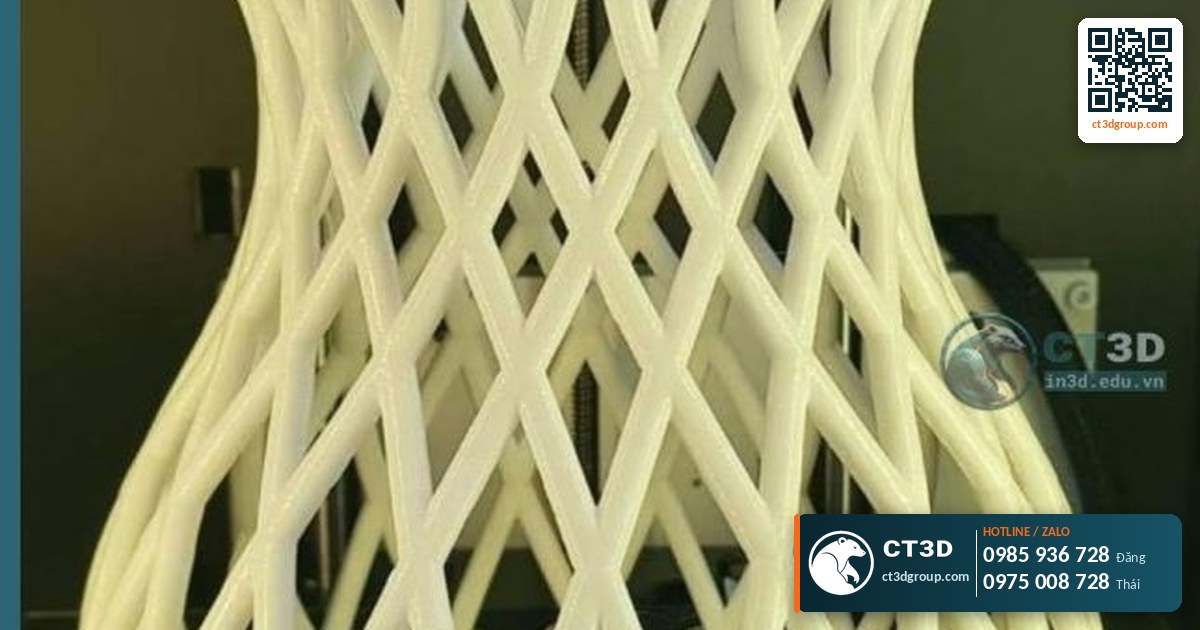
Quick answer: FDM technology (Fused Deposition Modeling, also known as material extrusion) is the most widely used type of 3D printing. The machine pulls plastic filament from a spool into a heated nozzle, melts it and “draws” thin layers of roughly 0.1–0.3 mm, one on top of another. Common materials are PLA, PETG, ABS, ASA and TPU. FDM is cheap, durable and can produce large parts, but the surface shows layer lines. At CT3D, FDM printing in PLA starts from 650 VND/g (≈ US$0.025/g).
This article is for readers hearing about FDM for the first time. I explain it with everyday examples and focus on the terms and questions beginners run into most. If you need technical specifications, detailed comparison tables and tips for optimizing your prints, read our in-depth article What is FDM 3D printing – principles, specs, pros and cons. The big picture of all technologies is in 3D printing technologies compared: FDM, SLA, MJF, SLM.
What Is FDM Technology? Explained with a Hot Glue Gun
Have you ever used a hot glue gun? A glue stick is pushed in, the hot tip melts the glue, and you draw a bead of glue across a sheet of paper. The glue cools and hardens.
An FDM printer does exactly the same thing, only it is computer controlled and far more precise. Instead of a glue stick, there is a spool of plastic filament, usually 1.75 mm in diameter. Instead of your hand, there are X, Y and Z motion axes. The nozzle follows a precomputed path, completes one layer, then moves up to draw the next.
FDM is also called FFF (Fused Filament Fabrication). The two names mean almost the same thing: FDM is the original trademarked name, while FFF is the generic term used by the community.
What Are the Main Parts of an FDM Printer?
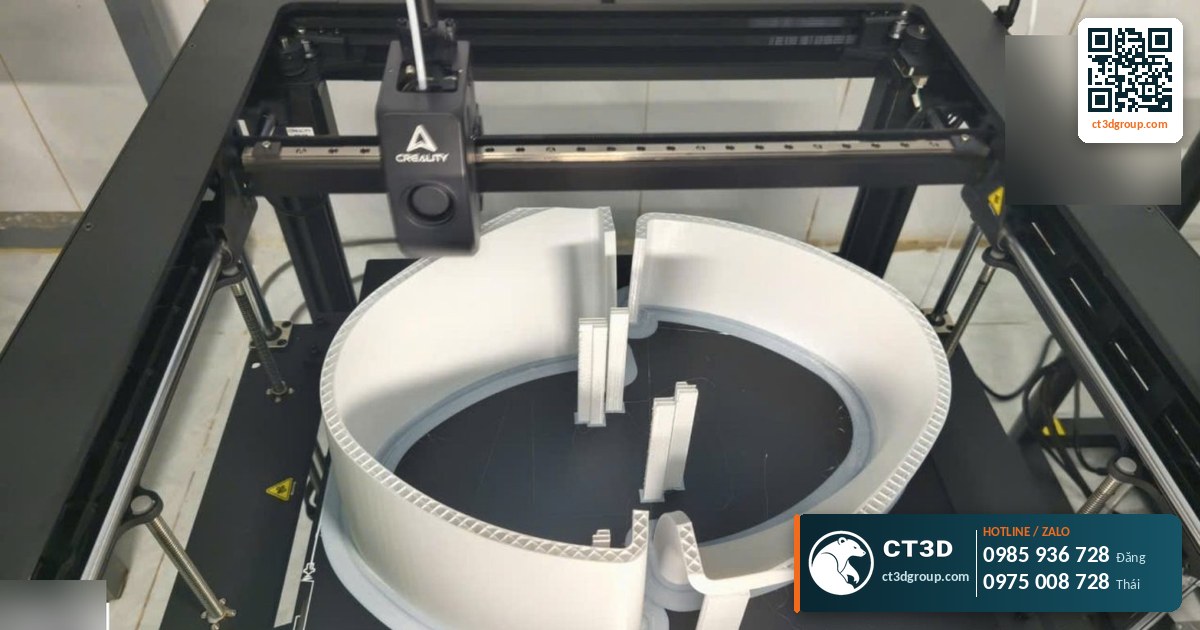
Beginners do not need to know every detail. Knowing the 6 main components below is enough to have a productive conversation with a print shop.
| Component | What it does | Everyday comparison |
|---|---|---|
| Filament spool | Holds the raw plastic filament | A spool of sewing thread |
| Extruder | Grips and pushes the filament into the hot end | Your finger squeezing the glue gun trigger |
| Hot end and nozzle | Melts the plastic and extrudes it as a fine strand | The tip of the glue gun |
| Build plate (bed) | Flat surface the first layer sticks to; many are heated | The sheet of paper you draw on |
| Motion axes | Move the nozzle or bed along X, Y and Z | Your hand guiding the glue gun |
| Cooling fan | Quickly cools the freshly printed plastic | Blowing on the glue so it sets faster |
Source: general technical knowledge of FDM printers, compiled by CT3D.
How Does FDM Printing Work? From File to Finished Part
- Prepare the 3D file (STL, STEP, OBJ, 3MF). No file yet? An engineer can build one from photos, drawings or a 3D scan.
- Slicing: the software divides the model into layers and sets the layer height, infill, number of perimeters and supports.
- Heating: the nozzle heats up to the plastic’s printing temperature. PLA, for example, typically prints at around 190–220 °C.
- Printing the first layer: the most important layer. If the first layer adheres well, the part is much less likely to detach or warp.
- Printing the remaining layers: on each layer, the nozzle draws the outer walls first, then fills the interior with a lattice pattern.
- Post-processing: removing the part from the bed, breaking off supports, sanding and painting if needed.
A simple example: a small palm-sized box printed at 0.2 mm layer height might take a few hours. The same box at 0.1 mm has twice as many layers, and the print time goes up accordingly. To understand print time and machine-hour costs in detail, see 3D printing time and machine-hour cost.
FDM Terms Beginners Often Come Across
Layer Height
The height of each plastic layer. Thinner layers give a smoother surface with less visible layer lines, but take longer to print. Thicker layers print fast and suit prototypes and parts that do not need to look perfect.
Infill (Internal Density)
FDM parts are usually not 100% solid. Inside is a honeycomb, grid or gyroid lattice. 15–20% infill is enough for display models; load-bearing parts need more. The higher the infill, the more plastic is used and the higher the price. Our article infill density, cost and strength explains this in more detail.
Walls (Perimeters)
The number of plastic loops around the outer surface. Adding walls makes the part stiffer and more watertight, and is sometimes more effective than increasing infill.
Supports
Molten plastic cannot be printed into thin air. Overhangs that are too steep (usually beyond about 45 degrees) need temporary supports. They are snapped off after printing, and the surface underneath is usually slightly rough.
Warping
Plastic shrinks as it cools. With high-shrinkage plastics such as ABS, the corners of a part can curl up off the build plate. Print shops prevent this with heated beds, enclosed build chambers and smart part orientation.
What Materials Can FDM Print?
Beginners only need to remember the 5 most familiar names. Detailed properties, print temperatures and selection tips are in FDM materials: PLA, ABS, PETG, ASA, TPU.
- PLA: easy to print, many colors, ideal for display models and student projects. Avoid leaving it in hot places or in direct sun for long periods.
- PETG: tougher and less brittle than PLA, used for boxes, clips and everyday functional parts.
- ABS: better impact and heat resistance, common in equipment housings and technical parts.
- ASA: similar to ABS but with better UV resistance, suited to outdoor items.
- TPU: a rubber-like flexible plastic for gaskets, pads and protective covers.
There are also engineering plastics such as nylon and carbon-fiber-filled filaments for jigs and parts that need to be stiff and lightweight.
When Should You Choose FDM Technology?
I usually recommend FDM to customers in these cases:
- You need a fast, low-cost prototype to check dimensions and assembly.
- The part is large, several tens of centimeters, where resin printing would be very expensive.
- The part is for real use: jigs, clamps, electrical enclosures, replacement parts, where durability matters more than looks.
- Project models and site models where light layer lines are acceptable or will be painted over.
On the other hand, if you need small figures, tiny details or a cast-like smooth surface, resin is usually the better choice. See our quick comparison FDM vs resin 3D printing.
FDM Advantages and Limitations in a Nutshell
| Advantages | Limitations |
|---|---|
| Lowest cost among the common 3D printing technologies | Visible layer lines; sanding and painting needed for a smooth finish |
| Wide choice of materials and colors | Very small details are not as crisp as with resin |
| Can print large parts, or print in sections and join them | Strength in the vertical direction (between layers) is lower than in the horizontal direction |
| Durable parts, ready to use as functional components | Some plastics warp easily if not printed correctly |
Source: CT3D production experience.
How Is FDM Printing Priced at CT3D?
CT3D prices FDM by the actual grams of plastic used (indicative 2026 prices): PLA from 650 VND/g (≈ US$0.025/g), PETG from 650 VND/g, ABS from 1,000 VND/g (≈ US$0.04/g), ASA from 2,000 VND/g (≈ US$0.08/g), and carbon-fiber filament from 2,750 VND/g (≈ US$0.11/g). Orders under 50 g are subject to a minimum charge. From 50 to 500 g, pricing is by weight and material. Above 500 g or for larger quantities, we provide a project quote. Post-processing, rush jobs and 3D modeling are charged separately.
Example: a 120 g PLA part, unpainted, costs roughly 120 × 650 = 78,000 VND (≈ US$3) to print. The actual figure will be confirmed by our engineers after reviewing the file. More detailed examples are in PLA 3D printing cost per gram.
What to Prepare When Sending an FDM Job to CT3D
- An STL/STEP/OBJ/3MF file, or photos and drawings with dimensions.
- Intended use: display, assembly, load-bearing, outdoor.
- Preferred material and color (if you are not sure, our engineers will advise).
- Quantity and required delivery date.
- Finish requirements: as printed, sanded, or painted.
CT3D has more than 12 years of experience, three workshops in Ho Chi Minh City (Linh Trung and Tam Binh in Thu Duc; former District 6) and drop-off points in many provinces. Nationwide delivery takes 1–3 days after completion. To dig deeper before ordering, read What is FDM 3D printing.
Frequently Asked Questions
Is there a difference between FDM and FFF?
In how they work, they are practically the same. FDM is the original trademarked name; FFF is the generic name used by the community.
Are FDM prints strong?
Yes. FDM parts in PETG, ABS, ASA or engineering plastics can be used as functional components. Strength depends on the material, infill, number of walls and print orientation.
Why do FDM parts have horizontal lines?
Because the part is built layer by layer. The thinner the layers, the less visible the lines. For a completely smooth surface, the part is sanded, primed and top-coated.
How much does FDM printing cost?
At CT3D, indicative prices start from 650 VND/g (≈ US$0.025/g) for PLA and PETG, ABS from 1,000 VND/g and ASA from 2,000 VND/g. Orders under 50 g are subject to a minimum charge.
Can FDM print large parts?
Yes. Parts larger than the build volume are split into sections, printed separately, then joined and the seams finished.
Real Footage from the CT3D Workshop
Watch Large-format liquid resin 3D printing for rapid prototyping, produced by CT3D, to get a clearer picture of the process and the quality of the finished parts. More videos are available on our YouTube channel Che Tao Vlog – CT3D.
Contact CT3D – Send Your File, Get a Fast Quote
Whether you have a 3D file, a 2D drawing, photos or just an idea, you can send it to CT3D. Our engineers will check the file, recommend the right technology and material, and send you a quote with a delivery lead time.
- Email: [email protected] – [email protected]
- Hotline / Zalo: +84 975 008 728 (Mr. Thai) – +84 985 936 728 (Mr. Dang), or use our contact form
- Head office: Binh Duong.
- Workshops in Ho Chi Minh City: Linh Trung (Thu Duc), Tam Binh (Thu Duc), former District 6.
- Other workshops and drop-off points: Can Tho, Da Nang, Bien Hoa, Ba Ria – Vung Tau, Hanoi, Hai Duong, Hai Phong. Nationwide delivery.
- Website: ct3dgroup.com – in3d.edu.vn
CT3D – 3D design & prototyping: 3D printing, 3D scanning, reverse engineering, silicone mold making, paint finishing, CNC machining, composite fabrication, and supply of 3D printers and 3D printing resins and filaments.
Danh sách cửa hàng:
CT3D là đơn vị cung cấp trọn gói các dịch vụ thiết kế và sản xuất theo yêu cầu tại TP.HCM và khu vực lân cận (Bình Dương, Đồng Nai, Long An…). Với năng lực khép kín từ thiết kế 3D, in 3D (FDM, resin/SLA, SLS, in 3D kim loại), scan 3D – thiết kế ngược, làm khuôn, đúc composite – poly resin – poly stone đến gia công CNC và sơn màu hoàn thiện, CT3D đồng hành cùng khách hàng qua toàn bộ quy trình – từ ý tưởng, bản vẽ hay sản phẩm mẫu đến thành phẩm hoàn chỉnh. Dù bạn cần tạo mẫu nhanh, sản xuất số lượng, chế tác tượng – mô hình – quà tặng hay linh kiện kỹ thuật, đội ngũ CT3D sẽ tư vấn công nghệ và vật liệu phù hợp, đảm bảo sản phẩm sắc nét, đúng yêu cầu và tối ưu chi phí. Khách hàng tại TP.HCM và vùng lân cận có thể trao đổi trực tiếp, gửi file online và nhận sản phẩm thuận tiện, hỗ trợ cả đơn gấp lẫn dự án số lượng.
CT3D cung cấp trọn gói các dịch vụ thiết kế và sản xuất theo yêu cầu, phục vụ khách hàng tại Hà Nội và các tỉnh lân cận (Bắc Ninh, Hưng Yên, Hải Phòng, Vĩnh Phúc…). Với năng lực khép kín từ thiết kế 3D, in 3D (FDM, resin/SLA, SLS, in 3D kim loại), scan 3D – thiết kế ngược, làm khuôn, đúc composite – poly resin – poly stone đến gia công CNC và sơn màu hoàn thiện, CT3D đồng hành cùng khách hàng qua toàn bộ quy trình – từ ý tưởng, bản vẽ hay sản phẩm mẫu đến thành phẩm hoàn chỉnh. Quy trình làm việc thuận tiện: bạn gửi file 3D hoặc mô tả ý tưởng qua online, đội ngũ CT3D tư vấn công nghệ – vật liệu, báo giá nhanh và giao hàng tận nơi tại Hà Nội. Dù bạn cần tạo mẫu nhanh, sản xuất số lượng, chế tác tượng – mô hình – quà tặng hay linh kiện kỹ thuật, CT3D đều đáp ứng với sản phẩm sắc nét, đúng yêu cầu và tối ưu chi phí.

