
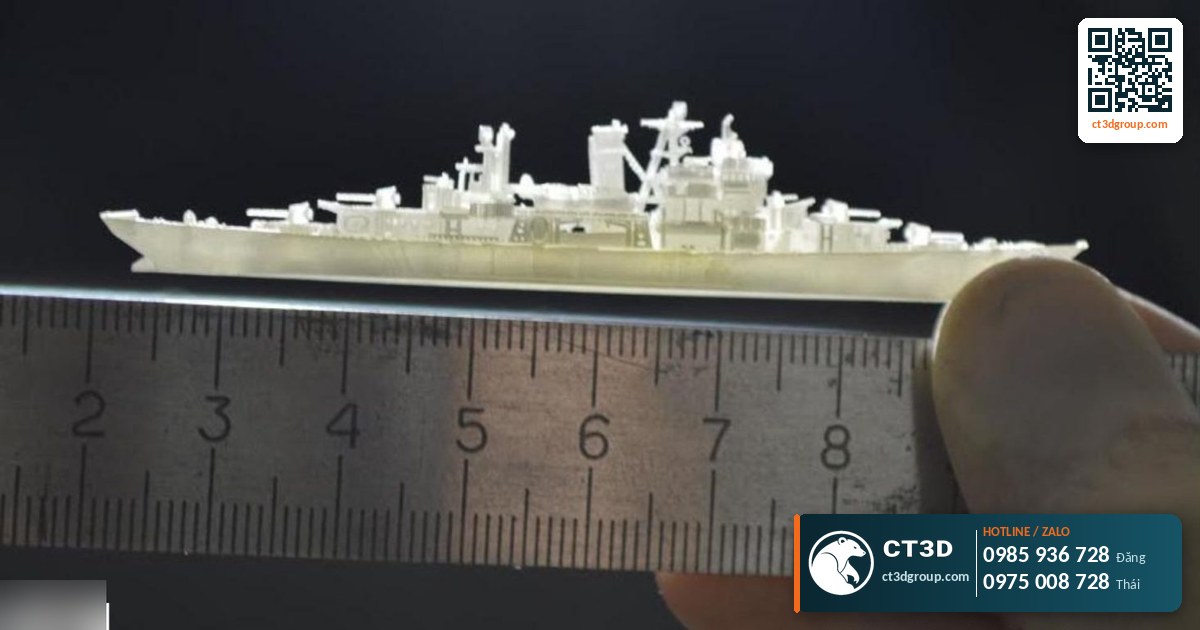
Quick answer: The most economical way to 3D print a student project model is FDM in PLA or PETG, with CT3D’s 2026 indicative price starting at 650 VND/g (≈ US$0.025/g), charged by actual weight; orders under 50 g are subject to a minimum charge. For example, a 200 g PLA model costs from 200 × 650 = 130,000 VND (≈ US$5) for printing alone, excluding painting and 3D modeling. Parts that need fine detail should be printed in resin at 25–100 micron layers. At typical market lead times, a print-ready file takes 1–3 days and a painted model 7–14 days, so send your file at least 1–2 weeks before your submission deadline.
Every thesis season, CT3D receives lots of messages like: “I need my model printed for Monday, the file isn’t finished, and my budget is tight.” Student projects face three constraints at once: little money, tight deadlines, and files that often aren’t print-ready. This article helps students and their supervisors plan properly, estimate costs in advance and avoid mistakes that cause missed deadlines. For an overview of our services, see our pillar article on custom 3D model printing.
Which Student Projects Usually Need a 3D Printed Model?
Almost every engineering and design discipline needs a physical model at some point:
- Architecture and urban planning: building models, site models.
- Mechanical engineering, mechatronics, robotics: machine housings, gears, couplings, jigs, robot frames.
- Industrial design and applied arts: appearance models, household products, packaging.
- Electrical/electronics and IoT: PCB enclosures, sensor housings.
- Biomedical and dentistry: anatomical models, dental models.
- Sculpture and animation: characters, small statues.
Each group has different needs: display models must look good, while functional models must bear loads and fit together correctly. Choosing the wrong technology is the biggest source of wasted money.
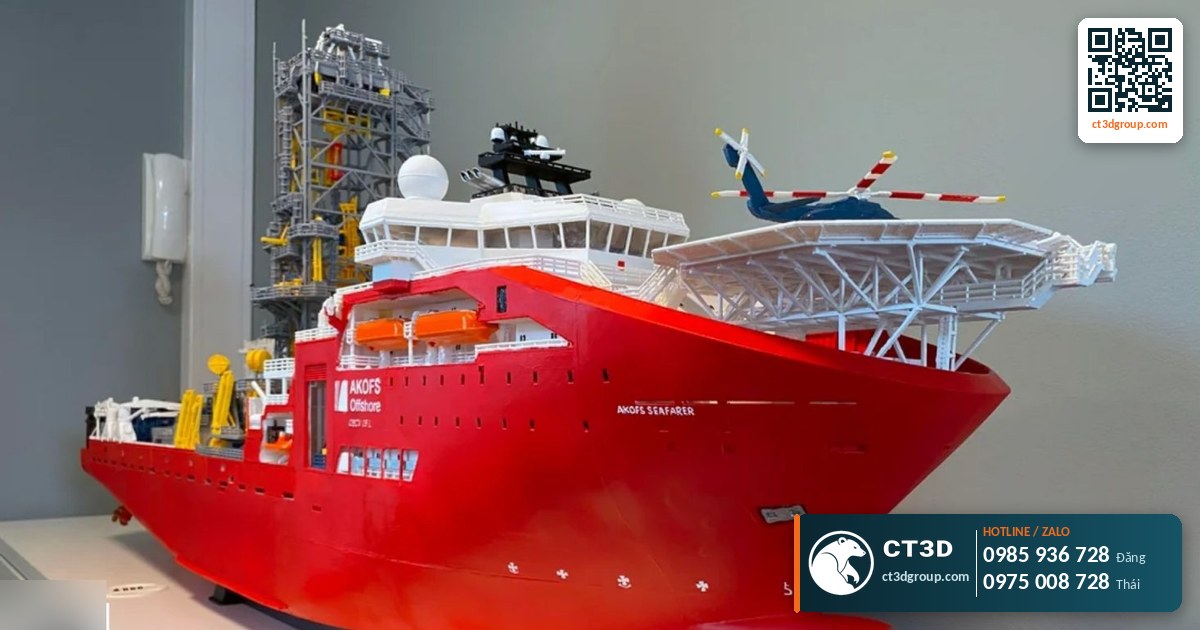
Choosing a Printing Technology by Project Type
| Project type | Suggested technology | Material | Why |
|---|---|---|---|
| Architectural massing model | FDM | PLA | Cheap, easy to print, paintable |
| Mechanical assembly parts | FDM | PETG, ABS | Tougher than PLA, better heat resistance |
| Load-bearing parts, jigs | FDM | Carbon-fiber filament | Stiff, light |
| Product housings that must look good | SLA/DLP resin | Standard resin, ABS-like resin | Smooth surface, little sanding needed |
| Characters, small details | SLA/DLP resin | Standard resin | Details down to 0.05 mm |
| Small gears, precision joints | Resin or MJF PA12 | Tough resin, PA12 | Tight tolerances (MJF ±0.05 mm) |
Source: CT3D technical documentation, 2026.
Accuracy specifications: FDM 100–300 micron layers, tolerance ±0.1–0.3 mm; SLA 25–100 micron layers, ±0.05–0.1 mm; DLP ±0.03–0.08 mm. Architectural models have their own dedicated article: 3D printed architectural models.
Calculating Student Project Printing Costs by the Gram
CT3D’s indicative FDM price list
| Material | CT3D indicative price, 2026 | Best for |
|---|---|---|
| PLA | from 650 VND/g (≈ US$0.025/g) | Display and architectural models |
| PETG | from 650 VND/g (≈ US$0.025/g) | Machine housings, parts that need toughness |
| ABS | from 1,000 VND/g (≈ US$0.04/g) | Parts near heat, parts needing chemical smoothing |
| ASA | from 2,000 VND/g (≈ US$0.08/g) | Outdoor use |
| Carbon-fiber filament | from 2,750 VND/g (≈ US$0.11/g) | Robot frames, rigid jigs |
Source: CT3D indicative FDM price list 2026, charged by actual weight. Prices are indicative. Under 50 g: minimum order charge; 50–500 g: per gram by material; over 500 g: project quote. Post-processing, rush service and 3D modeling are charged separately.
Quick examples
- 200 g PLA house model: 200 × 650 = from 130,000 VND (≈ US$5) for printing.
- 120 g PETG PCB enclosure: 120 × 650 = from 78,000 VND (≈ US$3).
- 150 g carbon-fiber robot frame: 150 × 2,750 = from 412,500 VND (≈ US$16).
- A set of small parts totaling 30 g: under 50 g, so the minimum charge applies.
Per-gram pricing is explained in more detail in PLA 3D printing cost per gram. For a market-wide price comparison, see our 3D printing price guide.
When do costs go up?
- The file isn’t printable: it has to be fixed or remodeled. Market rates for 3D modeling start at about 200,000 VND (≈ US$8) for a simple model.
- Paint finishing: market rates are 200,000–500,000 VND (≈ US$8–19) per model for a single color, and 600,000 – 2 million VND (≈ US$23–77) per model for airbrushing.
- Rush orders: at market rates, 3–4 day rush adds about 30%, and 1–2 day rush adds about 50%.
- Printing a large model entirely in resin: SLA is usually 1.5–2.5 times more expensive than FDM.
7 Ways to Cut Project Printing Costs Without Sacrificing Looks
- Reduce infill (internal density) for display models. A model that carries no load doesn’t need to be solid. See what infill is.
- Hollow out large solid volumes in the file, leaving walls just thick enough.
- Print only the detailed parts in resin, and the rest in FDM.
- Scale down sensibly: reducing size by 20% cuts weight by almost half (0.8³ ≈ 0.51).
- Use pre-colored filament instead of painting if your review panel doesn’t require a high-end finish.
- Combine orders across your group: printing together easily exceeds the minimum and avoids small-order fees.
- Send your file early to avoid rush surcharges.
Preparing Your Project File So It Doesn’t Get Sent Back
Common student file errors
| Error | Consequence | Fix |
|---|---|---|
| Exported in the wrong units (m instead of mm) | The model comes out tiny or gigantic | Check overall dimensions before sending |
| Surfaces with no thickness | Cannot be sliced | Give walls, glazing and roofs a thickness |
| Features too thin | Break or fail to print | FDM from about 1.2 mm, resin from about 0.8 mm |
| Zero clearance on mating parts | The two parts won’t fit together | Leave a gap larger than the process tolerance (FDM ±0.1–0.3 mm) |
| Sending the native CAD file without an STL | Time lost on conversion | Export STL/3MF, plus STEP for mechanical parts |
Source: CT3D file-intake experience; tolerances per CT3D technical documentation.
Mechanical projects with mating parts should also read accuracy and tolerances in 3D printing to design the right clearances. For file formats, see what is an STL file.
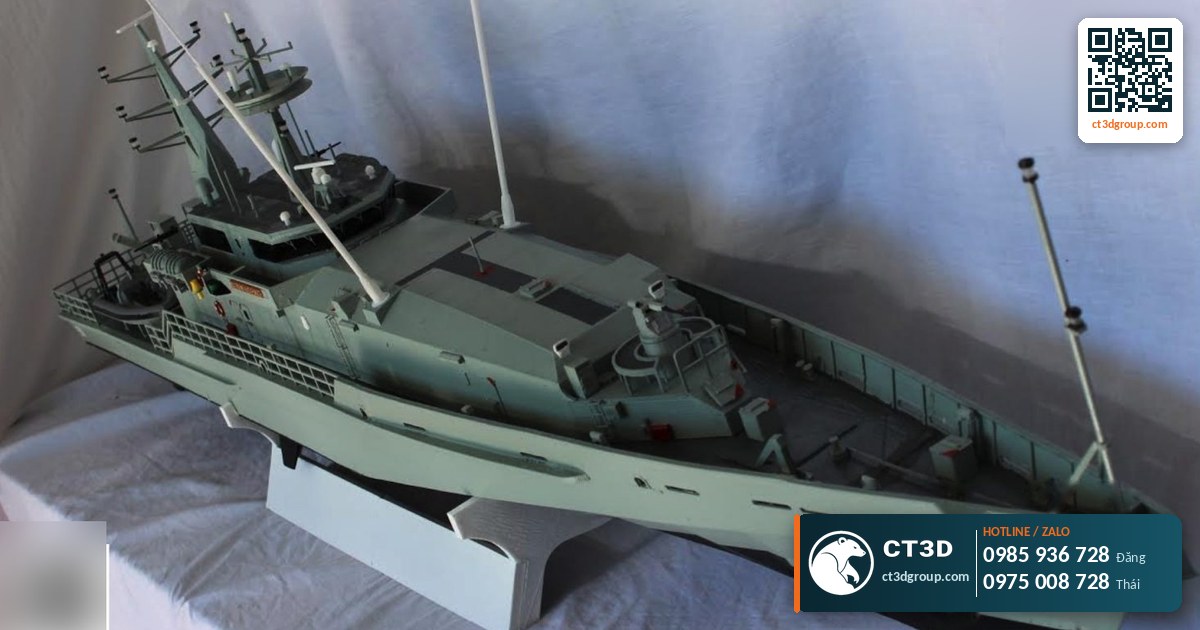
Planning Backward from Your Presentation Date
The most common mistake isn’t technical; it’s timing. Typical market lead times: 1–3 days for a print-ready file; 3–7 days if the file has to be modeled; 7–14 days with painting. Add 1–3 days of shipping if you are outside the city. Suggested schedule:
| Milestone | What to do |
|---|---|
| 3 weeks before the deadline | Finalize the design, send a draft file for CT3D to check printability |
| 2 weeks before | Revise the file based on feedback, confirm materials, receive a quote |
| 10–14 days before | Confirm production (if painting is required) |
| 3–5 days before | Receive the model, assemble it, photograph it for your report |
| 1–2 days before | Buffer for fixes and reprinting broken parts |
Source: lead times based on 2026 market rates in Ho Chi Minh City; schedule suggested by CT3D.
How to Order Student Project Printing from CT3D
- Send your file (STL/STEP/OBJ/3MF) via our website, Zalo or email; if you don’t have a file yet, send drawings or sketches.
- State your requirements: display or functional, size, color, required date.
- Engineers review the file, suggest fixes and calculate the weight.
- Quote with lead time.
- Confirmation and production.
- Delivery: pick up at our Linh Trung or Tam Binh (Thu Duc) or former District 6 workshops in Ho Chi Minh City, or nationwide delivery in 1–3 days via Viettel Post, Giao Hang Tiet Kiem or Vietnam Post.
Checklist before sending
- STL/3MF file in millimeters.
- Clearly mark which parts must fit together and which are display-only.
- Your expected budget, so the engineers can propose a suitable option.
- Your actual presentation date, not the date you’d “like” to receive the model.
- A Zalo phone number (or email) for quick discussion if the file has issues.
Typical Scenarios
Robotics project: frame printed in carbon-fiber filament for stiffness, wheels and covers in PETG, small gears in Tough resin. Our engineers will remind you to leave clearance for bearings and shafts.
Product design project: housing printed in resin for a smooth surface and painted to match the render; internal parts that don’t need to look good can be printed in FDM.
Architecture project: building masses in white PLA by FDM, acrylic glazing, a self-made site base; railing details simplified to suit the scale.
The CT3D website shows partner logos such as Ho Chi Minh City University of Technology (HCMUT) and Ho Chi Minh City University of Technology and Education (HCMUTE), so our team is used to academic requirements and presentation deadlines. In Hanoi, see custom 3D printing in Hanoi. For engineering plastic printing, see our industrial 3D printing service. For other model types, return to our article on custom 3D model printing.
Display Model or Working Model: Which Level of Finish?
Before ordering, answer one question clearly: is this model meant to be looked at or to work? The two goals lead to two different printing approaches, and different costs.
Display model
The goal is to look good when the review panel examines it up close and in the photos in your report. Prioritize a smooth surface, accurate color and no visible layer lines on the main faces. You can use low infill, hollow it out, print in PLA and then sand and paint. Closely viewed areas (front faces, logos, small details) can be printed in resin. It carries no load, so expensive engineering materials aren’t needed.
Functional model
The goal is for it to assemble, rotate and withstand loads during the demo. Prioritize tough materials (PETG, ABS, carbon-fiber filament), thicker walls, and higher infill around screw bosses and load-bearing areas. Fit clearances must account for the process tolerance. The surface can stay raw, with no painting.
Combining both
Many projects need both: a load-bearing frame printed in an engineering FDM material, and a smooth, painted outer shell. Splitting it this way puts your money where it matters. When you send your request, just mark which parts are “for looks” and which are “for function,” and CT3D engineers will propose the right material and print settings for each.
Frequently Asked Questions About Student Project Model Printing
How much does it cost to print a student project model?
FDM at CT3D is charged by the gram: PLA and PETG from 650 VND/g (≈ US$0.025/g), ABS from 1,000 VND/g (≈ US$0.04/g). Orders under 50 g are subject to a minimum charge. Painting, 3D modeling and rush service are charged separately.
How far in advance should I send my file?
Send it 2–3 weeks before your deadline. At typical market lead times, a print-ready file takes 1–3 days, a file that needs modeling 3–7 days, and a painted model 7–14 days.
What if I don’t have a 3D file yet?
Send 2D drawings or sketches; CT3D can create the 3D file. Market rates for modeling start at about 200,000 VND (≈ US$8) for a simple model.
Can moving, mating parts be printed for a project?
Yes, as long as the file leaves clearances larger than the process tolerance. FDM tolerance is ±0.1–0.3 mm; resin ±0.05–0.1 mm.
Can you rush a print in 1–2 days?
Possibly, if the file is ready and a machine is free; at market rates a 1–2 day rush adds about 50%.
Real Footage from the CT3D Workshop
Watch Affordable large-format 3D printing, filmed by CT3D, to get a clearer picture of the process and the finished quality. More videos are on our YouTube channel Chế Tạo Vlog – CT3D.
Contact CT3D – Send Your File, Get a Fast Quote
Whether you have a 3D file, a 2D drawing, photos or just an idea, you can send it to CT3D. Our engineers will check the file, recommend the right technology and material, and send you a quote with a lead time.
- Email: [email protected] – [email protected]
- Hotline / Zalo: +84 975 008 728 (Mr. Thai) – +84 985 936 728 (Mr. Dang), or use our contact form
- Head office: Binh Duong.
- Workshops in Ho Chi Minh City: Linh Trung (Thu Duc), Tam Binh (Thu Duc), District 6 (former).
- Other workshops and drop-off points: Can Tho, Da Nang, Bien Hoa, Ba Ria – Vung Tau, Hanoi, Hai Duong, Hai Phong. Nationwide delivery across Vietnam.
- Website: ct3dgroup.com – in3d.edu.vn
CT3D – 3D design & prototyping: 3D printing, 3D scanning, reverse engineering, silicone mold making, painting and finishing, CNC machining, composite fabrication, plus 3D printers and 3D printing materials.
Danh sách cửa hàng:
CT3D là đơn vị cung cấp trọn gói các dịch vụ thiết kế và sản xuất theo yêu cầu tại TP.HCM và khu vực lân cận (Bình Dương, Đồng Nai, Long An…). Với năng lực khép kín từ thiết kế 3D, in 3D (FDM, resin/SLA, SLS, in 3D kim loại), scan 3D – thiết kế ngược, làm khuôn, đúc composite – poly resin – poly stone đến gia công CNC và sơn màu hoàn thiện, CT3D đồng hành cùng khách hàng qua toàn bộ quy trình – từ ý tưởng, bản vẽ hay sản phẩm mẫu đến thành phẩm hoàn chỉnh. Dù bạn cần tạo mẫu nhanh, sản xuất số lượng, chế tác tượng – mô hình – quà tặng hay linh kiện kỹ thuật, đội ngũ CT3D sẽ tư vấn công nghệ và vật liệu phù hợp, đảm bảo sản phẩm sắc nét, đúng yêu cầu và tối ưu chi phí. Khách hàng tại TP.HCM và vùng lân cận có thể trao đổi trực tiếp, gửi file online và nhận sản phẩm thuận tiện, hỗ trợ cả đơn gấp lẫn dự án số lượng.
CT3D cung cấp trọn gói các dịch vụ thiết kế và sản xuất theo yêu cầu, phục vụ khách hàng tại Hà Nội và các tỉnh lân cận (Bắc Ninh, Hưng Yên, Hải Phòng, Vĩnh Phúc…). Với năng lực khép kín từ thiết kế 3D, in 3D (FDM, resin/SLA, SLS, in 3D kim loại), scan 3D – thiết kế ngược, làm khuôn, đúc composite – poly resin – poly stone đến gia công CNC và sơn màu hoàn thiện, CT3D đồng hành cùng khách hàng qua toàn bộ quy trình – từ ý tưởng, bản vẽ hay sản phẩm mẫu đến thành phẩm hoàn chỉnh. Quy trình làm việc thuận tiện: bạn gửi file 3D hoặc mô tả ý tưởng qua online, đội ngũ CT3D tư vấn công nghệ – vật liệu, báo giá nhanh và giao hàng tận nơi tại Hà Nội. Dù bạn cần tạo mẫu nhanh, sản xuất số lượng, chế tác tượng – mô hình – quà tặng hay linh kiện kỹ thuật, CT3D đều đáp ứng với sản phẩm sắc nét, đúng yêu cầu và tối ưu chi phí.

