
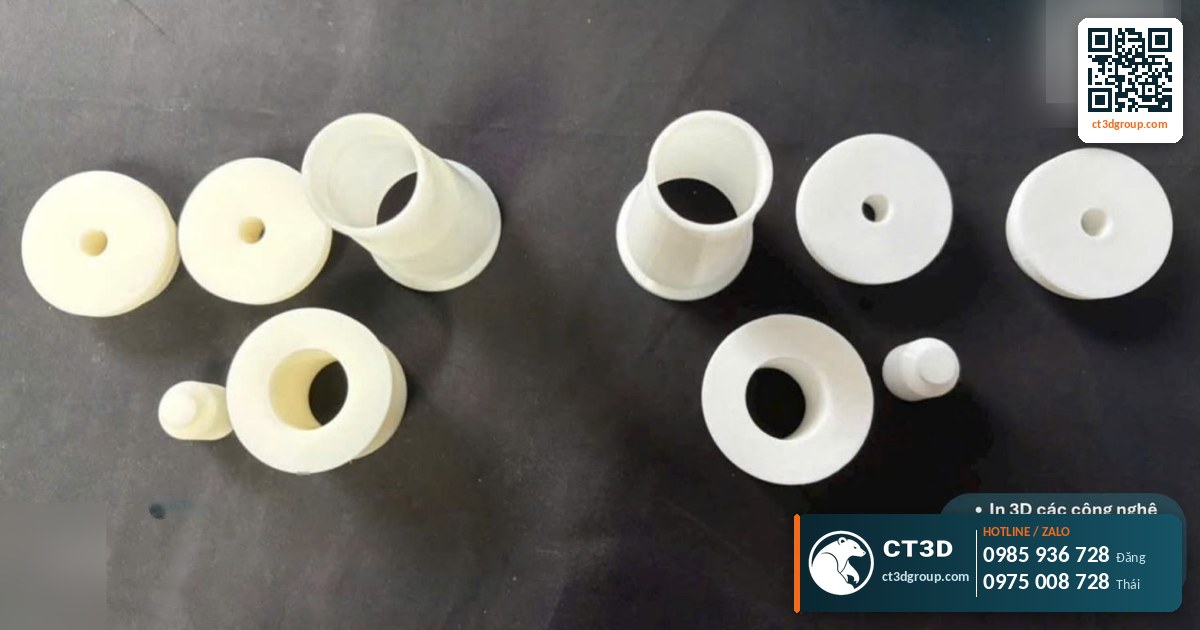
Quick answer: Tough resin and ABS-like resin are formulated to be tougher than standard resin: they withstand impact and flex slightly before springing back instead of snapping. That makes tough resin 3D printing well suited to assemblies, snap-fits, device housings and functional prototypes. Parts are printed on SLA at 25–100 micron layers with ±0.05–0.1 mm accuracy. At Ho Chi Minh City market rates in 2026, Tough resin typically costs 30–50% more than standard resin (not CT3D prices).
A situation CT3D sees all the time: you print an enclosure in standard resin, it looks crisp and beautiful, but the snap-fit breaks the very first time you press it. Or the hole cracks open as soon as you drive in a screw. The cause is not a bad printer – it is the wrong material choice and a design not suited to resin. This article covers mechanical properties, how to design assemblies, and how to choose between Tough, ABS-like and other materials. For a technology and pricing overview, see our pillar article on resin 3D printing.
How Is Tough Resin Different from Standard Resin?
3D printing resin is a thermoset: when exposed to UV light, its molecules cross-link into a three-dimensional network. Standard resin has a very dense, rigid network. The result is a hard, crisp surface that holds detail well, but it is brittle: elongation at break is low, meaning it stretches very little before it snaps.
Tough and ABS-like resins add elastomeric components and adjust the network to make it slightly “softer”. Under load, the material deforms and absorbs energy before breaking. Think of it this way: standard resin behaves like acrylic glass, while Tough behaves like the ABS used for appliance housings – stiff enough, but it does not shatter when dropped.
Three values you should read in the resin manufacturer’s Technical Data Sheet (TDS):
- Tensile strength (MPa): the maximum pulling force per unit area before breaking. Higher is not necessarily better for assemblies.
- Elongation at break (%): how far the material can stretch as a percentage of its length. This is the most important value for snap-fits.
- Impact strength (Izod, J/m): the energy absorbed when struck. Higher means less likely to break when dropped.
Increasing toughness usually sacrifices some stiffness and detail sharpness. No resin is “the stiffest, the toughest and the sharpest” all at once. Choosing a material means choosing a balance point.

Tough and ABS-Like Resin vs. Other Options
CT3D stocks many resin types: tough, clear, high-temperature, engineering, flexible and castable, plus ABS-like and PA12-like. The table below gives a qualitative comparison to help you choose quickly.
| Material | Stiffness | Toughness, impact resistance | Surface detail | Best for |
|---|---|---|---|---|
| Standard resin | High | Low, brittle | Very high | Appearance models, figures, display models |
| Tough resin | Medium – high | High | High | Snap-fits, housings, parts under vibration |
| ABS-like resin | Medium – high | Fairly high | High | Prototypes replacing injection-molded ABS parts |
| PA12-like resin | Medium | Good, slightly flexible | High | Simulating nylon parts, thin hinges |
| Flexible resin | Low | Highly bendable, elastic | Good | Gaskets, pads, soft buttons |
| FDM ABS/ASA | Medium | Good, depends on build orientation | Lower (100–300 micron layers) | Jigs, large parts, low cost |
| MJF PA12 | Medium | High, uniform in all directions | Medium, slightly grainy | End-use parts, low-volume production |
Source: CT3D material documentation; qualitative comparison – see each resin manufacturer’s TDS for specific values.
One little-known advantage of resin over FDM: resin parts are nearly uniform in all directions (isotropic). FDM parts are noticeably weaker along the layer-stacking direction because the extruded strands only adhere to each other. In resin, the layers bond chemically, so delamination is rare. That is why Tough resin snap-fits depend far less on build orientation than FDM ones. A detailed comparison of resin technologies is available in SLA vs. DLP vs. LCD.
Tough Resin Printing Parameters at CT3D
| Parameter | Value | Notes |
|---|---|---|
| SLA layer height | 25–100 microns | Assembly parts are usually printed at 50 microns |
| SLA accuracy | ±0.05–0.1 mm | Depends on size and orientation |
| DLP accuracy | ±0.03–0.08 mm | Suited to small parts with many pin holes |
| Part tilt angle | 20–45° | Reduces warping of large flat surfaces |
| Resin temperature | 25–28 °C | Tough resin is usually more viscous and must be kept warm |
| Tough surcharge (market) | +30–50% | Compared with standard resin, not CT3D prices |
Source: CT3D technical documentation; surcharge based on Ho Chi Minh City market rates in 2026.
How to Design Assemblies for Tough Resin Printing
Fit clearance
Clearance is the gap between two mating parts. With SLA accuracy of ±0.05–0.1 mm, if you design to “nominal size” (a 10 mm hole and a 10 mm pin), they will almost certainly not fit. The starting points CT3D usually recommends:
- Sliding or free-rotating fit: about 0.1–0.2 mm clearance per side.
- Snug fit, removable by hand: about 0.05–0.1 mm clearance.
- Press fit: zero to slightly negative clearance – use only with Tough resin; standard resin cracks easily.
These are reference values. For critical parts, CT3D prints a small “tolerance test coupon” with several pins and holes stepped by 0.05 mm to select the real-world clearance before printing the main part. The cost of the test coupon is tiny compared with the risk of reprinting an entire set.
Snap-fits: calculate the strain before printing
The cantilever snap-fit (one end fixed, the other with a hook) is the most common type. The maximum strain at the root of the snap can be estimated with the familiar engineering formula:
ε = 1.5 × t × y / L²
Where t is the snap thickness, y is the required deflection (hook height), and L is the snap length. Example: t = 1.5 mm, y = 1 mm, L = 15 mm. Then ε = 1.5 × 1.5 × 1 / 225 = 0.01, or 1%. If L is only 10 mm, ε = 1.5 × 1.5 × 1 / 100 = 2.25%. Shortening the snap by just one third more than doubles the strain.
Compare this strain with the elongation at break in the TDS, and always keep a safety factor (typically using only part of the allowable limit, since the snap must be pressed many times). Standard resin has low elongation and can break at just 2%; Tough resin handles it much better. Design tips: make snaps longer, taper them toward the hook, and fillet the root (radius at least half the thickness) to avoid stress concentration.
Screw holes and threads
- Directly printed threads: feasible for large threads, but small threads wear and chip at the crests easily. Not recommended for parts that are assembled and disassembled often.
- Tapping after printing: print a pilot hole and then tap the thread. Tough resin taps more cleanly than standard resin.
- Metal inserts: resin is a thermoset and does not soften when heated like ABS, so heat-set inserts perform poorly. Instead, use epoxy-bonded inserts or cold press-fit inserts into holes with a suitable clearance.
- Self-tapping screws: increase the wall thickness around the hole (boss) and avoid overtightening.
Hinges, thin walls and stiffening ribs
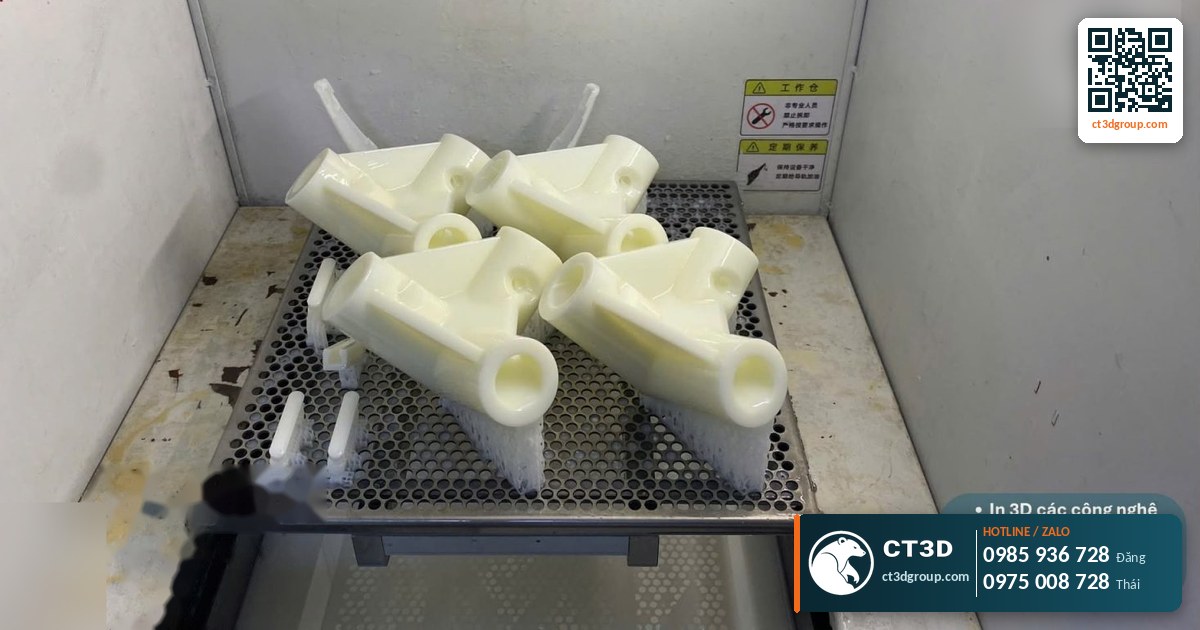
Living hinges should only be made in PA12-like or flexible resin, and even then have limited life. For enclosures, rather than thick walls, use moderately thin walls combined with stiffening ribs. Thick solid walls tend to warp during UV curing and waste resin. For minimum wall thickness and drain holes, see designing files for resin printing.
Common Problems with Tough Resin Parts and How to Fix Them
| Symptom | Cause | Solution |
|---|---|---|
| Snap breaks at the root | Snap too short, sharp corner, wrong material | Lengthen the snap, fillet the root, use Tough |
| Parts do not fit | Zero clearance, tolerance not accounted for | Add 0.1–0.2 mm clearance, print a tolerance test coupon |
| Holes distorted or undersized | Excess resin trapped in the hole, over-cure | Wash holes thoroughly, orient holes correctly, calibrate offset |
| Flat surfaces warp | Placed flat on the build plate, uneven UV curing | Tilt 20–45°, cure on a rotating turntable |
| Cracks around screws | Thin boss walls, overtightening | Enlarge the boss, use epoxy-bonded inserts |
| Becomes brittle over time | Sun/UV exposure, over-curing | Cure to spec, apply a UV-resistant coating |
Source: CT3D production experience.
Important note: resin parts are subject to creep – slow deformation under sustained load over long periods, especially when warm. Snap-fits that stay under constant clamping force may “relax” over time. If the part carries long-term loads or sits near a heat source, consider heat-resistant resin, MJF PA12 or CNC machining.
When to Choose Tough Resin and When to Choose Another Technology
Tough resin is a good choice when you need high detail and moderate strength at the same time: handheld device housings, prototype assemblies, parts with small snaps, small threads or embossed text. If the part is large, has few fine details and needs to be low-cost, FDM ABS/ASA is more economical. For long-term end use, fatigue loading and quantities of tens to hundreds, MJF PA12 is a better fit. For high loads and high temperatures, choose CNC machining or metal printing. A comparison of CNC and 3D printing is available in what is CNC machining.
Case example: a handheld device housing with 4 snap-fits
A two-piece device housing of about 120 × 70 × 30 mm, with 4 snap-fits and 2 screw holes, needs to be assembled and disassembled dozens of times during testing. CT3D’s recommendation: Tough resin at 50 micron layers; snaps 12–15 mm long, 1.2–1.5 mm thick, with filleted roots; 0.15 mm clearance on the mating rim; epoxy-bonded inserts for the screw holes. Print a tolerance test coupon before the main set. Cost-wise, at market rates a standard-resin part of 10–15 cm runs about 800,000–2,500,000 VND (≈ US$31–96); Tough adds 30–50%. These are not CT3D prices – CT3D quotes per file, and all figures are indicative.
When should you use ABS-like instead of Tough?
ABS-like resin is formulated so that its feel, stiffness and surface are close to injection-molded ABS. If the goal is a design-review model before tooling an injection mold – something that “feels like the real thing” and can be painted and test-assembled – ABS-like is the natural choice. Tough is better when impact resistance and repeated snap assembly are the priority.
Checklist for Sending a Tough Resin Printing Request to CT3D
- A STEP file (preferred, so our engineers can measure and adjust fit dimensions) or STL, OBJ, 3MF.
- A description of function: what the part mates with and the type of load (snapping, clamping, impact, vibration).
- Critical fit dimensions and desired tolerances.
- Environment: operating temperature, exposure to oil, chemicals or sunlight.
- Quantity, expected number of assembly cycles and deadline.
CT3D process: receive the file → engineering review, weight calculation, tolerance check → quote with lead time → printing and post-processing → door-to-door delivery or pickup at the workshop. You can also see our high-resolution resin printing capabilities at in3d.edu.vn (in Vietnamese). To compare all resin types and price levels, read our pillar article on resin 3D printing.
Frequently Asked Questions
Is Tough resin as strong as injection-molded ABS?
Tough resin is much tougher than standard resin and adequate for functional prototypes, but it usually cannot fully replace injection-molded ABS for parts under long-term load, heat or sun exposure.
How much fit clearance should I use for resin printing?
Starting point: 0.1–0.2 mm per side for a sliding fit, 0.05–0.1 mm for a snug fit. SLA accuracy is about ±0.05–0.1 mm, so print a tolerance test coupon for critical parts.
Can threads be printed directly in resin?
Yes, for large threads. For small threads or frequent assembly, tap after printing or use epoxy-bonded metal inserts.
How much more does Tough resin cost than standard resin?
At Ho Chi Minh City market rates in 2026, Tough resin typically costs 30–50% more than standard resin. These are not CT3D prices; CT3D quotes per file.
Can Tough resin print small details?
Yes. Tough resin is still printed on SLA/DLP at 25–100 micron layers and holds small snaps, embossed text and pin holes, just slightly less crisp than standard resin.
Real Footage from the CT3D Workshop
Watch the SLA resin 3D printing video produced by CT3D to get a clearer picture of our process and product quality. More videos are available on our Chế Tạo Vlog – CT3D channel.
Contact CT3D – Send Your File for a Fast Quote
Whether you have a 3D file, a 2D drawing, photos or just an idea, you can send it to CT3D. Our engineers will check the file, recommend the right technology and material, and send you a quote with a lead time.
- Email: [email protected] – [email protected]
- Hotline / Zalo: +84 975 008 728 (Mr. Thai) – +84 985 936 728 (Mr. Dang), or use our contact form
- Head office: Binh Duong.
- Workshops in Ho Chi Minh City: Linh Trung (Thu Duc), Tam Binh (Thu Duc), former District 6.
- Other workshops and drop-off points: Can Tho, Da Nang, Bien Hoa, Ba Ria – Vung Tau, Hanoi, Hai Duong, Hai Phong. Nationwide delivery.
- Website: ct3dgroup.com – in3d.edu.vn
CT3D – 3D design & prototyping: 3D printing, 3D scanning, reverse engineering, silicone mold making, painting and finishing, CNC machining, composite fabrication, plus 3D printers and 3D printing resins.
Danh sách cửa hàng:
CT3D là đơn vị cung cấp trọn gói các dịch vụ thiết kế và sản xuất theo yêu cầu tại TP.HCM và khu vực lân cận (Bình Dương, Đồng Nai, Long An…). Với năng lực khép kín từ thiết kế 3D, in 3D (FDM, resin/SLA, SLS, in 3D kim loại), scan 3D – thiết kế ngược, làm khuôn, đúc composite – poly resin – poly stone đến gia công CNC và sơn màu hoàn thiện, CT3D đồng hành cùng khách hàng qua toàn bộ quy trình – từ ý tưởng, bản vẽ hay sản phẩm mẫu đến thành phẩm hoàn chỉnh. Dù bạn cần tạo mẫu nhanh, sản xuất số lượng, chế tác tượng – mô hình – quà tặng hay linh kiện kỹ thuật, đội ngũ CT3D sẽ tư vấn công nghệ và vật liệu phù hợp, đảm bảo sản phẩm sắc nét, đúng yêu cầu và tối ưu chi phí. Khách hàng tại TP.HCM và vùng lân cận có thể trao đổi trực tiếp, gửi file online và nhận sản phẩm thuận tiện, hỗ trợ cả đơn gấp lẫn dự án số lượng.
CT3D cung cấp trọn gói các dịch vụ thiết kế và sản xuất theo yêu cầu, phục vụ khách hàng tại Hà Nội và các tỉnh lân cận (Bắc Ninh, Hưng Yên, Hải Phòng, Vĩnh Phúc…). Với năng lực khép kín từ thiết kế 3D, in 3D (FDM, resin/SLA, SLS, in 3D kim loại), scan 3D – thiết kế ngược, làm khuôn, đúc composite – poly resin – poly stone đến gia công CNC và sơn màu hoàn thiện, CT3D đồng hành cùng khách hàng qua toàn bộ quy trình – từ ý tưởng, bản vẽ hay sản phẩm mẫu đến thành phẩm hoàn chỉnh. Quy trình làm việc thuận tiện: bạn gửi file 3D hoặc mô tả ý tưởng qua online, đội ngũ CT3D tư vấn công nghệ – vật liệu, báo giá nhanh và giao hàng tận nơi tại Hà Nội. Dù bạn cần tạo mẫu nhanh, sản xuất số lượng, chế tác tượng – mô hình – quà tặng hay linh kiện kỹ thuật, CT3D đều đáp ứng với sản phẩm sắc nét, đúng yêu cầu và tối ưu chi phí.

