
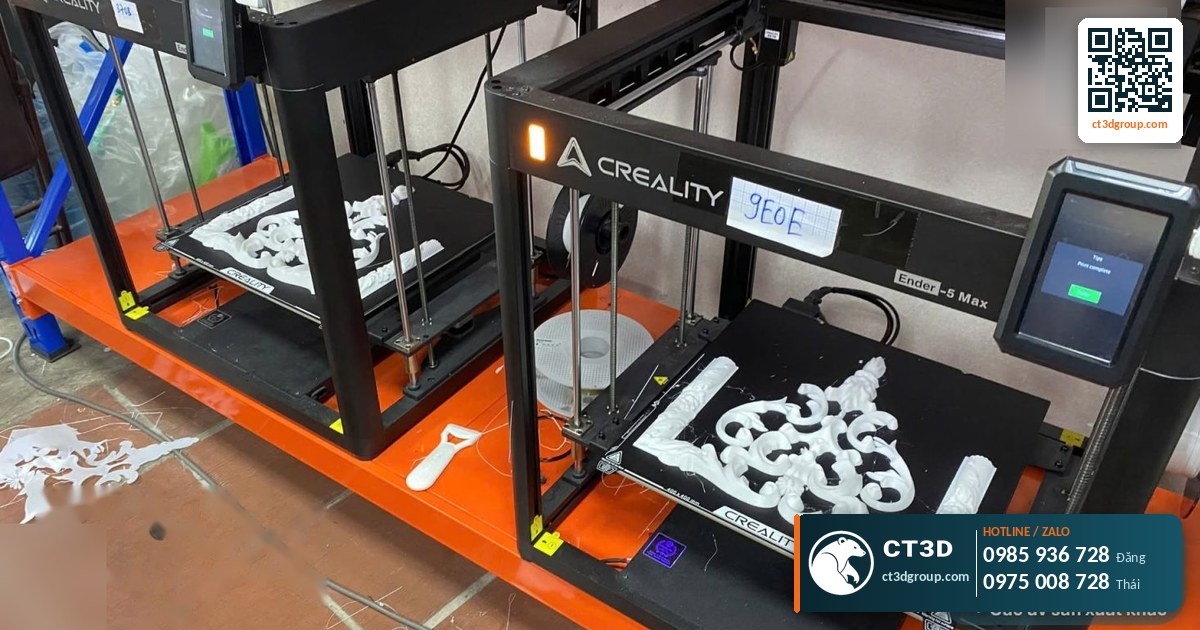
Quick answer: 3D printing is a way of making physical objects by building up material one thin layer at a time from a 3D file on a computer. Each layer is typically just 0.025–0.3 mm thick, depending on the technology. The material can be plastic filament (FDM), liquid resin (SLA/DLP/LCD), nylon powder (SLS/MJF) or metal powder (SLM). As a beginner, you only need to remember three steps: get a 3D file, slice it in software, and let the printer build it layer by layer until it is done. At CT3D, FDM printing in PLA starts from 650 VND/g (≈ US$0.025/g).
I am an engineer at CT3D. Every week I get a lot of questions along the lines of “What exactly is 3D printing, and can you print this?” This article is written for newcomers: plain language, everyday examples, and not too deep into specifications. When you need a detailed comparison of each technology, continue with our article 3D printing technologies compared: FDM, SLA, MJF, SLM. For costs, see How much does 3D printing cost? 2026 price guide.
What Is 3D Printing? A Simple Definition for Beginners
3D printing (also called additive manufacturing) is the process of creating a real object from a digital model. The machine does not cut material away from a large block. Instead, it adds material only where it is needed, one layer on top of another.
Imagine stacking sheets of rice paper. Each sheet is one layer. If every sheet is cut to a slightly different outline, the stack becomes a solid of almost any shape: a sphere, a cup, a statue. A 3D printer does exactly that, except each layer is about as thin as a human hair, or thinner.
Traditional machining such as turning, milling and CNC is the opposite, a “subtractive” method: you start with a large block and cut away the excess. That is why 3D printing can produce hollow interiors, intricate channels and one-piece parts that a cutting tool simply cannot reach.
A Few Terms You Should Know Right Away
- 3D file: the digital model of the object. Common formats are STL, STEP, OBJ and 3MF.
- Slicing: software divides the model into hundreds or thousands of thin layers and generates the instructions for the machine.
- Layer height: the thickness of each layer. Thinner layers give a smoother surface but take longer to print.
- Supports: temporary structures that hold up overhanging areas during printing and are removed afterward.
- Infill: the internal lattice inside an FDM part. Infill determines stiffness and how much plastic is used.
- Post-processing: the steps after printing, such as removing supports, sanding, painting and clear coating.
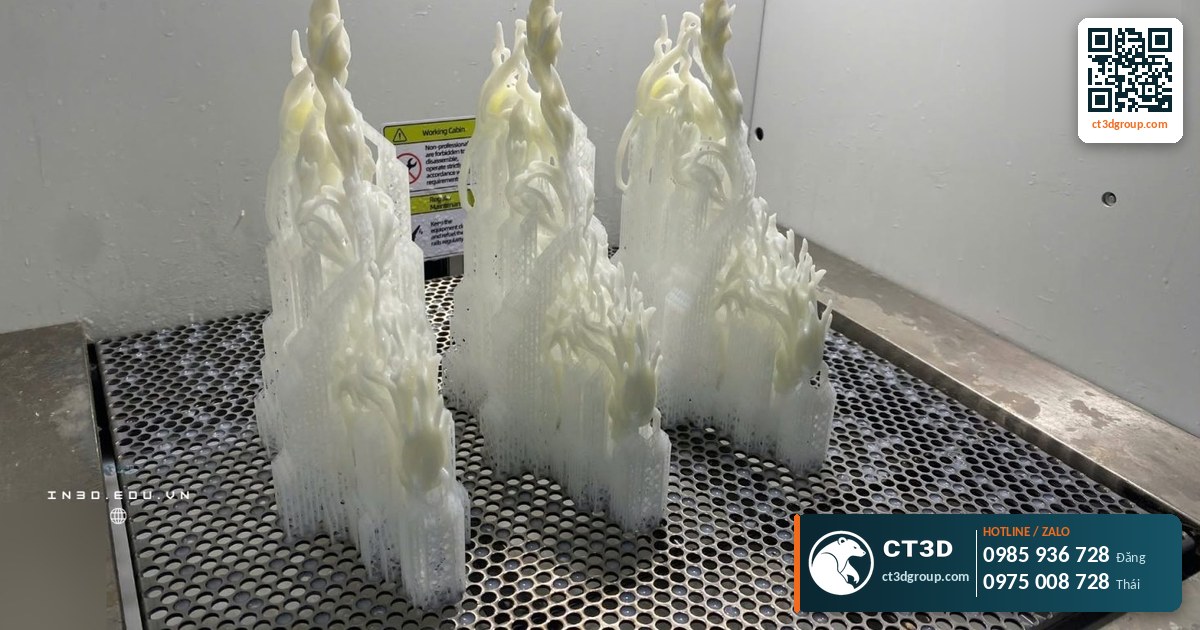
How Does 3D Printing Work? Three Basic Steps
Whether it is a budget desktop machine or an industrial system, every 3D printing workflow goes through the same three steps.
Step 1: Get a 3D File
You can model the part yourself in CAD software, download a ready-made model, or have an engineer build the file from photos or 2D drawings. If you already have a physical object, 3D scanning can digitize it. This is the most important step. If the file is wrong, even the best machine will print it wrong.
Step 2: Slice and Prepare the Print
The slicing software reads the file, sets the part orientation, adds supports and chooses the layer height and infill. The result is a command file for the machine. At this stage the engineer can also estimate material usage and print time, and from that, the price.
Step 3: The Printer Builds Layer by Layer
The machine starts from the bottom layer. Once a layer is finished, the build platform moves down (or up, on resin printers) by exactly one layer height, and the next layer is printed. This repeats until the top layer. A small part can be done in a few hours; a large one may run for several days.
Then comes post-processing: removing supports, washing, UV curing (for resin), sanding and painting. Many customers are surprised that finishing sometimes takes more labor than the printing itself.
What Types of 3D Printing Technology Are There? An Overview
There are many 3D printing technologies. The easiest way to remember them is to group them by feedstock. The table below is just a high-level map. Detailed specifications and the pros and cons of each are covered in our article 3D printing technologies compared: FDM, SLA, MJF, SLM.
| Technology group | Feedstock | How layers are formed (simply put) | Best for |
|---|---|---|---|
| FDM | Spools of plastic filament (PLA, PETG, ABS, ASA…) | A heated nozzle melts the filament and “draws” each layer, much like a hot glue gun | Prototypes, jigs, large parts, low cost |
| SLA / DLP / LCD | Liquid resin | UV light cures the resin into the shape of each layer | Statues, figures, jewelry, small parts that need a smooth surface |
| SLS / MJF | PA12 nylon powder | Heat (laser or infrared lamp) fuses the powder layer by layer | Load-bearing technical parts, low-volume production |
| SLM / DMLS | Metal powder (stainless steel, aluminum, titanium…) | A high-power laser melts the metal powder | Spare parts, mold inserts, complex metal components |
Source: technical documentation and CT3D production experience.
If you remember just one sentence: FDM is cheap and tough, resin is fine and beautiful, nylon powder is strong and consistent, and metal is for parts that carry real loads. Dedicated explainers: what is FDM 3D printing, what is SLA 3D printing, what is SLS 3D printing and custom SLM metal 3D printing.
What Is 3D Printing Used For? Everyday and Factory Examples
3D printing is no longer a tech toy. In Vietnam, CT3D customers use it for a wide range of jobs.
Product Prototypes
A company designing an equipment housing wants to hold the product in hand before committing to an injection mold. An injection mold costs a lot of money and takes weeks. 3D printing delivers a prototype in a few days; if something is wrong, you fix the file and print again. This is the most common application.
Jigs, Fixtures and Replacement Parts in Factories
A plastic gear breaks and is no longer available. An engineer measures or scans it, rebuilds the file and prints it in an engineering plastic. The line is running again within days instead of waiting for imported spares.
Statues, Models and Gifts
Character figures, religious statues, architectural models, commemorative trophies. For this kind of work, resin is the usual choice because its smooth surface takes paint beautifully. CT3D has delivered projects such as restoring a statue of Our Lady of La Vang, a 1 m tall Catholic statue printed in SLA, and a model of the famous Ca Mau shrimp landmark.
Education and Student Projects
Architecture, mechanical engineering and fine arts students print models for their projects. Teachers print anatomical and molecular models for hands-on teaching.
Medical, Dental and Jewelry
Dental models, aligner trays, anatomical models and castable wax patterns for rings. These applications need very fine detail, so they usually use specialty resins.
What Are the Advantages and Limitations of 3D Printing?
I always tell customers the truth: 3D printing is very powerful, but it is not always the best option.
| Advantages | Limitations |
|---|---|
| No tooling required, you can print just one part | At very high volumes, unit cost is usually higher than injection molding |
| Produces complex, hollow and one-piece shapes | Visible layer lines, especially with FDM; post-processing is needed for a premium look |
| Fast design iterations, you only change the file | Size is limited by the build volume; large parts must be printed in sections and joined |
| Saves material because it only adds where needed | Each material has its own limits on heat, UV exposure and durability |
Source: compiled from CT3D production experience.
For example: if you need 5 enclosures for a sales pitch, 3D printing makes sense. If you need 50,000 units for the market, consider injection molding. In between, you can 3D print a master pattern and make a silicone mold to replicate a few dozen to a few hundred parts.
How Much Does 3D Printing Cost? Understand the Pricing First
3D printing prices depend mainly on four factors: technology, material, weight (or volume) and finish level. For FDM, CT3D charges by actual weight in grams: PLA and PETG from 650 VND/g (≈ US$0.025/g), ABS from 1,000 VND/g (≈ US$0.04/g), ASA from 2,000 VND/g (≈ US$0.08/g), and carbon-fiber filament from 2,750 VND/g (≈ US$0.11/g). These are indicative 2026 prices. Orders under 50 g are subject to a minimum charge. Post-processing, rush jobs and 3D modeling are quoted separately.
Resin, SLS/MJF and metal are quoted per file, because every part differs in volume, supports and machine time. The full price list, worked examples and market price ranges are in our article How much does 3D printing cost? 2026 price guide. If you only print in PLA, also read PLA 3D printing cost per gram.
Which 3D Printing Technology Should a Beginner Choose?
This is the question I hear most often. Here is the quick way to decide, in the same order I usually ask customers:
- Is the part for looking at or for using? For display, where appearance matters: think resin. For assembly and load-bearing use: think FDM with engineering plastics, SLS/MJF or metal.
- How big is it? Small, detailed parts a few centimeters in size: resin. Large parts of several tens of centimeters: FDM is usually more economical. CT3D also runs large-format resin printers up to 800 × 800 × 500 mm for big one-piece statues.
- Will it face heat, sun or rain? For outdoor use, avoid PLA and consider ASA or other materials.
- How many parts, and what is the budget? Few parts on a low budget: FDM. Need it to look great straight away: resin. Many technical parts: MJF/SLS.
If you are torn between the two most popular options, our article FDM vs resin 3D printing will help you decide quickly.
Common Misconceptions About 3D Printing
- “3D printing can make anything.” Not quite. Walls that are too thin, features smaller than the machine can resolve, or the wrong material can all ruin a part. An engineer needs to check the file first.
- “3D printing is always cheap.” For 1–10 parts it is usually cheaper than making a mold. For thousands of parts, not necessarily.
- “You just press a button.” In reality you still have to choose the orientation and supports, then post-process. The better the finish, the more manual work it takes.
- “The print is 100% identical to the file.” Every technology has its own tolerances. Mating parts need appropriate clearances designed in.
How to Order 3D Printing from CT3D
CT3D has more than 12 years of experience, with its head office in Binh Duong, three workshops in Ho Chi Minh City and drop-off points in many provinces. The process has 6 steps:
- Send your STL/STEP/OBJ/3MF file via our website, Zalo, email or our contact form. No file yet? Send photos or drawings.
- Tell us your requirements: intended use, size, color, quantity and deadline.
- Our engineers analyze the file, calculate the weight and recommend a technology.
- You receive a quote with a delivery lead time.
- You confirm, and the workshop starts production.
- Door-to-door delivery or pickup at the workshop. Nationwide delivery takes 1–3 days after printing is complete.
Not sure which technology to use? No problem. Just describe what the part is for, and our engineers will advise you.
Frequently Asked Questions
What is 3D printing, in short?
3D printing is a technology that creates objects by depositing material in thin layers according to a 3D file on a computer, instead of cutting them out of a larger block.
What are the most common 3D printing technologies?
The most common are FDM (plastic filament), SLA/DLP/LCD (resin), SLS/MJF (nylon powder) and SLM (metal powder).
Can you print without a 3D file?
Yes. Our engineers can build the file from photos or 2D drawings, or 3D scan an existing physical part. File creation is quoted separately.
How much does 3D printing cost?
At CT3D, FDM printing in PLA starts from 650 VND/g (≈ US$0.025/g). Resin, SLS/MJF and metal are quoted per file.
How long does 3D printing take?
A small part can be printed in a few hours. Total lead time also depends on quantity, post-processing and machine schedule; our engineers will confirm the exact timing with the quote.
Real Footage from the CT3D Workshop
Watch Affordable large-format 3D printing, produced by CT3D, to get a clearer picture of the process and the quality of the finished parts. More videos are available on our YouTube channel Che Tao Vlog – CT3D.
Contact CT3D – Send Your File, Get a Fast Quote
Whether you have a 3D file, a 2D drawing, photos or just an idea, you can send it to CT3D. Our engineers will check the file, recommend the right technology and material, and send you a quote with a delivery lead time.
- Email: [email protected] – [email protected]
- Hotline / Zalo: +84 975 008 728 (Mr. Thai) – +84 985 936 728 (Mr. Dang), or use our contact form
- Head office: Binh Duong.
- Workshops in Ho Chi Minh City: Linh Trung (Thu Duc), Tam Binh (Thu Duc), former District 6.
- Other workshops and drop-off points: Can Tho, Da Nang, Bien Hoa, Ba Ria – Vung Tau, Hanoi, Hai Duong, Hai Phong. Nationwide delivery.
- Website: ct3dgroup.com – in3d.edu.vn
CT3D – 3D design & prototyping: 3D printing, 3D scanning, reverse engineering, silicone mold making, paint finishing, CNC machining, composite fabrication, and supply of 3D printers and 3D printing resins and filaments.
Danh sách cửa hàng:
CT3D là đơn vị cung cấp trọn gói các dịch vụ thiết kế và sản xuất theo yêu cầu tại TP.HCM và khu vực lân cận (Bình Dương, Đồng Nai, Long An…). Với năng lực khép kín từ thiết kế 3D, in 3D (FDM, resin/SLA, SLS, in 3D kim loại), scan 3D – thiết kế ngược, làm khuôn, đúc composite – poly resin – poly stone đến gia công CNC và sơn màu hoàn thiện, CT3D đồng hành cùng khách hàng qua toàn bộ quy trình – từ ý tưởng, bản vẽ hay sản phẩm mẫu đến thành phẩm hoàn chỉnh. Dù bạn cần tạo mẫu nhanh, sản xuất số lượng, chế tác tượng – mô hình – quà tặng hay linh kiện kỹ thuật, đội ngũ CT3D sẽ tư vấn công nghệ và vật liệu phù hợp, đảm bảo sản phẩm sắc nét, đúng yêu cầu và tối ưu chi phí. Khách hàng tại TP.HCM và vùng lân cận có thể trao đổi trực tiếp, gửi file online và nhận sản phẩm thuận tiện, hỗ trợ cả đơn gấp lẫn dự án số lượng.
CT3D cung cấp trọn gói các dịch vụ thiết kế và sản xuất theo yêu cầu, phục vụ khách hàng tại Hà Nội và các tỉnh lân cận (Bắc Ninh, Hưng Yên, Hải Phòng, Vĩnh Phúc…). Với năng lực khép kín từ thiết kế 3D, in 3D (FDM, resin/SLA, SLS, in 3D kim loại), scan 3D – thiết kế ngược, làm khuôn, đúc composite – poly resin – poly stone đến gia công CNC và sơn màu hoàn thiện, CT3D đồng hành cùng khách hàng qua toàn bộ quy trình – từ ý tưởng, bản vẽ hay sản phẩm mẫu đến thành phẩm hoàn chỉnh. Quy trình làm việc thuận tiện: bạn gửi file 3D hoặc mô tả ý tưởng qua online, đội ngũ CT3D tư vấn công nghệ – vật liệu, báo giá nhanh và giao hàng tận nơi tại Hà Nội. Dù bạn cần tạo mẫu nhanh, sản xuất số lượng, chế tác tượng – mô hình – quà tặng hay linh kiện kỹ thuật, CT3D đều đáp ứng với sản phẩm sắc nét, đúng yêu cầu và tối ưu chi phí.

