
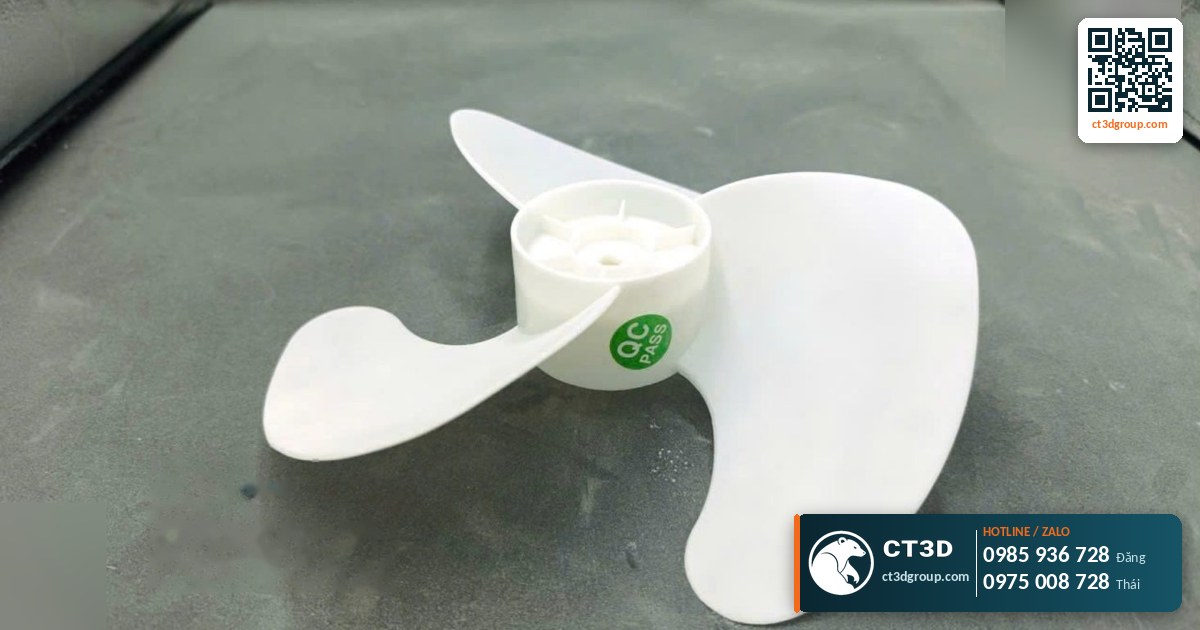
Quick answer: Rapid prototyping is the practice of producing a physical prototype of a product in days instead of weeks, mainly through 3D printing (FDM, SLA resin, MJF/SLS, SLM metal) and CNC machining. Prototypes let companies check the form, test the fit, validate function and present to customers before investing in production tooling. With a ready-to-print file, 3D printed prototypes are typically available in 1–3 days (market average). Fixing mistakes at the prototype stage is far cheaper than fixing them after the mold has been made.
This article is a beginner’s overview: what rapid prototyping is, what types of prototypes exist, and the role they play in product development. If you need a polished appearance model for presentations, photo shoots or fundraising, read our in-depth article on appearance prototypes and display models.
What is rapid prototyping?
A “prototype” is a test model – the first version of a product, made to be checked before real production. “Rapid” means fast. Put together, rapid prototyping is a set of methods that turn a design file into a physical model in a short time, without the need for a mold.
An everyday example: a company wants to develop a new speaker housing. If it goes straight to an injection mold, it has to wait several weeks and the tooling cost is substantial. If it then discovers that a button is in the wrong place, the mold must be modified or remade. With rapid prototyping, the company 3D prints the housing in a few days, holds it in hand, test-fits the circuit board, edits the file and prints again. After a few such rounds, the design is stable and only then is the mold made.
Today, when people say “rapid prototyping”, most of them think of 3D printing. In practice, it also includes CNC machining, vacuum casting with silicone molds and hybrid techniques.

The role of rapid prototyping in manufacturing
- Catch errors early: fit issues, ergonomic problems (it doesn’t feel right in the hand) and aesthetic flaws are found while still at the prototype stage.
- Shorter time to market: multiple test-and-fix rounds can happen in a few weeks instead of several months.
- Lower tooling investment risk: molds are only made once the design has been validated.
- Better communication: a physical model helps managers, customers and investors understand the product immediately, without reading drawings.
- Market testing: make a few dozen samples for user research, advertising photos or trade shows.
- Low-volume production: for small quantities, 3D printing can replace mass production altogether. See 3D printing vs. injection molding to find the break-even point.
Common types of prototypes
Not all prototypes are the same. Depending on the stage, you will need a different kind of model.
| Prototype type | Purpose | Stage | Typical technology |
|---|---|---|---|
| Concept model | Check form, proportions and overall size | First | FDM 3D printing in PLA |
| Fit prototype | Check assembly, hole positions, joints | Detailed design | FDM, SLA resin, MJF PA12 |
| Functional prototype | Test strength, heat resistance, moving mechanisms | Engineering validation | MJF/SLS PA12, Tough resin, SLM metal, CNC |
| Appearance model | Looks like the real product: color, gloss, logo | Presentations, photography, fundraising | SLA resin + paint finishing |
| Pre-production prototype | Nearly the final product, small quantities for market testing | Before tooling | Silicone casting, low-volume 3D printing, CNC |
Source: classification based on CT3D’s product development experience.
Appearance models demand the highest finishing skill: sanding, priming, color painting, logo printing, and a gloss or matte clear coat. A complete guide is available in appearance prototypes and display models.
Rapid prototyping technologies: which one to choose?
This section is only a summary to help you get oriented. A detailed specification comparison between technologies is available in 3D printing technologies compared: FDM, SLA, MJF, SLM.
FDM 3D printing – fast and economical for concept models
Molten plastic filament is extruded layer by layer. Layers of 100–300 microns, tolerance of about ±0.1–0.3 mm. Suitable for form models, jigs and rough fit checks. CT3D prices start at 650 VND/g (≈ US$0.025/g) for PLA and PETG.
SLA/DLP resin 3D printing – smooth and sharp
UV light cures liquid resin. Layers of 25–100 microns, features as small as 0.05 mm. Suitable for appearance models, small parts and clear prototypes.
MJF/SLS PA12 3D printing – durable, usable like a real product
PA12 nylon powder is fused. No supports needed; parts are strong and impact-resistant. Suitable for functional prototypes and low-volume runs. Quoted per file.
SLM metal 3D printing – metal prototypes without tooling
A laser melts metal powder. Tolerance of ±0.02 mm according to CT3D’s documentation, and production is possible from a single part. Suitable for load-bearing and heat-resistant parts. Quoted per file.
CNC machining – real materials, high precision
Material is cut from aluminum, plastic, wood or foam stock. Suitable for prototypes that need the actual production material, precise flat faces, or large foam form models.
A typical rapid prototyping workflow
- 3D file: you send STL, STEP, OBJ or 3MF files. If you only have photos, sketches or a physical sample, CT3D creates the model or 3D scans the sample.
- Define the prototype’s purpose: visual check, fit test, functional test or presentation. The purpose determines the technology and material.
- Engineering file review: checking wall thickness, print orientation and supports, and calculating material volume.
- Quote with lead time.
- Production and post-processing: printing/machining, support removal, sanding and painting if required.
- Delivery and feedback: you inspect the prototype, note what needs changing, the file is updated, and the next round begins.
Reference lead times based on the Ho Chi Minh City market in 2026 (not a CT3D commitment): ready file 1–3 days; modeling required 3–7 days; with paint finishing 7–14 days. CT3D delivers nationwide across Vietnam, usually within 1–3 days after completion.
Common prototyping mistakes
| Mistake | Consequence | What to do instead |
|---|---|---|
| Making an appearance model too early | Money spent on painting a design that is still changing | Use inexpensive FDM prototypes for the early rounds |
| Strength-testing with a PLA prototype | Results do not reflect the real material | Use PA12, Tough resin or a material close to production |
| No fit tolerances specified | Parts fit too tight or too loose | Allow clearances appropriate to the technology; see 3D printing accuracy and tolerances |
| Walls designed too thin | Prototype breaks or warps | Have an engineer check the file before printing |
| Prototype purpose not stated clearly | Wrong technology, wrong budget | Describe clearly what the prototype will be used for |
Source: CT3D order-handling experience.
Rapid prototyping applications by industry
- Home appliances and electronics: device housings, buttons, battery covers, launch display models.
- Mechanical engineering and factories: jigs, replacement parts, trial parts before metal machining.
- Automotive and motorcycles: interior parts, trim panels, accessories, fit-check models.
- Medical and dental: anatomical models, dental models, assistive devices.
- Packaging and cosmetics: bottle, cap and jar prototypes for shape approval and photography.
- Education and research: student project models, experimental samples.
Checklist before sending a prototyping request
- 3D file, or photos/drawings/a physical sample.
- What the prototype is for: visual check, fit test, functional test or presentation.
- Surface finish, color and material requirements.
- Number of prototypes and required delivery date.
- Fit information if applicable (which components the part mates with).
For specific costs, see how much does 3D printing cost, or send your file to CT3D via Zalo, email or our contact form for a file-based quote.
Frequently asked questions
What is rapid prototyping?
Rapid prototyping is producing a physical prototype from a design file in a short time, mainly with 3D printing and CNC, without the need for a mold.
How does rapid prototyping differ from mass production?
Rapid prototyping produces small quantities to validate a design. Mass production uses molds, requiring a large upfront investment but delivering a low unit cost at high volumes.
How long does it take to make a prototype?
Based on market averages, about 1–3 days with a ready file; 3–7 days if modeling is required; 7–14 days with paint finishing.
Which technology should I choose for a prototype?
FDM for concept models; SLA resin with painting for appearance models; PA12, Tough resin, SLM metal or CNC for functional prototypes.
Can a prototype be made without a 3D file?
Yes. CT3D creates the file from photos or drawings, or 3D scans a physical sample, and then prints it.
Real footage from the CT3D workshop
Watch the video Large-format SLA 3D printing service with a smooth surface finish by CT3D to get a clearer picture of the process and product quality. More videos on the Che Tao Vlog – CT3D channel.
Contact CT3D – send your files, get a fast quote
Whether you have a 3D file, a 2D drawing, photos or just an idea, you can send it to CT3D. Our engineers will review the file, recommend the right technology and material, and send you a quote with a lead time.
- Email: [email protected] – [email protected]
- Hotline / Zalo: +84 975 008 728 (Mr. Thai) – +84 985 936 728 (Mr. Dang), or use our contact form
- Head office: Binh Duong.
- Workshops in Ho Chi Minh City: Linh Trung (Thu Duc), Tam Binh (Thu Duc), former District 6.
- Other workshops and drop-off points: Can Tho, Da Nang, Bien Hoa, Ba Ria – Vung Tau, Hanoi, Hai Duong, Hai Phong. Nationwide delivery across Vietnam.
- Website: ct3dgroup.com – in3d.edu.vn
CT3D – 3D design & prototyping: 3D printing, 3D scanning, reverse engineering, silicone mold making, painting and finishing, CNC machining, composite fabrication, and supply of 3D printers and 3D printing materials.
Danh sách cửa hàng:
CT3D là đơn vị cung cấp trọn gói các dịch vụ thiết kế và sản xuất theo yêu cầu tại TP.HCM và khu vực lân cận (Bình Dương, Đồng Nai, Long An…). Với năng lực khép kín từ thiết kế 3D, in 3D (FDM, resin/SLA, SLS, in 3D kim loại), scan 3D – thiết kế ngược, làm khuôn, đúc composite – poly resin – poly stone đến gia công CNC và sơn màu hoàn thiện, CT3D đồng hành cùng khách hàng qua toàn bộ quy trình – từ ý tưởng, bản vẽ hay sản phẩm mẫu đến thành phẩm hoàn chỉnh. Dù bạn cần tạo mẫu nhanh, sản xuất số lượng, chế tác tượng – mô hình – quà tặng hay linh kiện kỹ thuật, đội ngũ CT3D sẽ tư vấn công nghệ và vật liệu phù hợp, đảm bảo sản phẩm sắc nét, đúng yêu cầu và tối ưu chi phí. Khách hàng tại TP.HCM và vùng lân cận có thể trao đổi trực tiếp, gửi file online và nhận sản phẩm thuận tiện, hỗ trợ cả đơn gấp lẫn dự án số lượng.
CT3D cung cấp trọn gói các dịch vụ thiết kế và sản xuất theo yêu cầu, phục vụ khách hàng tại Hà Nội và các tỉnh lân cận (Bắc Ninh, Hưng Yên, Hải Phòng, Vĩnh Phúc…). Với năng lực khép kín từ thiết kế 3D, in 3D (FDM, resin/SLA, SLS, in 3D kim loại), scan 3D – thiết kế ngược, làm khuôn, đúc composite – poly resin – poly stone đến gia công CNC và sơn màu hoàn thiện, CT3D đồng hành cùng khách hàng qua toàn bộ quy trình – từ ý tưởng, bản vẽ hay sản phẩm mẫu đến thành phẩm hoàn chỉnh. Quy trình làm việc thuận tiện: bạn gửi file 3D hoặc mô tả ý tưởng qua online, đội ngũ CT3D tư vấn công nghệ – vật liệu, báo giá nhanh và giao hàng tận nơi tại Hà Nội. Dù bạn cần tạo mẫu nhanh, sản xuất số lượng, chế tác tượng – mô hình – quà tặng hay linh kiện kỹ thuật, CT3D đều đáp ứng với sản phẩm sắc nét, đúng yêu cầu và tối ưu chi phí.

