

Quick answer: FDM 3D printing (Fused Deposition Modeling) is a 3D printing technology that uses a heated nozzle to melt plastic filament and deposit it layer by layer onto a build plate. According to CT3D technical documentation, FDM prints layers 100–300 micron thick (0.1–0.3 mm) with a tolerance of about ±0.1–0.3 mm. Common materials are PLA, PETG, ABS, ASA, Nylon and carbon fiber filled filament. FDM is the most affordable technology, with CT3D pricing from 650 VND/g (≈ US$0.025/g) for PLA, making it well suited to prototypes, jigs and fixtures, and medium to large technical parts.
Many customers send files to CT3D and ask: “Should I print this in FDM or resin?” To answer correctly, you first need to understand how FDM works and where its limits are. This article takes a deep dive into the mechanism, parameters and common defects of FDM. If you need the bigger picture comparing several technologies, see CT3D’s pillar article on 3D printing technologies.
What is FDM 3D printing and how does it work?
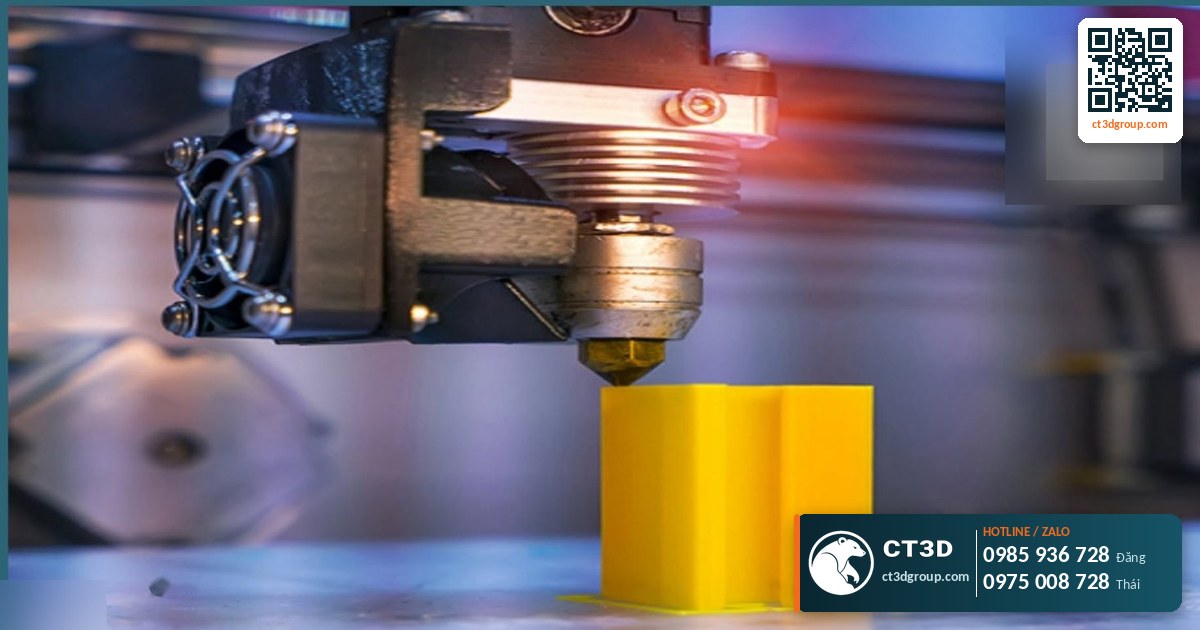
FDM is also known as FFF (Fused Filament Fabrication). Both names describe the same principle: thermoplastic filament is fed into the print head, melted and extruded through a very small nozzle. The print head follows toolpaths calculated in advance by slicing software (the slicer). The plastic cools and solidifies as soon as it leaves the nozzle. When one layer is finished, the build plate lowers (or the print head rises) by exactly one layer height, and the process repeats until the part is complete.
Main components of an FDM printer
- Extruder: gears grip the filament and push it into the hot end. Grip force and rotation speed determine how much plastic is extruded.
- Hot end: includes the heating zone, temperature sensor and nozzle. The most common nozzle diameter is 0.4 mm; 0.2 mm nozzles are used for fine details and 0.6–0.8 mm nozzles for large parts that need to print quickly.
- Build plate (bed): usually heated so the first layer adheres firmly and warping is reduced.
- Motion system: X, Y and Z axes driven by stepper motors, belts or lead screws. Frame rigidity directly affects accuracy.
- Part cooling fan: blows air onto the freshly printed layer so the plastic solidifies quickly, improving overhangs and bridges.
From 3D file to physical part: 4 steps
Step 1: you have a 3D mesh file, usually STL or 3MF (see What is an STL file?). Step 2: an engineer loads the file into the slicer and chooses orientation, layer height, number of perimeters, infill density and supports. Step 3: the slicer exports G-code, a list of motion and extrusion commands for the machine. Step 4: the machine prints, then the part is removed from the plate, supports are cut away and it is post-processed if needed.
Key technical specifications of FDM
The table below summarizes the parameters you will commonly encounter when ordering FDM prints. Layer height and tolerance come from CT3D documentation; print temperatures are typical values widely recommended by filament manufacturers.
| Parameter | Typical value | Effect |
|---|---|---|
| Layer height | 100–300 micron (0.1–0.3 mm) | Thinner layers are smoother but take longer |
| Dimensional tolerance | ±0.1–0.3 mm | Depends on material, size and print orientation |
| Nozzle diameter | 0.4 mm (common); 0.2–0.8 mm | Determines line width and smallest detail |
| Filament diameter | 1.75 mm (common) | Standard on most current machines |
| PLA print temperature | about 190–220 °C | Easy to print, little warping |
| PETG print temperature | about 220–250 °C | Tough, good layer adhesion |
| ABS/ASA print temperature | about 230–260 °C | Needs an enclosure, prone to shrinkage |
| Self-supporting overhang angle | about 45° from vertical | Steeper overhangs need supports |
Source: CT3D technical documentation (layer height, tolerance); common filament manufacturer recommendations (temperature, overhang angle).
Why does FDM part strength vary by direction?
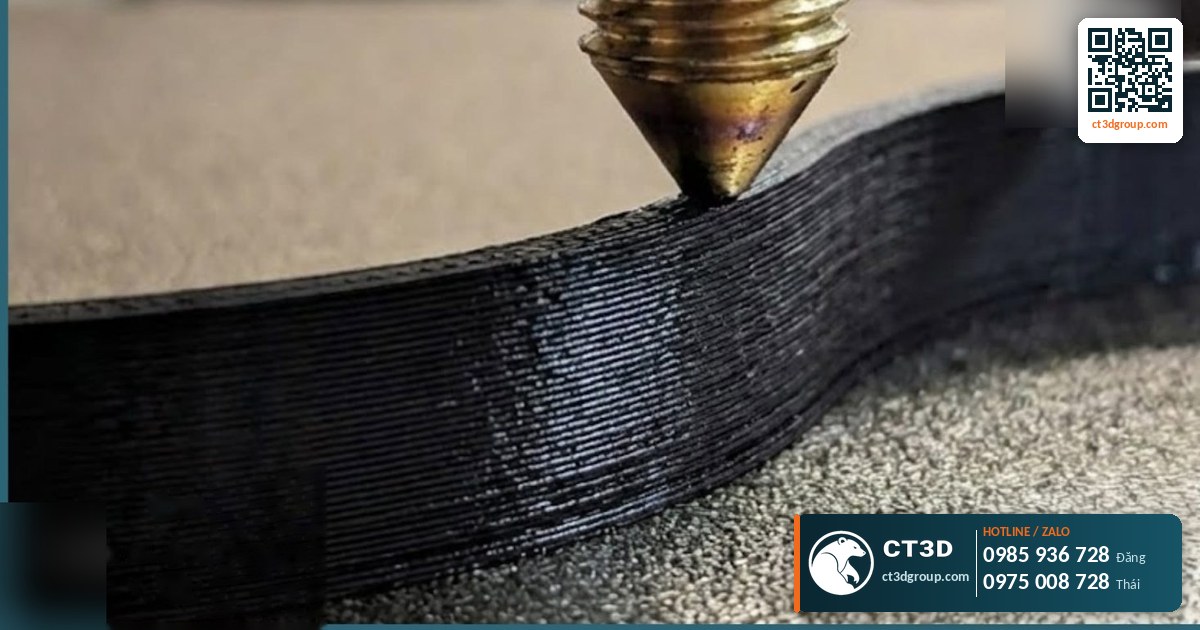
This is the most important technical point for customers making load-bearing parts. An FDM part is built from plastic strands laid side by side and stacked on top of each other. Within a layer, the strands bond quite well. Between layers, however, bonding only forms when the new layer is hot enough to slightly remelt the surface of the layer below. As a result, FDM parts are usually weakest in the Z direction (the stacking direction). This is called anisotropy.
In practice, a hook printed upright will easily snap across a layer, while the same hook printed lying flat can carry far more load. When CT3D engineers receive a load-bearing part, they always ask about the load direction so they can orient the print with forces acting along the strands rather than pulling the layers apart.
How to improve layer adhesion
- Print at a higher temperature within the material’s allowable range so each layer fuses firmly to the one below.
- Reduce fan cooling for ABS, ASA and Nylon; use an enclosure to keep ambient temperature stable.
- Increase the number of walls/perimeters, which is usually more effective than increasing infill.
- Choose a sensible layer height: layers too thick relative to the nozzle reduce the contact area between layers. A common rule is to keep layer height below about 75–80% of the nozzle diameter.
What determines the quality and cost of FDM printing?
Layer height: trading smoothness for time
Print time is roughly inversely proportional to layer height. For the same 100 mm tall part, 0.2 mm layers require 500 layers while 0.1 mm layers require 1,000, so the layer count doubles and print time rises accordingly. For technical parts that do not need a cosmetic surface, CT3D usually prints at 0.2–0.3 mm. For display models, 0.1–0.12 mm layers give a smoother surface with less visible layer lines.
Infill and number of perimeters
FDM parts are usually not 100% solid inside; they are filled with a lattice pattern. An infill density of 15–20% is enough for appearance models; 30–50% suits load-bearing parts. Higher infill means more plastic, longer print times and higher cost. See the detailed analysis in infill density, cost and strength.
Supports and print orientation
FDM cannot extrude plastic into thin air. Overhangs beyond about 45° or bridges that are too long need support structures. Supports consume extra plastic and time and leave marks on the surface after removal. Good design can reduce supports significantly; see 3D printing supports explained.
Example: cost per gram
CT3D prices FDM by actual weight in grams. Reference formula: Print cost ≈ part weight (grams, including supports) × material unit price, plus any surcharges for post-processing, rush orders or modeling. Example: a PETG part weighing 120 g after slicing → 120 × 650 VND = 78,000 VND (≈ US$3) for printing (CT3D PETG pricing from 650 VND/g). The same part in ASA (from 2,000 VND/g) → 120 × 2,000 VND = 240,000 VND (≈ US$9). Orders under 50 g are subject to a minimum charge; orders over 500 g or large quantities receive a project quote. The full price list is in PLA 3D printing cost per gram. Prices are indicative.
Which FDM materials are common and which should you choose?
| Material | Key characteristics | Typical applications | CT3D indicative price 2026 |
|---|---|---|---|
| PLA | Easy to print, good surface finish, low heat resistance | Appearance models, scale models, form prototypes | from 650 VND/g (≈ US$0.025/g) |
| PETG | Tough, impact resistant, good moisture resistance | Enclosures, light mechanical parts | from 650 VND/g (≈ US$0.025/g) |
| ABS | Better heat resistance than PLA, easy to post-process | Device housings, technical parts | from 1,000 VND/g (≈ US$0.04/g) |
| ASA | Similar to ABS but UV resistant | Outdoor parts | from 2,000 VND/g (≈ US$0.08/g) |
| Carbon fiber filled | Stiff, lightweight, dimensionally stable | Jigs, fixtures, load-bearing parts | from 2,750 VND/g (≈ US$0.11/g) |
Source: CT3D indicative FDM price list 2026, charged by actual weight.
For a deeper look at each plastic, including TPU and Nylon, read FDM materials: PLA, ABS, PETG, ASA, TPU.
Advantages and disadvantages of FDM 3D printing
Advantages
- Lowest cost among common 3D printing technologies. Based on the 2026 Ho Chi Minh City market (not CT3D pricing), SLA costs about 1.5–2.5 times more than FDM.
- Wide material range, from commodity plastics to engineering plastics and carbon fiber composites.
- Large parts are possible and can be split into sections and joined.
- Functional end-use parts: thermoplastics are less brittle than many standard resins, making them suitable for jigs, clamps and enclosures.
- Simple post-processing: no chemical washing or UV curing as with resin printing.
Disadvantages
- Visible layer lines, especially on curved and gently sloped surfaces.
- Larger tolerances than resin: ±0.1–0.3 mm versus ±0.05–0.1 mm for SLA.
- Difficult to print very small details: the minimum line width is close to the nozzle diameter.
- Anisotropic mechanical properties, as discussed above.
- Not perfectly watertight if walls are thin or settings are not suitable.
If you are torn between FDM and resin for a specific model, our FDM vs resin 3D printing comparison has a quick selection table.
Common FDM printing defects and how to fix them
| Defect | Main cause | Fix |
|---|---|---|
| Corner warping | Plastic shrinks as it cools, especially ABS/ASA | Heated bed, enclosure, add a brim, round sharp corners in the design |
| Layer separation, horizontal cracks | New layer not hot enough to fuse with the previous one | Raise print temperature, reduce fan, avoid drafts |
| Stringing | Plastic oozes while the print head travels | Tune retraction, lower temperature, dry damp filament |
| Under-extrusion, porous layers | Clogged nozzle, damp filament, speed too high | Clean the nozzle, dry the filament, reduce speed |
| Elephant’s foot | First layer squished too hard, bed too hot | Adjust nozzle gap, add a 0.3–0.5 mm chamfer on the bottom edge in the design |
| Holes smaller than designed | Extruded plastic encroaches into the hole | Compensate hole tolerance, or drill/ream after printing |
Source: CT3D FDM workshop operating experience.
A note on damp filament: PETG, Nylon and TPU absorb moisture quite quickly. Moist filament boils in the hot end, creating bubbles, a rough surface and reduced strength. In a hot, humid climate like Vietnam’s, any serious print shop always has filament dryers and sealed storage boxes.
When should you choose FDM, and when another technology?
This is the quick decision guide CT3D engineers use when advising customers:
- Choose FDM when you need fast functional prototypes, medium to large parts, factory jigs and clamps, a limited budget, and visible layer lines are acceptable.
- Choose SLA/DLP resin when you need a smooth surface, details down to 0.05 mm, a tolerance of ±0.05–0.1 mm, display models, jewelry or dental work. See What is SLA 3D printing?
- Choose MJF/SLS PA12 when you need engineering plastic parts with uniform strength in all directions, complex geometry without supports, or low-volume production. See MJF PA12 3D printing.
- Choose SLM metal when the part must be stainless steel, aluminum or titanium and withstand high loads and temperatures.
CT3D’s FDM process and request checklist
CT3D has more than 12 years of experience and follows a 6-step process: send your file (STL/STEP/OBJ/3MF via our website, Zalo or email) → state your technical requirements → engineers analyze the file and calculate weight → quote with lead time → confirmation and production → delivery to your door or pickup at the workshop. Goods are delivered nationwide within 1–3 days after completion.
For a fast, accurate quote, please prepare:
- A 3D file (STEP preferred for technical parts, STL/3MF for models). If you only have a drawing or a physical sample, CT3D offers modeling and 3D scanning services.
- Intended use: appearance model, fit-check model or functional end-use part.
- Operating environment: indoor or outdoor, temperature, exposure to oil or chemicals.
- Which surfaces need to look good and which are mating surfaces that need to be accurate.
- Quantity and required delivery date.
- Post-processing requirements: sanding, painting, plating (see 3D print post-processing basics).
Real-world applications of FDM 3D printing
Product prototypes: R&D teams print device housings in PLA or PETG to check dimensions, ergonomics and assembly before committing to injection molds. A design iteration takes just a few days instead of several weeks.
Jigs and fixtures: factories use FDM to print locating fixtures, guide channels and inspection clamps. Carbon fiber filled filament produces stiff, lightweight, stable fixtures. See 3D printed jigs & fixtures.
Large models: architectural models, display models and stage props can be printed in FDM in sections, assembled, then sanded and painted.
Replacement parts: many discontinued plastic parts can be 3D scanned, remodeled and printed in ABS, PETG or ASA. You can also check out CT3D’s industrial black ABS 3D printing service.
In short, FDM is the workhorse of the 3D printing industry: cheap, flexible and available in many materials. Understanding its limits in layer lines, tolerance and anisotropy helps you design correctly from the start. To compare FDM with SLA, MJF and SLM side by side, read our pillar article on 3D printing technologies.
Frequently asked questions about FDM 3D printing
Is there a difference between FDM and FFF 3D printing?
Not in principle. FDM was the original trade name, while FFF is the generic name for fused filament extrusion technology. Both deposit plastic layer by layer through a nozzle.
What is the tolerance of FDM 3D printing?
According to CT3D documentation, FDM tolerance is about ±0.1–0.3 mm depending on material, size and print orientation. Critical mating surfaces should be compensated for or machined after printing.
Can FDM parts carry loads?
Yes, if you choose the right material (PETG, ABS, ASA, carbon fiber filled), increase the number of perimeters, use 30–50% infill and orient the print so forces do not pull the layers apart.
What layer height looks best?
0.1–0.12 mm layers give a smooth surface for display models; 0.2 mm is the common balance; 0.25–0.3 mm suits large parts that need to print fast.
How does CT3D price FDM 3D printing?
By actual weight: PLA and PETG from 650 VND/g (≈ US$0.025/g), ABS from 1,000 VND/g (≈ US$0.04/g), ASA from 2,000 VND/g (≈ US$0.08/g), carbon fiber filled from 2,750 VND/g (≈ US$0.11/g). A minimum charge applies to orders under 50 g. Prices are indicative.
Real footage from the CT3D workshop
Watch the video Large-format liquid resin 3D printing for rapid prototyping by CT3D to get a clearer picture of the process and product quality. More videos are available on the Che Tao Vlog – CT3D channel.
Contact CT3D – send your file, get a fast quote
Whether you have a 3D file, a 2D drawing, photos or just an idea, you can send it to CT3D. Our engineers will check the file, advise on technology and materials, and send a quote with a delivery time.
- Email: [email protected] – [email protected]
- Hotline / Zalo: +84 975 008 728 (Mr. Thai) – +84 985 936 728 (Mr. Dang), or use our contact form
- Head office: Binh Duong.
- Workshops in Ho Chi Minh City: Linh Trung (Thu Duc), Tam Binh (Thu Duc), District 6 (former).
- Other workshops and drop-off points: Can Tho, Da Nang, Bien Hoa, Ba Ria – Vung Tau, Hanoi, Hai Duong, Hai Phong. Nationwide delivery.
- Website: ct3dgroup.com – in3d.edu.vn
CT3D – 3D design & prototyping: 3D printing, 3D scanning, reverse engineering, silicone mold making, paint finishing, CNC machining, composite fabrication, and supply of 3D printers and 3D printing resins.
Danh sách cửa hàng:
CT3D là đơn vị cung cấp trọn gói các dịch vụ thiết kế và sản xuất theo yêu cầu tại TP.HCM và khu vực lân cận (Bình Dương, Đồng Nai, Long An…). Với năng lực khép kín từ thiết kế 3D, in 3D (FDM, resin/SLA, SLS, in 3D kim loại), scan 3D – thiết kế ngược, làm khuôn, đúc composite – poly resin – poly stone đến gia công CNC và sơn màu hoàn thiện, CT3D đồng hành cùng khách hàng qua toàn bộ quy trình – từ ý tưởng, bản vẽ hay sản phẩm mẫu đến thành phẩm hoàn chỉnh. Dù bạn cần tạo mẫu nhanh, sản xuất số lượng, chế tác tượng – mô hình – quà tặng hay linh kiện kỹ thuật, đội ngũ CT3D sẽ tư vấn công nghệ và vật liệu phù hợp, đảm bảo sản phẩm sắc nét, đúng yêu cầu và tối ưu chi phí. Khách hàng tại TP.HCM và vùng lân cận có thể trao đổi trực tiếp, gửi file online và nhận sản phẩm thuận tiện, hỗ trợ cả đơn gấp lẫn dự án số lượng.
CT3D cung cấp trọn gói các dịch vụ thiết kế và sản xuất theo yêu cầu, phục vụ khách hàng tại Hà Nội và các tỉnh lân cận (Bắc Ninh, Hưng Yên, Hải Phòng, Vĩnh Phúc…). Với năng lực khép kín từ thiết kế 3D, in 3D (FDM, resin/SLA, SLS, in 3D kim loại), scan 3D – thiết kế ngược, làm khuôn, đúc composite – poly resin – poly stone đến gia công CNC và sơn màu hoàn thiện, CT3D đồng hành cùng khách hàng qua toàn bộ quy trình – từ ý tưởng, bản vẽ hay sản phẩm mẫu đến thành phẩm hoàn chỉnh. Quy trình làm việc thuận tiện: bạn gửi file 3D hoặc mô tả ý tưởng qua online, đội ngũ CT3D tư vấn công nghệ – vật liệu, báo giá nhanh và giao hàng tận nơi tại Hà Nội. Dù bạn cần tạo mẫu nhanh, sản xuất số lượng, chế tác tượng – mô hình – quà tặng hay linh kiện kỹ thuật, CT3D đều đáp ứng với sản phẩm sắc nét, đúng yêu cầu và tối ưu chi phí.

