
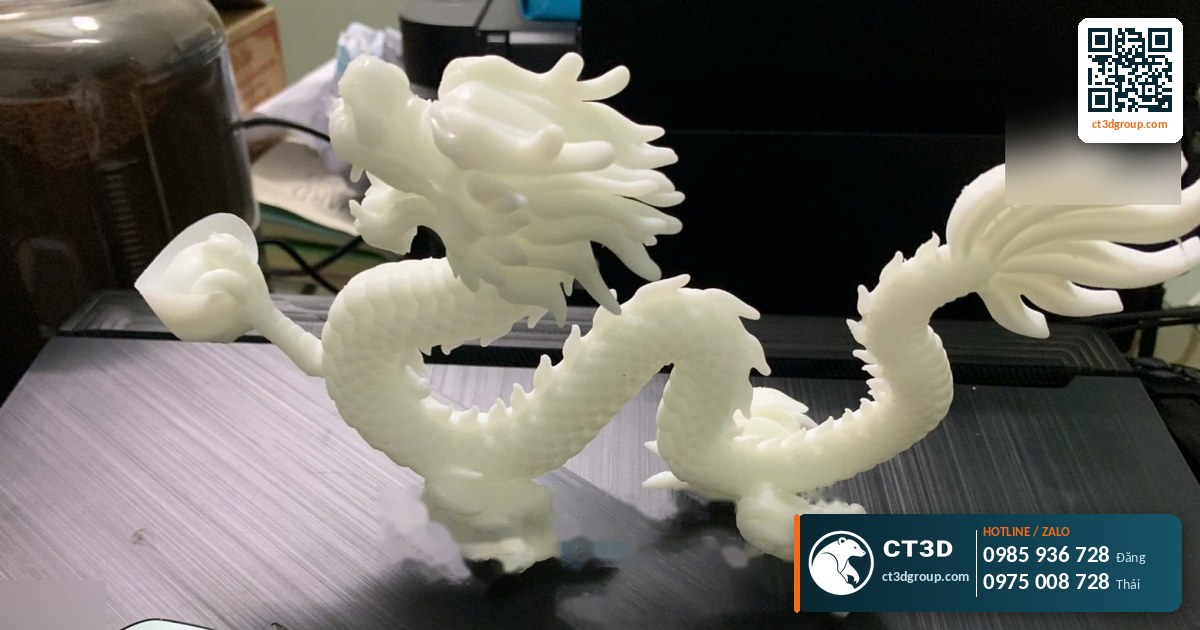
Quick answer: SLA resin 3D printing uses UV light to cure liquid resin in thin layers of 25–100 microns, giving a tolerance of about ±0.05–0.1 mm and detail as fine as 0.05 mm. It is ideal for statues, figures, jewelry and product samples that need a smooth surface and fine detail. Resin printing usually costs about 1.5–2.5 times more than FDM. In the Ho Chi Minh City market in 2026, a standard resin model under 5 cm tall costs about 150,000–400,000 VND (≈ US$6–15), and a 10–15 cm model about 800,000 – 2.5 million VND (≈ US$31–96). CT3D runs large-format resin printers with a build volume up to 800 × 800 × 500 mm.
Customers who come to CT3D for resin printing usually fall into three groups. The first is handicraft workshops and artisans who need smooth statue masters for mold making. The second is product design firms that need presentation models that look like the real thing. The third is engineers who need small, precise parts that FDM printers cannot achieve. This article explains in plain terms what resin printing is, which resins are available, what it costs, and when you should – and should not – choose it. If you are comparing several technologies, see FDM vs SLA vs MJF/SLS vs SLM compared. If you only care about cost, see our 2026 3D printing price guide.
Prices in this article are indicative, in Vietnamese dong (VND) with approximate US dollar equivalents at 1 USD ≈ 26,000 VND.
1. What is resin 3D printing?
Resin 3D printing is the umbrella term for 3D printing technologies that use liquid photopolymer resin. This resin stays liquid until it is exposed to UV light of the right wavelength, at which point it hardens. The printer projects UV light in the exact shape of each slice; that layer cures, the build platform moves slightly, and the next layer is printed. Thousands of layers stacked on top of each other form the part.
There are three common types of resin printing:
- SLA (stereolithography): a UV laser traces each point. High accuracy, well suited to large-format industrial machines.
- DLP (Digital Light Processing): a projector exposes the whole layer at once. Fast, with a tolerance of about ±0.03–0.08 mm, commonly used for jewelry and dental work.
- LCD/MSLA: an LCD screen masks the light. Low machine cost, common in desktop printers.
In this article, “resin printing” or “SLA printing” refers to this whole group of technologies, because for the customer the end result is quite similar: a smooth surface and sharp detail.
2. SLA resin printing specifications
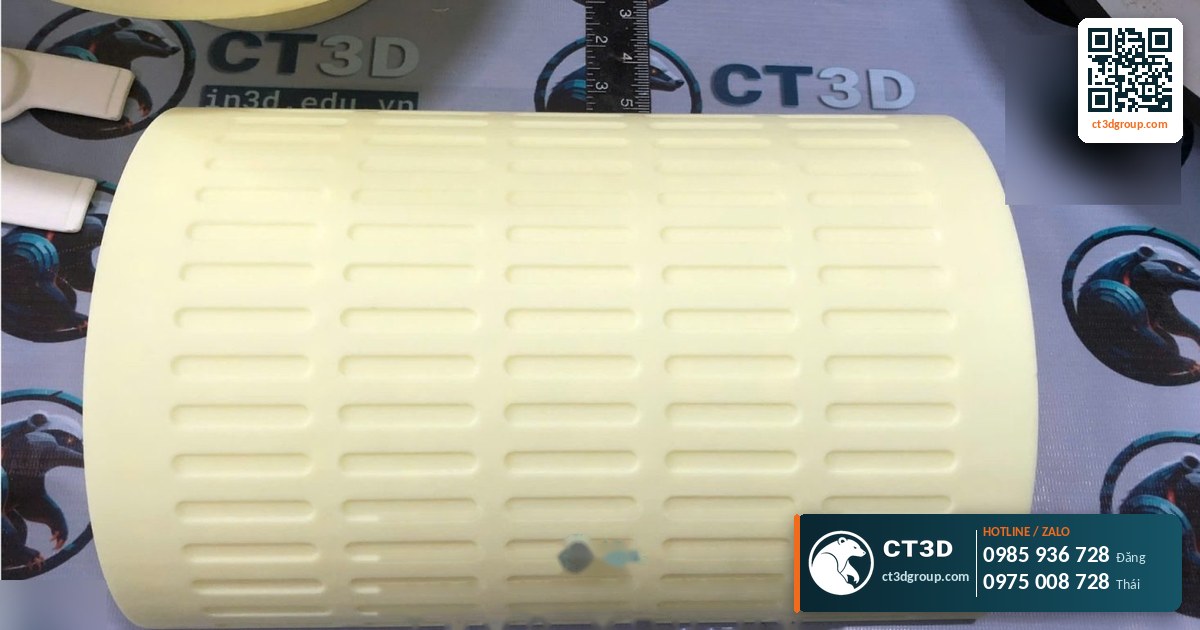
| Specification | SLA resin | Compared with FDM |
|---|---|---|
| Layer height | 25 – 100 microns (0.025 – 0.1 mm) | FDM: 100 – 300 microns |
| Dimensional tolerance | ±0.05 – 0.1 mm | FDM: ±0.1 – 0.3 mm |
| Smallest reproducible detail | About 0.05 mm | FDM: about 0.4 mm (nozzle-dependent) |
| Surface | Smooth, layer lines barely visible | Visible layer lines, needs sanding |
| Largest build volume at CT3D | 800 × 800 × 500 mm | Depends on the large-format FDM machine |
| Market material price | About 0.8 – 3 million VND/kg (≈ US$31–115) | PLA about 250,000 VND/kg (≈ US$9.60) |
Technical data from CT3D’s technology documentation on in3d.edu.vn. Material prices compiled from public market price lists in 2026.
3. Common types of resin
Not all resins are the same. Choosing the right resin is just as important as choosing the right machine. These are the resin families CT3D prints most often:
3.1. Standard resin
The cheapest resin, with a smooth surface; gray or white versions are easy to paint. Suitable for display statues, figures, presentation models and masters for mold making. The downside is that it is more brittle than FDM plastics and can chip if dropped hard.
3.2. Tough resin (ABS-like)
Toughness close to ABS plastic, with better impact resistance than standard resin. Used for parts with snap fits, assembly joints and prototype housings. Market prices are about 30–50% higher than standard resin.
3.3. Clear resin
After polishing and clear coating it can become almost glass-clear. Used for lamps, lampshades, fluid channel models and architectural models with glazing. CT3D prints light-transmitting clear resin at 0.05 mm resolution. It costs about 40–70% more than standard resin because of the extra polishing labor.
3.4. High-temperature resin
Withstands higher temperatures than standard resin; used for parts near heat sources, very short-run trial injection molds and fixtures in hot environments. It costs about 60–100% more.
3.5. Castable and wax resins
Used to print patterns for metal casting (lost-wax casting), common in jewelry and art bronze casting. During burnout the resin burns out cleanly, leaving a mold cavity in the exact shape of the pattern.
3.6. Flexible resin and other engineering resins
Flexible resin mimics rubber and is used for prototype gaskets, pads and buttons. There are also medical, dental and food-safe resins, priced about 100–200% higher than standard resin.
4. How much does resin 3D printing cost?
Resin printing is usually quoted per part, because the price depends on resin volume, build height (which determines machine time) and post-processing labor. The table below shows the 2026 market price range in Ho Chi Minh City for standard resin, including resin, printing, washing, UV curing and support removal, but excluding painting and shipping. These figures are compiled for reference and are not CT3D’s price list.
| Model height | Indicative price (standard resin) |
|---|---|
| Under 5 cm | 150,000 – 400,000 VND (≈ US$6–15) |
| 5 – 10 cm | 300,000 – 1,200,000 VND (≈ US$12–46) |
| 10 – 15 cm | 800,000 – 2,500,000 VND (≈ US$31–96) |
| 15 – 20 cm | 1,500,000 – 3,500,000 VND (≈ US$58–135) |
| 20 – 30 cm | 3,000,000 – 7,000,000 VND (≈ US$115–270) |
| Over 30 cm | Quoted per file |
Points to note when you receive a resin quote:
- Solid or hollow: large statues should be hollowed with 2–3 mm walls and resin drain holes. This can cut resin use significantly.
- Height drives print time: resin printers build layer by layer, so a 20 cm tall model always takes longer than a 5 cm one, even if the 5 cm model is very wide. Nesting several short models on one platform pays off.
- Painted finish: market rates for single-color painting are about 200,000–500,000 VND per model (≈ US$8–19), multi-color airbrushing 600,000 – 2 million VND per model (≈ US$23–77).
- Quantity: many shops give 10–15% off for 10–30 pieces and 20–25% off for 30–100 pieces.
5. When should you choose resin printing, and when not?
Choose resin printing when:
- You need a smooth surface for display, product photography or customer presentations.
- The model has fine detail: statue faces, ornamental patterns, small raised lettering, small gear teeth.
- You need a master for a silicone mold. The smoother the master, the better the cast parts. See what is silicone mold making.
- You need clear parts or wax patterns for jewelry casting.
- You need precise fits with tolerances under 0.1 mm.
Avoid resin printing when:
- You only need a form prototype or a rough dimensional check. FDM PLA is much cheaper.
- The part carries high loads, sees repeated impacts or is used outdoors for a long time. Use FDM ABS/ASA, carbon fiber filament, MJF PA12 or metal printing instead.
- The model is very large but needs no detail, for example a 2 m stage decoration. Consider CNC foam cutting with a composite coating instead.
6. SLA resin printing workflow at CT3D
- File intake and check: CT3D accepts all common formats (STL, OBJ, STEP, 3MF). Engineers check the mesh, wall thickness and overly thin features that could break.
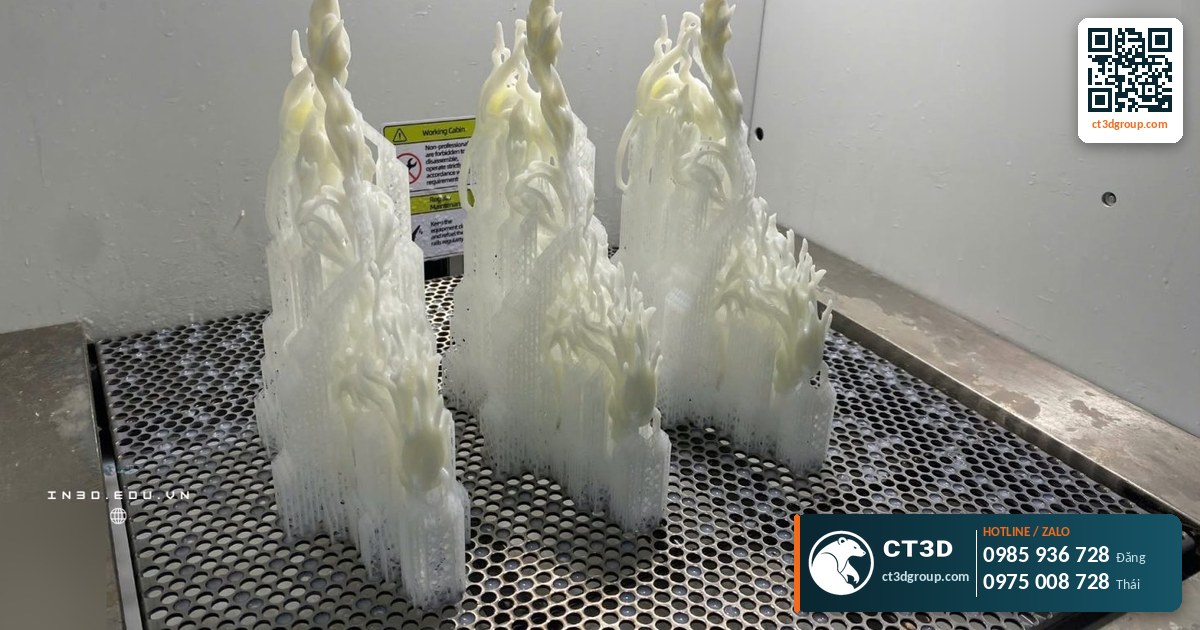
- Orientation and supports: models are usually tilted 20–45° to reduce peel forces between layers and prevent failures. Supports are placed on less visible faces so they do not affect appearance.
- Printing: the resin temperature is kept stable at about 25–28 °C so the resin flows evenly and layers bond well.
- Washing: uncured resin is washed off with a dedicated solvent.
- UV curing: additional UV exposure brings the resin to full hardness.
- Support removal and finishing: support tips are cut and sanded, then primed, painted or polished if requested.
- Inspection and packing: critical dimensions are measured and parts are packed to withstand shocks.
Thanks to tight control of these steps, CT3D keeps its resin print failure rate below 5%. Typical failures at less experienced shops are models collapsing mid-print, “spaghetti” (layers stretched into strings) and layer separation. The main causes are wrong orientation, insufficient supports or resin that is too cold.
7. Real-world applications of resin 3D printing
7.1. Art and religious statues
This is one of CT3D’s long-standing strengths. Our workshop has SLA printed 1 m tall Catholic statues, taken part in restoring the Our Lady of La Vang statue and made masters for large statues. The usual workflow is 3D scanning or modeling, printing a resin master, refining it, then making a silicone mold to cast polyresin or composite.
7.2. Figures, character models, mascots
Resin captures hair, clothing folds and facial features well. Printed models can be hand-painted or airbrushed. Details of this service are in our article on custom 3D model printing.
7.3. Product samples and presentation models
Companies making cosmetic packaging, household goods and electronics use resin to print presentation models before committing to injection molds. An injection mold can cost hundreds of millions of VND, so printing a resin sample to approve the shape first is a very effective way to reduce risk.
7.4. Jewelry and metal casting
Castable resin lets you print ring and pendant patterns with very fine detail, which are then cast in gold, silver or bronze.
7.5. Engineering and inspection
Small assembly parts, clear duct models for flow visualization and small inspection fixtures that require precision.
8. File preparation tips for resin printing
- Minimum wall thickness: 1–2 mm for normal parts; 2–3 mm for large hollow models.
- Thin features: rods, small fingers and figure swords should be at least 0.8–1 mm thick so they do not break when supports are removed.
- Drain holes: hollow models need at least 2 drain holes about 3–5 mm in diameter, placed on hidden faces.
- Fit clearance: leave a 0.1–0.2 mm gap between two mating parts.
- Clean files: watertight mesh, no overlapping faces. See also What is an STL file.
If you have a physical sample but no file, CT3D offers 3D scanning and reverse engineering to create an accurate file.
9. Safety and care of resin parts
- Fully cured resin is safe for normal handling.
- Do not leave resin parts in strong sunlight for long periods; they may yellow or become more brittle. For outdoor use, apply a UV-resistant coating.
- Keep standard resin parts away from high heat sources.
- Do not use standard resin for food containers.
10. Why choose CT3D for resin printing?
- More than 12 years in 3D printing, 3D scanning, mold making and statue production.
- Large-format resin printers up to 800 × 800 × 500 mm, printing large models in one piece with fewer joints.
- Full pre- and post-print services: 3D scanning, modeling, file repair, printing, painting, silicone mold making, polyresin and composite casting.
- Multiple workshops in Binh Duong, Ho Chi Minh City (Linh Trung, Tam Binh, former District 6), Can Tho, Da Nang, Bien Hoa, Ba Ria – Vung Tau, Hanoi, Hai Duong and Hai Phong.
- 3D printers and materials supply: customers who want to print in-house can buy machines and resin with technical support.
More on our industrial resin printing capabilities (in Vietnamese): Industrial-grade SLA resin 3D printing and Large-format SLA 3D printing service.
Quick selection table: which resin for which need?
So you do not have to reread the whole article, here is how to pick a resin, framed around the questions customers most often ask CT3D’s sales team.
| You need | Choose | Why |
|---|---|---|
| Display statues, gifts, models for painting | Gray standard resin | Cheapest resin, smooth, surface defects easy to spot before painting |
| A master for silicone molding | Standard resin, 0.05 mm layers | A smooth master gives smooth castings and less sanding |
| Prototype housings with snap fits and joints | Tough / ABS-like resin | Snap fits do not break after repeated assembly |
| Lampshades, duct models, see-through parts | Clear resin + polishing | Transmits light, lets you see inside |
| Parts near engines or hot machinery | High-temperature resin | Does not soften or deform at higher working temperatures |
| Rings, pendants, small bronze casting patterns | Castable / wax resin | Burns out cleanly, no ash left in the mold |
| Prototype gaskets, buttons, pads | Flexible resin | Rubber-like elasticity |
Project example: from photos to a painted resin statue
This is the typical workflow CT3D follows for customers ordering portrait or devotional statues, and it applies to many similar projects:
- Day 1: The customer sends photos from several angles or brings an old statue to the workshop. If there is a physical sample, a technician 3D scans it to capture the exact shape.
- Days 2–4: A 3D artist models or edits the file: reworking the face and clothing folds and adjusting proportions as requested. The customer approves the file via renders before printing, avoiding costly reprints.
- Days 4–6: Resin printing. Large statues are split sensibly to print on large-format machines, then joined and the seams finished.
- Days 6–9: Sanding, priming, and painting in color or faux bronze, wood or stone finishes as requested.
- If multiple copies are needed: the resin statue becomes the master for a silicone mold to cast polyresin or composite. From the second copy onward, the price per statue drops significantly compared with reprinting.
Note: these timings are an example for a medium-sized statue. Large statues or complex details need more time. Engineers will state the schedule clearly in the quote.
Checklist for a fast resin printing quote
If you send the following information, our engineering team can quote very quickly without back-and-forth:
- 3D file (STL, OBJ, STEP, 3MF) or photos and drawings with dimensions.
- Desired real-world size (height, width).
- Purpose: display, mold making, assembly, engineering testing or gifts.
- Preferred resin type, or a description of the operating conditions so our engineers can choose for you.
- Whether painting is needed, how many colors, and any color references.
- Quantity and required delivery date.
- Delivery address if shipping is needed.
For projects with many parts, you can zip all files into one folder and send it by email. Our sales team will provide a total quote with a unit price breakdown per part for easy approval.
Resin or FDM for mold masters: practical experience
Many customers ask whether a mold master needs to be printed in resin, or whether FDM plus sanding is enough. CT3D’s workshop experience: for statues, figures and fine ornamentation, print in resin, because a silicone mold “copies” every detail of the master’s surface – including layer lines. If an FDM master still shows layer lines, every casting will have them too and each one must be sanded, multiplying the labor. For large, simple shapes such as boxes, geometric blocks and name plates, you can print in FDM, then fill, sand and prime to a very smooth finish before molding, saving on printing costs. The right approach also depends on casting quantity and aesthetic requirements; CT3D engineers will recommend the best option for each order.
11. Frequently asked questions about resin 3D printing
What is the difference between resin and FDM 3D printing?
Resin uses liquid resin cured by UV, with 25–100 micron layers, a smooth surface and a tolerance of ±0.05–0.1 mm. FDM extrudes molten plastic filament with 100–300 micron layers, visible layer lines and a tolerance of ±0.1–0.3 mm, but it is cheaper and more impact resistant.
Are resin prints durable?
Durability depends on the resin. Standard resin is more brittle than FDM plastics. Tough and ABS-like resins have better impact resistance and can be used for assembly parts.
How much does resin 3D printing cost?
Ho Chi Minh City market levels in 2026: models under 5 cm about 150,000–400,000 VND (≈ US$6–15), 10–15 cm about 800,000 – 2.5 million VND (≈ US$31–96), 20–30 cm about 3–7 million VND (≈ US$115–270). Engineering resins add 30–200% depending on type.
Can resin printing handle large models?
Yes. CT3D has resin printers with an 800 × 800 × 500 mm build volume. Larger models are printed in sections, joined and the seams finished before painting.
How long does it take to get a resin print?
Small models with a ready file usually take 2–4 days. Large models or those needing a painted finish take 5–10 days depending on complexity.
In-depth articles on this topic
Read more detailed technical analyses from the CT3D team:
- Clear resin 3D printing: 6 sanding and clear-coating steps for glass-like parts
- Tough, ABS-like resin 3D printing: mechanical properties, snap fits, fit tolerances
- Heat-resistant resin 3D printing: what HDT means, trial molds and parts near heat sources
- Castable resin jewelry patterns: the gold, silver and bronze casting process
- Large-format resin 3D printing at 800×800×500 mm: statues, one-piece large models, hollowing
- SLA vs DLP vs LCD: a detailed comparison of 3 resin printing technologies
- Common resin 3D printing problems: failed prints, spaghetti, layer separation and fixes
- Resin print post-processing: IPA washing, UV curing, support removal, sanding, painting
- Dental and medical resin 3D printing: dental models, aligners, anatomical models at ±0.03 mm
- Designing for resin printing: wall thickness, hollowing, drain holes and 0.1 mm tolerances
Real footage from the CT3D workshop
Watch the video Ultra-fine SLA resin 3D printing workshop by CT3D to get a clearer picture of the process and product quality. More videos are available on our channel Che Tao Vlog – CT3D.
Contact CT3D – send your file, get a fast quote
Whether you have a 3D file, a 2D drawing, photos or just an idea, you can send it to CT3D. Our engineers will review the file, recommend the right technology and material, and send a quote with the delivery lead time.
- Email: [email protected] – [email protected]
- Hotline / Zalo: +84 975 008 728 (Mr. Thai) – +84 985 936 728 (Mr. Dang), or our contact form
- Head office: Binh Duong.
- Workshops in Ho Chi Minh City: Linh Trung (Thu Duc), Tam Binh (Thu Duc), District 6 (former).
- Other workshops and drop-off points: Can Tho, Da Nang, Bien Hoa, Ba Ria – Vung Tau, Hanoi, Hai Duong, Hai Phong. Nationwide delivery.
- Website: ct3dgroup.com – in3d.edu.vn
CT3D – 3D design & prototyping: 3D printing, 3D scanning, reverse engineering, silicone mold making, painting and finishing, CNC machining, composite fabrication, and supply of 3D printers and 3D printing materials.
Danh sách cửa hàng:
CT3D là đơn vị cung cấp trọn gói các dịch vụ thiết kế và sản xuất theo yêu cầu tại TP.HCM và khu vực lân cận (Bình Dương, Đồng Nai, Long An…). Với năng lực khép kín từ thiết kế 3D, in 3D (FDM, resin/SLA, SLS, in 3D kim loại), scan 3D – thiết kế ngược, làm khuôn, đúc composite – poly resin – poly stone đến gia công CNC và sơn màu hoàn thiện, CT3D đồng hành cùng khách hàng qua toàn bộ quy trình – từ ý tưởng, bản vẽ hay sản phẩm mẫu đến thành phẩm hoàn chỉnh. Dù bạn cần tạo mẫu nhanh, sản xuất số lượng, chế tác tượng – mô hình – quà tặng hay linh kiện kỹ thuật, đội ngũ CT3D sẽ tư vấn công nghệ và vật liệu phù hợp, đảm bảo sản phẩm sắc nét, đúng yêu cầu và tối ưu chi phí. Khách hàng tại TP.HCM và vùng lân cận có thể trao đổi trực tiếp, gửi file online và nhận sản phẩm thuận tiện, hỗ trợ cả đơn gấp lẫn dự án số lượng.
CT3D cung cấp trọn gói các dịch vụ thiết kế và sản xuất theo yêu cầu, phục vụ khách hàng tại Hà Nội và các tỉnh lân cận (Bắc Ninh, Hưng Yên, Hải Phòng, Vĩnh Phúc…). Với năng lực khép kín từ thiết kế 3D, in 3D (FDM, resin/SLA, SLS, in 3D kim loại), scan 3D – thiết kế ngược, làm khuôn, đúc composite – poly resin – poly stone đến gia công CNC và sơn màu hoàn thiện, CT3D đồng hành cùng khách hàng qua toàn bộ quy trình – từ ý tưởng, bản vẽ hay sản phẩm mẫu đến thành phẩm hoàn chỉnh. Quy trình làm việc thuận tiện: bạn gửi file 3D hoặc mô tả ý tưởng qua online, đội ngũ CT3D tư vấn công nghệ – vật liệu, báo giá nhanh và giao hàng tận nơi tại Hà Nội. Dù bạn cần tạo mẫu nhanh, sản xuất số lượng, chế tác tượng – mô hình – quà tặng hay linh kiện kỹ thuật, CT3D đều đáp ứng với sản phẩm sắc nét, đúng yêu cầu và tối ưu chi phí.

